美的集团

Search documents
中国电泳漆市场现状研究分析与发展前景预测报告
QYResearch· 2025-12-31 09:24
Core Viewpoint - The electrophoretic paint market in China is characterized by moderate scale, technical intensity, and stable growth, driven by both domestic demand and global industry trends. The market is expected to grow from $1,504.1 million in 2024 to $1,855.5 million by 2031, with a CAGR of 2.80% from 2025 to 2031 [3][9]. Market Size and Growth Trends - The Chinese electrophoretic paint market is projected to reach $1,504.1 million in sales revenue by 2024 and $1,855.5 million by 2031, indicating a stable growth trend with a CAGR of 2.80% from 2025 to 2031 [3]. Demand Analysis - The automotive and home appliance sectors are the primary consumers of electrophoretic paint, with automotive applications requiring high corrosion resistance and compatibility with subsequent coatings. The demand from the home appliance sector is characterized by large-scale, standardized needs [9]. Competitive Landscape - The market features a mix of international giants and local specialized manufacturers. Multinational companies dominate the high-end market due to their advanced formulation technologies and relationships with major automotive manufacturers, while local firms excel in the mid-to-low-end market segments [10][13]. Key Players - Major players in the Chinese market include PPG Industries, BASF, Haolisen, Xiangjiang Kansai, Axalta, Nippon Paint, and Jinlitai, with the top three companies holding approximately 38.63% of the market share in 2024 [13]. Industry Chain Analysis - Upstream - Key raw materials for electrophoretic paint include resins, solvents, additives, and pigments, with the chemical industry being the primary upstream sector. The market is competitive, and product costs are closely linked to fluctuations in crude oil prices [16]. Industry Chain Analysis - Midstream - Foreign brands hold a strong position in the automotive OEM paint sector, with six major companies controlling about 90% of the market share in automotive coatings. Domestic companies are gradually gaining market share in non-passenger vehicle segments [17]. Industry Chain Analysis - Downstream - The downstream industries include automotive manufacturing and other sectors such as engineering machinery, motorcycles, hardware, and home appliances, which are closely tied to macroeconomic conditions and exhibit cyclical characteristics [18]. Development Drivers - Key drivers for the industry include government support for environmentally friendly coatings, advancements in technology leading to diverse and functional products, and stable growth in downstream industries such as automotive and home appliances [21]. Development Constraints - The industry faces challenges such as risks from macroeconomic fluctuations, volatility in raw material prices, and intense competition, particularly from foreign brands in the high-end market [21].


白色家电板块12月31日跌1.01%,TCL智家领跌,主力资金净流出4.24亿元
Zheng Xing Xing Ye Ri Bao· 2025-12-31 08:59
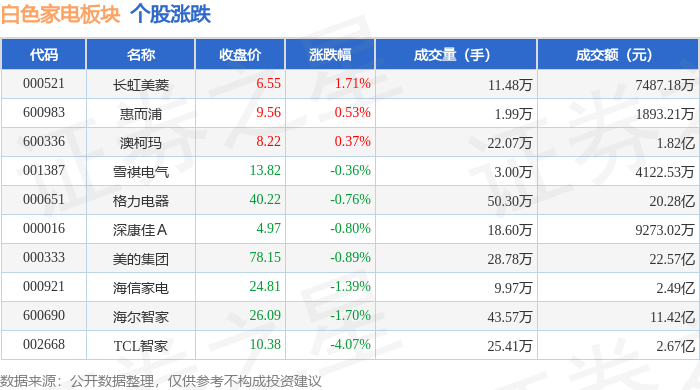
Market Overview - The white goods sector experienced a decline of 1.01% on December 31, with TCL leading the drop [1] - The Shanghai Composite Index closed at 3968.84, up 0.09%, while the Shenzhen Component Index closed at 13525.02, down 0.58% [1] Individual Stock Performance - Changhong Meiling (000521) closed at 6.55, up 1.71% with a trading volume of 114,800 shares and a turnover of 74.87 million yuan [1] - Whirlpool (600983) closed at 9.56, up 0.53% with a trading volume of 19,900 shares and a turnover of 18.93 million yuan [1] - Aucma (600336) closed at 8.22, up 0.37% with a trading volume of 220,700 shares and a turnover of 182 million yuan [1] - Gree Electric (000651) closed at 40.22, down 0.76% with a trading volume of 503,000 shares and a turnover of 2.028 billion yuan [1] - Midea Group (000333) closed at 78.15, down 0.89% with a trading volume of 287,800 shares and a turnover of 2.257 billion yuan [1] - Hisense Home Appliances (000921) closed at 24.81, down 1.39% with a trading volume of 99,700 shares and a turnover of 249 million yuan [1] - Haier Smart Home (600690) closed at 26.09, down 1.70% with a trading volume of 435,700 shares and a turnover of 1.142 billion yuan [1] - TCL Smart Home (002668) closed at 10.38, down 4.07% with a trading volume of 254,100 shares and a turnover of 267 million yuan [1] Capital Flow Analysis - The white goods sector saw a net outflow of 424 million yuan from institutional investors, while retail investors contributed a net inflow of 235 million yuan [1] - TCL Smart Home experienced a net outflow of 45.27 million yuan from retail investors, despite a net inflow of 35.83 million yuan from institutional investors [2] - Midea Group had a net outflow of 44.91 million yuan from retail investors, with a net inflow of 29.11 million yuan from institutional investors [2] - Haier Smart Home had a significant net inflow of 68.95 million yuan from retail investors, despite a net outflow of 21.1 million yuan from institutional investors [2]




美的美拉人形机器人进入最终测试,2026年进驻线下门店
Bei Ke Cai Jing· 2025-12-31 08:36
【#人形机器人美拉系列最终测试#】智通财经12月31日电,美的集团(000333.SZ)发布投资者关系活动 记录表公告称,公司的人形机器人,面向工业场景的"美罗"系列已完成三代产品迭代;面向商业与家庭 场景的"美拉"系列产品已进入最终测试阶段,计划2026年进驻美的线下体验门店,承担产品导览、功能 演示等服务类任务。(智通财经) ...


铝价存趋势格局,氧化铝寻底路漫漫
Yin He Qi Huo· 2025-12-31 08:17
Report Industry Investment Rating No relevant content provided. Core Viewpoints of the Report - The aluminum price is expected to show a trending pattern, while alumina is on a long - term downward path. The financial attribute of aluminum will continue to strongly drive the price in 2026, and the global supply - demand shortage of aluminum will support the price. Alumina will maintain a cost - based pricing logic due to an oversupply situation [6][86]. - The consumption of aluminum will grow at a low rate but still have bright spots, such as in energy transformation, lightweight applications, and the export of aluminum - processed products. However, traditional industries like real estate and home appliances may still perform weakly [34][54]. - The supply of recycled cast aluminum alloy will be affected by raw material shortages and policy uncertainties, and its price will generally follow the trend of the aluminum price [89]. Summary by Directory Part One: Preface Summary 1. Market Review - **Electrolytic Aluminum**: Overseas tariffs, monetary policies, and the "de - dollarization" trend have affected the aluminum price. The supply - demand contradiction and low inventory have supported the price, and the cost has decreased while the profit has increased [5]. - **Aluminum Alloy**: The casting aluminum alloy futures were successfully launched this year. The price of aluminum alloy is highly correlated with the aluminum price, but the spot price of casting aluminum alloy has difficulty following the increase in the aluminum price [5]. - **Alumina**: The supply - demand situation at home and abroad has turned to oversupply, and the price has declined. The industry is shifting profits to the ore end, and there are basis trading opportunities [5]. 2. Market Outlook - **Electrolytic Aluminum**: The financial attribute will continue to strongly drive the aluminum price. The supply - demand shortage and low inventory will give the price greater elasticity [6]. - **Aluminum Alloy**: The supply - demand pattern will remain slightly oversupplied, and the price will generally follow the metal sector and the aluminum price. There are risks in basis and cross - variety spreads [6]. - **Alumina**: The oversupply situation will continue, and the price will maintain a downward - selling strategy. There are policy risks, and basis trading opportunities still exist [6]. 3. Strategy Recommendation - **Unilateral**: Be bullish on the aluminum price on dips; the absolute price of casting aluminum alloy will follow the aluminum price, and pay attention to basis and variety spread opportunities before the expiration of warehouse receipts; maintain a downward - selling strategy for alumina, and pay attention to price elasticity risks driven by policy expectations [7]. - **Arbitrage**: Pay attention to the expansion of the monthly spread of aluminum at low inventory levels, the convergence of the basis at the end of the off - season, and the repeated arbitrage opportunities in the internal - external price difference; for aluminum alloy, pay attention to the arbitrage opportunities in the range of a discount of 100 - 1400 yuan to the aluminum price and the spot - futures arbitrage opportunities; there are basis trading opportunities for alumina when the warehouse receipts are low and before expiration [7]. Part Two: Supply Rigidity and Global Shortage, Aluminum Price in a Trending Pattern 1. 2025 Aluminum Market Review - The aluminum price showed a volatile upward pattern in 2025, with the Shanghai Aluminum main contract price ranging from a minimum of 19,000 yuan to a maximum of 22,980 yuan, an annual increase of 13.8% [11]. - The price increase in the first and fourth quarters was mainly driven by LME aluminum, while in the second and third quarters, the price rebounded steadily after a decline [12][13]. 2. 2026 - 2030 Global Electrolytic Aluminum Supply Outlook - **Domestic**: The supply - side constraints on domestic electrolytic aluminum capacity still exist. The capacity will reach the theoretical ceiling in 2026, and the supply elasticity will decrease significantly. The production in 2026 and 2027 will have limited growth [20][21][22]. - **Overseas**: The overseas electrolytic aluminum capacity is expected to increase by 820,000 tons in 2026 and 1.65 million tons in 2027. The new - investment capacity is mainly concentrated in Indonesia [24][25]. - **Imports**: China will still rely on imported aluminum ingots in 2026, and the net import volume is expected to increase to 2.5 million tons [33]. 3. Aluminum Consumption with Low Growth but Bright Spots - **Export of Aluminum - processed Products**: The export volume of aluminum - processed products in 2025 is expected to be about 10.2 million tons, a year - on - year decrease of 2.55%. It is expected to turn positive in 2026, with an increase of about 400,000 tons [34]. - **Domestic Aluminum Demand**: The proportion of domestic aluminum demand in the total apparent demand increased in 2025. The growth of domestic demand was mainly in the first half of the year, and the demand in the energy transformation and lightweight application fields will be a stable growth source [41][54]. - **Difference between Apparent Demand and Actual Output**: The apparent demand of aluminum is significantly higher than the actual output of aluminum - processed materials, mainly due to the inventory in the intermediate links of the industry [45]. - **Traditional Industries**: The demand for aluminum in the real estate industry will still be weak, and the home appliance industry is expected to have a mild growth in air - conditioner production. The "aluminum - for - copper" substitution is ongoing [59][65]. 4. Certainties and Uncertainties of Aluminum - The global aluminum supply - demand gap may continue in the next five years, which will increase the price elasticity of aluminum. Tariffs and trade barriers mainly affect the price difference between regions, and the EU's CBAM policy may increase the trading cost [69][70]. - The aluminum market has a weak tolerance for supply - side uncertainties. Overseas electrolytic aluminum plants face risks such as accidents, carbon tariffs, and energy supply, and the climate phenomenon may also affect production and demand [71]. 5. Supply - Demand Balance and Inventory Expectations - **Balance Sheet**: The global economic growth is expected to be slow from 2025 to 2030. The domestic aluminum demand in 2026 is expected to increase by 2.54%. The global aluminum supply - demand gap is expected to be 570,000 tons in 2026 and 330,000 tons in 2027 [72]. - **Inventory**: Overseas, the LME aluminum spot basis has been in a premium state, and the new regulatory rules may make the price increase more stable. Domestically, the overall inventory is expected to remain stable, but attention should be paid to the changes in the monthly spread and basis during peak seasons [79][84]. 6. Macroeconomic and Fundamental Factors Affecting Aluminum Price The price of aluminum is affected by both financial and commodity attributes. In 2026, the resonance of these two attributes may push the aluminum price to break through previous highs, and the smelting profit is expected to be considerable [86]. Part Three: Recycled Cast Aluminum Alloy Expected to Follow the Aluminum Price 1. Supply - Demand of Recycled Aluminum Alloy - **Supply**: In 2025, the total built - in capacity of recycled aluminum alloy reached 18.67 million tons, with a low production rate due to raw material shortages, price inversion, and policy disturbances. In 2026, about 1 million tons of new capacity are expected to be put into operation, but the supply growth is still restricted [89]. - **Demand**: The demand for recycled aluminum alloy is mainly from the transportation industry, especially in the automotive sector. The demand growth rate is expected to slow down in 2026 [94][95]. - **Supply - Demand Balance**: The industry is expected to face a shortage in 2025 and 2026. The futures market may drive demand, but the expiration of warehouse receipts may widen the basis [102]. 2. Scrap Aluminum Raw Materials - The global scrap aluminum trade has been growing steadily. China's scrap aluminum is in short supply and relies on imports. The application of scrap aluminum in non - alloy products is increasing, which will keep the scrap aluminum in short supply and narrow the refined - scrap price difference [105][108]. 3. Price and Spread of Recycled Aluminum Alloy The price of recycled aluminum alloy is highly correlated with the aluminum price. In 2026, it is expected to follow the aluminum price, but the seasonal performance of the spread may be weaker than in previous years [113][114]. Part Four: Alumina in an Oversupply Situation with a Long - term Downward Path 1. 2025 Alumina Market Review The alumina price showed a downward trend in 2025, mainly due to the improvement of the supply - demand situation. The price rebounded in May and July but then continued to decline. The domestic production capacity and output increased significantly [120][121][124]. 2. Alumina Supply Outlook - **Domestic**: The domestic alumina production capacity is expected to increase in 2026, with a theoretical maximum output of 103.68 - 104.68 million tons. After considering dynamic balance, the output is expected to be about 99.45 million tons, a year - on - year increase of 4.8% [127][128]. - **Overseas**: The overseas alumina production is expected to increase by about 7% to 61.73 million tons in 2026 [133]. 3. Alumina Supply - Demand Balance Expectation The growth rate of electrolytic aluminum production is not significant, and there will be an oversupply of about 4 million tons at home and abroad in 2026. The alumina price will mainly follow the cost - based pricing logic, but the price may rebound if the supply - demand surplus narrows [141]. 4. Bauxite with Significant Increment and Expected Price Decline In 2025, the domestic bauxite production increased slightly, and the import volume increased significantly. The supply of bauxite is expected to be in surplus in 2026, and the price is expected to continue to decline, which will drive the alumina price down [145][153][154].
美的集团:接受华创证券等投资者调研
Mei Ri Jing Ji Xin Wen· 2025-12-31 08:10
每经头条(nbdtoutiao)——2025十大财经新闻出炉!护航、酣战、变局、狂飙分别指向哪些大事件? (记者 曾健辉) 每经AI快讯,美的集团发布公告称,2025年12月31日,美的集团接受华创证券等投资者调研,公司管 理层参与接待,并回答了投资者提出的问题。 ...
美的集团:面向工业场景的“美罗”系列已完成三代产品迭代
Mei Ri Jing Ji Xin Wen· 2025-12-31 08:10
12月31日,美的集团(000333.SZ)发布投资者关系活动记录表公告称,公司的人形机器人,面向工业场 景的"美罗"系列已完成三代产品迭代;面向商业与家庭场景的"美拉"系列产品已进入最终测试阶段,计 划2026年进驻美的线下体验门店,承担产品导览、功能演示等服务类任务。 (文章来源:每日经济新闻) ...
美的集团:公司的人形机器人 面向工业场景的“美罗”系列已完成三代产品迭代
Xin Lang Cai Jing· 2025-12-31 08:05
Core Viewpoint - Midea Group has made significant advancements in its humanoid robot product lines, with the "Meiro" series for industrial applications completing its third generation of product iteration and the "Meila" series for commercial and home use entering the final testing phase, aiming for a 2026 launch in Midea's offline experience stores [1] Group 1 - The "Meiro" series has completed its third generation of product iteration, indicating ongoing innovation in industrial humanoid robotics [1] - The "Meila" series is currently in the final testing phase, showcasing Midea's commitment to developing humanoid robots for commercial and home environments [1] - The planned introduction of the "Meila" series in 2026 aims to enhance customer experience through product guidance and functional demonstrations in physical stores [1]
美的集团(000333) - 2025年12月31日投资者关系活动记录表
2025-12-31 07:46
Group 1: Financial Performance - The intelligent building technology segment achieved a revenue of 28.1 billion RMB in the first three quarters, representing a 25% year-on-year growth [2] - The company's commercial multi-split air conditioning (VRF) domestic market sales accounted for over 28%, maintaining the industry leader position [3] - The centrifugal chiller market sales share exceeded 15%, also ranking first in the industry, with a year-on-year shipment increase of over 65% [3] Group 2: Market Expansion - The intelligent building technology segment has diversified its customer base, including data centers, healthcare, industrial parks, and high-end hotels [3] - The company has established 200 R&D centers and 41 major manufacturing bases across more than ten countries, allowing it to mitigate short-term currency fluctuations through local manufacturing and sales [2] Group 3: Technological Advancements - The humanoid robot follows a path of "industrial first, commercial follow-up, household exploration," with prototypes capable of various tasks released this year [3][4] - The "Miro U" humanoid robot, a six-arm wheeled robot, was officially unveiled at the 2025 Guangdong-Hong Kong-Macao Greater Bay Area New Economy Development Forum [4] - The "Mira" series humanoid robots are in the final testing phase, with plans to enter Midea's offline experience stores in 2026 for service tasks [4]
国投证券:2026年家电以旧换新政策出台 有望提振家电消费景气
智通财经网· 2025-12-31 06:58
智通财经APP获悉,国投证券发布研报称,2026年家电以旧换新政策落地,相较于2025年,明年补贴政 策支持范围有所缩小、补贴比例有所下调、更聚焦高能效产品,整体内容基本符合市场预期,有望刺激 家电内销边际改善,推动行业产品结构优化。预计国内家电消费将保持稳健表现,具有研发、渠道和品 牌优势的白电、黑电企业将更受益于新政策;外销方面,中美贸易冲突趋于缓和,关税压力有望降低, 且家电企业全球产能逐步释放,新兴市场持续贡献增量。 3)实施机制方面,2026年政策明确在全国范围内执行统一的补贴标准;建立补贴资金预拨制度,缓解企 业垫资压力;充分发挥不同销售渠道优势,支持线下实体零售;增加农村地区线下经营主体、引导线上 渠道向农村地区倾斜等方式,提高农村地区消费便利度。 2025年以旧换新政策有效刺激家电消费 据国家统计局数据显示,2025年1-11月份,全国限额以上单位家用电器和音像器材类商品零售额 YoY+14.8%。据央视新闻援引商务部消息,1-11月,全国家电以旧换新超12844万台,测算累计补贴金 额约827亿元,带动家电消费约4395亿元。家电以旧换新补贴政策带动更新需求释放,有效提振家电消 费景气。 2 ...
顾家家居回应3万套沙发订单质疑,称均为自制
Sou Hu Cai Jing· 2025-12-31 06:42
Core Viewpoint - The surge in sales from a live-streaming event has raised questions about the production capacity of Gujia Home, particularly regarding the fulfillment of nearly 30,000 sofa orders generated during the event, which totaled over 1 billion yuan in sales [3][7][10]. Group 1: Sales Performance and Production Concerns - A live-streaming event hosted by popular influencer Dong Yuhui resulted in over 1 billion yuan in sales for Gujia Home, with nearly 30,000 sofas ordered [3][7]. - Gujia Home confirmed that the sofas sold during the live stream are self-manufactured and that production is being accelerated to meet demand [3][9]. - Concerns have been raised about the company's ability to fulfill such a large order, with industry observers noting that many manufacturers are hesitant to take on the production due to low margins and long payment cycles [5][7]. Group 2: Financial Performance and Market Position - Gujia Home reported a revenue of 184.8 billion yuan in 2024, a decline of 3.81% year-on-year, marking the first time since its IPO in 2016 that both revenue and net profit have decreased [9][10]. - In the first three quarters of 2025, the company saw a revenue increase of 8.77% year-on-year, with a net profit growth of 13.24% [10][11]. - The company is facing challenges with high accounts receivable and payable, indicating potential liquidity issues [11][12]. Group 3: Strategic Shifts and Management Changes - Gujia Home is undergoing a transformation under new ownership, with a focus on efficiency and profitability rather than just growth [19][20]. - The company plans to invest 1.997 billion yuan in six major projects, including smart home product development and production line upgrades, to enhance operational efficiency [19][20]. - The management team has shifted significantly, with new leaders from the Midea Group taking over, indicating a strategic pivot towards leveraging synergies with Midea [17][18].