
晶澳科技

Search documents
光伏的好日子还得等一等
远川投资评论· 2025-08-06 08:04
Core Viewpoint - The A-share market is experiencing a rally driven by the "anti-involution" policy, with a particular focus on the photovoltaic (PV) sector, which has been heavily impacted by overcapacity and price competition [2][3]. Group 1: Industry Dynamics - The photovoltaic industry, once a market darling, is now facing significant challenges due to severe overcapacity and price wars, making it a focal point for the "anti-involution" policy [2][3]. - Following the central government's call for "anti-involution," leading PV companies have begun to calculate their costs and collaborate to stabilize prices, leading to a recent increase in the prices of polysilicon and other PV products [3][10]. - Despite initial successes in price stabilization, the industry has struggled with self-regulation, as evidenced by the breakdown of price agreements and the resurgence of price wars [9][10]. Group 2: Market Reactions - Investors have shown mixed reactions, with some adopting a cautious approach while others are taking contrarian positions, betting on the recovery of leading companies in the PV sector [15][16]. - The market has seen significant fluctuations, with institutional holdings in PV stocks declining prior to the "anti-involution" policy, indicating a lack of confidence among investors [15][16]. Group 3: Policy Comparisons - The current "anti-involution" policy shares similarities with the 2015 supply-side reform, both emerging from a backdrop of economic slowdown and declining demand [20][21]. - However, the "anti-involution" policy is more complex, aiming not only to reduce overcapacity but also to address issues like low-price competition and the protection of small and medium enterprises [24][26]. Group 4: Demand Challenges - The photovoltaic industry is facing a critical demand issue, with the post-2021 period seeing a shift to stable growth, yet the aggressive expansion and financial overpricing have created significant pressure on demand [30][31]. - The recent surge in polysilicon prices poses a risk to downstream demand, complicating the recovery process for the industry [34][35].


硅片价格持续上涨,专家:多晶硅价格回弹后,硅片制造以不亏本为底线
Mei Ri Jing Ji Xin Wen· 2025-08-05 11:45
Core Viewpoint - The increase in silicon wafer prices reflects a rebound in raw material polysilicon prices, with manufacturers pricing to avoid losses rather than competing for sales [1][2]. Group 1: Price Trends - The average price of N-type G10L monocrystalline silicon wafers increased by 9.09% week-on-week to 1.2 yuan per piece, while N-type G12R and G12 wafers saw increases of 8.00% and 7.64%, respectively [2]. - The overall increase in silicon wafer prices is attributed to rising raw material costs and increased purchasing orders from downstream [1][2]. Group 2: Industry Dynamics - The industry is experiencing a shift where pure silicon wafer manufacturers are focusing on not pursuing high operating rates or accumulating inventory, instead opting for production based on sales [2][3]. - The overall operating rate in the industry remained stable, with major companies operating at 50% and 40% rates, while integrated companies operated between 50% and 80% [2]. Group 3: Cost Implications - The rise in polysilicon prices from 35,000 yuan/ton to 45,000 yuan/ton is expected to increase costs in the component manufacturing sector by only 0.02 to 0.03 yuan/W, which is not significant [3]. - If polysilicon prices were to reach 60,000 yuan/ton, it would raise component costs by approximately 0.05 yuan/W, which downstream manufacturers would struggle to absorb [3]. Group 4: Market Outlook - The National Energy Administration reported that new renewable energy installations reached 268 million kilowatts in the first half of the year, a 99.3% year-on-year increase, with solar power installations doubling compared to the previous year [3]. - The forecast for solar installation capacity in 2025 has been adjusted upward to between 570 GW and 630 GW, indicating continued growth in the sector [7]. Group 5: Policy and Regulation - The Ministry of Industry and Information Technology has initiated energy-saving inspections for the polysilicon industry, which may limit outdated production capacity and concentrate production among leading companies [4]. - Policies are in place to prevent sales below cost, which helps stabilize price floors in the market [4]. Group 6: Company Performance - Longi Green Energy expects a net loss of 2.4 to 2.8 billion yuan for the first half of the year, although it has managed to significantly reduce losses compared to the previous year [6]. - Other major companies, such as Tongwei and JA Solar, also anticipate substantial losses, indicating a challenging market environment despite some segments beginning to show profitability [6][7].



硅片价格持续上涨 专家:多晶硅价格回弹后 硅片制造以不亏本为底线
Mei Ri Jing Ji Xin Wen· 2025-08-05 11:05
Core Viewpoint - The increase in silicon wafer prices reflects a rebound in raw material polysilicon prices, with manufacturers setting prices to avoid losses rather than competing for sales [1][2]. Group 1: Price Trends - The average price of N-type G10L monocrystalline silicon wafers increased by 9.09% week-on-week to 1.2 yuan per piece, while N-type G12R and G12 wafers saw increases of 8.00% and 7.64%, respectively [2]. - The average price of silicon wafers rose by approximately 0.1 yuan per piece due to increased raw material costs and higher downstream orders [1][2]. Group 2: Industry Dynamics - The overall operating rate in the industry remained stable, with major companies operating at 50% and 40% capacity, while integrated companies operated between 50% and 80% [2]. - From the second half of 2024, pure silicon wafer producers are expected to adopt a strategy of not pursuing high operating rates or accumulating inventory, focusing instead on sales-based production [2][3]. Group 3: Cost and Profitability - The price of polysilicon has risen from 35,000 yuan/ton to 45,000 yuan/ton, which could lead to a cost increase of 0.02 to 0.03 yuan/W for component manufacturing [3]. - Despite the increase in polysilicon prices, it is anticipated that prices will not reach 60,000 yuan/ton due to existing inventory levels and production rates, which would make it difficult for downstream manufacturers to absorb the costs [3]. Group 4: Policy and Regulation - The Ministry of Industry and Information Technology has issued a notice for energy-saving inspections in the polysilicon industry, which may limit outdated production capacity and concentrate production among leading companies [4]. - The National Market Supervision Administration has prohibited sales below cost, which helps stabilize price floors in the market [4]. Group 5: Company Performance - Longi Green Energy expects a net loss of 2.4 to 2.8 billion yuan for the first half of the year, while Tongwei and JA Solar also anticipate significant losses [5][6]. - Despite the losses, Longi Green Energy reported an increase in component sales, although the overall competitive environment has led to continued losses [6]. Group 6: Market Outlook - The solar power sector saw a 99.3% year-on-year increase in new installed capacity, with 268 million kW added in the first half of the year, supporting the stabilization of silicon wafer prices [3][6]. - The forecast for solar installation capacity in 2025 has been adjusted upward to between 570 GW and 630 GW, indicating continued growth in the sector [6].
硅片价格持续上涨 专家:多晶硅价格回弹后,硅片制造以不亏本为底线
Mei Ri Jing Ji Xin Wen· 2025-08-05 10:57
Group 1 - The core viewpoint of the article highlights the increase in silicon wafer prices due to the rebound in raw material polysilicon prices, with manufacturers setting prices to avoid losses rather than competing for sales [1][2] - The average price of various specifications of silicon wafers has increased, with N-type G10L single crystal wafers averaging 1.2 yuan/piece (up 9.09% week-on-week), N-type G12R at 1.35 yuan/piece (up 8.00%), and N-type G12 at 1.55 yuan/piece (up 7.64%) [1][2] - The overall operating rate of the industry remained stable, with major companies operating at 50% and 40%, while integrated companies operated between 50% to 80% [2] Group 2 - The increase in polysilicon prices from 35,000 yuan/ton to 45,000 yuan/ton has raised production costs for silicon wafer manufacturers, but the cost increase for component manufacturing is minimal, only 0.02 to 0.03 yuan/W [2][3] - The industry is expected to see a significant reduction in profits for small and medium enterprises if polysilicon prices fall below 40,000 yuan/ton by 2025 [3] - The National Energy Administration reported that new renewable energy installations reached 268 million kW in the first half of the year, a year-on-year increase of 99.3%, with solar power installations doubling compared to the same period last year [3] Group 3 - Major companies like Longi Green Energy and Tongwei Co. are forecasting significant losses for the first half of the year, with Longi expecting a net loss of 2.4 to 2.8 billion yuan [4][5] - Despite the losses, Longi reported an increase in component sales, but the competitive environment has led to prices falling below the industry cost line [5] - The industry is seeing a shift towards profitability in the component sector, with emerging markets showing significant growth despite slowdowns in traditional markets [5][6] Group 4 - The current inventory of polysilicon has decreased by approximately 30,000 to 40,000 tons compared to the beginning of the year, but the reduction is not substantial [6] - There are no new polysilicon production capacities expected, and some companies have halted production lines, while Tongwei is resuming a 120,000-ton annual polysilicon project [6]
高层重拳“反内卷”,光伏、汽车领涨,创业板综指有望困境反转!
市值风云· 2025-08-05 10:08
高层"反内卷"战略一经部署,政策驱动的价值重估行情已迅速启动。 短短半月内,从水泥行业联手控产到光伏产业倡导自律减产,政策在多个领域加速落地。 国家力量强势介入,减产令动真格。 作者 | RAYYYY 编辑 | 小白 | | | 近期主要相关行业协会的"反内卷"事件 | | --- | --- | --- | | 行业 | 日期 | 相关新闻 | | 汽车 | 5月末 | 工信部将加大汽车行业"内卷式"竞争整治力度 | | 光伏 | 6月30日 | 光伏玻璃行业计划7月集中减产 | | 水泥 | 7月1日 | 中国水泥协会发布《关于进一步推动水泥行业"反内卷" "稳增长"高质量发展工作的意见》 | | 建材 | 7月7日 | 33家建筑类中央企业、地方国企、民营企业基层党组织 联 合发出《关于号召建筑行业党组织和广大党员在营造风 | | | | 清 | | 钢铁 | 7月7日 | 部分钢厂近期已收到减排限产通知 | | 快递 | 7月10日 | 国家邮政局强调反对邮政快递行业"内卷式"竞争 | (来源:Choice数据,市值风云APP制表) 此外,7月18日,工业和信息化部总工程师谢少锋在国新办新闻发布会上表 ...

晶澳科技:将持续坚持技术创新夯实核心竞争力
Sou Hu Cai Jing· 2025-08-05 09:43
金融界8月5日消息,有投资者在互动平台向晶澳科技提问:贵公司股价连年下跌,让中小投资者亏损严 重,对此你们以前的回复是受行业波动和阶段供需关系影响,现在国家加强反内卷,这明显是非常有利 于贵公司做大做强的政策。而你们的市场表现明显也落后于同行业其它的公司,对此你们公司如何恢复 投资者信心? 来源:金融界 公司回答表示:您好,对于反内卷的政策,公司会积极关注并严格执行,但政策出台到落地会有一定地 时间差,相信随着相关措施的落地,行业会逐步改善。同时,公司将持续坚持技术创新,通过优化生产 工艺、提高产能生产效率、深化供应链整合、优化智能制造等措施夯实核心竞争力,提高公司长期投资 价值,谢谢关注。 ...
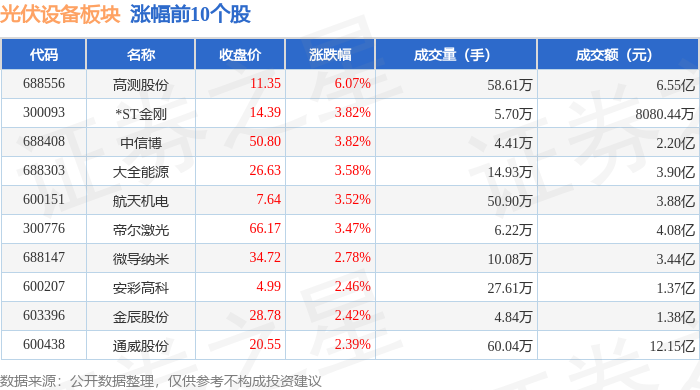
光伏设备板块8月5日涨1.49%,高测股份领涨,主力资金净流入1.15亿元
Zheng Xing Xing Ye Ri Bao· 2025-08-05 08:37
| 代码 | 名称 | 收盘价 | 涨跌幅 | 成交量(手) | 成交额(元) | | --- | --- | --- | --- | --- | --- | | 688556 | 筒测股份 | 11.35 | 6.07% | 58.61万 | 6.55亿 | | 300093 | *ST金刚 | 14.39 | 3.82% | 5.70万 | 8080.44万 | | 688408 | 中信博 | 50.80 | 3.82% | 4.41万 | 2.20亿 | | 688303 | 大全能源 | 26.63 | 3.58% | 14.93万 | 3.90亿 | | 600151 | 航天机电 | 7.64 | 3.52% | 50.90万 | 3.88亿 | | 300776 | 帝尔激光 | 66.17 | 3.47% | 6.22万 | 4.08亿 | | 688147 | 微导纳米 | 34.72 | 2.78% | 10.08万 | 3.44亿 | | 600207 | 安彩高科 | 4.99 | 2.46% | 27.61万 | 1.37亿 | | 603396 | 金辰股份 | 28.78 | ...

一上市企业实控人发生变更
Sou Hu Cai Jing· 2025-08-05 07:25
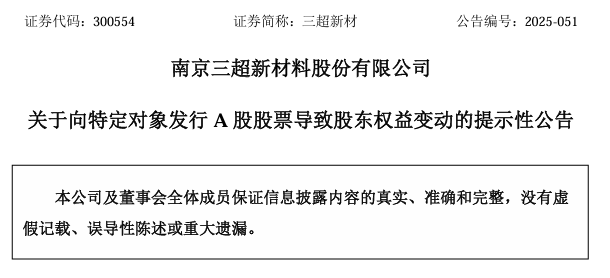
Group 1 - The second Photovoltaic Low-Silver/No-Silver Technology Forum 2025 will be held on September 3 in Suzhou, focusing on industry outlook and market prospects for low-silver/no-silver technology [1][3] - The company Nanjing San Chao New Materials Co., Ltd. has signed a share transfer agreement with Wuxi Boda He Yi Technology Co., Ltd. and Wuxi Boda New Energy Technology Co., Ltd., leading to a change in controlling shareholder and actual controller [2] - The company plans to issue A-shares to specific investors, with Boda He Yi intending to subscribe for all 12,475,049 shares at a price of 20.04 yuan per share, raising up to 250 million yuan for working capital and bank loan repayment [2] Group 2 - Boda He Yi is a holding platform company that operates through its subsidiary Boda New Energy, which is a global photovoltaic module brand with supply chain integration capabilities [3] - In the first half of 2025, Boda He Yi achieved revenue of 1.843 billion yuan and a net profit of 400 million yuan [3] - The fourth Perovskite Technology, Equipment, and Materials Forum 2025 will be held from October 14-16 in Suzhou, discussing the application scenarios and market potential of perovskite components [3]

上半年实际利用外资增长65.8%,投资海口磁吸效应凸显
2 1 Shi Ji Jing Ji Bao Dao· 2025-08-05 06:25
Core Insights - Haikou's economic growth is significantly driven by investment attraction, with a GDP of 1080.85 billion yuan in the first half of the year, reflecting a 5.4% year-on-year increase [1] - The city has seen a remarkable 65.8% increase in actual foreign investment, indicating strong confidence from global enterprises [1] Investment Attraction as an Economic Engine - Haikou has successfully attracted 63 key investment projects in the first half of the year, contributing directly to a 16.8% increase in industrial added value [1] - Notable projects include Bitmain, which contributed 1.62 billion yuan to local industrial added value [1] Expansion of Investment Network - Haikou's investment network is expanding, with 26 new projects in the comprehensive bonded zone and 13 investment projects signed in the national high-tech zone [2] - Significant projects include those from Indian Sun Pharmaceutical and Silver Medical, as well as investments from various regions across China [2] Regional Cooperation and Development - The establishment of the Guangdong-Hainan Advanced Manufacturing Cooperation Industrial Park has led to 74 investment trips to Guangdong, resulting in 52 projects with a total investment exceeding 12 billion yuan [3] - The park has attracted 442 enterprises, with actual investments nearing 1.4 billion yuan [3] Win-Win Situation for City and Enterprises - The investment attraction strategy has created a win-win scenario, where Haikou's GDP growth aligns with the benefits enterprises gain from the free trade port policies [4] - For instance, Taishan Sports Industry Group plans to leverage tax exemptions for importing materials to establish a high-end bicycle production base [4] Positive Feedback Loop in Economic Growth - Haikou's economic model has established a positive feedback loop: policy attracts enterprises, enterprises generate output, which optimizes the economic structure and further enhances investment attraction [5] - The city aims to attract globally competitive enterprises post-customs closure, leveraging its unique regulatory environment [5] Institutional Advantages and Future Outlook - Haikou's investment attraction has transcended geographical boundaries, creating a new institutional landscape characterized by customs facilitation and tax reforms [6] - The city is expected to experience a surge in investment projects in the upcoming months, marking a critical phase in its economic development [6]
7月政治局会议火线解读
2025-08-05 03:20
Summary of Key Points from the Conference Call Industry and Company Involvement - The conference call primarily discusses the macroeconomic policies and strategic planning of the Chinese government, particularly focusing on the 14th and 15th Five-Year Plans, which impact various industries including real estate, technology, and consumer sectors. Core Insights and Arguments 1. **Economic Growth and Policy Stability** The political bureau meeting emphasized the dual focus on stable growth and high-quality development, aiming for a GDP growth target of around 5% for the year, with the first half achieving a growth rate of 5.3% [2][6][22]. 2. **Fiscal and Monetary Policy Adjustments** - Fiscal policy will accelerate government bond issuance and improve fund utilization efficiency, with a projected fiscal gap of 300 to 500 billion [13][31]. - Monetary policy remains flexible, with potential for interest rate cuts in the latter half of the year, depending on economic pressures [14][32]. 3. **Reform Focus Areas** Key reforms include promoting technological innovation, regulating competition, and advancing green transformation. The government aims to integrate technology and industry innovation deeply [7][8][43]. 4. **Real Estate and Urban Renewal** The meeting highlighted the importance of high-quality urban renewal and maintaining a stable real estate market, with a focus on improving existing urban areas rather than expanding [10][39][41]. 5. **Consumer Market Dynamics** Consumer retail sales grew by 5.0% year-on-year in the first half of 2025, driven by policies encouraging consumption. The government plans to continue supporting both goods and service consumption [16][35]. 6. **Emerging Industries and Technological Innovation** The government is prioritizing emerging industries such as high-end chips, AI, and biotechnology, aiming to increase their contribution to GDP from 11% to 17% [20][25][56]. 7. **Risk Areas** The main risks identified include real estate, local government debt, and capital market stability. The government is taking measures to mitigate these risks, including prohibiting new hidden debts [21][28]. 8. **Investment Opportunities** - The conference identified potential investment opportunities in sectors like water conservancy, technology innovation, and consumer electronics, particularly in companies that can adapt to new market conditions [24][25][36]. - Specific recommendations include companies in the AI sector and those involved in urban renewal projects [49][62]. Other Important but Possibly Overlooked Content 1. **Impact of Global Changes** The meeting acknowledged the significant global changes affecting China's economy, including trade tensions and technological competition, which necessitate adaptive policies [3][4]. 2. **Long-term Vision for Technology** The focus on technology is not just about self-sufficiency but also about enhancing global competitiveness and market share [44][45]. 3. **Consumer Electronics and AI Hardware** The consumer electronics sector is expected to innovate significantly, with AI technology driving new product developments [59][60]. 4. **Sustainability and Green Initiatives** The emphasis on green transformation indicates a long-term commitment to sustainable development across various sectors [8][12]. 5. **Market Mechanisms and Competition** The meeting discussed the need for market mechanisms to replace blanket subsidies, promoting healthy competition and resource allocation [47][48]. This summary encapsulates the key points discussed in the conference call, providing insights into the current economic landscape and future directions for various industries in China.