
明阳智能

Search documents
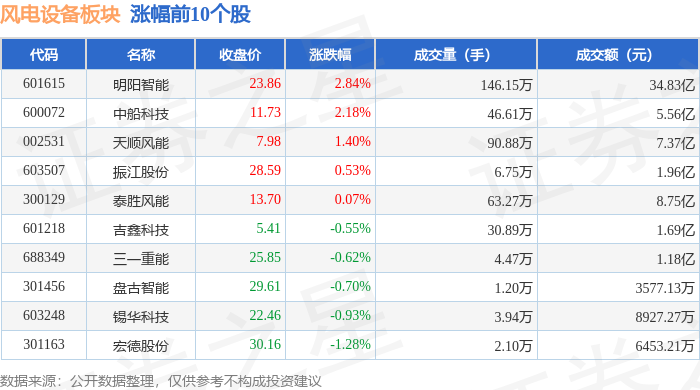
风电设备板块2月2日跌1.85%,海力风电领跌,主力资金净流出4.99亿元
Zheng Xing Xing Ye Ri Bao· 2026-02-02 09:15
Market Overview - The wind power equipment sector experienced a decline of 1.85% on February 2, with HaiLi Wind Power leading the drop [1] - The Shanghai Composite Index closed at 4015.75, down 2.48%, while the Shenzhen Component Index closed at 13824.35, down 2.69% [1] Individual Stock Performance - Mingyang Smart Energy (601615) closed at 23.86, up 2.84% with a trading volume of 1.4615 million shares [1] - China Shipbuilding Technology (600072) closed at 11.73, up 2.18% with a trading volume of 466,100 shares [1] - HaiLi Wind Power (301155) closed at 75.88, down 12.96% with a trading volume of 131,200 shares [2] - Yunda Co., Ltd. (300772) closed at 18.19, down 6.53% with a trading volume of 205,000 shares [2] Capital Flow Analysis - The wind power equipment sector saw a net outflow of 499 million yuan from institutional investors, while retail investors contributed a net inflow of 276 million yuan [2] - Major stocks like Mingyang Smart Energy and China Shipbuilding Technology had varying net inflows and outflows from different investor types [3] - Mingyang Smart Energy had a net inflow of 166 million yuan from institutional investors, while retail investors had a net outflow of 224 million yuan [3]



"太空光伏"概念走热,部分企业触发交易异常,业内: 目前仍处于0到1阶段
Di Yi Cai Jing· 2026-02-02 07:45
Core Viewpoint - The "space photovoltaic" concept has become a major focus in the secondary market, significantly influenced by Tesla CEO Elon Musk's endorsements, with the relevant index rising 19.83% in the past month, outperforming the CSI 300 index's 1.18% increase [1] Group 1: Market Performance - The space photovoltaic concept index has seen a substantial increase, with notable stocks such as JunDa Co., Ltd. rising by 84.62%, Mingyang Smart Energy increasing by 60.22%, and Jiejia Weichuang up by 44.04% over the past 20 days [1] - Several photovoltaic companies have experienced significant stock price surges, triggering trading anomalies, with stocks like Dongfang Risen and Laplace exceeding a cumulative price deviation of 30% over multiple trading days [3] Group 2: Technology and Feasibility - Space photovoltaic energy involves utilizing solar photovoltaic technology in outer space to generate and supply energy, with the potential for direct power transmission to Earth or powering satellites and space stations [3] - The feasibility of space photovoltaic technology is supported by the abundant sunlight in space and the ability to deploy photovoltaic components on satellites, with near-Earth orbit satellites experiencing over 60% sunlight exposure [3] - Despite the market enthusiasm, the industry faces significant uncertainties regarding the maturity and long-term reliability of the technology, as well as the economic viability required for large-scale commercialization [4][5] Group 3: Industry Insights - Industry insiders indicate that the application scenarios for space photovoltaic technology are still in the exploratory phase, with many companies in the secondary market not yet supplying products to commercial space satellite companies [4] - Analysts emphasize that space photovoltaic technology is currently in the early stages, requiring validation of technical routes and economic benefits for large-scale commercial applications [5] - The current cost of space photovoltaic energy is estimated to be around $2-3 per kilowatt-hour, significantly higher than ground photovoltaic costs of $0.03-0.05 per kilowatt-hour, highlighting the economic challenges ahead [6] Group 4: Future Outlook - Companies like Trina Solar and HaiMuxing express optimism about the future of space photovoltaic technology, with ongoing collaborations with leading aerospace institutions to accumulate practical experience [6] - The commercial viability of space photovoltaic technology is projected to gradually materialize over the next 10 to 15 years, driven by decreasing launch costs and breakthroughs in battery technology [7]




国盛证券:低轨星座竞赛与太空算力革命 引爆太空光伏需求新周期
智通财经网· 2026-02-02 07:34
Group 1 - The rapid increase in satellite deployment and the planning of space AI computing power are driving exponential growth in demand for space photovoltaic systems, which are transitioning from supporting components to strategic infrastructure [1] - China plans to submit applications for 203,000 satellites by the end of December 2025, while the US has launched over 10,000 satellites under the SpaceX Starlink program, intensifying the global space race [1] - The emergence of "space-based data centers" is driven by the limitations of ground data centers, with space offering continuous sunlight and near-zero cost cooling due to the cold cosmic background [1] Group 2 - New technological pathways are emerging, including P-type HJT batteries and silicon/perovskite tandem cells, which offer lower costs and improved performance compared to traditional gallium arsenide batteries [2] - P-type HJT batteries benefit from lower costs due to their manufacturing process and established supply chains, while silicon/perovskite tandem cells have demonstrated laboratory efficiencies of around 35% [2] - Perovskite materials are seen as the ultimate solution for space photovoltaics due to their high defect tolerance and radiation resistance, making them suitable for the harsh conditions of space [2] Group 3 - The global manufacturing landscape is misaligned, presenting historic opportunities for Chinese equipment and battery manufacturers as the US lacks capabilities in HJT and perovskite production lines [3] - The demand for photovoltaic equipment is expected to surge as SpaceX and Tesla plan to build a total of 200 GW of photovoltaic capacity in the US over the next three years [3] - Chinese photovoltaic companies, equipped with aerospace certification and large-scale delivery capabilities, are transitioning from ground support to core space applications, positioning themselves to benefit from the growing demand for space photovoltaics [3] Group 4 - Investment recommendations include photovoltaic equipment suppliers such as Maiwei Co., and potential players like Laplace, Liancheng CNC, Jiejia Weichuang, Aotwei, Gaocai Co., Dier Laser, and Jingsheng Mechanical & Electrical [4] - Material suppliers recommended include Junda Co., Dongfang Risheng, Mingyang Smart Energy, Shanghai Port, Qianzhao Optoelectronics, Trina Solar, and Shuangliang Energy [4]

中国对英投资的“绿色新现实”:在气候与金融的双轨驱动下寻求合作确定性 | 跨越山海-国别观察
Di Yi Cai Jing· 2026-02-02 03:48
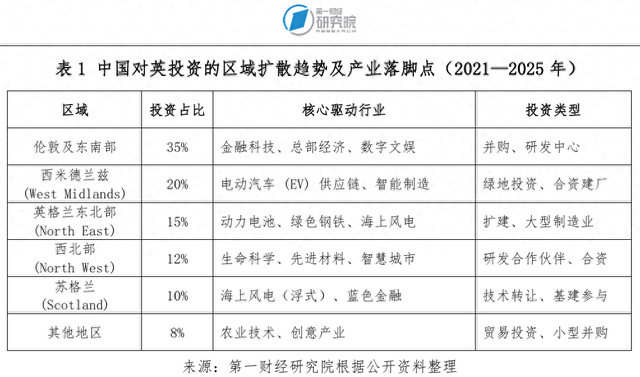
Core Insights - The visit of UK Prime Minister Keir Starmer to China in January 2026 resulted in 11 positive outcomes, marking a new phase in UK-China relations characterized by "re-engagement" and "divergence management" [1] - China's direct investment in the UK has shifted from "capital scale expansion" to "high-quality supply chain integration" over the past five years, with a significant rebound in investment flow expected in 2024-2025, driven by strong performance in renewable energy and greenfield projects [1][4] - The establishment of a "High-Level Climate and Nature Partnership" during the visit validates the business logic of collaboration in the "net-zero emissions" sector, highlighting the complementary strengths of both countries [1][3] Investment Trends - China's direct investment in the UK has transitioned from acquisition-driven capital to strategic greenfield projects, with FDI stock declining from approximately £6 billion in 2020 to £3.7 billion by the end of 2023, representing about 0.2% of the UK's total inward FDI [5][6] - Despite the decline in FDI stock, the number of Chinese projects in the UK has remained robust, averaging 37 to 46 new projects annually from 2021 to 2025, with a notable rebound in investment flow expected to reach €10 billion in 2024-2025 [5][6] Employment Impact - Chinese enterprises in the UK employ over 57,000 individuals and generate nearly £99 billion in annual revenue, with at least 9,356 new jobs created from 2021 to 2025, peaking at 2,814 new jobs in the 2023 fiscal year [6] Regional Investment Distribution - Investment from China has shifted from a concentration in London to a more balanced distribution across the UK, with greenfield investments rising to 60% of total investments by 2025, benefiting regions such as the West Midlands and North East England [8][11] Strategic Focus Areas - The focus of Chinese investment has moved towards renewable energy and electric vehicle supply chains, with significant investments in offshore wind, energy storage, and battery technology [14][19] - The West Midlands has become a key area for electric vehicle supply chains, while the North East and Yorkshire are transitioning from traditional heavy industries to low-carbon manufacturing [15][19] Challenges and Opportunities - The UK faces increasing competition from other European countries for Chinese investment, with regulatory uncertainties and unclear review processes diminishing its attractiveness [20][21] - The UK's National Security and Investment Act (NSIA) presents challenges for Chinese enterprises, as the unpredictability of the review process can lead to increased costs and project delays [23][24] Recommendations for Improvement - To enhance its attractiveness to Chinese investors, the UK should establish a green investment fast track for low-sensitivity projects and create a standardized trust framework to help Chinese enterprises navigate the regulatory landscape [28][29] - Strengthening post-investment support systems and ensuring clear communication regarding project delivery processes will be crucial for fostering a conducive investment environment [31]
电力设备与新能源行业1月第4周周报:容量电价机制政策发布,储能发展有望加速-20260202
Bank of China Securities· 2026-02-02 02:47
Investment Rating - The report maintains an "Outperform" rating for the industry [2][3] Core Insights - The global sales of new energy vehicles are expected to continue growing rapidly in 2026, driving demand for batteries and materials [2] - The solid-state battery technology is entering a critical phase of engineering validation, with a focus on related materials and equipment companies [2] - The photovoltaic sector is seeing investment driven by "anti-involution" and "space photovoltaics," with significant projects like Musk's plan for a 100GW photovoltaic supply chain [2] - The wind power sector is projected to grow continuously, with government support for new projects [2] - The energy storage sector remains in high demand, with recommendations to focus on energy cell and large storage integration manufacturers [2] - Hydrogen energy is expected to see increased demand, particularly in green hydrogen applications, with a focus on equipment and operational segments [2] - Nuclear fusion is highlighted as a long-term energy development direction, with recommendations to monitor core suppliers in this area [2] Industry Dynamics - The report notes a 5.10% decline in the electric power equipment and new energy sector this week, which is higher than the Shanghai Composite Index [11] - Key information includes the introduction of subsidies for new energy vehicles in Shanghai, and significant growth in installed capacity for solar and wind energy in 2025 [24] - The report highlights the commercial viability of silicon anode solid-state batteries proposed by SK On [24] - The National Energy Administration projects that by the end of 2025, China's renewable energy hydrogen production capacity will exceed 250,000 tons per year, doubling from the previous year [24] Company Insights - Enjie Co., Ltd. expects a net profit of 109-164 million yuan in 2025, turning profitable [25] - Tianqi Lithium Industries anticipates a net profit of 369-553 million yuan in 2025, also turning profitable [25] - Longpan Technology expects a net loss of 148-180 million yuan in 2025, but a reduction in losses compared to previous years [25] - Greeenme expects a net profit of 1.429-1.735 billion yuan in 2025, representing a year-on-year growth of 40%-70% [25] - Mingyang Smart Energy anticipates a net profit of 800-1,000 million yuan in 2025, with a significant year-on-year growth of 131%-189% [25]
独立储能容量电价政策出台,2025年国内光伏装机创新高
Ping An Securities· 2026-02-02 02:31
Investment Rating - The report maintains a "stronger than the market" investment rating for the industry [1] Core Views - The report highlights the introduction of a national capacity pricing policy for independent energy storage and anticipates a record high in domestic photovoltaic installations in 2025 [1][6] Wind Power - A significant event occurred on January 26, where nine countries signed the North Sea Offshore Wind Investment Agreement, committing to provide planning and investment guarantees for offshore wind projects, aiming for an annual addition of 15GW of offshore wind capacity from 2031 to 2040 [5][9] - The wind power index fell by 3.01% during the week, underperforming the CSI 300 index by 3.09 percentage points, with a current PE_TTM valuation of approximately 28.16 times [4][10] Photovoltaics - In 2025, the domestic photovoltaic installation is expected to reach a record high of 31.507 million kilowatts, a year-on-year increase of 13.67%, driven by the promotion of the 136 document [5][6] - The report forecasts that the domestic photovoltaic manufacturing industry will face significant supply-demand pressure and profitability challenges in 2026, with expected new installations between 200-250GW [5][6] Energy Storage & Hydrogen Energy - The national capacity pricing policy for independent energy storage has been established, allowing independent storage to earn revenue through a combination of capacity pricing and spot market arbitrage [6] - The report recommends investing in domestic and international large-scale storage companies, highlighting firms like Sungrow Power Supply, Huaneng Renewables, and others as having strong competitive advantages [6] Investment Recommendations - The report suggests focusing on companies with competitive advantages in high-efficiency battery technology and those involved in the emerging markets of distributed storage [6] - Specific recommendations include Ningde Times and Penghui Energy in the battery segment, and companies like Goldwind Technology and Mingyang Smart Energy in the wind power sector [6]




未知机构:商业航天领航员东吴计算机王紫敬SpaceX申请100万颗算力星座抢占频-20260202
未知机构· 2026-02-02 02:05
【商业航天领航员|东吴计算机王紫敬】SpaceX申请100万颗算力星座,抢占"频轨"即抢占未来6G话语权 这不仅是算力的布局,更是对近地轨道资源的极限挤压。 核心逻辑升级: 1透过"算力"看本质,实为"太空圈地 【商业航天领航员|东吴计算机王紫敬】SpaceX申请100万颗算力星座,抢占"频轨"即抢占未来6G话语权 新闻事件: 1月31日,SpaceX向FCC提交申请,拟部署最多100万颗卫星用于大规模AI推理及数据中心,轨道高度500-2000公 里。 这不仅是算力的布局,更是对近地轨道资源的极限挤压。 核心逻辑升级: 新闻事件: 1月31日,SpaceX向FCC提交申请,拟部署最多100万颗卫星用于大规模AI推理及数据中心,轨道高度500-2000公 里。 这已不是商业选择,而是国家战略必争。 1透过"算力"看本质,实为"太空圈地": 虽然SpaceX名义上申请的是"AI算力卫星",但其部署高度(500- 2000km)正是近地轨道(LEO)的黄金地带。 在ITU"先申报先得"的规则下,申请100万颗实则是利用海量卫星物理锁死轨道资源和频谱资源。 未来3-5年将是发射量的指数级爆发期,这将对火箭运力(发动 ...
未知机构:电新周观点更新好看太空光伏储能锂钠电锂电全国容量电-20260202
未知机构· 2026-02-02 02:05
Industry and Company Analysis Summary Industry Overview Lithium Battery and Energy Storage - The national capacity electricity price policy has been implemented, expected to increase the Internal Rate of Return (IRR) for energy storage by over 3% [1] - In February, lithium battery production is projected to decrease by over 10%, indicating a strong production season despite being traditionally off-peak [1] - Sodium batteries are undergoing winter tests with multiple automotive companies, with expectations for mass shipments in Q2 [1] Key Segments Ranking - The preferred segments in the energy storage industry are ranked as follows: - Energy storage cells (Penghui) - Iron lithium cathodes - Energy storage integration (Haibo) - Separators (Enjie) - Copper and aluminum foils (Nord and Dingsheng) [1] Sodium Battery Sector - The lithium carbonate market is expected to undergo adjustments, with a new upward trend anticipated next week, maintaining a long-term positive outlook [2] - Recent price drops are not due to fundamental factors; downstream procurement has increased, with significant spot transactions indicating acceptance of the 150,000 yuan price for lithium [2] - February is expected to see price increases due to strong battery production and ongoing maintenance at lithium salt plants [2] Wind Power Sector - Recent earnings forecasts in the wind power sector have largely fallen short of expectations, primarily due to a decline in Q4 shipments and year-end impairments [2] - The main machine segment has cleared out low-priced orders, indicating a confirmed bottom, with expectations for overall gross margin recovery starting in Q1 2026 [2] - Recommended stocks in this sector include Jinlei Co., Daikin Heavy Industries, and major machine manufacturers (Goldwind, SANY, Yunda, Mingyang) [2] Photovoltaic Sector - Positive outlook for space photovoltaic technology and silver-free solutions [2] - SpaceX has applied to the FCC to deploy 1 million satellites, enhancing the logic behind space photovoltaic initiatives [2] - High silver prices and technological breakthroughs have led to a reduction in costs for copper-based batteries by an average of 0.15 yuan/W, indicating a potential explosion in silver-free industrialization [2] AIDC (Artificial Intelligence Data Center) Sector - A new round of bidding is emerging in the domestic supply chain [2] - ByteDance is shifting its bidding towards high-voltage direct current solutions, while NVIDIA's GB300 liquid cooling certification is tightening, potentially redirecting investments towards core components and ASIC overflow [2] - The production capacity of Yingwei QD is expected to increase by 20 times in Q1, closely integrating with the NVIDIA ecosystem [2]
未知机构:电新周观点更新好看太空光伏储能锂钠电申万电新锂电全-20260202
未知机构· 2026-02-02 02:00
Summary of Key Points from Conference Call Records Industry Overview - **Industry Focus**: The records primarily discuss the lithium battery, sodium battery, wind power, and photovoltaic sectors, highlighting recent developments and future expectations in these industries. Lithium Battery Sector - **National Capacity Pricing Policy**: The introduction of the national capacity pricing policy is expected to increase the Internal Rate of Return (IRR) for energy storage by over 3%, with more provinces likely to adopt energy storage solutions by 2026 [1] - **Lithium Battery Production**: In February, lithium battery production is projected to decrease by over 10%, indicating that the production season is not as weak as anticipated [1] - **Sodium Battery Testing**: Ningde has initiated winter testing with multiple automotive companies for sodium batteries, with expectations for mass production in Q2 [1] - **Investment Focus**: The preferred investment hierarchy includes energy storage cells (Penghui) > lithium iron phosphate cathodes > energy storage integration (Haibo) > separators (Enjie), copper, and aluminum foil (Nord and Dingsheng) [1] Sodium Battery Sector - **Lithium Carbonate Price Adjustment**: A new round of price increases for lithium carbonate is anticipated following adjustments, with strong downstream purchasing activity observed after recent price drops [2] - **Wind Power Sector Performance**: Recent performance forecasts for the wind power sector have largely fallen short of expectations due to a decline in Q4 shipments and year-end impairments, indicating a confirmed bottom for the main engine sector [2] - **Investment Recommendations**: Recommended stocks include Jinlei Co., Daikin Heavy Industries, and major engine manufacturers (Goldwind, SANY, Yunda, Mingyang) [2] Photovoltaic Sector - **Space Photovoltaics**: The application by SpaceX to deploy 1 million satellites to create a space data center reinforces the logic behind space photovoltaics [3] - **Cost Reduction in Battery Production**: The high silver prices and technological breakthroughs have led to an average cost reduction of over 0.15 CNY/W in copper-based batteries, indicating a potential explosion in the no-silver industrialization [3] - **Investment Focus**: The preferred investment hierarchy includes equipment manufacturers (Liancheng, Lap, Maiwei, Yujing) and battery materials (Bojian, Foster, Kaisheng, Juhua, Dike, Risheng, Junda) [3] AIDC (Artificial Intelligence Data Center) Sector - **New Bidding Opportunities**: The domestic supply chain is entering a new round of bidding, with ByteDance shifting its focus to high-voltage direct current solutions and Nvidia tightening certification for liquid cooling [3] - **Production Increase**: The production capacity of Yingwei's QD is expected to increase by 20 times in Q1, indicating a strong alignment with Nvidia's ecosystem [3]




未知机构:电新周观点更新好看太空光伏储能锂钠电锂电全国容量电价-20260202
未知机构· 2026-02-02 02:00
Industry and Company Summary Industry: Lithium Battery and Energy Storage Key Points - **National Capacity Pricing Policy**: The introduction of the national capacity pricing policy is expected to increase the Internal Rate of Return (IRR) for energy storage by over 3%, with more provinces expected to adopt energy storage solutions by 2026 [1] - **Lithium Battery Production**: In February, lithium battery production is projected to decrease by over 10%, indicating that the production season is not as weak as anticipated [1] - **Sodium Battery Testing**: Ningde has initiated winter testing for multiple automotive companies regarding sodium batteries, with expectations for mass shipments in Q2 [1] - **Investment Focus**: The preferred investment hierarchy is as follows: energy storage cells (Penghui) > lithium iron phosphate cathodes > energy storage integration (Haibo) > separators (Enjie), copper and aluminum foils (Nord and Dingsheng) [1] Industry: Sodium Battery and Lithium Carbonate Key Points - **Lithium Carbonate Price Adjustment**: Following a price adjustment, there is a strong expectation for a new upward trend in lithium carbonate prices, with downstream procurement becoming more active after recent price drops [2] - **Wind Power Sector Performance**: The wind power sector has seen numerous earnings forecasts that fell short of expectations due to a decline in Q4 shipment volumes and year-end impairments, indicating a confirmed bottom for the main engine sector [2] - **Investment Recommendations**: Recommended stocks include Jinlei Co., Daikin Heavy Industries, and major turbine manufacturers (Goldwind, SANY, Yunda, Mingyang) [2] Industry: Photovoltaics Key Points - **Space Photovoltaics**: SpaceX's application to deploy 1 million satellites to create a space data center reinforces the logic behind space photovoltaics [3] - **Cost Reduction in Battery Production**: The high price of silver and technological breakthroughs have led to an average cost reduction of over 0.15 CNY/W in copper-based batteries, indicating a potential explosion in the no-silver production sector [3] - **Investment Focus in Photovoltaics**: The preferred investment hierarchy includes equipment manufacturers (Liancheng, Lap, Maiwei, Yujing) and battery and auxiliary material producers (Bojian, Foster, Kaisheng, Juhua, Dike, Risheng, Junda) [3] Industry: AIDC (Artificial Intelligence Data Center) Key Points - **New Bidding Round**: The domestic supply chain is entering a new round of bidding, with ByteDance shifting its bidding focus to high-voltage direct current solutions [3] - **NVIDIA Certification**: NVIDIA's GB300 liquid cooling certification is tightening, which may lead future investments to focus on core components and ASIC overflow [3] - **Increased Production Capacity**: The production capacity of Yingweike's QD is expected to increase by 20 times in Q1, strengthening ties with the NVIDIA ecosystem [3]
