易方达基金

Search documents
首尾相差125个百分点 QDII基金近一年业绩显著分化
Shang Hai Zheng Quan Bao· 2025-12-21 18:14
Group 1: QDII Fund Performance - The performance of QDII products has shown significant differentiation over the past year, with the top-ranking fund, Huatai-PineBridge Hong Kong Advantage Selected Mixed A, achieving a net value increase of 111%, leading the bottom-ranking products by 124.6 percentage points [1] - As of December 17, the average net value increase for QDII funds over the past year was 20.9%, with notable performers including Huatai-PineBridge Hong Kong Advantage Selected Mixed A (111%), Chuangjin Hexin Global Pharmaceutical Biotechnology Stock A (86.54%), and GF Zhongzheng Hong Kong Innovation Medicine (74.14%) [1] - The top ten funds in the QDII performance rankings are primarily Hong Kong stock funds, many of which have significant holdings in the Hong Kong pharmaceutical sector [1] Group 2: Market Trends and Analysis - The Hong Kong innovative pharmaceutical sector has recently experienced a significant adjustment, leading to a decline in the net value of related products, attributed to seasonal outflows of southbound funds and a decrease in the holding ratio of leading pharmaceutical stocks in the Hong Kong Stock Connect [2] - Despite the recent downturn, the fundamental outlook for the innovative pharmaceutical industry remains positive, with ongoing trends of innovative drugs going global, benefiting the entire supply chain, including upstream CXO and research services [2] - The performance of Saudi-themed ETFs and oil-related products has been poor, with two Saudi-themed products seeing net value declines of over 10% in the past year, while several oil-focused funds also reported negative returns [2] Group 3: Future Outlook - Looking ahead to global asset allocation for the next year, there is a belief that Hong Kong stocks still possess significant low valuation advantages amidst high valuations in most global markets, with expectations of orderly capital inflows as the external environment stabilizes and the Chinese economic outlook improves [2]
ETF周报:A500ETF净申购超300亿元,上周新成立三只科创创业人工智能ETF-20251221
Guoxin Securities· 2025-12-21 14:29
1. Report Industry Investment Rating - No information provided in the content 2. Core Viewpoints of the Report - Last week (from December 15 to December 19, 2025), the median weekly return of equity ETFs was -0.26%. Among broad-based ETFs, the median return of SSE 50 ETF was 0.67%, the highest. By sector, the median return of large financial ETFs was 1.22%, the highest. By theme, the median return of military ETFs was 2.56%, the highest [1][13][18]. - Last week, equity ETFs had a net subscription of 55.447 billion yuan, and the overall scale increased by 38.992 billion yuan. Among broad-based ETFs, A500 ETF had the largest net subscription, reaching 32.639 billion yuan. By sector, technology ETFs had the largest net subscription, amounting to 6.382 billion yuan. By hot theme, chip ETFs had the largest net subscription, reaching 3.050 billion yuan [2][27][33]. - As of last Friday, the valuation quantiles of ChiNext - related ETFs among broad - based ETFs were relatively low. By sector, the valuation quantiles of consumer and large financial ETFs were relatively moderate. By sub - theme, the valuation quantiles of liquor and new energy vehicle ETFs were relatively low. Compared with the previous week, the valuation quantiles of A500 and consumer ETFs increased significantly [3][34][44]. - From Monday to Thursday last week, the margin trading balance of equity ETFs increased from 46.443 billion yuan in the previous week to 47.714 billion yuan, and the short - selling volume decreased from 2.582 billion shares in the previous week to 2.481 billion shares. Among the top 10 ETFs with the highest average daily margin purchases and short - selling volumes, securities ETFs and STAR Market ETFs had relatively high average daily margin purchases, while CSI 1000 ETF and SSE 50 ETF had relatively high average daily short - selling volumes [4][45][53]. - As of last Friday, Huaxia, E Fund, and HuaTai - Berry ranked top three in the total scale of listed non - monetary ETFs. This week, 5 ETFs, including Huaxia CSI All - Share Food ETF, Huabao CSI All - Share Electric Power Utility ETF, ICBC ChiNext New Energy ETF, E Fund SSE STAR Market Chip Design Theme ETF, and E Fund CSI All - Share Food ETF, will be issued [5][57][60]. 3. Summary by Relevant Catalogs ETF Performance - **Equity ETFs**: The median weekly return was -0.26%. The median returns of SSE 50, CSI 500, CSI 300, A500, CSI 1000, ChiNext - related, and STAR Market ETFs were 0.67%, 0.03%, -0.13%, -0.14%, -0.53%, -2.25%, and -2.43% respectively. The median returns of commodity, bond, money - market, and cross - border ETFs were 0.98%, 0.05%, 0.02%, and -1.76% respectively [13]. - **By Sector**: The median returns of large financial, consumer, cyclical, and technology sector ETFs were 1.22%, 0.38%, -0.52%, and -2.31% respectively [18]. - **By Theme**: The median returns of military, bank, and securities ETFs were 2.56%, 1.23%, and 1.07% respectively, showing relatively strong performance. The median returns of chip, photovoltaic, and AI ETFs were -3.24%, -2.91%, and -2.45% respectively, showing relatively weak performance [18]. ETF Scale Changes and Net Subscriptions/Redeemptions - **Overall Scale**: As of last Friday, the scales of equity, cross - border, and bond ETFs were 3,683.2 billion yuan, 965.0 billion yuan, and 743.0 billion yuan respectively. The scales of commodity and money - market ETFs were relatively small, at 246.8 billion yuan and 186.2 billion yuan respectively [20]. - **Broad - based ETFs**: The scales of CSI 300 and A500 ETFs were relatively large, at 1,176.9 billion yuan and 243.0 billion yuan respectively. The scales of STAR Market, SSE 50, CSI 500, ChiNext - related, and CSI 1000 ETFs were relatively small, at 207.8 billion yuan, 184.6 billion yuan, 180.8 billion yuan, 174.3 billion yuan, and 170.3 billion yuan respectively [20]. - **By Sector**: As of last Friday, the scale of technology sector ETFs was 418.5 billion yuan, followed by cyclical sector ETFs at 210.3 billion yuan. The scales of large financial and consumer ETFs were relatively small, at 197.1 billion yuan and 186.7 billion yuan respectively [25]. - **By Theme**: As of last Friday, the scales of chip, securities, and pharmaceutical ETFs were the highest, at 147.5 billion yuan, 139.2 billion yuan, and 101.7 billion yuan respectively [25]. - **Net Subscriptions/Redeemptions**: Last week, equity ETFs had a net subscription of 55.447 billion yuan, and the overall scale increased by 38.992 billion yuan. Money - market ETFs had a net redemption of 1.662 billion yuan, and the overall scale decreased by 1.645 billion yuan. Among broad - based ETFs, A500 ETF had the largest net subscription of 32.639 billion yuan, and its scale increased by 32.528 billion yuan. SSE 50 ETF had the largest net redemption of 461 million yuan, and its scale increased by 560 million yuan [27]. By sector, technology ETFs had the largest net subscription of 6.382 billion yuan, and their scale decreased by 3.386 billion yuan. Cyclical ETFs had the largest net redemption of 3.207 billion yuan, and their scale decreased by 1.987 billion yuan. By hot theme, chip ETFs had the largest net subscription of 3.050 billion yuan, and their scale decreased by 2.222 billion yuan. Military ETFs had the largest net redemption of 4.229 billion yuan, and their scale decreased by 3.058 billion yuan [31][33]. ETF Benchmark Index Valuation - **Broad - based ETFs**: As of last Friday, the price - to - earnings ratios of SSE 50, CSI 300, CSI 500, CSI 1000, ChiNext - related, and A500 ETFs were at the 82.44%, 82.44%, 95.22%, 93.82%, 59.52%, and 90.79% quantiles respectively, and the price - to - book ratios were at the 60.72%, 68.43%, 96.70%, 48.23%, 59.03%, and 89.70% quantiles respectively. Since December 31, 2019, the current price - to - earnings and price - to - book ratios of STAR Market - related ETFs were at the 81.37% and 70.82% quantiles respectively. Compared with the previous week, the valuation quantiles of A500 ETF increased significantly [34][36]. - **By Sector**: As of last Friday, the price - to - earnings ratios of cyclical, large financial, consumer, and technology sector ETFs were at the 73.54%, 32.15%, 25.89%, and 92.75% quantiles respectively, and the price - to - book ratios were at the 69.08%, 56.31%, 36.19%, and 79.39% quantiles respectively. Compared with the previous week, the valuation quantiles of consumer ETFs increased significantly [38]. - **By Theme**: As of last Friday, the price - to - earnings quantiles of photovoltaic, military, and dividend ETFs were relatively high, at 99.59%, 99.01%, and 96.04% respectively. The price - to - book quantiles of AI, dividend, and robot ETFs were relatively high, at 99.75%, 96.13%, and 92.50% respectively. Overall, among broad - based ETFs, the valuation quantiles of ChiNext - related ETFs were relatively low. By sector, the valuation quantiles of consumer and large financial ETFs were relatively moderate. By sub - theme, the valuation quantiles of liquor and new energy vehicle ETFs were relatively low [40][41][44]. ETF Margin Trading and Short - Selling - Overall, the short - selling volume of equity ETFs has generally maintained an upward trend in the past year. As of last Thursday, the margin trading balance of equity ETFs increased from 46.443 billion yuan in the previous week to 47.714 billion yuan, and the short - selling volume decreased from 2.582 billion shares in the previous week to 2.481 billion shares [45]. - Among the top 10 ETFs with the highest average daily margin purchases from Monday to Thursday last week, securities ETFs and STAR Market ETFs had relatively high average daily margin purchases. Among the top 10 ETFs with the highest average daily short - selling volumes, CSI 1000 ETF and SSE 50 ETF had relatively high average daily short - selling volumes [48][50][53]. ETF Managers - As of last Friday, Huaxia Fund ranked first in the total scale of listed non - monetary ETFs, and had a relatively high management scale in multiple sub - fields such as scale - based index ETFs, theme - based, style - based, and strategy - based index ETFs, and cross - border ETFs. E Fund ranked second, with a relatively high management scale in scale - based index ETFs and cross - border ETFs. HuaTai - Berry ranked third, with a relatively high management scale in scale - based index ETFs and theme - based, style - based, and strategy - based index ETFs [54]. - Last week, 7 new ETFs were established. This week, 5 ETFs, including Huaxia CSI All - Share Food ETF, Huabao CSI All - Share Electric Power Utility ETF, ICBC ChiNext New Energy ETF, E Fund SSE STAR Market Chip Design Theme ETF, and E Fund CSI All - Share Food ETF, will be issued [57].
百余只货基收益率“破1”!基金公司集体限购保收益......
券商中国· 2025-12-21 14:27
Core Viewpoint - The yield of money market funds is rapidly declining, with over 100 funds now yielding below 1%, indicating a broader trend of decreasing returns in the market [1][2][3]. Group 1: Current Market Situation - As of December 19, 123 money market funds have seen their seven-day annualized yields drop below 1%, with some products like Tianfeng Jin Guanjia and Guangfa Cash Treasure A falling below 0.5% [3]. - The largest money market fund, Tianhong Yu'ebao, has a seven-day annualized yield of 1.02%, having briefly dipped to 1.001% on December 4 [3]. - Other leading funds such as Jianxin Jiaxinbao A and Huaxia Caifubao A have yields of 1.15% and 1.06%, respectively [3]. Group 2: Reasons for Yield Decline - The decline in money market fund yields is attributed to a decrease in the risk-free interest rate, which has led to lower returns on bank deposits and bond repurchase agreements [4]. - Market liquidity has increased, resulting in an asset shortage, compelling funds to reduce leverage and shorten duration to manage risk, further impacting yield performance [4]. - Despite the overall decline, some funds like Bank of China Ruyi Bao A maintain yields around 2%, employing more aggressive duration and leverage strategies [4]. Group 3: Management Fee Adjustments - Due to falling yields, several funds have been forced to lower management fees as per their contractual obligations. For instance, Guangda Baodexin Fund adjusted its management fee to 0.25% when the yield fell below a certain threshold [5][6]. - In December alone, over 30 funds have adjusted their management fees due to yields dropping below twice the rate of demand deposits [6]. Group 4: Fund Subscription Restrictions - Many fund companies have announced subscription limits or even suspended new subscriptions to protect existing investors and ensure stable fund operations [7]. - For example, funds like Shenyin Wanguo and Tianzhi Tiande Li have implemented limits on large subscriptions, while others have completely halted new subscriptions [7]. - The recent subscription restrictions are partly in response to regulatory requirements aimed at improving liquidity management and preventing practices that dilute existing investors' interests [8].


基金周报:国内ETF规模增长超2万亿,全市场首只船舶ETF正式启航-20251221
Guoxin Securities· 2025-12-21 14:02
- The report does not contain any specific quantitative models or factors for analysis[1][2][3][4]
年末QDII限额低至10元,552份风险提示拦不住溢价抢筹
第一财经· 2025-12-21 12:52
Core Viewpoint - The QDII fund market is experiencing a tightening of purchase limits, with many products reducing daily subscription limits to as low as 10 RMB, indicating a significant demand for overseas assets and leading to high premium risks [3][4]. Group 1: QDII Fund Market Dynamics - Multiple QDII funds have recently implemented strict purchase limits, with some popular products reducing daily subscription limits to 10 RMB, raising market concerns [4]. - As of December 21, over 90 QDII products have adjusted their subscription rules since the fourth quarter, affecting popular overseas markets such as the US and Japan [5]. - Nearly half of the QDII products in the market are currently under purchase restrictions, with 21 products completely closed to new subscriptions and 138 facing varying degrees of large purchase limits [5][6]. Group 2: Premium Risks and Market Reactions - The scarcity of QDII quotas has led to a significant increase in premium rates, with over 550 risk warning announcements issued in the past month due to high premiums [7][8]. - Some QDII products have reported IOPV premium rates exceeding 20%, indicating a strong market demand despite warnings from fund companies about potential losses from blind investments [8][9]. - The phenomenon of high premiums is attributed to a combination of strong market demand and ineffective arbitrage mechanisms, leading to a "hot炒" situation in the market [8]. Group 3: Outlook on US Stock Market - Analysts express optimism about the US stock market, predicting further growth in the S&P 500 index, with expectations of reaching 7,300 points by mid-2024 and 7,700 points by the end of 2026 [11]. - The influence of artificial intelligence (AI) is expected to expand beyond technology sectors, potentially driving productivity and corporate earnings, which are crucial for stock performance [11][12]. - Concerns about a technology bubble are noted, but analysts believe that current tech stocks have stronger fundamental support compared to previous market cycles [12].

年末QDII限额低至10元,552份风险提示拦不住溢价抢筹
Di Yi Cai Jing· 2025-12-21 11:29
Group 1 - The QDII fund market is experiencing a significant tightening of purchase limits, with some popular products reducing daily purchase limits to as low as 10 RMB, indicating a near "closure" of access [1][2] - As of December 21, over 90 QDII products have adjusted their purchase rules, reflecting a broader trend of tightening across the market, particularly for funds related to US and Japanese stocks [2][3] - The tightening of purchase limits is a response to high demand for overseas assets, with many funds facing pressure to manage their operations effectively [3] Group 2 - The scarcity of QDII quotas has led to a persistent high premium phenomenon, with over 550 risk warning announcements issued in the past month, indicating significant investor interest and potential risks [4][5] - Notably, the Southern S&P 500 ETF has issued 32 risk warnings in the last month, with an IOPV premium rate exceeding 5% as of December 19 [4] - High premiums are prevalent across various popular cross-border ETFs, with many products showing IOPV premium rates above 5%, despite repeated warnings from fund companies about the risks of blind investment [5][6] Group 3 - Investor optimism regarding overseas markets, particularly US stocks, is driving the demand for QDII products, with expectations for further growth in the S&P 500 index [7][8] - Analysts predict that the S&P 500 index could reach 7,300 points by mid-2024 and 7,700 points by the end of 2026, driven by advancements in AI and corporate earnings growth [7] - There is a shift anticipated from a "tech bull" market to a broader "expansion bull" market, with expectations of more balanced performance across different sectors [8]
本周ETF市场大额净流入870.91亿元 宽基ETF成资金“避风港”
Sou Hu Cai Jing· 2025-12-21 11:02
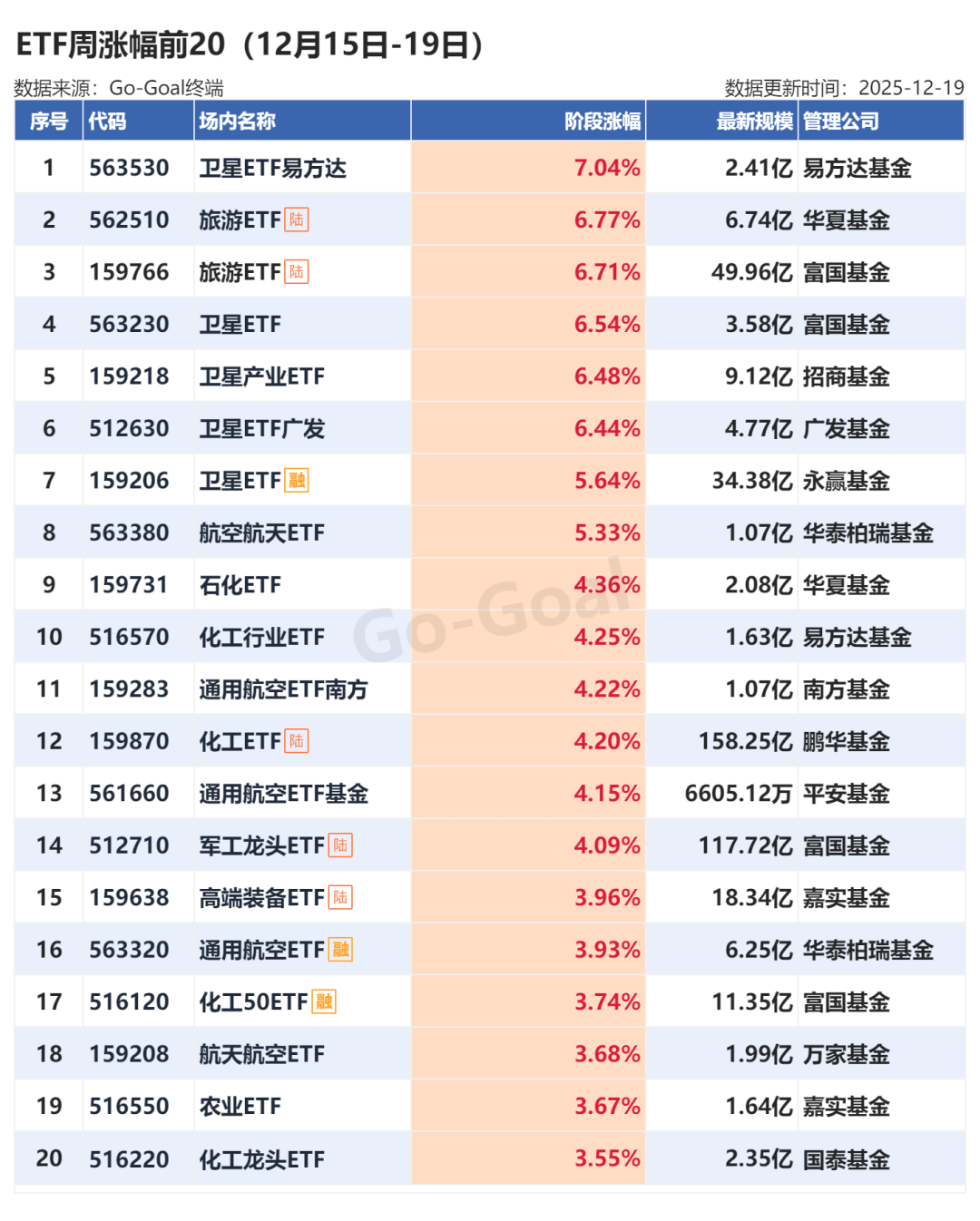
Core Viewpoint - Despite market fluctuations, broad-based ETFs have become a "safe haven" for funds and a tool for positioning [1][3] Fund Flows - This week, the ETF market saw a significant net inflow of 87.09 billion yuan, with broad-based ETFs receiving a net inflow of 47.45 billion yuan, cross-border ETFs gaining 13.55 billion yuan, and bond ETFs attracting 19.98 billion yuan [1][3] Market Performance - The three major A-share indices showed mixed performance, with the Shanghai Composite Index rising by 0.03%, while the Shenzhen Component Index fell by 0.89% and the ChiNext Index dropped by 2.26% [1] ETF Performance - Satellite, general aviation, and aerospace-related ETFs performed strongly this week, with the E Fund Satellite ETF leading with a 7.04% increase. Other notable performers included tourism and chemical ETFs, while chip and semiconductor ETFs experienced the largest declines [1][2] Upcoming ETFs - Four new ETFs are set to be issued next week, including a shipbuilding ETF and a photovoltaic ETF, with subscription periods starting from January 5 and January 12, 2026 [4][5]
37万亿行业,大消息!年度“十大”来了
中国基金报· 2025-12-21 10:46
Core Viewpoint - The article discusses the significant developments in the public fund industry in China throughout 2025, highlighting key reforms, growth in fund sizes, and the shift towards high-quality development in the sector [2]. Group 1: High-Quality Development Action Plan - The China Securities Regulatory Commission (CSRC) issued the "Action Plan for Promoting High-Quality Development of Public Funds," which includes 25 measures aimed at reshaping the industry ecosystem [3]. - The plan emphasizes investor-centric development, strong regulation, and risk prevention, encouraging fund companies to shift focus from scale to returns [3][4]. Group 2: Fee Rate Reform - The public fund fee rate reform has entered its final phase, with annual savings for investors exceeding 500 billion yuan [5]. - The reform consists of three stages: reducing management and custody fees, lowering trading commission rates, and decreasing subscription and purchase fees [5][6]. Group 3: Fund Size and Structure - By October 2025, the total size of public funds reached 36.96 trillion yuan, marking a continuous increase over seven months [6][7]. - The proportion of equity products has significantly increased, with stock and mixed funds reaching a combined scale of 10.18 trillion yuan, reflecting a shift towards quality development [7]. Group 4: ETF Market Growth - The ETF market size surged to 5.7 trillion yuan by October 2025, a 53% increase from the end of 2024, with stock ETFs becoming a core component of equity allocation [8]. - Bond ETFs have also seen substantial growth, with total sizes exceeding 700 billion yuan, driven by innovative products like the Sci-Tech Bond ETFs [9]. Group 5: Performance Assessment Reforms - New performance assessment guidelines for fund management companies were released, focusing on long-term value creation and reducing homogeneous competition [10][11]. - The introduction of performance benchmarks aims to enhance accountability and align fund managers' interests with investors [11][12]. Group 6: AI Integration in Fund Management - The fund industry is accelerating its intelligent transformation driven by AI, enhancing investment decision-making, risk assessment, and client services [12][13]. - AI technologies are being integrated into core investment processes, providing data-driven insights and improving operational efficiency [14][15]. Group 7: Expansion of Public REITs - The public REITs market has experienced significant growth, with 77 products listed and a total market value of 216.03 billion yuan by December 2025 [17]. - The asset types for REITs have diversified beyond traditional infrastructure to include commercial real estate, expanding investment opportunities [18]. Group 8: Cross-Border Investment Innovations - The public fund industry is enhancing its international presence, with the number of cross-border ETFs reaching 200 and total sizes nearing 920 billion yuan [19][20]. - The establishment of overseas subsidiaries by multiple fund companies indicates a strategic push towards global asset allocation [20].

转向中证A500,资金岁末“高低切换”,释放什么信号?
券商中国· 2025-12-21 07:20
Core Viewpoint - The market is witnessing a significant shift in capital flow towards the CSI A500 ETF, indicating a strategic move by institutional investors to protect returns as the year-end approaches, favoring low-valuation sectors over high-valuation technology stocks [1][7]. Group 1: Market Activity and Fund Flows - As of December 19, the CSI A500 ETF has surpassed the CSI 300, becoming the index with the highest net inflow of funds since December, with a total inflow exceeding 460 billion yuan [2][4]. - The trading activity of the CSI A500 ETF has surged since December 10, with daily trading volumes consistently breaking through 300 billion yuan, reaching a peak of 525.76 billion yuan on December 19 [3][4]. - The total scale of the CSI A500 ETF has exceeded 240 billion yuan, contributing to a total fund scale of over 300 billion yuan across various fund products [4]. Group 2: Institutional Investment Trends - Institutional investors are increasingly using broad-based index products to enter the market, with insurance funds potentially bringing in over 100 billion yuan in new capital due to policy changes [5]. - There is a notable trend of resident funds moving towards equity markets, driven by low interest rates and the need for better returns, with the average yield of equity mixed funds reaching 28.18% year-to-date [6]. Group 3: Investment Strategy Shifts - As the year-end approaches, institutional funds are shifting their focus from high-growth technology sectors to more balanced investments, indicating a "high-low switch" in strategy [7]. - Analysts predict that 2026 will see a more balanced market, with opportunities in cyclical industries and high-return sectors, as well as continued interest in innovative fields like AI and renewable energy [8].

太猛了!神秘资金突然爆买
Xin Lang Cai Jing· 2025-12-21 07:19
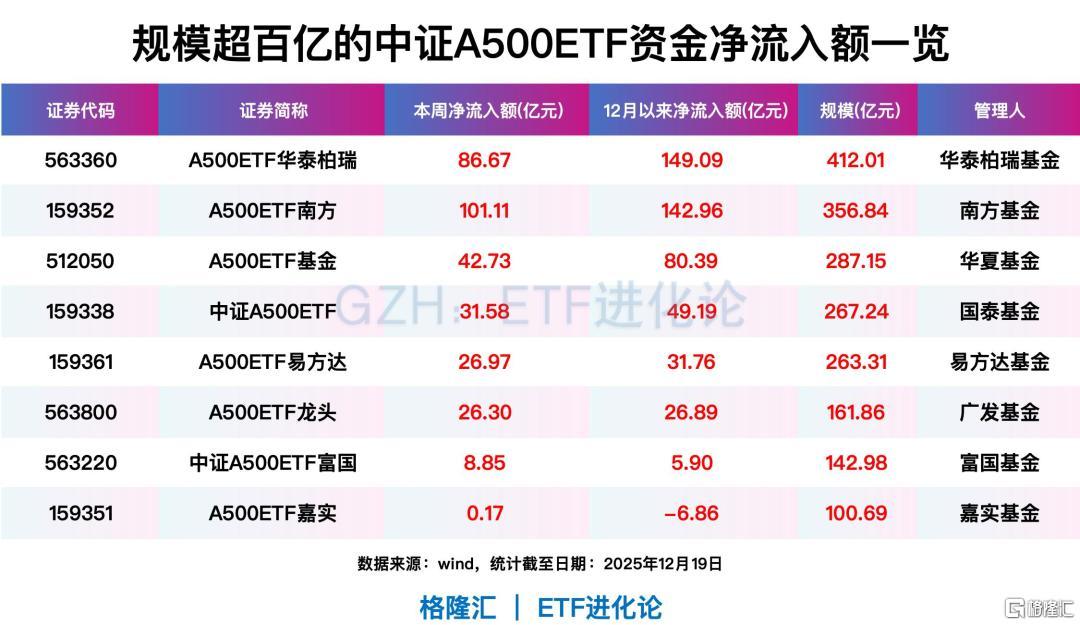
最近市场在震荡,情绪谈不上火热,大家已经默认:年末行情,大概就这样了。 突然,神秘资金进场扫货ETF。 节奏多少有点猛啊。。 仅最近一周,中证A500ETF净流入资金就高达326亿元,占到同期股票ETF净流入总额的近七成。 截至最新,全市场A500ETF规模已经达到2438亿元。 A500ETF华泰柏瑞,最新规模已突破412亿元,成为首只规模超过400亿元的A500ETF。更夸张的是,这个百亿跨越,只用了一周时间。 A500ETF南方紧随其后,单周资金净流入超过百亿,最新规模达到356.84亿元。 华夏、国泰、易方达旗下的A500ETF,规模也已经全部站上260亿元。 | 证券代码 | 证券简称 | 本周净流入额(亿元) | 12月以来净流入额(亿元) | 规模(亿元) | 管理人 | | --- | --- | --- | --- | --- | --- | | 563360 | A500ETF华泰柏瑞 | 86.67 | 149.09 | 412.01 | 华泰柏瑞基金 | | 159352 | A500ETF南方 | 101.11 | 142.96 | 356.84 | 商万基金 | | 512050 ...