
智谱

Search documents
2025年12月中国AI大模型平台排行榜
Sou Hu Cai Jing· 2026-01-16 10:44
Group 1: Industry Trends - The domestic AI large model industry is experiencing a critical turning point with intensified competition for C-end traffic and clearer commercialization paths [2][3] - Major companies are shifting focus from B-end empowerment to comprehensive efforts in the C-end market, leading to the emergence of "AI native super apps" [2][3] - The rapid growth of user engagement is evident, with ByteDance's Dola achieving over 10 million daily active users and the Kimi model from Moonlight achieving a monthly user growth rate of 170% [3][4] Group 2: Capital and Financing - The AI large model sector has seen significant capital activity, with Moonlight completing a $500 million Series C funding round, raising its valuation to $4.3 billion [4][5] - The industry is projected to generate over 10 billion in revenue by the end of 2025, indicating a shift from merely burning cash to demonstrating real monetization capabilities [4][5] - Companies are adopting differentiated capital strategies, with some focusing on immediate funding through technological advancements while others pursue long-term IPOs [4][5] Group 3: Company Developments - Alibaba's Qwen team launched several new models and applications, including the Qwen-Image-Edit model and the Qwen-Image-Layered model, enhancing capabilities in image generation and editing [11][12][14] - ByteDance's Dola and the Beanbag model have shown remarkable growth, with the latter's daily token usage surpassing 50 trillion, reflecting a tenfold increase year-on-year [9][20] - SenseTime's Kapi camera app has reached over 10 million users, becoming a leading choice in the photography app market [34] Group 4: Market Dynamics - The competition is shifting from simple parameter comparisons in chip performance to a focus on overall computational efficiency and cost-effectiveness across chips, systems, and software [6][7] - The AI large model industry is entering a phase characterized by differentiated competition and a focus on commercial performance, moving away from the narrative of merely burning cash [5][6] - The emergence of AI native applications is expected to enhance user experience and promote healthier business ecosystems [3][5]




MiniMax、智谱上市背后:中国AI产业链的连锁反应正在到来
Sou Hu Cai Jing· 2026-01-16 10:18
Core Insights - The recent IPOs of MiniMax and Zhipu mark a significant shift in the Chinese large model industry, transitioning from a trial phase to a collaborative stage focused on long-term capability building [2][27] - The competition in China's large model sector is evolving into a game of patience, capital, and engineering capabilities, indicating a more mature market landscape [2][27] Group 1: Market Dynamics - The user base for generative AI in China reached 515 million by June 2025, with a penetration rate of 36.5%, reflecting a significant increase in adoption [3][5] - The regulatory framework for generative AI is becoming more established, allowing companies to move beyond concept validation to actual business operations [5][9] Group 2: Financial Performance - Zhipu's R&D expenses surged from 84.377 million RMB in 2022 to an estimated 2.195 billion RMB in 2024, indicating a heavy investment in development [6][18] - MiniMax's R&D expenditures also increased significantly, with 2024 projected at approximately six times its revenue for that year [8][15] Group 3: Investment Landscape - The venture capital landscape in China has seen a 36% decline in total financing in the first eight months of 2025, leading to a more cautious investment environment [9][12] - The shift from VC funding to public market financing is becoming essential for large model companies, as they require stable capital structures to support long-term investments [13][21] Group 4: Competitive Landscape - The competition among leading players is intensifying, with companies needing to secure long-term capital to avoid being forced to cut back on investments during tighter financing conditions [12][24] - The public market is now seen as a viable path for large model companies, providing a platform for sustained investment and operational transparency [21][23] Group 5: Industry Implications - The transition to public markets is expected to change the operational dynamics of model companies, allowing for more stable cash flow and long-term planning [23][24] - As companies like MiniMax and Zhipu establish themselves in the public market, they are likely to become more reliable technology partners for enterprise clients, enhancing their role in the industry [24][25]
计算机行业年度策略报告:AI商业化加速推进,量子科技前景广阔-20260116
Guoyuan Securities· 2026-01-16 10:14
Group 1: Industry Overview - The computer industry saw an 18.24% increase in the Shenwan index in 2025, outperforming the CSI 300 but underperforming the ChiNext and Sci-Tech 50 indices, ranking 14th among Shenwan industries [1][11] - AI technology is rapidly evolving, with DeepSeek achieving advanced performance at significantly lower costs than overseas competitors, leading to increased application across various sectors and a substantial rise in token consumption [1][11] - Domestic GPU manufacturers like Moer Thread and Muxi successfully went public, while leading domestic large model companies such as Zhipu and MiniMax are set to list in Hong Kong, indicating a robust push for domestic AI stack replacement [1][11] Group 2: AI Technology Development - Since early 2025, generative AI technology has accelerated, with significant improvements in model capabilities, reducing hallucinations and enhancing reliability, thus becoming a stable expert assistant [2][28] - Major US tech companies have significantly increased capital expenditures, with Amazon, Google, Meta, Microsoft, and Oracle showing rapid quarterly growth in spending on AI [2][62] - Domestic companies like Zhipu, DeepSeek, MiniMax, and Alibaba are also increasing investments and making breakthroughs in technology, with commercial progress accelerating and long-term growth potential being substantial [2][28] Group 3: Quantum Technology Prospects - Quantum computing is expected to become a core component of future computing systems, with significant investments from companies like Microsoft, Google, IBM, and NVIDIA, indicating promising commercial prospects [3][31] - The Chinese government has included quantum technology in its long-term industrial strategy, further supporting the industry's development [3][31] - Domestic companies such as Guoyi Quantum and Benyuan Quantum are making strides in technology and collaborating closely with downstream clients, gradually opening up commercialization opportunities [3][37] Group 4: Financial Performance - In the first three quarters of 2025, the computer sector achieved a total revenue of 938.614 billion yuan, a year-on-year increase of 9.19%, and a net profit of 24.414 billion yuan, up 30.37% [16][19] - The gross profit margin for the computer sector was approximately 23.26%, a decrease of 2.23 percentage points from the previous year, while the net profit margin increased by 1.03 percentage points to 2.60% [19][19] Group 5: Valuation Overview - As of December 31, 2025, the PE TTM for the computer sector was 54.70, ranking it among the highest in various industries, indicating a reasonable valuation level with good long-term investment potential [22][26] - The valuation levels for the computer sector have receded from their peak, but the growth attributes of the industry justify a higher valuation premium [26][27]

全线回调!开年最热赛道突然刹车
格隆汇APP· 2026-01-16 09:29
Core Viewpoint - The article discusses the recent downturn in the AI application sector, highlighting the volatility and potential future trends in the industry, particularly focusing on Generative Engine Optimization (GEO) and its implications for marketing and AI applications [2][12][22]. Group 1: Market Trends and Performance - The AI application sector experienced a significant drop, with companies like Visual China hitting a trading halt and others like Liou Co. and Yidian Tianxia facing scrutiny after rapid stock price increases [3][5]. - The recent listing of large model companies such as MiniMax and Zhipu has increased market enthusiasm, indicating a growing commercial viability for AI applications [7][8]. - The cost of AI operations has drastically decreased due to the large-scale deployment of domestically developed inference chips, prompting many large model companies to lower their prices [10][11]. Group 2: Generative Engine Optimization (GEO) - GEO, defined as Generative Engine Optimization, aims to enhance the visibility of brand content in AI-generated responses, potentially increasing citation rates by 40% [15][16]. - The global GEO market is projected to grow significantly, with estimates of $11.2 billion in 2025 and $100.7 billion by 2030, reflecting a compound annual growth rate (CAGR) of 55% [22]. - The marketing landscape is shifting as AI search engines begin to replace traditional search methods, with predictions that AI search will capture 50% of search engine traffic by 2028 [18][19]. Group 3: Company Performance and Future Outlook - BlueFocus, a marketing company, reported a revenue of 51.098 billion yuan in the first three quarters of 2025, with a notable 310% increase in AI-driven business revenue [26][27]. - Despite impressive growth, AI-driven revenue still represents less than 5% of BlueFocus's total revenue, indicating room for expansion [28]. - The article suggests that while GEO may transform marketing strategies, the fundamental competitive dynamics of the marketing industry remain focused on scale [34]. Group 4: Future of AI Applications - The article anticipates that 2026 will be a pivotal year for AI applications, driven by advancements in model capabilities and supportive policies from government bodies [36][38]. - AI applications are expected to proliferate across various sectors, including marketing, industrial, and financial services, enhancing efficiency and driving revenue growth [52]. - The emergence of AI-generated content, such as AI cartoons, is highlighted as a new trend, with significant market potential indicated by the rapid increase in AI-generated media [44][46].



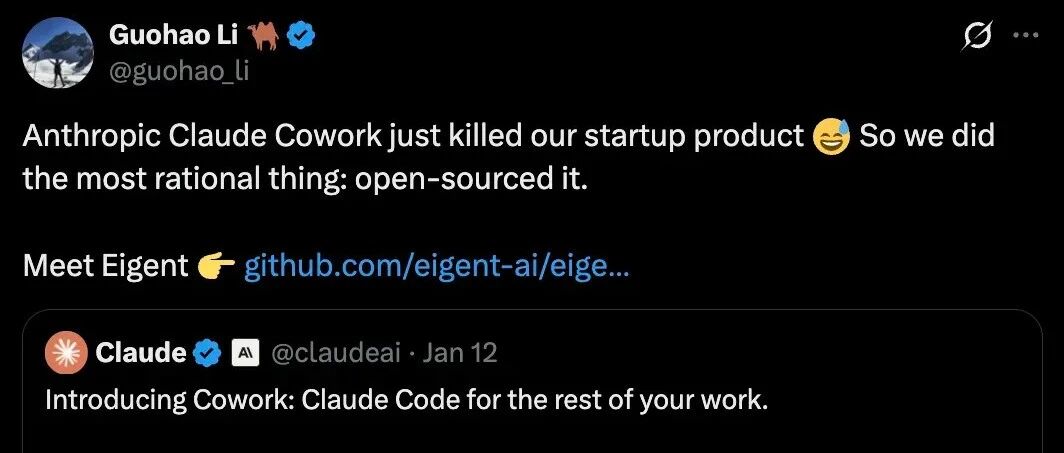
开源版 Cowork 项目在 X 爆火,创始人:感谢 Cowork,让我们三年的探索被看到
Founder Park· 2026-01-16 09:02
Core Insights - The article discusses the rise of CAMEL AI and its open-source project Eigent, which gained popularity following the success of Anthropic's Cowork tool. The CAMEL framework, launched in March 2023, aims to enable multiple AI agents to collaborate and solve complex problems, receiving significant recognition in the AI community [4][6][7]. Group 1: CAMEL Framework and Development - CAMEL was introduced as a multi-agent collaboration framework based on large language models, aiming to mimic human-like division of labor and communication among AI agents [7]. - The framework quickly gained traction, achieving over 4,000 GitHub stars within a week and having its paper accepted at NeurIPS, where it was highlighted by notable figures in the AI field [7][6]. - The design of CAMEL incorporates a "think-act-feedback" loop, which has become foundational for subsequent projects, including Eigent [12][13]. Group 2: Eigent Product Development - Eigent is a desktop application that allows AI agents to access local files and the operating system to perform real-world tasks, inspired by the initial explorations of the CAMEL framework [6][32]. - The product's architecture is designed around three core roles: Task Agent, Coordinator Agent, and Worker Agent, facilitating efficient task management and execution [32]. - The decision to focus on a desktop application stems from the need for seamless integration with user contexts and the ability to manipulate local systems effectively [35]. Group 3: Community Engagement and Feedback - The CAMEL AI community has grown to over 19,000 members, providing valuable feedback and support for the development of AI applications [7]. - Following the viral success of a self-deprecating tweet, the team received significant engagement, including interest from industry figures and potential collaborations [57][59]. - The community's feedback has been instrumental in refining the Eigent product, leading to its successful launch and initial user adoption [46][47]. Group 4: Future Directions and Collaborations - The company aims to create a comprehensive open-source agent system, emphasizing the importance of community and collaborative development in achieving this vision [74]. - Collaborations with other companies and integration with various AI models are ongoing, enhancing Eigent's capabilities and expanding its user base [70][51]. - The focus on enterprise applications has led to successful pilot programs with large organizations, showcasing the practical utility of Eigent in real-world scenarios [49][51].
港股收评:恒指跌0.29%,科技股多数低迷,AI应用概念股午后部分回升
Ge Long Hui· 2026-01-16 08:23
Market Performance - The Hong Kong stock market indices showed a high open but low close, with overall declines being modest. The Hang Seng Index fell by 0.29%, the Hang Seng China Enterprises Index decreased by 0.5%, and the Hang Seng Tech Index dropped by 0.11% [1] Sector Performance - Large technology stocks mostly performed poorly, with Xiaomi down by 2%. JD.com, Meituan, Tencent, and Baidu also experienced declines, while Alibaba rose nearly 1%, showing relative strength [1] - The Baltic Dry Index has fallen for the ninth consecutive day, leading to declines in port and shipping stocks. Real estate stocks, which had surged at the previous day's close, also fell again. New consumption concept stocks, film and entertainment stocks, steel stocks, gaming stocks, oil stocks, insurance stocks, and gold stocks mostly declined [1] AI and Semiconductor Sector - AI application concept stocks saw some recovery in the afternoon, with Zhizhu achieving a new high. TSMC plans to invest up to $56 billion by 2026, indicating continued prosperity in the semiconductor industry. Chip and semiconductor stocks were active throughout the day, with leading company SMIC rising by 2.39% [1] Power and Equipment Sector - The State Grid disclosed a plan worth 4 trillion, signaling a favorable cycle for the power grid. Consequently, power equipment stocks continued to rise [1]
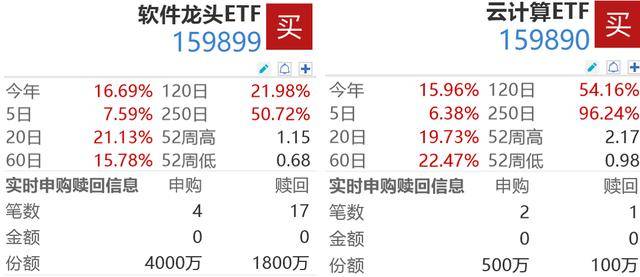
GEO成AI变现核心引擎!高“应用”含量软件龙头ETF(159899)、云计算ETF(159890)再获资金逆势加仓!
Sou Hu Cai Jing· 2026-01-16 07:45
Group 1 - The satellite industry and semiconductor equipment continue to show strong performance, while popular sectors like GEO and AI applications are experiencing a decline [1] - The popular satellite industry ETF (159218) and semiconductor equipment ETF (561980) saw intraday gains of over 1.6% and 2.2% respectively, while software leading ETF (159899) and cloud computing ETF (159890) fell nearly 2% but received significant capital inflows of 23 million and 8 million respectively [1] - The software leading ETF (159899) has accumulated a net inflow of over 300 million in the last four trading days, and the cloud computing ETF (159890) has seen a continuous net inflow of approximately 126 million over the last five trading days [1] Group 2 - Major domestic companies are focusing on the integration of AI applications, with Alibaba's "Ant Aifu" upgrading health services and ByteDance's Volcano Engine becoming the exclusive AI cloud partner for the Spring Festival Gala [2] - The large model has evolved beyond a technical foundation to become a dominant traffic entry point in the AI era, establishing a trend of simultaneous increase in volume and price [3] - By 2026, the global GEO market is expected to reach 24 billion, with the domestic market projected to reach 11.1 billion, indicating exponential growth [4] Group 3 - The global large model market is expected to reach 206.5 billion by 2029, with a CAGR of 80.7% from 2024 to 2029, driven primarily by the large model application market [7] - The cloud computing ETF (159890) focuses on key sectors such as servers, data centers, and cloud services, combining computing infrastructure with AI applications, while the software leading ETF (159899) tracks the CSI All-Share Software Index, which includes leaders in various fields with approximately 35% AI application content [7] - Investors may consider the cloud computing ETF (159890) and software leading ETF (159899) for a comprehensive layout of computing infrastructure and AI technology value realization, capitalizing on the commercial benefits of the "application is king" era [7]
智谱盘中涨超8%破顶 GLM-Image登顶Hugging Face Trending榜
Zhi Tong Cai Jing· 2026-01-16 07:42
Core Viewpoint - The stock of Zhiyuan (02513) surged over 8% during trading, reaching a new high of 263 HKD, driven by the successful launch of the GLM-Image model in collaboration with Huawei, which topped the Hugging Face Trending chart shortly after its release [1] Group 1: Stock Performance - Zhiyuan's stock price increased by 5.06% to 253.2 HKD, with a trading volume of 948 million HKD [1] Group 2: Product Development - The GLM-Image model, developed jointly by Zhiyuan and Huawei, achieved state-of-the-art (SOTA) performance and innovative architecture, sparking discussions in the international tech community [1] Group 3: Market Outlook - Dongwu Securities expressed optimism about Zhiyuan's strengths in local large model technology, open-source ecosystem development, and localized implementation capabilities for government and enterprise sectors, suggesting the company is well-positioned to benefit from the long-term trend of transitioning from localized deployment to cloud services in China's large model industry [1]
港股异动 | 智谱(02513)盘中涨超8%破顶 GLM-Image登顶Hugging Face Trending榜
智通财经网· 2026-01-16 07:40
Core Viewpoint - The stock of Zhiyu (02513) surged over 8% during trading, reaching a new high of 263 HKD, driven by the successful launch of the GLM-Image model in collaboration with Huawei, which topped the Hugging Face Trending chart shortly after its release [1] Group 1: Company Performance - Zhiyu's stock price increased by 5.06% to 253.2 HKD, with a trading volume of 948 million HKD [1] - The GLM-Image model, developed in partnership with Huawei, achieved significant recognition in the AI community, indicating strong market interest and potential for future growth [1] Group 2: Industry Insights - Dongwu Securities expressed optimism regarding Zhiyu's capabilities in local large model technology, open-source ecosystem development, and localized implementation for government and enterprise [1] - The company is expected to benefit from the long-term trend of transitioning from localized deployment to cloud services within China's large model industry [1]
国芯训国模取得世界第一,智谱再创新高,上市七个交易日累涨超126%
Ge Long Hui· 2026-01-16 07:04
Core Viewpoint - Zhiyuan (2513.HK) experienced a significant surge, rising over 9% to reach a peak of 263 HKD, marking a cumulative increase of over 126% within seven trading days, driven by the success of its GLM-Image model in collaboration with Huawei [1] Group 1: Company Performance - Zhiyuan's stock price reached a historical high of 263 HKD, reflecting strong market confidence and investor interest [1] - The company has seen a remarkable increase of over 126% in its stock price since its listing, indicating robust growth potential [1] Group 2: Technological Achievement - The GLM-Image model, co-developed with Huawei, topped the Trending chart on the Hugging Face platform, showcasing its technological strength and application value [1] - This achievement breaks the long-standing dominance of foreign models in the open-source leaderboard, highlighting a significant milestone for domestic AI technology [1] Group 3: Strategic Collaboration - The collaboration between Zhiyuan and Huawei represents a deep integration of software and hardware, essential for the advancement of the domestic AI industry [1] - Huawei's "domestic computing power base" plays a crucial role in supporting the GLM-Image model, which runs on Huawei's Ascend Atlas 800T A2 chip and MindSpore framework [1] Group 4: Model Innovation - GLM-Image features an innovative hybrid architecture of "autoregressive + diffusion decoder," enabling the model to understand complex instructions and generate detailed images [1] - The model's open-source availability on GitHub and Hugging Face allows global developers to access this "domestic solution" for free, promoting wider adoption [1]