亚马逊

Search documents
甲骨文燃起AI交易热情,中国AI硬件股也重拾动能
Di Yi Cai Jing· 2025-09-12 07:13
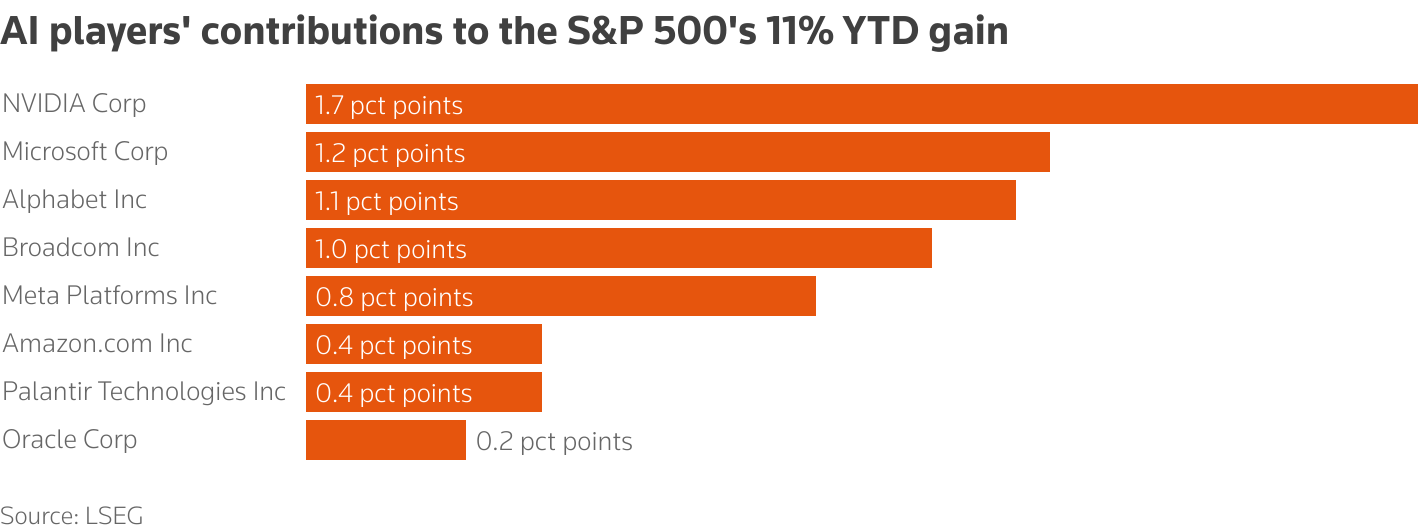
美股市值前八大的AI概念股已占据标普500指数权重的30%,并贡献了该指数今年涨幅的约一半。 软件巨头甲骨文本周股价大涨令投资者对人工智能(AI)交易的乐观情绪重燃,甲骨文斩获多份巨额合同向投资者证明了AI驱动的云计算需求依然高涨, 缓解了AI概念股估值过高的担忧。 由于苹果和特斯拉股价下跌,传统的"美股科技七巨头"今年整体录得下跌。而截至周三,美股市值前八大的AI概念股已占据标普500指数权重的30%,并贡 献了该指数今年涨幅的约一半。同样得益于这种AI交易情绪重燃,中国AI硬件股也重拾动能,继续被看好。 AI交易热情重燃 甲骨文(ORCL.N)周三股价一度上涨36%,使其市值达到9220亿美元,向万亿美元市值俱乐部进军,周四收跌6.23%,但分析师普遍预计其股价调整后仍 将上涨。 Stock Trader Network的首席策略师迪克(Dennis Dick)表示:"在创纪录飙升后,买家略微疲惫,但逢低买入的投资者会重新出现。甲骨文的前瞻指引是如 此令人难以置信,很难想象围绕于此的交易故事已经结束。"根据伦敦证交所(LSEG)的数据,分析师对该股的目标价中位数为342美元,较目前股价仍有 约10%的上涨 ...

太空算力:苍穹之上的算力新纪元
GOLDEN SUN SECURITIES· 2025-09-12 06:55
Investment Rating - The report maintains an "Accumulate" rating for the space computing industry [6] Core Insights - Space computing represents a new paradigm for AI computing infrastructure, extending capabilities from terrestrial to orbital environments, leveraging unique conditions in space for enhanced efficiency and autonomy [12][17] - The demand for computing power is expected to surge, with projections indicating that global AI data center (AIDC) electricity demand could reach 347 GW by 2030, highlighting the urgent need for innovative solutions like space computing to address energy and cooling challenges [2][67] - Several companies, including Starcloud and ADA Space, are actively developing space computing projects, indicating a strong market potential and commercial viability for this technology [3][15] Summary by Sections What is Space Computing? - Space computing involves deploying data centers in low or medium Earth orbit, utilizing modular server nodes capable of AI inference and training, thus forming "orbital data centers" [17][20] - It is distinct from edge computing, as it integrates distributed AI architecture in space, enhancing real-time processing and collaboration capabilities [20] Energy Constraints and Cooling Challenges - The report emphasizes that the explosive growth in computing demand is straining existing energy supplies, particularly in the U.S., where electricity infrastructure has not kept pace with demand [13][69] - Space computing offers significant advantages in energy efficiency and cooling, as it can harness solar energy continuously and utilize the vacuum of space for effective heat dissipation [14][14] Global Deployment Progress - Numerous companies are initiating space computing projects, with notable examples including Starcloud's plans for a gigawatt-scale data center in space and ADA Space's launch of AI satellites [3][15] - The report suggests that space computing is transitioning from conceptual validation to engineering implementation, with strong commercial prospects [3][15] Investment Recommendations - The report advises investors to focus on companies that are strategically positioning themselves within the space computing supply chain, such as SOCE, RKLB in the U.S., and Shunhao Co., Hangang Co., Putian Technology, and China Satellite in China [4][15]


军事智能化:新质战斗力核心,掌握制智权关键
AVIC Securities· 2025-09-12 03:01
Investment Rating - The report maintains an "Overweight" investment rating for the defense industry [3]. Core Insights - Military intelligence is not a future concept but a current reality, driven by advancements in artificial intelligence and technology [3][19][28]. - The military sector is undergoing significant transformation due to the integration of AI, which is reshaping defense strategies, operational capabilities, and equipment systems [17][30]. - The global military AI market is projected to reach approximately $21.003 billion by 2027, with the U.S. military AI market expected to grow to $3.133 billion by 2025 [9][10]. Summary by Sections Military Intelligence: New Quality Combat Power - Military intelligence is characterized by self-perception, decision-making, execution, learning, adaptation, and enhancement capabilities [3][18]. - The current era is witnessing a rapid evolution in military operations, with AI technologies being pivotal in this transformation [19][28]. Transformation of Defense Systems - AI is not just upgrading equipment but is fundamentally changing the defense system, structure, and operational models [3][30]. - Companies like Palantir have seen significant market success, with stock prices increasing by over 1263.68% since the onset of the Russia-Ukraine conflict [3][8]. Main Application Paths of Military Intelligence - AI encompasses various technologies, including machine learning, robotics, computer vision, biometrics, and natural language processing, which are applied across different military domains [8][9]. - The military AI market is expected to grow significantly, with the U.S. market projected to reach $3.133 billion by 2025 and the global market reaching $12.428 billion [9][10]. Key Industry Segments - The report identifies several companies involved in the military AI sector, including aerospace electronics, Chengdu Huami, and others focusing on computing power, sensors, algorithms, and intelligence analysis [10][11].
巨额订单风险重重?质疑声四起,甲骨文股价从历史高点回调逾6%
Feng Huang Wang· 2025-09-12 02:44
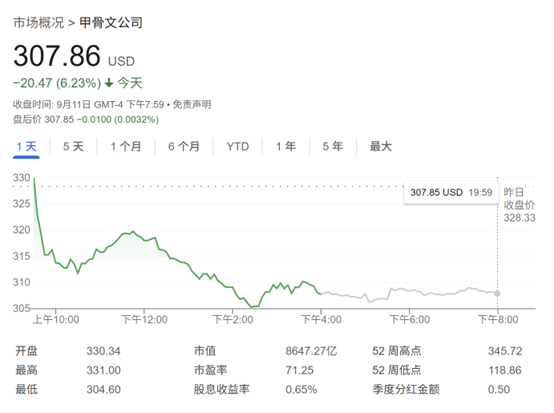
Core Insights - Oracle's stock price fell over 6% after reaching a record high, with analysts raising concerns about the company's reliance on a single client, OpenAI, for future growth [1][3] - Oracle reported a significant increase in remaining performance obligations (RPO) to $455 billion, a 359% year-over-year growth, with $317 billion added in the first quarter alone [1][2] - The company anticipates cloud infrastructure revenue to grow 14 times by 2030, driven by its competitive position in the AI computing market [1] Financial Performance - Oracle's first-quarter earnings report revealed a surge in future contract revenue, with a notable contract with OpenAI valued at $300 billion over five years, starting in 2027 [2][3] - The recent quarterly report indicated that nearly 95% of the new future contract revenue was attributed to the OpenAI deal [2] Market Reaction - Following the earnings announcement, Oracle's stock rose by 30% in after-hours trading and nearly 36% the following day, reaching a closing price of $328.33 [1] - However, after the concerns regarding customer concentration emerged, Oracle's stock price dropped to $307.86, a decrease of 6.23% [3][4] Analyst Concerns - Analysts expressed skepticism about Oracle's order backlog, highlighting risks related to customer concentration and the potential delay in revenue recognition [3] - Morgan Stanley estimated that only about 10% of the $455 billion RPO would be recognized as revenue within the next 12 months, raising questions about the sustainability of Oracle's growth [3]
云计算概念股延续涨势 甲骨文巨额算力订单震动市场 北美云厂商上调资本支出预算
Zhi Tong Cai Jing· 2025-09-12 02:40
Group 1 - Cloud computing stocks continue to rise, with notable increases in companies such as GDS Holdings (up 18% to HKD 39.6), Alibaba (up 6.56% to HKD 152.7), New Oriental (up 3.63% to HKD 7.13), and Kingsoft Cloud (up 3.14% to HKD 8.87) [1] - Oracle reported a future contract revenue increase of USD 317 billion for Q1 of fiscal year 2026, indicating strong demand in the cloud computing sector [1] - OpenAI has reportedly signed a five-year agreement to purchase USD 300 billion worth of computing power from Oracle, highlighting the growing collaboration between AI and cloud services [1] Group 2 - The four major North American cloud providers—Google, Microsoft, Meta, and Amazon—have significantly increased their capital expenditures, totaling USD 87.4 billion in Q2 2025, a 69% year-over-year increase and a 23% quarter-over-quarter increase [1] - Analysts predict that the demand for AI servers will continue to grow, with major cloud service providers expected to maintain double-digit growth in procurement to meet the needs for AI training and inference [1]


中原证券:半导体行业25Q2持续稳健增长 国产AI算力厂商进入加速发展期
智通财经网· 2025-09-12 02:21
Core Viewpoint - The semiconductor industry is currently in an upward cycle, with AI being a significant driver of growth [1][3][4] Group 1: Semiconductor Industry Performance - In August 2025, the domestic semiconductor industry (CITIC) rose by 23.84%, outperforming the CSI 300, which increased by 10.33% [1] - The integrated circuit sector saw a 31.47% increase, while discrete devices rose by 16.29%, semiconductor materials by 15.24%, and semiconductor equipment by 13.67% [1] - Year-to-date, the semiconductor industry (CITIC) has increased by 36.16% [1] - The Philadelphia Semiconductor Index rose by 1.09% in August 2025, with a year-to-date increase of 13.84% [1] Group 2: Financial Performance of AI Chip Manufacturers - In Q2 2025, the semiconductor industry reported revenues of 188.43 billion yuan, a year-on-year increase of 13.87%, and a net profit of 14.763 billion yuan, up 23.99% [2] - Major domestic AI chip manufacturers showed remarkable performance: Cambrian's revenue grew by 4425.01% year-on-year and 59.19% quarter-on-quarter, with a net profit increase of 324.97% year-on-year [2] - Haiguang Information's revenue increased by 41.15% year-on-year and 27.66% quarter-on-quarter, while Chipone's revenue rose by 49.90% quarter-on-quarter [2] Group 3: Global Semiconductor Market Trends - Global semiconductor sales in July 2025 increased by 20.6% year-on-year, marking the 21st consecutive month of growth [3] - North American cloud providers' capital expenditures rose by 69% year-on-year in Q2 2025, with a quarter-on-quarter increase of 23% [3] - Domestic internet companies' capital expenditures grew by 168% year-on-year in Q2 2025 [3] - Global wafer fab capacity utilization improved significantly in Q2 2025, with a slight decrease in inventory levels for some chip manufacturers [3] Group 4: Investment Opportunities - Nvidia's CEO estimates that the Chinese market will present approximately $50 billion in opportunities by 2025, with a projected compound annual growth rate of 50% [4] - The domestic AI chip manufacturers are expected to continue gaining market share, suggesting investment opportunities in the AI chip supply chain [4] - North American cloud providers are expected to increase their capital expenditures significantly, with a forecast of $600 billion in 2025 [6]


巨额订单风险重重?甲骨文股价大跌6%
财联社· 2025-09-12 01:39
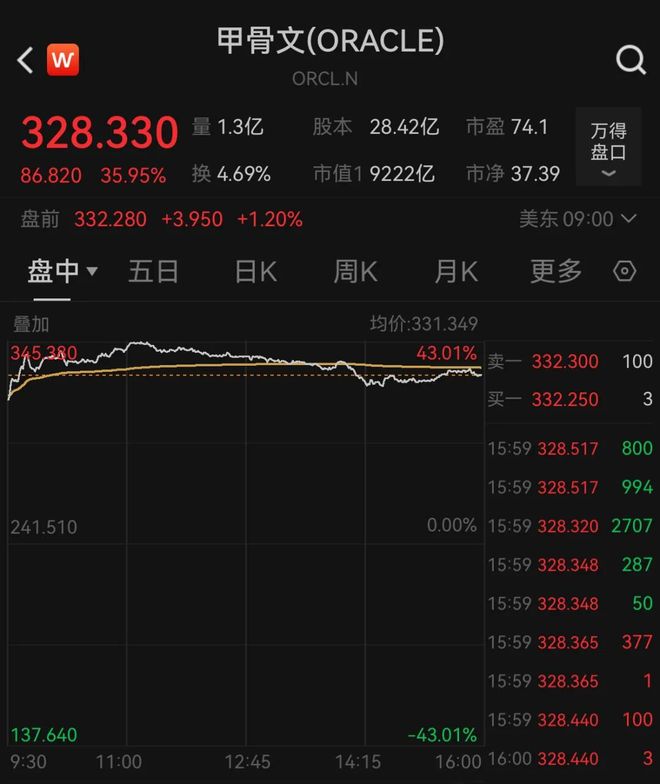
Core Viewpoint - Oracle's stock price experienced a significant drop of over 6% after reaching a historical high, primarily due to concerns about its reliance on a single client, OpenAI, for future growth [1][4]. Financial Performance - Oracle reported a remarkable increase in its Remaining Performance Obligations (RPO), which surged to $455 billion, reflecting a year-on-year growth of 359%. In the first quarter alone, the company added $317 billion to its RPO [1]. - The CEO of Oracle, Safra Catz, indicated that the backlog of orders is expected to exceed $500 billion in the coming months due to multiple large contracts signed with different clients [1]. Market Dynamics - Oracle forecasts that its cloud infrastructure revenue will grow 14 times by 2030, positioning itself strongly in the competitive AI computing market against giants like Amazon, Microsoft, and Alphabet's Google [2]. - The company has partnered with NVIDIA to deploy large-scale GPU clusters in its cloud infrastructure, enhancing its capabilities for AI model training and inference [2]. Stock Market Reaction - Following the earnings announcement, Oracle's stock price surged by 30% in after-hours trading and closed nearly 36% higher at $328.33, marking a record high [3]. - However, reports of a $300 billion contract with OpenAI, which accounts for nearly 95% of Oracle's new future contract revenue in the first quarter, raised concerns about customer concentration risk [3][5]. Analyst Concerns - Analysts have expressed skepticism regarding Oracle's heavy reliance on OpenAI for its order backlog, which could pose risks to the company's revenue stability [4][5]. - Concerns were raised about the low profit margins associated with AI model training contracts and whether Oracle has sufficient resources to support the massive infrastructure needed for these orders [5]. - Morgan Stanley estimated that only about 10% of the $455 billion RPO would be recognized as revenue within the next 12 months, highlighting the long-term nature of these contracts [5].
AI算力下半场,具备预期差的方向梳理
Ge Long Hui A P P· 2025-09-12 00:18
Core Insights - The rise of ASIC chip manufacturers, exemplified by Broadcom, is reshaping the technology investment landscape, with ASICs transitioning from a supporting role to a leading position in the market [1] Market Overview - The global ASIC chip market is projected to reach approximately $12 billion in 2024, with expectations to exceed $30 billion by 2027, reflecting a compound annual growth rate (CAGR) of 34% from 2024 to 2027 [1] Company Performance - Broadcom reported a 63% year-over-year increase in AI chip revenue in Q3, driven by a significant $10 billion custom AI chip (XPU) order from a fourth major client [3] - The demand for ASICs is being fueled by cloud service providers (CSPs) favoring ASICs over traditional GPUs due to performance and cost advantages [3] Technological Advancements - ASICs are designed for specific tasks, offering superior efficiency compared to general-purpose GPUs, which are likened to multi-functional tools [4] - Recent innovations have reduced the design cycle for ASICs from 18-24 months to 6-12 months, cutting costs by over 60% [4] Competitive Landscape - Major players in the ASIC design space include IDM giants like Broadcom, cloud companies like Amazon and Google, and specialized design firms such as Cambricon and Rockchip [6] - Broadcom holds a 60% market share in data center interconnect scenarios with its XPU products [6] Manufacturing and Supply Chain - Domestic manufacturers are leveraging advanced manufacturing and packaging technologies to meet ASIC production demands, with companies like SMIC and Changdian Technology playing key roles [7] Supporting Industries - The high power consumption of ASICs has led to increased demand for cooling solutions and optical interconnects, with companies like Invec and Taicheng providing innovative products [8] Investment Opportunities - Investors are advised to focus on companies with visible long-term orders, strong technological barriers, and flexible supply chains in the ASIC ecosystem [9] - The shift towards ASICs represents a significant investment opportunity as the technology landscape evolves, similar to the transition from feature phones to smartphones [9]

甲骨文市值逼近万亿美元,AI大订单是主要原因
2 1 Shi Ji Jing Ji Bao Dao· 2025-09-11 14:52
Core Viewpoint - Oracle's stock price surged significantly due to its latest financial report and substantial AI contracts, with a notable increase in its Remaining Performance Obligations (RPO) [1][3][6] Financial Performance - For Q1 of fiscal year 2026, Oracle reported total revenue of $14.9 billion, a year-over-year increase of 12% [6] - Cloud revenue grew by 28% to $7.2 billion, with IaaS revenue increasing by 55% to $3.3 billion and SaaS revenue rising by 11% to $3.8 billion [6][10] - RPO surged to $455 billion, exceeding market expectations of $178 billion, driven by demand for AI computing power and multi-cloud services [3][6] AI Contracts and Market Impact - Oracle signed four contracts worth billions with three major clients, contributing to the RPO increase and indicating strong future revenue potential [4][6] - A reported $300 billion, five-year computing power procurement agreement with OpenAI may explain the RPO surge and market revaluation of Oracle's stock [7][8] Competitive Positioning - Oracle's multi-cloud strategy has led to a 1529% year-over-year increase in multi-cloud database revenue, expanding its market presence [8][10] - The company is actively collaborating with major cloud providers like Google, Microsoft, and Amazon to enhance its service offerings and customer reach [11][12] Future Outlook - Oracle anticipates Q2 fiscal year 2026 total revenue growth of 12% to 14%, with cloud business expected to grow by 32% to 36% [6][10] - The company is focused on converting RPO into actual revenue, contingent on its ability to fulfill contracts and secure necessary AI chip supplies [10] Market Reaction - Following Oracle's stock surge, related AI hardware stocks in the Chinese market also experienced significant gains, indicating a broader market enthusiasm for AI investments [14]
暴涨的甲骨文 被重构的AI竞赛
Bei Jing Shang Bao· 2025-09-11 14:41
Core Viewpoint - Oracle's stock surged nearly 36% on September 10, 2023, driven by a significant order from OpenAI, marking a shift in AI competition from technology showcase to industrial application [2][3][4] Financial Performance - Oracle's Q1 FY2026 revenue was $14.9 billion, an 11% increase year-over-year, slightly below market expectations of $15.04 billion [3][8] - Net profit for the quarter was $2.9 billion, a 4% decline compared to the previous year [3] - Remaining performance obligations (RPO) for Oracle's OCI business reached $455 billion, a staggering 359% increase year-over-year, exceeding market expectations [4][8] Market Reaction - Following the announcement, Oracle's market capitalization increased by approximately $270 billion, nearing $1 trillion, making it the tenth largest publicly traded company in the U.S. [2][3] - Larry Ellison's wealth briefly surpassed Elon Musk's, reaching $393 billion before settling at $295 billion [3] Strategic Developments - Oracle's OCI business is now a critical infrastructure for major clients like OpenAI and Meta, indicating strong demand for cloud services [4][5] - The company plans to increase capital expenditures to $35 billion for FY2026, significantly up from $21 billion in FY2025, to support data center expansion [7][9] Future Outlook - Oracle anticipates OCI revenue growth of 77% in FY2026, reaching $18 billion, with projections for subsequent years increasing to $144 billion by FY2030 [4][7] - Despite the positive long-term outlook, concerns remain regarding Oracle's immediate financial performance and cash flow, with Q1 free cash flow reported at negative $362 million [9]