SpaceX

Search documents
太空光伏,未来最具确定性的25家公司
Sou Hu Cai Jing· 2026-02-27 13:45
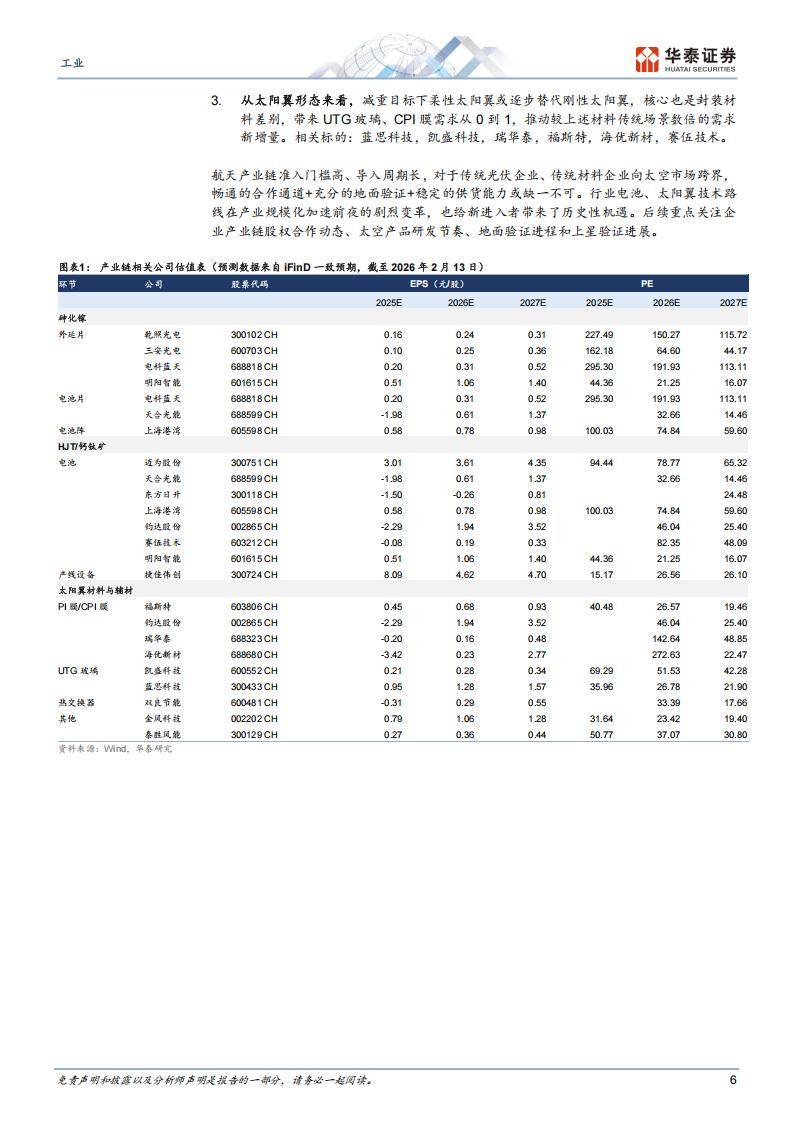
Group 1 - The deployment of over 200,000 satellites by China and 1 million by SpaceX indicates a significant shift in the satellite internet landscape, moving from communication functions to space-based computing capabilities [1][2] - The low Earth orbit (LEO) satellite market is transitioning from tens of megawatts to hundreds of megawatts and even gigawatts, with energy supply becoming a critical bottleneck for space asset expansion [1][2] - Space solar power (SSP) is emerging as a key area of focus, with two main scenarios: space-to-space (S2S) and space-to-earth (S2E) power supply [1][4] Group 2 - The demand for space-based computing is expected to reach 100 gigawatts annually, driven by the exponential growth of artificial intelligence applications [2][34] - The advantages of space-based computing include unlimited solar energy and reduced hidden costs compared to ground-based data centers, which face land and energy consumption challenges [2][34] - The theoretical solar constant in space is approximately 1367 watts per square meter, significantly higher than ground levels, providing a stable energy source for space applications [2][34] Group 3 - Current space solar applications focus on providing power to various spacecraft, with the power requirements of satellites increasing from hundreds of watts to kilowatts and even megawatts [3][4] - High-efficiency, radiation-resistant, and lightweight battery technologies are becoming essential, with triple-junction gallium arsenide batteries leading the market due to their high conversion efficiency [3][4] - Flexible solar arrays are gradually replacing traditional rigid panels, offering better power-to-weight ratios and space-saving advantages during launch [3][4] Group 4 - The concept of space power stations (SPS) aims to collect solar energy in geostationary orbit and transmit it to Earth, potentially providing a continuous clean energy source [4][5] - China plans to validate megawatt-level experimental systems in orbit by around 2030 and achieve gigawatt-level commercial operation by 2035 [4][5] - Two main transmission methods are being explored: microwave transmission, which has high efficiency but requires large ground antennas, and laser transmission, which has high energy density but is affected by weather conditions [4][5] Group 5 - The evolution of efficient photovoltaic batteries is critical, with traditional silicon batteries being replaced by triple-junction gallium arsenide batteries and next-generation perovskite batteries showing promise for space applications [6][10] - Perovskite batteries exhibit high power-to-weight ratios and lower production costs, with ongoing research aimed at improving their radiation resistance [6][10] Group 6 - Wireless power transmission (WPT) is a crucial component of the space solar power chain, requiring advanced technologies for precise energy focusing and beam control [7][9] - Current research focuses on the 2.45 GHz and 5.8 GHz frequency bands, balancing atmospheric attenuation and equipment size [7][9] Group 7 - The space solar power industry chain is extensive, involving upstream materials, midstream battery components, and downstream system integration and launch services [8][9] - Upstream materials include high-purity gallium and arsenic, while midstream involves battery production and power management systems, which require high reliability [8][9] Group 8 - Chinese companies have a competitive advantage in both the photovoltaic and aerospace sectors, with strong synergies emerging from their integration [10][11] - Companies like Longi and Qianzhao are leading in high-efficiency silicon battery technology, while institutions like the Aerospace Fifth Academy have extensive experience in space power systems [10][11] Group 9 - The space solar power sector faces challenges such as heat dissipation in vacuum environments and structural integrity under mechanical stress [11][12] - The increasing risk of space debris poses a significant threat to the safety of space solar power stations, necessitating research into self-repairing structures [11][12] Group 10 - The historical context of energy transformation suggests that space solar power could play a pivotal role in humanity's transition to interstellar civilization [12][13] - As technologies mature, the commercial model for space solar power is expected to shift from government-led initiatives to market-driven approaches, fostering the emergence of competitive aerospace energy giants [12][13]

沙特资金上演“向西迁徙”! 沙特国内股市失色 资金向美股狂奔
Zhi Tong Cai Jing· 2026-02-27 13:03
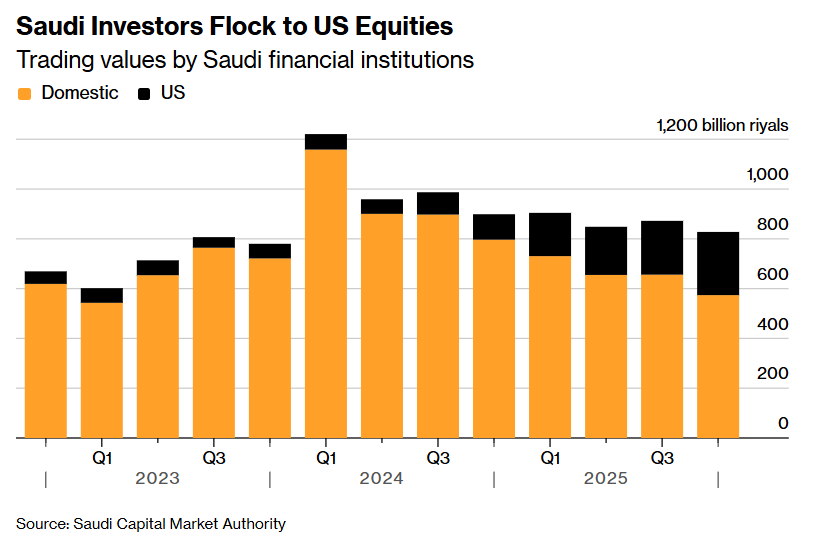
Core Insights - Saudi Arabian investors significantly increased their trading activities in the US stock market in 2025, reallocating funds from a domestic market that ranked among the worst globally [1][4][6] - The Saudi stock market experienced a notable decline, with the Tadawul All Share Index dropping 9% in Q4 and a total annual decline of 13%, while the US market, particularly the S&P 500, rose over 16% [4][6] Group 1: Trading Activities - In Q4 2025, Saudi financial institutions' trading volume in US stocks reached approximately 254 billion riyals (about 68 billion USD), doubling compared to the same period last year [1] - The total trading volume in the Saudi stock market fell sharply from over 1.1 trillion riyals at the beginning of 2024 to about 574 billion riyals by the end of 2025 [1] Group 2: Market Performance - The decline in the Saudi stock market is attributed to expectations of oversupply in oil, fiscal pressures, and regional tensions, contrasting sharply with the performance of the US market driven by major tech companies and enthusiasm for AI [4][6] - Despite the Public Investment Fund (PIF) reducing its holdings in US-listed stocks, it still invested heavily in significant acquisitions, including a 55 billion USD purchase of Electronic Arts and a 3 billion USD investment in xAI [4] Group 3: IPO Market Dynamics - The Saudi IPO market has cooled significantly, with a series of underperforming new listings and a slow start to new offerings this year [5] - In contrast, US companies are preparing for a new wave of large IPOs, including SpaceX, which could surpass Saudi Aramco's IPO as the largest globally [5] Group 4: Investment Strategy - Saudi investors are actively reallocating to the US market due to a significant relative return gap, with the US market offering asset supplies that the local market cannot match [6] - The Saudi government's investment commitments to the US have increased, with potential investments reaching close to 1 trillion USD across various strategic sectors [7]
马斯克:特斯拉将在20年内上月球建厂,建议投资者长期持股
Sou Hu Cai Jing· 2026-02-27 12:00
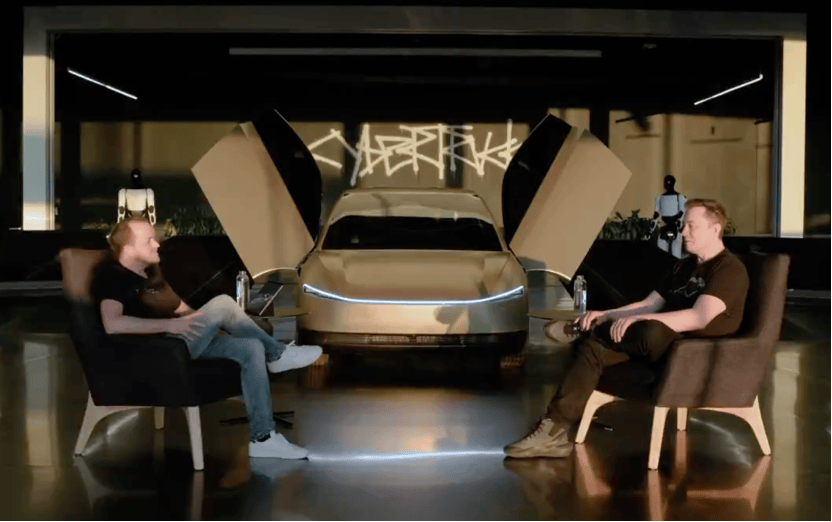
Group 1 - The core idea presented by Elon Musk is that Tesla plans to build a factory on the Moon within the next 20 years, indicating a long-term vision for the company [3][5] - Musk emphasized the importance of holding Tesla stock for the long term, suggesting that the company's future value will be significant [4] - The discussion also highlighted Tesla's ongoing efforts in autonomous driving, with the Full Self-Driving (FSD) system expected to receive regulatory approval in the Netherlands by March 20 [6] Group 2 - Musk mentioned the production of the Cybercab, an autonomous taxi, which is set to begin mass production in April, marking a key component of Tesla's future business model [6] - The conversation touched on external challenges facing the Berlin factory's expansion, with Musk indicating that external organizations could complicate matters [7] - Musk criticized the European automotive industry for resisting the transition to electric vehicles and autonomous driving, suggesting it is regressing to a "dinosaur era" [8]

风起青萍,拥抱趋势,空天产业2026年十大展望
GUOTAI HAITONG SECURITIES· 2026-02-27 11:31
Investment Rating - The report does not explicitly state an investment rating for the industry Core Insights - The commercial aerospace sector is expected to see significant advancements in reusable rocket technology, with over 12 rockets planned for flight and recovery tests in 2026, marking a substantial increase from 2 in 2025 [8][9] - The low Earth orbit (LEO) satellite market is evolving towards a three-layer structure, with SpaceX's approval to deploy satellites in Very Low Earth Orbit (VLEO) enhancing communication capabilities and reducing latency [14][18] - The satellite configuration is shifting towards flat stacked satellites, which optimize launch efficiency and are expected to become the standard in the industry [23][25] - The rise of computing satellites is anticipated, with major companies planning to establish gigawatt-level data centers in space, leveraging the unique advantages of the space environment [29][31] - The Chinese capital market is poised for a wave of IPOs from commercial aerospace companies, driven by technological maturity and policy support [33][35] Summary by Sections Commercial Aerospace Outlook - China's reusable rockets are expected to achieve their first successful recovery in 2026, with a significant increase in test flights planned [8][9] - SpaceX has received approval to deploy additional satellites in VLEO, enhancing the capacity and performance of its Starlink constellation [14][18] - The industry is witnessing a shift towards flat stacked satellite designs to maximize launch efficiency [23][25] - Major companies are investing in space computing infrastructure, with plans for gigawatt-level data centers [29][31] - The commercial aerospace sector is likely to see a surge in IPOs, with several companies preparing for public offerings [33][35] Low Altitude Economy Outlook - The industrial drone market is projected to grow rapidly, with a forecasted market size of 77.5 billion yuan by 2025, despite potential mismatches in supply and demand [36][37] - Drone applications are diverse, with established sectors like surveying and agriculture, and emerging fields such as emergency response and inspection [42][43] - The eVTOL sector is facing challenges in commercial deployment due to regulatory hurdles and economic factors, with many companies exploring logistics and emergency applications to generate cash flow [43][44]
模拟芯片,有机会吗
半导体芯闻· 2026-02-27 10:15
Core Insights - The article discusses the transformation in analog circuit design, highlighting both challenges and opportunities in the industry [1][2][20] - The shift in workforce demographics shows a significant increase in foreign-born engineers dominating the field, particularly from India and China [2][3] Workforce Dynamics - Over 55% of PhD-level engineers in the U.S. are foreign-born, with over 60% of engineering PhD students being international [2] - The salary disparity between analog circuit designers and software engineers is driving young American engineers to migrate to higher-paying fields, with software engineers earning significantly more [3] Structural Changes - The relative importance of analog circuits in chips has decreased due to the explosive growth of digital circuit density, leading to a focus on stability over innovation in analog design [4][5] - Analog circuit design is labor-intensive, with design cycles taking 2-3 times longer than digital circuits, making it less attractive for engineers [5][6] Market Growth Areas - The analog integrated circuit market is projected to grow from approximately $76 billion in 2024 to over $124 billion by 2032, driven by specialized applications rather than general-purpose modules [8] - High-speed interfaces, automotive semiconductors, image sensors, power semiconductors, and sensor technologies are identified as key growth areas [9][11][12][13] High-Speed Interfaces - The SerDes market is expected to grow from $750 million to $2.4 billion by 2032, with a CAGR of 13% to 14%, driven by demands in data centers and AI [9][10] Automotive Semiconductors - The automotive BMS market is projected to grow from $4.9 billion in 2025 to $26 billion by 2035, with a CAGR exceeding 18% [11] Image Sensors - The CMOS image sensor market is expected to reach $23.2 billion in 2024 and exceed $30 billion by 2030, with Sony and Samsung being the leading players [12] Power Semiconductors - The power electronics market is forecasted to grow from $26.2 billion in 2024 to $43.3 billion by 2030, with GaN and SiC materials leading the growth [13] Specialized Knowledge - The article emphasizes the importance of specialized knowledge in high-end applications, suggesting that expertise in specific fields will be more valuable than general analog design skills [18][21] Conclusion - The transformation in analog circuit design presents both challenges and opportunities, with a growing demand for specialized skills in various sectors, indicating a need for adaptation and strategic positioning in the industry [20][21]
马斯克要把数据中心送太空!黄仁勋冷笑:散热成本比火箭还高!
Sou Hu Cai Jing· 2026-02-27 07:55
Group 1 - The core argument revolves around the increasing demand for AI computing power and the limitations of Earth's electrical supply, leading to the consideration of space-based data centers as a potential solution [2][7][9] - Elon Musk asserts that within 36 months, space will become the cheapest place to deploy AI due to the exponential growth of chip production contrasted with stagnant electrical output on Earth [2][3] - The global AI chip market is projected to exceed $120 billion by 2025, with GPU computing power expected to increase tenfold in three years, while global electricity growth remains around 3% [2][3] Group 2 - Jensen Huang highlights the challenges of cooling systems in space, emphasizing that heat dissipation in a vacuum requires large radiative cooling panels, which could be economically unfeasible for large-scale data centers [5][7] - The current best application for space-based GPUs is image processing, but large-scale data centers in space are not economically viable at present, although future improvements may change this [5][7] - The debate is not about whether space data centers are good or bad, but rather if Earth can sustain the growing appetite for AI computing power, with demand increasing at a rate of 50% annually [7][9] Group 3 - The discussion between Musk and Huang reflects a deeper question about whether humanity should conserve resources on Earth or expand into space to alleviate limitations [9][10] - Musk advocates for an aggressive approach to survival by exploring space, while Huang represents a more cautious engineering perspective, focusing on solving current technological challenges before venturing into space [9][10] - The evolution of technology may lead to breakthroughs that make space data centers feasible, similar to past advancements in telecommunications and computing [9][10]