
长安汽车

Search documents
中国首批L3级自动驾驶专用正式号牌车辆上路通行
第一财经· 2025-12-26 09:55
Group 1 - The first batch of L3 level autonomous driving vehicles in China officially hit the road in Chongqing on December 26, 2025, with 46 vehicles equipped with L3 level intelligent driving assistance systems from Deep Blue Automotive [1] - On December 20 of this year, Changan Automobile was awarded the first national L3 level autonomous driving official license "渝AD0001Z," which is installed on the Deep Blue Automotive SL03 [1]


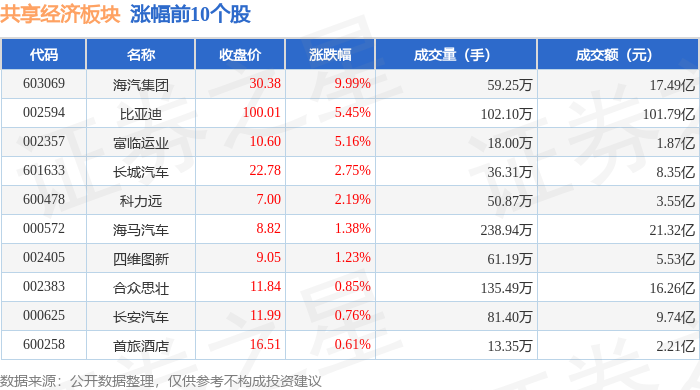
共享经济板块12月26日涨2.26%,海汽集团领涨,主力资金净流入13.03亿元




Sou Hu Cai Jing· 2025-12-26 09:22
Market Performance - The shared economy sector increased by 2.27% on December 26, with Haiqi Group leading the gains [1] - The Shanghai Composite Index closed at 3963.68, up 0.1%, while the Shenzhen Component Index closed at 13603.89, up 0.54% [1] Individual Stock Performance - Haiqi Group (603069) closed at 30.38, up 9.99% with a trading volume of 592,500 shares and a transaction value of 1.749 billion [1] - BYD (002594) closed at 100.01, up 5.45% with a trading volume of 1,021,000 shares and a transaction value of 10.179 billion [1] - Other notable performers include: - Fulin Yuan (002357) at 10.60, up 5.16% [1] - Great Wall Motors (601633) at 22.78, up 2.75% [1] - Keli Yuan (600478) at 7.00, up 2.19% [1] Capital Flow Analysis - The shared economy sector saw a net inflow of 1.303 billion from main funds, while retail funds experienced a net outflow of 306 million [2] - The main funds' net inflow for BYD was 1.473 billion, representing 14.48% of its trading volume, while retail funds had a net outflow of 683 million [3] - Haiqi Group had a main fund net inflow of 195 million, accounting for 11.13% of its trading volume, with retail funds showing a net outflow of 72.79 million [3]
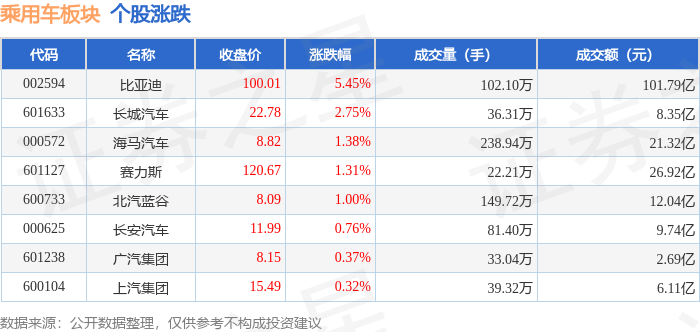
乘用车板块12月26日涨2.54%,比亚迪领涨,主力资金净流入16.99亿元
Zheng Xing Xing Ye Ri Bao· 2025-12-26 09:07
Group 1 - The passenger car sector increased by 2.54% compared to the previous trading day, with BYD leading the gains [1] - The Shanghai Composite Index closed at 3963.68, up 0.1%, while the Shenzhen Component Index closed at 13603.89, up 0.54% [1] - Major stocks in the passenger car sector showed varied performance, with BYD closing at 100.01, up 5.45%, and Great Wall Motors at 22.78, up 2.75% [1] Group 2 - The passenger car sector saw a net inflow of 1.699 billion yuan from main funds, while retail investors experienced a net outflow of 794 million yuan [1] - BYD attracted a significant net inflow of 1.473 billion yuan from main funds, while retail investors had a net outflow of 683 million yuan [1] - Other notable stocks included Seres with a net inflow of 152 million yuan from main funds and a net outflow of 106 million yuan from retail investors [1]
【深度分析】2025年11月份全国新能源市场深度分析报告
乘联分会· 2025-12-26 08:36
Overall Market - The total market for passenger vehicles in China includes both traditional internal combustion engine (ICE) vehicles and new energy vehicles (NEV), which comprise battery electric vehicles (BEV) and plug-in hybrid electric vehicles (PHEV) [4][5] - In November 2025, the total production of NEVs reached 1,756,587 units, while ICE vehicles produced were 1,349,384 units, leading to a total market production of 3,105,971 units [6][7] - Year-to-date (YTD) data for January to November 2025 shows NEV production increased by 6.3%, while ICE vehicle production decreased by 4.0% compared to the same period in 2024 [6][8] Market Segmentation - The market is segmented into various categories including sedans, MPVs, and SUVs, with NEVs showing a significant growth trend in all segments [25][26] - In November 2025, NEV sales in the sedan category were 593,948 units, while ICE sedans sold were 413,429 units, indicating a strong preference for NEVs in the sedan market [26] Export Market - The export of NEVs has shown substantial growth, with a total of 2,149,769 units exported in November 2025, reflecting a 243.3% increase compared to the previous year [16][21] - The NEV export penetration rate reached 41.7% in the first eleven months of 2025, up from 27.1% in 2024, indicating a growing international demand for Chinese NEVs [18][20] Manufacturer Performance - BYD remains the leading manufacturer in the NEV market, with a wholesale volume of 474,921 units in November 2025, despite a year-on-year decline of 5.8% [22][23] - Other notable manufacturers include Geely and Chery, with Geely achieving a 53.4% increase in wholesale volume, indicating strong competitive performance in the NEV segment [22][23] Price Positioning - The market is categorized into price segments, with vehicles priced below 100,000 yuan showing a significant share in the NEV market, reflecting consumer preferences for affordable electric options [4][5] - The price segmentation also indicates a growing trend towards higher-priced NEVs, as consumers are increasingly willing to invest in premium electric vehicles [4][5]


有色金属板块活跃,19位基金经理发生任职变动
Sou Hu Cai Jing· 2025-12-26 08:20
Market Performance - On December 26, A-shares experienced a rise and then a pullback, with the Shanghai Composite Index closing up 0.1% at 3963.68 points, the Shenzhen Component Index up 0.54% at 13603.89 points, and the ChiNext Index up 0.14% at 3243.88 points [1] Fund Manager Changes - On December 26, a total of 19 fund managers experienced changes in their positions, with 681 fund products having manager changes in the past 30 days [3] - Among the changes on December 26, 20 fund products announced manager departures, involving 8 fund managers, with reasons including work changes, personal reasons, and product expirations [3][4] - Notably, 4 fund managers left due to work changes, 2 due to personal reasons, and 2 due to product expirations [3] Fund Manager Performance - Chen Qi from Huafu Silver Fund manages assets totaling 0.15 billion, with the highest return product being Huafu Internet World Flexible Allocation Mixed A, achieving a return of 176.89% over 6 years and 68 days [5] - Cheng Kun from GF Fund manages assets of 39.58 billion, with the highest return product being GF Reverse Strategy Mixed A, achieving a return of 247.91% over 11 years and 116 days [5] Fund Research Activity - In the past month (November 26 to December 26), Bosera Fund conducted the most company research, engaging with 41 listed companies, followed by Huaxia Fund, Southern Fund, and Huitianfu Fund [6][7] - The most researched industry was specialized equipment, with 168 instances, followed by the chemical products industry with 130 instances [6] Individual Stock Research - The most focused stock by public funds in the past month was Zhongke Shuguang, with 117 fund management companies participating in the research [8] - In the last week (December 19 to December 26), the most researched company was Lingyi Zhi Zao, with 40 fund institutions conducting research [8][9]

开业一周首次出手,中信AIC投了一家清洁能源公司
2 1 Shi Ji Jing Ji Bao Dao· 2025-12-26 07:38
南方财经记者庞成广州报道 国内第二家股份制银行系金融资产投资公司(AIC)——信银金融资产投资有限公司(以下简称"信银金投")揭牌开业仅一周,已完成首笔对外出资。 南方财经记者注意到,工商信息显示,12月24日信银金投完成了对深圳港华顶信清洁能源有限公司的投资,认缴出资额6442.34元,持股比例49%,成为该 公司的第二大股东。 除了信银金投以外,南方财经记者注意到,另外两家股份制银行AIC近期亦披露了首笔对外投资情况。12月24日晚间,长安汽车公告显示,其控股子公司深 蓝汽车科技有限公司拟增资扩股,招银金融资产投资有限公司为新增投资者之一;12月9日,兴银金融资产投资有限公司完成对福建恒申电子材料科技有限 公司的投资,认缴出资额2515.13万元,持股比例11.09%。 民生证券分析师徐亮、梁克淳梳理了过去一段时间AIC重点投资的领域及持股情况。从行业分布来看,若以国标行业大类划分,AIC投资企业主要聚焦电 力、热力生产和供应业、土木工程建筑业、科技推广和应用服务业等领域;若以战略性新兴产业一级行业划分,除传统产业升级相关领域外,投资重点集中 在新能源产业、新一代信息技术产业、高端装备制造产业等赛道。 持 ...

二十载同行,再启新程!2025商用车新驱动大会在京举行
Zhong Guo Qi Che Bao Wang· 2025-12-26 07:21
Group 1 - The 2025 Commercial Vehicle New Drive Conference was held in Beijing, focusing on low-carbon and intelligent transformation in the commercial vehicle industry [2] - The 20-year history of the Commercial Vehicle News reflects the evolution of China's commercial vehicle industry, transitioning from scale expansion to efficiency and quality competition, and from traditional fuel to diverse new energy technologies [3][5] - The industry has experienced significant changes, with a shift from domestic focus to global outreach, symbolizing the transformation from "Made in China" to "Intelligent Manufacturing in China" [3] Group 2 - The commercial vehicle industry can be divided into two phases: a rapid development period and an adjustment and transformation period, supported by policy guidance, technological innovation, and market competition [7] - The upcoming 2026 marks the beginning of the 14th Five-Year Plan, presenting new opportunities and challenges for the commercial vehicle industry [7] - Energy conservation remains a core concern for the commercial vehicle industry, directly impacting user value realization [8] Group 3 - The 2025 energy-saving tests showcased significant advancements in energy consumption, range management, and intelligent control across various models, establishing new benchmarks for energy efficiency [10] - The logistics sector is pivotal for the transition to new energy in commercial vehicles, with the "Youyun Wang" offline experience event highlighting the evolving demands in urban logistics [10][11] - The eighth "Youyun Wang" event recognized several models that set new standards in urban logistics, reflecting the industry's technological advancements [11] Group 4 - The "Vehicle Enterprise Service Satisfaction Survey" has become a key focus for the Commercial Vehicle News, emphasizing the importance of service quality in market competition [14] - Digitalization and intelligence are driving improvements in service capabilities, with China National Heavy Duty Truck Group receiving high praise for its service quality [14] - The Commercial Vehicle News aims to continue its role as an observer and leader in the industry, contributing to high-quality development in the next five to ten years [16]

350亿,又一家新势力宣布破产
3 6 Ke· 2025-12-26 07:11
Core Insights - The demise of Qoros Auto serves as a warning for the Chinese automotive industry, highlighting the challenges of transitioning from product development to market success [1][5] - The industry is entering a critical phase where competition will focus on value and user experience rather than just product availability [10][12] Company Overview - Qoros Auto, once seen as a benchmark for high-end domestic brands, has officially entered bankruptcy proceedings due to long-standing debt issues and inability to repay creditors [2][3] - The company has accumulated over 1,000 enforcement records and has a total equity freeze amounting to over 35 billion yuan, reflecting severe financial distress [2] Historical Context - Founded in 2007 as a joint venture between Chery Automobile and Israel's Quantum Group, Qoros aimed to create a truly international high-end brand [3] - The first model, Qoros 3, launched in 2013, received high praise for its design and safety but was priced too high compared to established competitors, leading to poor sales [3][6] Strategic Missteps - Qoros's strategy under Baoneng Group, which acquired a 51% stake in 2017, was marked by short-sightedness and operational disconnect, leading to a temporary spike in sales that did not translate to sustainable growth [4][6] - The company failed to adapt to the rapid shift towards electric vehicles and smart technology, resulting in a significant decline in sales, dropping to fewer than 100 units in 2023 [4][7] Industry Implications - The bankruptcy of Qoros highlights systemic issues within the automotive industry, including the need for effective brand building, market positioning, and technological pathways [5][9] - The case illustrates the importance of strategic consistency and market timing, as Qoros struggled to keep pace with competitors who embraced electric and smart vehicle trends [7][8] Future Outlook - The automotive industry is moving towards a "value realization period," where companies must focus on user experience and long-term ownership value rather than just product features [10][11] - Successful companies will need to evolve from being mere car manufacturers to becoming intelligent mobility technology enterprises, emphasizing user engagement and ecosystem integration [10][12]
L3级辅助驾驶落地在即 相比L2有何区别?
Xin Lang Cai Jing· 2025-12-26 06:42
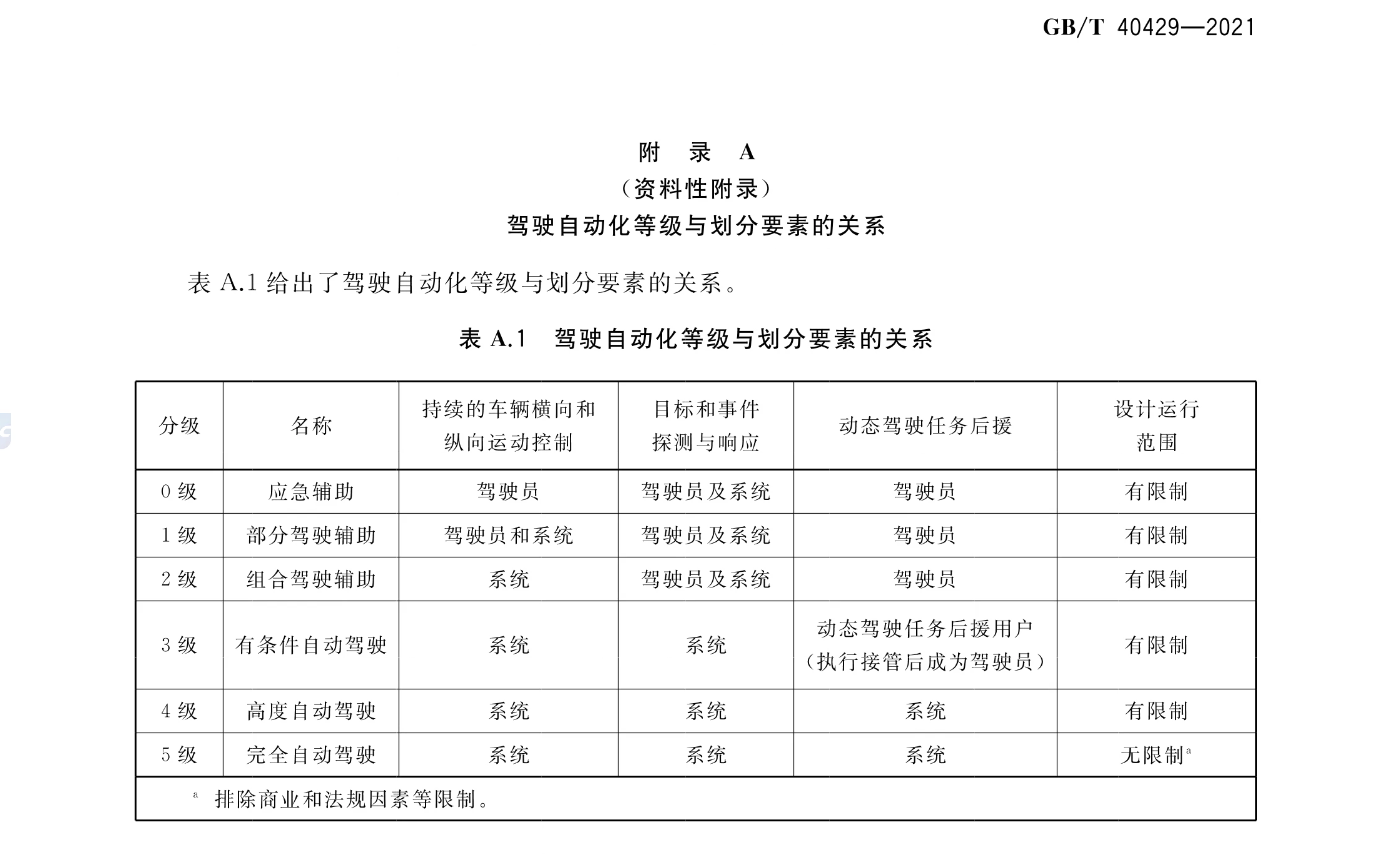
Core Viewpoint - The approval of L3 conditional autonomous driving for Changan Deep Blue and Arcfox models marks a significant advancement in China's autonomous driving technology, transitioning from "assisted driving" to "conditional driving" [1] Classification of Driving Automation Levels - China's driving automation levels are defined by the standard "Automotive Driving Automation Classification" (GB/T 40429-2021), which categorizes driving automation from Level 0 to Level 5 based on the execution capability of dynamic driving tasks [1] - Level 2 (Partial Automation) requires the driver to monitor the environment continuously, while Level 3 (Conditional Automation) allows the system to perform all dynamic driving tasks under specific conditions, with the driver needing to take over only when requested [4][5] Technical Differences Between L2 and L3 - L2 relies on a combination of cameras and millimeter-wave radar with processing power typically ≤100 TOPS, while L3 requires a more advanced setup with laser radar and multi-sensor fusion, demanding processing power ≥500 TOPS [8] - L3 systems feature dual-loop control and redundancy in braking systems, enhancing safety by ensuring functionality even if a single hardware component fails [10] Legal and Responsibility Framework - The key distinction between L2 and L3 is the shift in responsibility; L2 is "human-led, system-assisted," while L3 is "system-led, human fallback," clarifying liability during system activation and takeover requests [11] - Recent regulations from the Ministry of Industry and Information Technology outline the approval and operational rules for L3/L4 autonomous vehicles, establishing a legal framework for responsibility allocation [13] User Experience and Safety - L3 offers significant improvements in user experience, allowing drivers to disengage from constant monitoring under certain conditions, with manufacturers bearing liability in case of accidents [14] - Testing data indicates that L3 systems have a lower takeover rate compared to L2, with a response time of at least 10 seconds for drivers to take control when requested [14] Challenges and Future Outlook - Despite initial approvals, widespread adoption of L3 technology faces challenges including technical validation, regulatory refinement, and user education [15] - The government plans to expand L3 pilot programs and enhance related legal frameworks to promote the development of the autonomous driving industry [15]
三家股份行AIC首投均已落地 都投了什么?
2 1 Shi Ji Jing Ji Bao Dao· 2025-12-26 06:31
Core Insights - Three joint-stock banks under the AIC model have successfully completed their first external investments within a month of their establishment, focusing on technology-related sectors [1] Group 1: Investment Activities - Xingyin Investment has made at least three external investments, primarily in the lithium battery industry, including a C-round investment of 1 billion yuan in Ganfeng Lithium [2] - Zhaoyin Investment has also completed its first investment, contributing 5 billion yuan to Changan Automobile's subsidiary, Deep Blue Automotive, which is involved in intelligent vehicle technology [3] - Xinyin Jintou has invested approximately 64.42 million yuan in Shenzhen Ganghua Clean Energy, acquiring a 49% stake in the company [4] Group 2: Sector Focus - The three AICs have distinct sector focuses: Xingyin Investment targets the lithium battery and environmental refrigerant sectors, Zhaoyin Investment is concentrated on the smart automotive industry, and Xinyin Jintou is focused on clean energy [5] - Xingyin Investment's projects align with national "dual carbon" goals, emphasizing support for new energy and high-end manufacturing [5] Group 3: Strategic Collaborations - Xingyin Investment has signed project cooperation agreements with 12 companies, with a total intended investment exceeding 10 billion yuan [6] - Zhaoyin Investment's collaboration with Changan Automobile reflects a unique synergy within the bank's ecosystem, potentially leading to further capital market activities [6] - Xinyin Jintou aims to leverage its AIC license and resources from CITIC Group to serve local enterprises in the Guangdong-Hong Kong-Macao Greater Bay Area [7]