
成都银行

Search documents
前瞻预测:2026年,谁将会成为上市银行的十大牛股?
Sou Hu Cai Jing· 2026-01-05 04:16
Core Viewpoint - The A-share banking sector concluded 2025 with a structural rise, with 35 out of 42 listed banks experiencing gains, and the banking index rising by 12.04%, indicating strong defensive and allocation value [2][3]. Group 1: 2025 Banking Sector Performance - The banking sector exhibited significant structural differentiation, with the top ten stocks including Agricultural Bank (52.66%), Xiamen Bank (35.78%), and others showing gains over 20% [3][4]. - The market's focus shifted towards "certainty of returns" and "growth cost-effectiveness" amid an "asset shortage" backdrop, leading to a preference for certain banks [3][4]. Group 2: Core Drivers of 2025 Bull Stocks - Three main factors drove the performance of bull stocks: high dividends and low valuations supporting state-owned banks, regional economic vitality empowering small and medium banks, and asset structure optimization promoting value reassessment [4][5]. - Agricultural Bank led with a dividend yield above 5% and a price-to-book ratio exceeding 1, breaking the long-standing trend of state-owned banks trading below book value [4][5]. Group 3: 2026 Bull Stock Predictions - The banking sector is expected to maintain a "steady progress" operational trend in 2026, with key dimensions for identifying bull stocks including net interest margin improvement, business transformation growth, and stable asset quality [5][6]. - The predicted top ten bull stocks for 2026 include Agricultural Bank, China Merchants Bank, and Ningbo Bank, among others, with each having specific growth drivers [7][8]. Group 4: Key Factors for 2026 Predictions - Agricultural Bank is expected to continue its strong performance due to its county-level business advantages and low liability costs [7]. - China Merchants Bank is anticipated to see dual growth in performance and valuation, driven by its wealth management transformation and strong asset quality [8]. - Ningbo Bank is positioned to benefit from regional economic vitality and diversified non-interest income growth [8][9]. Group 5: Structural Trends and Risks - The banking sector is likely to experience a dual rise in performance and valuation, supported by improved net interest margins and robust asset quality [12][13]. - However, structural differentiation risks may intensify, with some smaller banks facing challenges due to high regional economic dependency and single customer structures [12][13].






成都农商银行晋级万亿元:农商行头部阵营扩容至五家 金融资源“极化”趋势凸显
Mei Ri Jing Ji Xin Wen· 2026-01-04 15:24
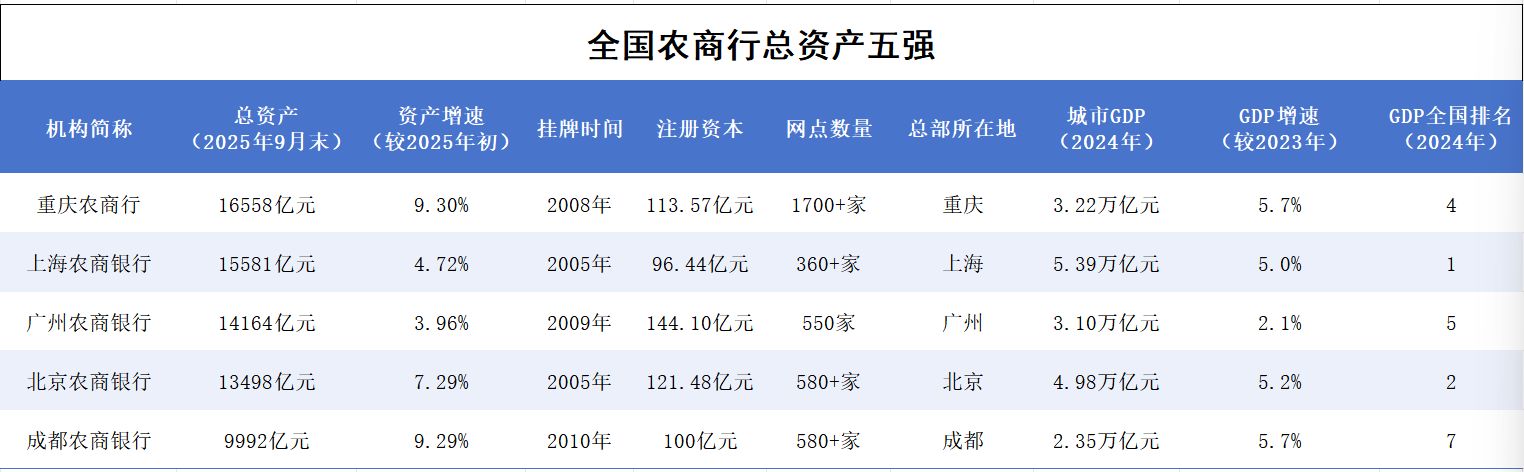
Core Insights - Chengdu Rural Commercial Bank has officially announced that its asset scale has surpassed 1 trillion yuan as of December 31, 2025, joining the "trillion yuan club" alongside four other major rural commercial banks in China [1][3] - The emergence of these banks reflects a trend of financial resource concentration in economically vibrant regions, indicating a shift in China's regional economic development landscape [1][8] Group 1: Overview of the Trillion Yuan Club - The "trillion yuan era" for rural commercial banks began six years ago, with Chongqing Rural Commercial Bank being the first to exceed this threshold in June 2019 [2] - As of September 2025, the total assets of the five major rural commercial banks exceeded 11% of the total assets of all rural financial institutions in China, showcasing significant concentration effects [4] - The five banks—Chongqing, Shanghai, Guangzhou, Beijing, and Chengdu—are primarily located in major cities with strong economic performance, collectively accounting for over 14% of the national GDP [4] Group 2: Individual Bank Performance - As of September 2025, the asset scales of the five banks are as follows: Chongqing Rural Commercial Bank at 1.66 trillion yuan, Shanghai Rural Commercial Bank at 1.56 trillion yuan, Guangzhou Rural Commercial Bank at 1.42 trillion yuan, Beijing Rural Commercial Bank at 1.35 trillion yuan, and Chengdu Rural Commercial Bank at 999.2 billion yuan [6] - Each bank has developed unique strategies based on their regional characteristics, such as Beijing's focus on serving agriculture and small enterprises, and Shanghai's emphasis on wealth management and technology [10][11] Group 3: Strategic Implications - The formation of the "trillion yuan club" among these banks enhances their ability to support local infrastructure projects, providing greater financial autonomy for regional development [15] - The collective strength of these banks facilitates the integration of financial services across administrative boundaries, potentially lowering financing costs for businesses operating in multiple regions [15] - The emergence of this banking cluster is expected to contribute to the establishment of a Western financial center, attracting more financial resources and fostering innovation in financial products tailored to local industries [15]

看好开门红,把握金融修复机会
HTSC· 2026-01-04 11:58
证券研究报告 金融 看好开门红,把握金融修复机会 华泰研究 2026 年 1 月 04 日│中国内地 行业周报(第一周) 投资机会方面证券>银行>保险。2025 年收官,A 股、港股全年日均成交额 同比+63%、+89%;A 股日均融资余额同比+34%;上证、恒指、恒生科技 全年均录得两位数涨幅。证监会修订发布《公开募集证券投资基金销售费用 管理规定》,销售阶段改革正式落地,相较征求意见稿,正式稿进一步细化 认申购费率要求,对赎回费机制有一定放宽,并将整改期统一为 12 个月。 REITs 高质量发展和商业不动产 REITs 试点规则发布,明确支持符合条件 的公募基金将 REITs 纳入投资范围,探索 REITs ETF,并推动将 REITs 纳 入沪深港通。 子行业观点 1)证券:2025 年申万证券指数涨幅 2.6%,跑输沪深 300 指数 15.1pct, 尤其 9 月以来明显滞涨。元旦假期港股交出亮眼答卷,2 号恒指、科指分别 涨 2.76%、4.00%,中资券商指数涨 2.93%。2)银行:2025 年全年涨幅为 12.5%,在 30 个一级行业中排名第 22;银行指数跑输沪深 300 指数 5.2 ...
谈谈过去一年的教训和经验
雪球· 2026-01-04 08:04
Core Viewpoint - The article reflects on past investment experiences, emphasizing the importance of market trends alongside fundamental analysis and valuation in making investment decisions [4][11]. Group 1: Lessons from Profitable Stocks - The success with China Hongqiao was attributed to its favorable fundamentals, low valuation, and positive market trends, which were initially overlooked, leading to insufficient position size [5][6]. - The analysis of market trends, fundamental changes, and valuation is crucial; when two out of three factors indicate a better choice, decisive action should be taken [5][6]. Group 2: Lessons from Unprofitable Stocks - Chengdu Bank's disappointing third-quarter report highlighted the risk of ignoring market signals, leading to a misguided decision to buy against market trends [7]. - The experiences with Gree Electric and thermal power stocks underscored the necessity of having strong confidence in fundamentals before investing, as lack of confidence can lead to panic selling during market corrections [8]. Group 3: Key Investment Strategies - Identifying opportunities where fundamentals, low valuation, and positive market trends align is rare; when such opportunities arise, significant investment should be made [11]. - When market trends confirm investment logic, it is essential to increase position size decisively, as demonstrated by the successful investment in Shenhuo [10][11]. - A lack of confidence in fundamentals can lead to poor investment decisions, especially during market adjustments, resulting in losses [11]. Group 4: Future Focus - The company plans to concentrate on analyzing firms with strong cash flow, low valuations, and a commitment to sharing value with minority shareholders, while continuing to explore the thermal power sector [12].



多行业联合红利资产12月报:股息率年关盘点-20260104
Huachuang Securities· 2026-01-04 06:46
证 券 研 究 报 告 【策略月报】 股息率年关盘点 ——多行业联合红利资产 12 月报 策略研究 策略月报 2026 年 01 月 04 日 华创证券研究所 证券分析师:姚佩 邮箱:yaopei@hcyjs.com 执业编号:S0360522120004 证券分析师:吴一凡 邮箱:wuyifan@hcyjs.com 执业编号:S0360516090002 证券分析师:徐康 电话:021-20572556 邮箱:xukang@hcyjs.com 执业编号:S0360518060005 证券分析师:欧阳予 邮箱:ouyangyu@hcyjs.com 执业编号:S0360520070001 证券分析师:韩星雨 邮箱:hanxingyu@hcyjs.com 执业编号:S0360525050001 证券分析师:单戈 邮箱:shange@hcyjs.com 执业编号:S0360522110001 证券分析师:马野 邮箱:maye@hcyjs.com 执业编号:S0360523040003 相关研究报告 《【华创策略】杠杆&ETF 资金分化趋势逆转—— 流动性&交易拥挤度&投资者温度计周报》 2025-12-01 《【华 ...
优先股隐退永续债上位!银行业资本补充进入密集冲刺期,年利息至少省3%
Xin Lang Cai Jing· 2026-01-04 05:31
Core Viewpoint - The Chinese banking industry is undergoing a significant transformation, with banks redeeming high-cost preferred shares and issuing perpetual bonds as a more cost-effective financing alternative, driven by declining social financing costs and regulatory changes [2][4][11]. Group 1: Redemption of Preferred Shares - By the end of 2025, a total of 9 banks announced the redemption of preferred shares, amounting to 111.8 billion RMB in domestic preferred shares and 5.72 billion USD in foreign preferred shares [4]. - In December 2025 alone, five banks, including Changsha Bank and Beijing Bank, redeemed a total of 45.8 billion RMB in preferred shares [3]. - The redemption of preferred shares is facilitated by their lack of maturity dates but includes redemption clauses, allowing banks to manage capital flexibly [4]. Group 2: Issuance of Perpetual Bonds - As of December 31, 2025, Chinese commercial banks issued 69 perpetual bonds, raising a total of 821.8 billion RMB, marking a historical high in both issuance quantity and scale [5]. - The interest rates for newly issued perpetual bonds generally ranged from 2.0% to 2.9%, the lowest in nearly three years, with a significant issuance peak occurring in the second half of 2025 [5][6]. - The issuance of perpetual bonds is seen as a response to the urgent need for capital replenishment, especially among small and medium-sized banks facing declining capital adequacy ratios [2][6]. Group 3: Cost Savings and Financial Efficiency - By replacing preferred shares with perpetual bonds, banks can save at least 3% annually on interest expenses, significantly reducing their financing costs [8][10]. - For instance, the interest rate on newly issued perpetual bonds is substantially lower than that of previously issued preferred shares, with examples showing potential annual savings of 12.8 million RMB for banks like Industrial Bank [10]. - The transition from preferred shares to perpetual bonds is viewed as a strategic move to optimize capital structure and reduce interest payment burdens, aligning with regulatory requirements [8][10]. Group 4: Regulatory Environment and Market Dynamics - The shift towards perpetual bonds is influenced by regulatory changes that favor capital instruments with loss absorption capabilities, making traditional preferred shares less attractive [11]. - The approval process for issuing perpetual bonds is simpler and faster compared to preferred shares, which require dual regulatory approvals, thus enhancing their appeal to banks [11]. - The current low-interest-rate environment is expected to persist, allowing banks to lock in low financing costs for the next 5 to 10 years, effectively mitigating the pressure from narrowing net interest margins [10].





2025银行股业绩梳理
2 1 Shi Ji Jing Ji Bao Dao· 2025-12-31 23:42
Core Viewpoint - The A-share banking sector experienced a year of volatility in 2025, with an overall increase of 7%, which is significantly lower than the 34.39% gain in 2024, yet many individual bank stocks reached historical highs [1][3]. Group 1: Market Performance - By the end of 2025, 35 out of 42 bank stocks in the sector recorded gains, with 20 banks hitting historical highs and 21 banks increasing by over 10%, while 6 banks saw gains exceeding 20% [1][6]. - Agricultural Bank of China saw a remarkable stock price increase of over 52% during the year, briefly surpassing Industrial and Commercial Bank of China (ICBC) in market capitalization [1][3]. - ICBC maintained its position as the "king of stocks" with a market capitalization of 2.63 trillion yuan and a stock price increase of 21.54% [1][3]. Group 2: IPO Market - The A-share IPO market for banks remained stagnant in 2025, with no new listings, as several banks, including Guangzhou Bank, withdrew their applications [2][11]. - The only banks still in the IPO queue are Dongguan Bank, Huzhou Bank, Hubei Bank, Jiangsu Kunshan Rural Commercial Bank, and Guangdong Nanhai Rural Commercial Bank [11]. Group 3: Investment Trends - Long-term funds, particularly insurance capital, have been actively purchasing bank stocks, with insurance companies holding 382.5 million shares valued at 37.976 billion yuan by the end of Q3 2025 [8]. - The "stock accumulation for dividends" strategy has gained popularity among investors, with 28 out of 42 listed banks offering dividend yields above 4% [7][8]. Group 4: Capital Support - In 2025, state-owned banks received significant capital injections, with a total of approximately 520 billion yuan raised through targeted placements to enhance their capital structure [10]. - Meanwhile, smaller banks attracted investments from foreign and local state-owned enterprises, although the IPO process remains challenging for most [10][11].
银行:银行2026年展望:稳中求进
2025-12-31 16:02
Summary of the Conference Call Transcript Industry Overview - The banking sector is entering a phase of high-quality development, with a focus on absolute and relative returns from bank stocks, driven by high dividend yields and asset quality [3][4][20]. Key Points Financial Performance Projections - Expected revenue growth for listed banks in 2026 and 2027 is +2.5% and +3.6% respectively, with net profit growth of +1.9% and +2.6% [4][20]. - Revenue and profit growth are anticipated to improve due to: 1. Narrowing net interest margin pressure 2. Quality-focused credit issuance amid weak demand [4][20]. 3. Stabilization of fee income growth after several years of fee reductions [4][20]. 4. Stable or improving net non-performing loan generation rates [4][11]. 5. Accelerated supply-side reforms leading to a reduction in the number of bank licenses, improving competition and operational landscape [4][11]. Customer Demand and Market Dynamics - The low-interest-rate environment has shifted customer demand, with government and state-owned enterprises becoming significant contributors to leverage, affecting the structure of new social financing [5][10]. - Regulatory policies are influencing the development of inclusive finance, focusing on risk compensation rather than merely increasing customer numbers [5][10]. Risk Factors - Risks associated with real estate developers and retail sectors are highlighted, with potential for greater-than-expected exposure [6][11]. Profitability and Valuation Adjustments - Adjustments to profitability forecasts for 2025 and 2026 have been made, with a focus on net interest income recovery and fee income growth [20][21]. - The expected net interest margin for 2026 is projected to be approximately 1.34%, a decrease of 6 basis points from 2025 [21][22]. - Fee income is expected to grow by 3.6% and 4.9% in 2026 and 2027 respectively, indicating a positive trend in non-interest income [21][22]. Asset Quality and Credit Costs - The net non-performing loan generation rate is expected to stabilize or slightly decline, with structural characteristics of retail and corporate lending continuing [11][21]. - Credit costs are projected to remain stable at around 0.58% for 2026 and 2027, reflecting the balance between corporate and household debt servicing capabilities [21][22]. Investment Recommendations - The report suggests a continued positive outlook for bank stocks, emphasizing the importance of dividend yield and asset quality in investment decisions [3][4][20]. Additional Insights - The banking sector is undergoing a transformation towards high-quality development, with a shift in focus from scale to quality, driven by macroeconomic pressures and regulatory changes [12][20]. - The reduction in the number of banking licenses over the past five years indicates successful risk management efforts within the sector [11][12]. - The report emphasizes the need for banks to adapt their strategies to maintain competitiveness in a changing regulatory and economic environment [12][20].


成都银行监事长孙波因工作调动辞职
Xin Lang Cai Jing· 2025-12-31 16:01
成都银行(601838)发布公告,因工作调动另有任用,孙波辞去公司监事长、职工监事、监事会提名委 员会委员、监事会监督委员会委员职务,自2025年12月31日起生效。孙波辞任后,不再担任公司任何职 务。 成都银行(601838)发布公告,因工作调动另有任用,孙波辞去公司监事长、职工监事、监事会提名委 员会委员、监事会监督委员会委员职务,自2025年12月31日起生效。孙波辞任后,不再担任公司任何职 务。 ...
因工作调动另有任用,成都银行监事长孙波辞任
Bei Jing Shang Bao· 2025-12-31 11:29
北京商报讯(记者 孟凡霞 周义力)12月31日,成都银行公告,该行监事会于近日收到孙波提交的辞职 报告。因工作调动另有任用,孙波辞去成都银行第八届监事会监事长、职工监事、监事会提名委员会委 员、监事会监督委员会委员职务,自2025年12月31日起生效。孙波辞任后,不再担任成都银行任何职 务。 ...