
华为

Search documents
纯电体验拉满 华为李小龙:问界M9开了两年头一次加油
Xin Lang Cai Jing· 2026-01-28 15:23
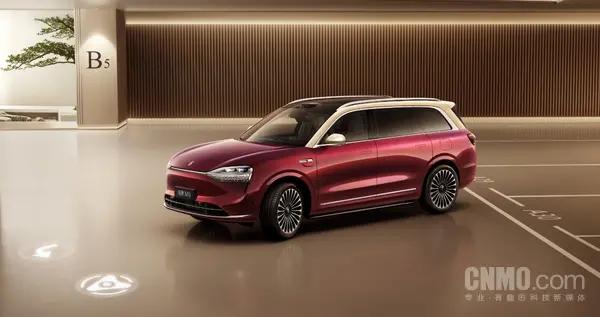
近日,华为终端BG CTO李小龙在社交媒体分享了一段独特的用车经历:他的问界M9在行驶超过1.1万 公里、开了快两年之后,燃油才首次告罄,需要进站加油。他调侃道,"实践证明,汽油在油箱里放两 年不影响使用"。 据CNMO了解,汽油的保质期受储存条件影响较大。在 密封性良好的油箱中,普通无铅汽油的理想保存期限约 为12个月,而乙醇汽油则较短,仅为1至3个月。若油箱 长期处于半满状态,加速氧化,保质期还会进一步缩 短。李小龙的车辆在两年后仍能正常使用残留燃油,可 能得益于其车辆油箱的密封性较好,且期间燃油消耗殆 尽的极端使用情况,为一次特殊的"压力测试"。 问界M9 这一个人分享生动印证了当前大电池插电混动及增程式车型带来的用车习惯变革。随着此类车型纯电续 航里程不断增长,以及补电便利性增强,许多车主日常通勤完全依赖电力,使得车辆油箱中的燃油可能 长期处于"闲置"状态。 李小龙的这次分享,从侧面反映了问界M9这类高端新能 源车主的真实使用场景:超长的纯电续航足以覆盖绝大 多数日常出行,使得"加油"成为了低频甚至被遗忘的操 作,真正实现了"纯电体验拉满"。当然,这也给广大插 混、增程车主提了个醒:若长期无长途需求, ...

华为Momenta合计占第三方城市NOA市场八成,月搭载量均达 8-10 万量级
凤凰网财经· 2026-01-28 14:15
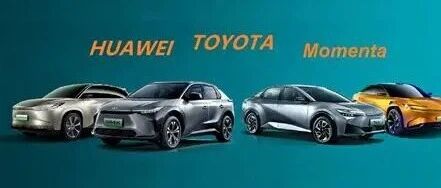
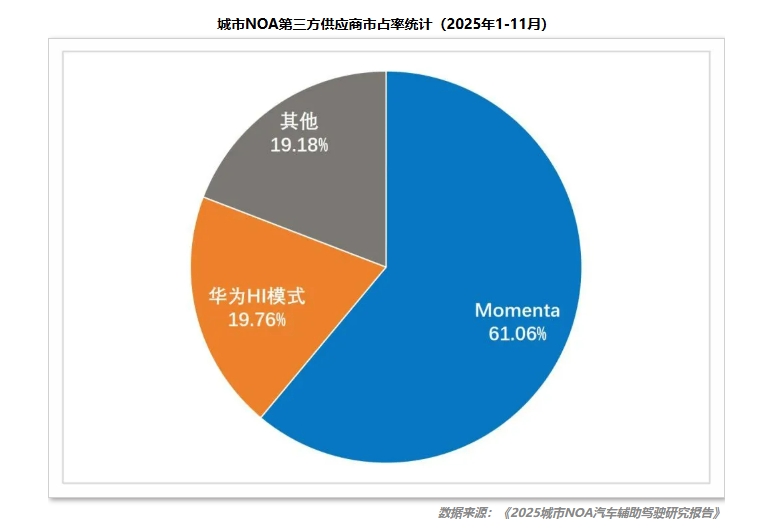
Core Insights - The report indicates that by November 2025, the cumulative sales of passenger cars equipped with urban NOA functionality in China reached 3.129 million units, highlighting rapid industry growth [1] - Momenta and Huawei's HI model dominate the market, collectively accounting for approximately 80% of the third-party supplier market share, with both companies achieving monthly installation volumes in the range of 80,000 to 100,000 units, establishing a strong "dual strong pattern" [1] Group 1 - The urban NOA market is characterized by a "dual-wheel drive" model, where car manufacturers either develop the technology in-house or collaborate with third-party suppliers to seize market opportunities [3] - In the period from January to November 2025, Momenta's urban NOA installation volume reached 414,400 units, representing about 61.06% of the third-party supplier market share, and it collaborates with 8 out of the top 10 global automotive manufacturers [3] - Huawei's HI model achieved an installation volume of approximately 134,100 units, accounting for about 19.76% of the third-party supplier market share, with a notable increase in installations by November 2025 [3] Group 2 - Domestic brands sold 2.5373 million units equipped with urban NOA functionality, making up 81.1% of the total, showcasing the innovation and competitiveness of domestic brands in the smart connected vehicle sector [3] - Global automotive brands such as Mercedes-Benz, BMW, Audi, Cadillac, Buick, and Toyota are actively collaborating with leading Chinese smart driving suppliers to implement urban NOA functionality and enhance technology [4] - The report emphasizes that third-party technology suppliers like Huawei and Momenta provide a "Chinese solution" for the global smart driving industry, attracting renowned automotive brands from Germany, the United States, Japan, and South Korea to collaborate deeply with Chinese tech companies [6]
九家中国AI芯片公司出货量超万卡,华为昇腾等领跑
Cai Jing Wang· 2026-01-28 14:05
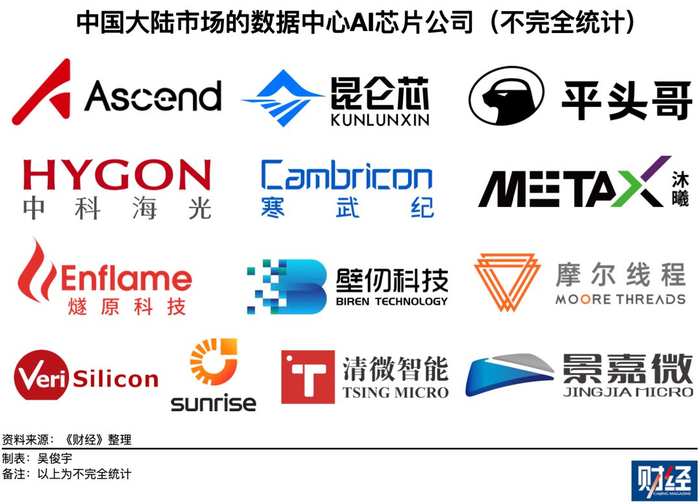
Core Viewpoint - The self-sufficiency process of domestic AI chips in China is accelerating, with at least nine companies exceeding 10,000 units in shipment or orders [1] Group 1: Company Performance - Domestic AI chip brands include Huawei Ascend, Baidu Kunlun, Alibaba Pingtouge, and Cambricon, among others [1] - Companies with significant shipment volumes have reached a cumulative shipment level of 100,000 units [1] - Smaller AI chip companies, such as Sunrise and Qingwei Intelligent, are projected to exceed 10,000 units in shipment or orders by 2025 [1] Group 2: Market Landscape - The market features a mix of established tech giants and emerging startups in the AI chip sector [1] - Companies like Cambricon, Muxi, Tianshu Zhixin, and Suiruan Technology are either publicly listed or preparing for an IPO [1]


中国人工智能芯片领域的“四小龙”或将造就下一个DeepSeek时刻
Xin Lang Cai Jing· 2026-01-28 13:59
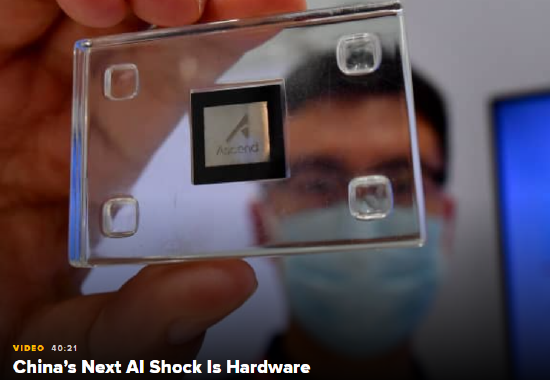
Core Insights - The next key breakthrough in China's artificial intelligence sector may come from local chip companies that rival Nvidia through technological iterations [1][3] - In recent months, four Chinese chip startups known as the "Four Little Dragons"—Mole Thread, Muxi, Birun, and Suiruan—have either completed their IPOs or submitted applications for listing [2][3] - Experts indicate that Huawei's chip performance is now close to that of similar products from Nvidia [1][3] Group 1 - The emergence of local AI chip companies is expected to accelerate their development and scale, contributing to China's broader industrial strategy of enhancing its domestic AI hardware supply chain and reducing reliance on U.S. technology [3][7] - Established chip companies like Huawei and Cambricon are rapidly expanding their production capacity [3][7] - Huawei has announced a development plan to surpass Nvidia within three years, leveraging its extensive technological foundation and industry experience [3][7] Group 2 - The CEO of Unconventional AI stated that while Chinese chip technology still lags behind U.S. companies, the performance gap is narrowing [4][8] - Each generation of Chinese chips shows performance improvements, with production capabilities increasing to the point where individual chip performance is nearly on par with Nvidia's products [4][8] - The growth of China's local chip industry is driven by government support, which includes investments of billions of dollars and policies that encourage domestic tech giants to prioritize local chips [4][8] Group 3 - A significant advantage for China in the AI sector is its energy supply, which has seen substantial growth in recent years, contrasting with stagnation in U.S. power generation [5][8] - Elon Musk noted that many regions outside of China may soon face a surplus of chip production capacity without sufficient power to support operations, highlighting China's strong momentum in electricity generation [5][8]

“智驾双强”格局已定!华为、Momenta月搭载量进入8—10万量级
Zheng Quan Ri Bao Wang· 2026-01-28 13:44
Group 1 - The report indicates that from January to November 2025, the cumulative sales of passenger cars equipped with urban NOA functions in China reached 3.129 million units, highlighting rapid industry expansion [1] - Momenta and Huawei's HI model dominate the market, collectively accounting for approximately 80% of the third-party supplier market share, with both companies achieving monthly installation volumes in the range of 80,000 to 100,000 units, establishing a strong "dual strong pattern" [1][2] - The urban NOA market is characterized by a "dual-wheel drive" model, where most automakers opt to collaborate with third-party suppliers to implement urban NOA, aiming to seize market opportunities [2] Group 2 - Momenta's urban NOA installation volume reached 414,400 units, representing about 61.06% of the third-party supplier market share, and it collaborates with 8 out of the top 10 global automakers [2] - Huawei's HI model, through strong partnerships, achieved an installation volume of approximately 134,100 units, accounting for about 19.76% of the third-party supplier market share [2] - Domestic brands sold 2.5373 million units of passenger cars equipped with urban NOA, making up 81.1% of the total, showcasing their innovation and competitiveness in the smart connected vehicle sector [2] Group 3 - The report emphasizes that third-party technology suppliers like Huawei and Momenta provide a "Chinese solution" for the global smart driving industry, attracting renowned automotive brands from Germany, the US, Japan, and South Korea to collaborate with Chinese tech companies [3] - This collaboration not only promotes the global reach of China's smart driving technology but also enhances China's influence in the global automotive industry's value chain [3]
专家热议智能经济:大模型要从“动口”走向“动手”
Di Yi Cai Jing· 2026-01-28 13:30
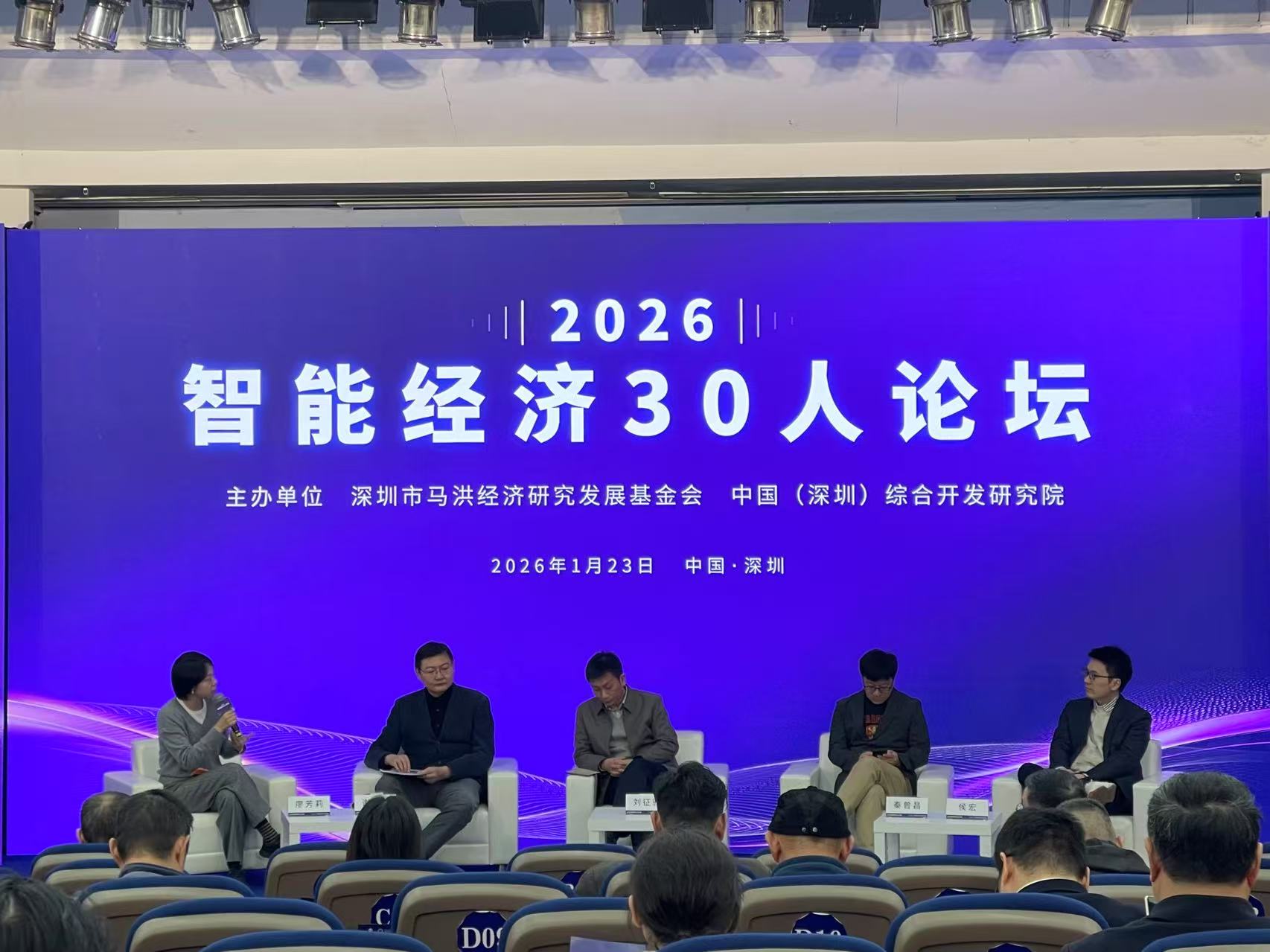
中国应善用在应用能力方面的优势,把握智能经济机遇。 以大模型为代表的人工智能正从实验室走向实际应用,成为引领新一轮科技革命与产业革命的战略性力量。在此背景下,智能经济30人论坛日前在深圳举 行。 来自中国(深圳)综合开发研究院、清华大学、北京大学、中国信息通信研究院等机构的专家学者及产业界代表,围绕AI对经济、就业、治理带来的深远 影响展开深度对话。 专家学者们普遍认为,AI将对产业、社会带来多层次的影响,历史规律表明技术替代终将催生新需求与新职业;大模型正从语言交互向"能说会做"升级;需 通过完善治理平衡创新与风险,依托制度优势化解技术冲击带来的社会矛盾。 第一个层面是产业内部的冲击。部分传统企业将被淘汰,掌握新技术、具备更高效率的新企业会对老牌企业形成挤压,导致老牌企业的市场份额持续萎缩, 新企业份额则不断攀升;第二个层面是产业结构的重构,表现为新兴产业对传统产业的替代,推动产业体系发生根本性变革;第三个层面是社会层面的冲 击,反映在经济领域是收入差距的变化。 樊纲进一步阐释,随着工作时长缩短,人类闲暇时间大幅增加,由此催生旅游、健身、宠物经济等精神文化与体验类消费需求。这些领域高度依赖人际互 动、情感共 ...
江苏首个人工智能发展局 在南京揭牌
Shang Hai Zheng Quan Bao· 2026-01-28 13:30
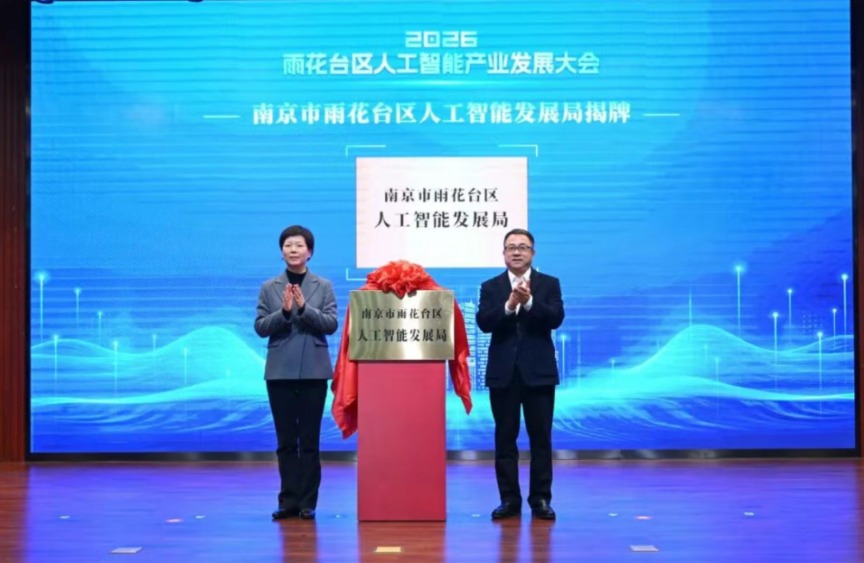
日前,南京宣布软件和信息服务业成为该市首个万亿级产业。作为南京软件产业的核心承载区,拥有中国软件谷的南京市 雨花台区贡献了3500亿元产值,占南京市约35%、江苏省近20%。 站上"万亿"后,南京软件产业把下一站目标锚定在"人工智能+"赛道上。1月27日,在南京市雨花台区召开的人工智能产业 发展大会上,雨花台区人工智能发展局揭牌成立。这是江苏首家列入政府机构序列、配备专门行政编制的区级人工智能主 管部门,走在了全国前列。 优化生态:设立"AI资源超市" 发放"算力券""模型券" 从"给优惠"转向"营生态",雨花台区新的一年还精心构建起软件产业与人工智能+相结合的全链条服务体系。该区人工智能 发展局成立之初就开展资源整合和普惠机制,设立"AI资源超市",创造普惠算力与合规数据供给;设计"算力券""模型 券",降低人工智能训练和推理成本;成立场景公司,计划全年开放场景不少于30个,推动AI进一步走向可用、好用。 揭牌现场 体制护航:突出优势 深耕"人工智能+"赛道 "在这片仅占南京2%的土地上,活跃着4900多家软件企业、37万软件从业人员。"1月27日的揭牌仪式上,南京市雨花台区 委书记、中国(南京)软件谷党工 ...
星宇股份递表港交所 招股书透露其毛利率增长乏力?
Zheng Quan Ri Bao Wang· 2026-01-28 13:14
Core Viewpoint - The company, Xingyu Automotive Lighting Co., Ltd., has submitted its listing application to the Hong Kong Stock Exchange, aiming to enhance its global production capacity and R&D investment, following its previous listing on the Shanghai Stock Exchange in 2011 [1] Group 1: Business Overview - Xingyu's business encompasses the design, development, manufacturing, and sales of automotive front and rear lighting, as well as interior and exterior decorative lights, serving both international automakers like Volkswagen and BMW, and domestic brands such as NIO and Li Auto [1] - According to Frost & Sullivan, the company holds a 11.0% market share in the Chinese automotive lighting market, ranking first, and a 4.2% share globally, ranking seventh [1] Group 2: Financial Performance - The company's revenue has shown consistent growth, with projected revenues of 10.248 billion yuan, 13.253 billion yuan, and 10.710 billion yuan for the years 2023, 2024, and the first three quarters of 2025, respectively [2] - Despite revenue growth, cost pressures are evident, with sales costs expected to rise by 31.5% in 2024, outpacing the revenue growth of 29.3%, leading to a decline in gross margin from 20.5% in 2023 to 19.1% in 2024 [2] Group 3: Competitive Landscape - The company's competitive advantages include a broad customer base, economies of scale, and strong product iteration capabilities, having established partnerships with nine of the top ten global automakers [3] - However, the company faces risks, as a significant portion of its revenue (approximately 66.7% in recent periods) comes from five major clients, making it vulnerable to fluctuations in their purchasing behavior [3] Group 4: Future Plans and Funding - The company plans to use the funds raised from the IPO for technology R&D, global production base expansion, and digital transformation, anticipating increased demand for high-end and smart automotive lighting as the industry evolves [4] - Industry experts suggest that the significance of the Hong Kong listing extends beyond financing, emphasizing the importance of improving operational resilience through capital structure and global resource allocation [4]

一财社论:力促央企在发展新质生产力上积厚成势
Di Yi Cai Jing· 2026-01-28 13:10
央企作为科技创新排头兵,应当将优化创新生态作为基础发力点。 1月28日,国新办举行新闻发布会,邀请国务院国资委相关负责人介绍2025年国资央企高质量发展情 况。其中指出,当前央企已经在科技创新、战略性新兴产业和未来产业布局上取得了一系列重大突破, 新质生产力发展正在积厚成势。 在积极推进研发成果高效率转化方面,要充分发挥央企对创新链、产业链、资金链的集成作用,强化产 学研协同,打造要素共投、收益共享、风险共担的联合创新体系。 持续加大研发投入带来的是创新成效不断显现。2025年这一年,央企围绕国家战略和重大需求,牵头或 参与了全部22个国家重大科技专项,攻克领跑技术121项,天问二号、首艘电磁弹射型航母等一批"大国 重器"捷报频传,"天权""钢铁脊梁号"等重大创新成果竞相涌现。 国资委相关负责人表示,今年央企将进一步增强责任感使命感,大力强化自主创新、原始创新,为实现 高水平科技自立自强、建设科技强国提供有力支撑;就"十五五"时期来说,要充分发挥央企科技创新主 体作用,加强自主创新、原始创新和关键核心技术攻关,加上其他措施的协同,更好催生新质生产力。 央企要进一步在发展新质生产力上积厚成势,持续加大研发投入是 ...
AI助力,我国手机行业攀高向优
Xin Hua She· 2026-01-28 12:48
Core Insights - The Chinese smartphone market is projected to exceed 1 trillion yuan in 2025, driven by the trade-in policy for consumer goods and advancements in technology such as AI and foldable screens [1] Group 1: Market Performance - In 2025, Honor's smartphone shipments surpassed 71 million units, marking a 9% year-on-year increase [2] - From January to November 2025, the domestic smartphone shipment reached 282 million units, a 0.9% increase year-on-year, with 5G smartphones accounting for 244 million units, up 1.3% [2] - The number of new smartphone models launched in the domestic market reached 474, reflecting a 14.5% increase year-on-year [2] Group 2: Innovation and Technology - Huawei launched the industry's first wide-foldable smartphone, the Huawei Pura X, which combines the features of an e-reader and a foldable device [3] - The foldable smartphone market is expected to see shipments of 9.47 million units in 2025, a 3.3% increase [4] - Companies are focusing on differentiating factors such as satellite communication, design, battery technology, and camera capabilities to enhance product competitiveness [4] Group 3: AI Integration - AI is reshaping user experience, with new AI smartphones like the Doubao AI phone from ByteDance and ZTE expected to drive a new wave of innovation [5] - The integration of AI in smartphones is becoming a key focus for manufacturers, with advancements in systems like Huawei's HarmonyOS and Honor's Magic8 Pro [6] - By 2025, AI smartphone shipments in China are projected to exceed 118 million units, capturing 40.7% of the overall market [7] Group 4: Market Trends and Challenges - The Chinese smartphone market is entering a critical adjustment phase in 2026, characterized by total pressure and structural differentiation [8] - The high-end market is expected to expand due to innovation, while the low-end market may shrink due to price sensitivity [8] - By 2026, the market share for smartphones priced above $600 is projected to reach 35.9%, a 5.4 percentage point increase year-on-year [8] Group 5: Consumer Behavior - Emotional consumption is reshaping purchasing logic, with design and brand emotional connections becoming as important as technical performance [10] - Manufacturers are expected to invest more in differentiated designs and collaborations to meet consumer emotional value needs [10]