
舜宇光学科技

Search documents
港股概念追踪|深圳产全景相机在美热销 机构关注光学核心配件成长空间(附概念股)
智通财经网· 2025-04-30 02:05
Group 1 - The core point of the article highlights the successful launch of the Insta360 X5, a flagship 360-degree camera from the Chinese company Insta360, which has gained significant popularity among tech enthusiasts in the U.S. [1] - Insta360 has established itself as a leader in the smart imaging sector, being recognized as the global market leader in panoramic cameras for six consecutive years, with a projected market share of 81.7% in 2024 [1] - The demand for smart imaging devices is driven by trends in short videos and outdoor activities, with the global market for panoramic and action cameras expected to reach nearly 40 billion in 2023 and grow at a compound annual growth rate (CAGR) of 10% to 15% from 2023 to 2027 [2] Group 2 - The report from CITIC Securities emphasizes the importance of optical components and DSP/SOC as core elements in smart imaging devices, which account for over 50% of the cost, while the significance of AI and software algorithms continues to rise [2] - The local manufacturers in the smart imaging sector have made significant strides, positioning themselves among the top three in the global market due to their strong product capabilities and continuous product iteration [2] - Key optical lens and module suppliers listed include Sunny Optical Technology (02382) and Q Technology (01478), indicating potential investment opportunities in this segment [3]

研判2025!中国手机摄像头行业产业链、发展现状、竞争格局及发展趋势分析:智能手机补贴政策的出台,手机摄像头需求有望持续上涨[图]
Chan Ye Xin Xi Wang· 2025-04-30 01:20
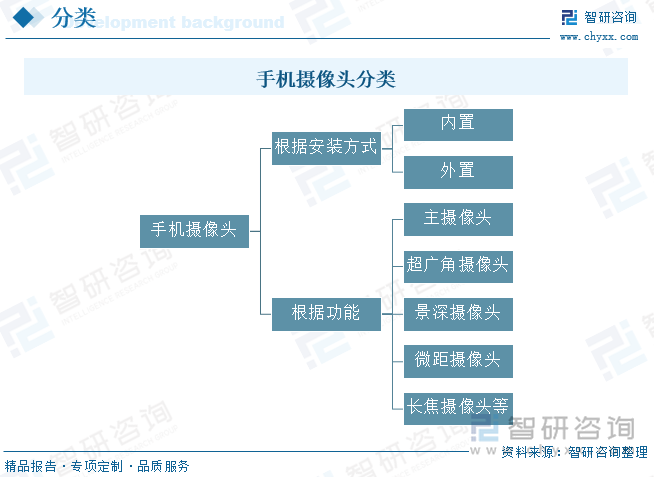
Core Viewpoint - The smartphone camera industry is experiencing significant growth driven by increasing consumer demand for high-quality photography and video capabilities, particularly due to the rise of short videos and live streaming. Technological advancements, such as multi-camera systems and variable aperture technology, are enhancing camera performance, leading to a projected increase in China's smartphone camera shipments from 1.13 billion units in 2017 to 2.38 billion units by 2024, with a compound annual growth rate of 11.23% [1][13]. Industry Overview - Smartphone cameras are modules installed in smartphones for capturing photos and videos, categorized into built-in and external types. They can also be classified based on functionality, including main, ultra-wide, depth, macro, and telephoto cameras [3]. Industry Chain - The smartphone camera industry consists of an upstream segment of component suppliers providing chips, lenses, sensors, voice coil motors, and infrared filters. The midstream involves the design, manufacturing, and testing of camera modules, while the downstream is represented by the smartphone industry, which drives demand for camera modules [5]. Market Trends - The optical lens market in China is projected to reach 17.39 billion yuan by 2024, reflecting a year-on-year increase of 7.81%, driven by technological advancements and supportive government policies [7]. - The global smartphone camera module shipments are expected to grow from 4.765 billion units in 2019 to 6.518 billion units by 2024, with a compound annual growth rate of 6.47% [11]. Competitive Landscape - The Chinese smartphone camera industry is highly competitive, featuring major players like Sony and Samsung, alongside domestic companies such as Sunny Optical and OFILM. These companies leverage strong R&D capabilities, manufacturing prowess, and brand influence to maintain market leadership [15]. Future Development Trends 1. **Pixel and Technology Enhancement**: Future smartphone cameras will continue to improve in pixel quality and advanced imaging technologies, focusing on features like optical stabilization and night mode, with AI applications enhancing user experience [20]. 2. **Multi-Camera System Proliferation**: Multi-camera systems are becoming a key trend, allowing for diverse shooting effects and enhancing photography capabilities [21]. 3. **Expansion of New Application Scenarios**: Beyond traditional photography, smartphone cameras will find applications in live streaming, online education, and telemedicine, increasing demand for video capabilities [23]. 4. **Industry Chain Integration and Collaborative Development**: Future trends will include greater integration and collaboration across the smartphone camera industry chain, fostering innovation and technological upgrades [24].




港股汽车板块布局利器!恒生汽车ETF即将发行
Quan Jing Wang· 2025-04-29 00:41
Group 1 - The 2025 Shanghai Auto Show features nearly 1,000 companies from 26 countries, showcasing over 100 new energy vehicles and advanced technologies like flying cars and humanoid robots, signaling an acceleration in China's automotive industry's smart transformation [1] - China's new energy vehicle penetration rate has surpassed 40%, while the penetration rate for smart vehicles (L2+) is only 14%, indicating that smart technology could become a new growth point for the industry [1] - The upcoming Hang Seng Automotive ETF, launching on May 6, is positioned as a convenient tool for investors looking to capitalize on the smart automotive wave in China [1] Group 2 - The Hang Seng Automotive ETF tracks the Hang Seng Hong Kong Stock Connect Automotive Theme Index, which includes major smart automotive companies like BYD, Xpeng, Li Auto, and Xiaomi, with nearly 50% of the index weight concentrated in "new car-making forces" [2] - The index also includes companies involved in smart driving system components, with nearly 70% of the weight attributed to firms developing perception, communication, and control components for smart driving systems [2] - The Hang Seng Automotive Theme Index has shown a cumulative rebound of over 61% in the past six months, outperforming other high-volatility indices, reflecting the index's superior composition [2] Group 3 - The Hang Seng Automotive ETF will be managed by experienced fund manager Tian Ximeng, who has eight years of industry experience and has been focused on Hong Kong stock investments, managing several ETFs with significant assets [3] - As 2025 approaches, competition among Chinese automotive companies in smart technology is intensifying, with breakthroughs expected to exceed industry forecasts, suggesting a promising future for smart vehicles [3] - Investors are encouraged to consider the Hang Seng Automotive ETF to strategically position themselves in the emerging era of smart driving [3]
电子掘金 科技硬件年报一季报解读
2025-04-28 15:33
Summary of Key Points from Conference Call Records Industry Overview - **Power Semiconductor Industry**: Expected revenue growth of approximately 10% in 2024, but net profit is projected to decline by 22%. Excluding Wentai Technology, actual profit growth is 0%, indicating a phenomenon of revenue growth without profit increase. However, third-generation semiconductor company Tianyue Advanced shows significant revenue and profit growth of 40% and 500% respectively [1][3][4]. Key Companies and Their Performance - **Hengxuan Technology**: Benefited from the growing demand in the smart watch and wristband market, with Q1 revenue increasing by 116% year-on-year and gross margin rising to 38.47% [1][5]. - **Rockchip**: In the automotive electronics sector, has mass-produced over ten models and has more than 20 targeted projects [1][5]. - **Stewei**: Achieved a revenue increase of 100% year-on-year in Q1, with smartphone chip business revenue growing by 269%, ranking fifth in the global mobile CIS market with an 11.2% share [1][6]. - **Optical Companies**: Companies like Qiu Tai, Gao Wei, and Rui Sheng have shown profit growth exceeding 100% due to industry recovery and improved profitability after the end of price wars [22][23]. Market Dynamics - **Consumer Electronics**: The sector is recovering well, with a 24% year-on-year revenue increase and an 18.6% increase in net profit in 2024. This is driven by smartphone inventory replenishment and global smartphone shipment growth of 6.4% [22][23]. - **Telecom Equipment**: Facing growth pressure with a 9.7% decline in capital expenditure from major operators in 2024, expected to further decline by 9.1% in 2025. Companies like ZTE are actively seeking new opportunities to offset traditional business pressures [16]. Emerging Trends - **AI and Autonomous Driving**: The AI-driven demand in the optical communication market is maintaining high growth rates. Companies like Xuchuang and Xinyi have seen improved gross margins due to the increased proportion of high-speed products [12][13]. - **IoT Modules**: The global cellular IoT module shipments increased by 10% year-on-year, with China showing a faster growth rate of 21% [18]. Investment Insights - **Valuation Recovery**: Companies like Yangjie Technology and Times Electric have seen their PE ratios drop below 20, indicating potential for valuation recovery as inventory and competition dynamics improve [7]. - **Long-term Outlook**: The consumer electronics sector is expected to face challenges from tariff changes, but companies with strong fundamentals and supply chain resilience are recommended for long-term investment [30][32]. Risks and Considerations - **Tariff Impact**: The consumer electronics sector is significantly affected by tariff changes, particularly for companies heavily reliant on Apple. However, the immediate impact on earnings has been minimal, with no requests for price reductions from Apple suppliers [28][30]. - **Market Competition**: The telecom equipment sector is experiencing intense competition, which may affect profit margins and growth prospects [16]. Conclusion The conference call highlights a mixed outlook for various sectors within the technology and semiconductor industries, with significant growth opportunities in AI, automotive electronics, and consumer electronics, while also addressing the challenges posed by market competition and tariff changes. Investors are advised to focus on companies with strong fundamentals and resilience in their supply chains for long-term gains.


暴涨!历史新高!
Zhong Guo Ji Jin Bao· 2025-04-28 10:27
Group 1: Market Overview - The Hang Seng Index slightly decreased by 0.04%, closing at 21,971.96 points, while the Hang Seng Tech Index rose by 0.12% to 4,988.94 points [2] - The total market turnover for the day was 169 billion HKD, with net purchases from southbound funds amounting to 2.03 billion HKD [2] - The performance of various sectors was mixed, with the telecommunications sector up by 0.73% and the healthcare sector down by 1.63% [4] Group 2: BYD Performance - BYD Electronics saw a significant drop of 8.49%, closing at 31.80 HKD, while BYD Company Limited fell by 3.98% to 381.20 HKD [3][12] - BYD Electronics reported a revenue of 36.88 billion RMB for Q1, a year-on-year increase of 1.1%, but a quarter-on-quarter decline of over 33% [16] - BYD Company Limited achieved a total revenue of 170.36 billion RMB in Q1, marking a year-on-year growth of 34.42% and a net profit increase of 100.38% to 9.15 billion RMB [19][20] Group 3: Pop Mart Performance - Pop Mart's new product LABUBU sparked a buying frenzy overseas, with the stock price reaching a historical high of 193.00 HKD, up 12.01% for the day [8] - According to Zheshang Securities, Pop Mart's revenue is projected to grow significantly, with estimates of 24.06 billion RMB, 32.69 billion RMB, and 40.86 billion RMB for 2025 to 2027 [11] - The company reported a staggering 475%-480% year-on-year revenue growth in overseas markets for Q1 2025, with the Americas seeing an increase of 895%-900% [11]

企业带着建议对策来 还主动抛出橄榄枝 这场圆桌会信息量和效率“双高”
Jie Fang Ri Bao· 2025-04-28 01:31
Group 1 - The "Most Hongqiao" International Business Roundtable focused on multinational automotive companies, with participation from firms like Bosch China, Michelin China, and Magna Automotive [1] - Hesai Technology's representative highlighted the impact of the tariff war on their business, leading to a mutual waiting phase with clients [1] - Many European companies expressed interest in collaborating with EU and Belt and Road countries through the platform provided by the roundtable [1] Group 2 - Michelin China emphasized its commitment to helping Chinese new energy vehicles expand globally, having registered four companies in Changning District [2] - Magna's representative offered collaboration opportunities for Chinese automotive companies, leveraging their extensive manufacturing capabilities in Europe [2] - Changning District is actively developing a comprehensive service platform for companies to expand overseas, integrating resources from various sectors including aviation and shipping [2]
Optimus机器人试生产线亮相,马斯克披露量产规划
Huafu Securities· 2025-04-27 06:25
Investment Rating - The industry rating is "Outperform the Market" indicating that the overall return of the industry is expected to exceed the market benchmark index by more than 5% in the next 6 months [15]. Core Insights - The Optimus humanoid robot production line has been revealed at the Fremont factory, with Tesla maintaining its production timeline [2][3]. - The Optimus project is progressing as planned, with the goal of producing the first batch of humanoid robots capable of performing actual work by the end of the year [3]. - By the end of 2025, thousands of robots are expected to be deployed in factories, with a target of achieving an annual production capacity of one million units within 4-5 years [5]. - Most components of the Optimus robot are newly designed, and the supply chain is still under development, which may affect production speed [5]. - Tesla is in discussions with China regarding the use of rare earth permanent magnets to meet material requirements for critical components [5]. - The development of intelligent humanoid robots is seen as a significant technological advancement that could benefit humanity by taking over repetitive physical labor [6]. - The Chinese humanoid robot market is projected to reach nearly 38 billion yuan by 2030, with a compound annual growth rate exceeding 61% from 2024 to 2030 [6].

港股收盘(04.25) | 恒指收涨0.32% 内房股冲高回落 百度集团-SW(09888)收涨近4%
智通财经网· 2025-04-25 08:50
Market Overview - The Hong Kong stock market showed strong performance in the morning, with the Hang Seng Index recovering above 22,000 points, but experienced a pullback in the afternoon, closing up 0.32% at 21,980.74 points with a total turnover of HKD 208.04 billion [1] - For the week, the Hang Seng Index rose 2.74%, the Hang Seng China Enterprises Index increased by 2.32%, and the Hang Seng Tech Index gained 1.96% [1] Blue Chip Performance - Baidu Group (09888) led the blue-chip stocks, rising 3.85% to HKD 87.6, contributing 4.56 points to the Hang Seng Index. The company launched several AI products, including the Wenxin model 4.5 Turbo, which is faster and 80% cheaper than its predecessor [2] - Other notable blue-chip performances included Lenovo Group (00992) up 3.39%, Sands China (01928) up 2.94%, while Chow Tai Fook (01929) fell 4.15% and SMIC (00981) dropped 2.8% [2] Sector Performance - Large tech stocks mostly rose, with Baidu up nearly 4%, and Alibaba and Tencent both gaining over 1%. The mobile industry chain saw significant gains, with Highway Electronics rising over 6% [3] - Real estate stocks initially surged but then retreated, with Sunac China (01918) down 6.63%. Analysts from Citigroup and HSBC are optimistic about the sector, expecting improved profitability due to policy support [3][4] - Semiconductor stocks faced declines, with Hua Hong Semiconductor (01347) down 6.28% and SMIC (00981) down 2.8% [4] Gold Sector - Gold stocks collectively weakened as spot gold prices fell below USD 3,300 per ounce. Major gold companies like China National Gold International (02099) and Lingbao Gold (03330) saw declines of 1.87% and 3.72%, respectively [6] Emerging Opportunities - The Chinese government has exempted certain semiconductor-related tax codes from tariffs, potentially reducing import duties from 125% to 0%, which may accelerate domestic semiconductor substitution [5] - The consumer electronics sector is expected to stabilize in the long term despite short-term tariff disruptions, with analysts noting significant valuation recovery potential for quality domestic stocks [7] Notable Stock Movements - Giordano International (00709) saw a rise of 5.71% after reporting a 5.2% increase in sales for the first quarter, despite adverse currency impacts [8] - Zai Lab (09911) reported a projected revenue increase of 41.5%-48.1% for Q1 2025, driven by growth in its social business [9] - Horizon Robotics (09660) announced a strategic partnership with Bosch to develop new multifunctional cameras, contributing to its stock performance [10] - Chow Tai Fook (01929) faced pressure with a reported 11.6% decline in retail value for the last quarter, underperforming compared to peers [11]

智立方(301312) - 2025年4月25日投资者关系活动记录表
2025-04-25 08:48
Group 1: Business Overview - The company focuses on high-end equipment manufacturing, specializing in semiconductor and industrial automation equipment, providing customized solutions for downstream clients [1] - The core business is divided into two main sectors: semiconductor and electronic products, responding to national strategies for semiconductor localization [2] Group 2: Strategic Analysis - The electronic products sector is a traditional strength, with automation testing and assembly equipment widely used in consumer electronics, automotive electronics, and other advanced industries [3] - The company has embedded itself deeply in the supply chains of major semiconductor manufacturers, transitioning from single equipment supply to collaborative process development [3] Group 3: Financial Performance - In 2024, the company achieved revenue of CNY 554.61 million, a year-on-year increase of 29.77%, while net profit attributable to shareholders was CNY 59.49 million, a decrease of 18.02% [4] - R&D expenses from 2022 to 2024 were CNY 48.27 million, CNY 54.26 million, and CNY 53.63 million, representing 9.50%, 12.70%, and 9.67% of revenue respectively [5] Group 4: Key Q&A Insights - The decline in net profit is attributed to product structure changes and increased R&D investments, with a focus on semiconductor equipment [5] - The semiconductor business is seen as a second growth curve, with significant breakthroughs in product matrix and customer expansion [5] - The company plans to maintain a positive outlook for overall performance in 2024, with customer orders progressing as planned [7] Group 5: Future Outlook and Plans - The company aims to enhance its semiconductor equipment business through a dual strategy of horizontal technology extension and vertical industry deepening [6] - Plans for global positioning include establishing R&D centers in Shenzhen, production bases in Dongguan, and marketing strategies in Suzhou and Vietnam [6] - A dividend plan for 2024 proposes a cash distribution of CNY 4 per 10 shares, totaling CNY 34.88 million, which is 58.63% of net profit attributable to shareholders [8]


