阳光电源

Search documents
量化市场追踪周报:资金面趋于谨慎,观望情绪浓厚-20251130
Xinda Securities· 2025-11-30 05:04
- The report does not contain any specific quantitative models or factors for analysis[1][2][3] - The content primarily focuses on market trends, fund flows, and sector performance without detailing any quantitative model construction or factor analysis[4][5][6] - No quantitative backtesting results or specific factor performance metrics are provided in the report[7][8][9]





东方财富3位高管亮出减持计划,这一减持动因为何成普遍现象?
Xin Lang Cai Jing· 2025-11-29 14:16
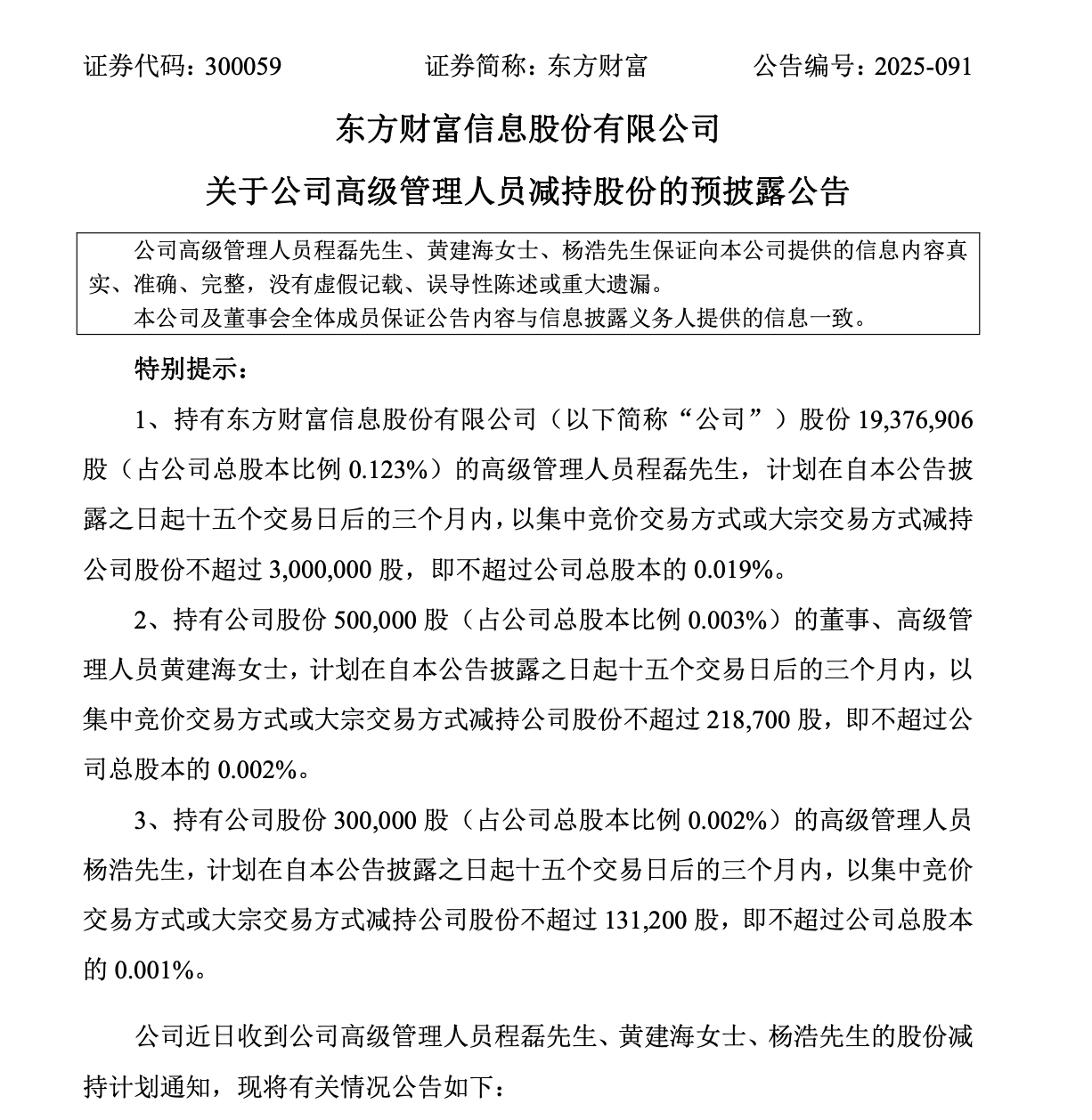
Core Viewpoint - Dongfang Caifu has announced a share reduction plan involving three executives, citing the need to repay equity incentive loans, pay related taxes, and meet personal funding requirements [1][3][4] Group 1: Share Reduction Details - The three executives plan to reduce their holdings by a total of no more than 0.022% of the company's total share capital [1][4] - The shares to be reduced by Huang Jianhai and Yang Hao come from the company's equity incentive plan, while Cheng Lei's shares include those obtained before the IPO, from the equity incentive plan, and from rights distribution [4][5] - The reduction is a common practice in the industry, as many companies face similar funding pressures due to equity incentive mechanisms [3][5] Group 2: Industry Context - Since 2025, several companies, including Zhaoyi Innovation and Huichuan Technology, have also announced similar share reductions for comparable reasons [3][5] - As of November 29, eight listed securities firms have disclosed shareholder reduction plans, with most reductions occurring in the second half of the year [6][7][10] - The overall reduction scale among these firms is generally moderate, with most not exceeding 1% of total share capital, indicating no significant impact on control or governance structures [10][11] Group 3: Market Implications - The frequent share reductions in the brokerage sector may influence market sentiment, as such actions are often interpreted by investors as signals regarding industry outlook [11] - Despite the reductions, the stability of Dongfang Caifu's management team and its core talent retention remain unaffected, as the company continues to show steady performance and growth [5][6]


收益率30%仍清盘,昔日百亿基金经理,为何留不住规模?
Xin Lang Cai Jing· 2025-11-29 04:04
Core Viewpoint - The fund managed by Jian Cheng, known for its significant scale, has been liquidated despite achieving over 30% returns since its inception, highlighting a disconnect between performance and asset growth [1][4][6]. Group 1: Fund Performance and Liquidation - Jian Cheng's fund, Invesco Great Wall Industry Selection One Year, was established in May 2023 and entered liquidation on November 12, 2023, after approximately 1.5 years of operation [1]. - The fund's initial fundraising was challenging, taking over two months to complete, and despite achieving a return of over 30%, it faced continuous outflows and a decline in scale [1][3]. - By the end of Q2 2023, the fund's scale had dropped below 1 billion, and by Q3, it further decreased to 0.41 billion, triggering liquidation warnings [3][4]. Group 2: Fund Management and Strategy - Jian Cheng has a history of launching new funds, with 9 out of 10 public funds he managed being newly issued, indicating a focus on new product launches rather than maintaining existing funds [2][7]. - The fund's asset management strategy showed a high overlap in top holdings across Jian Cheng's products, suggesting a unified investment approach [5][6]. - Despite efforts to boost scale through hiring additional distribution agencies and lowering fees, the fund could not reverse the trend of asset shrinkage and client loss [4][6]. Group 3: Broader Implications and Market Trends - The trend of new fund launches correlates with Jian Cheng's rise and fall in asset management scale, with a peak of 143.18 billion in Q2 2021, which has since declined by over 60% [6][7]. - The performance of other funds managed by Jian Cheng has been mixed, with some experiencing significant losses, raising questions about the effectiveness of the investment strategies employed [6][8].
突发!昨夜11家上市公司披露减持计划,7家拟减持超1%,包括石油,电子龙头
Sou Hu Cai Jing· 2025-11-29 03:15
Market Overview - The A-share market experienced a volatile session, with the ChiNext Index initially rising by 2.21% before a significant drop in the afternoon, leading to both the ChiNext and Shenzhen Composite Index closing in the red [1] - A total of 11 companies announced shareholder reduction plans, with 7 planning to reduce their holdings by more than 1% [1] Shareholder Reduction Trends - Notable companies involved in the reduction include Zhongman Petroleum and Yidelong, both of which have seen significant stock price increases recently [1] - Yidelong's stock price rebounded from a low of 12.38 yuan to a high of 56.30 yuan, marking a maximum increase of 355%. A major shareholder plans to reduce 3.2 million shares, accounting for 2% of total shares, expecting to cash out approximately 116 million yuan [2] - Zhongman Petroleum's stock price increased from 5.83 yuan to 26.66 yuan over five years, a maximum increase of 357%. However, the company reported a 32.18% decline in net profit for Q3, prompting shareholders to plan a reduction of up to 13.87 million shares, or 3% of total shares, with an expected cash-out of 323 million yuan [3] Broader Market Implications - The trend of shareholder reductions is not isolated, with significant reductions totaling over 380 billion yuan in the first eight months of 2025, and a 62% year-on-year increase in the first two weeks of August alone [3] - The primary drivers of these reductions are not retail investors but rather company insiders, with controlling shareholders and actual controllers accounting for 40.3% of the reductions [3] - Sectors with the highest reduction activity include electronics, pharmaceuticals, and new materials, which collectively account for over 42% of the reductions [3] Sector-Specific Insights - In the technology sector, 106 companies announced major shareholder reduction plans since September, with the electronics industry being the most affected [5] - Notable examples include Lanke Technology, where shareholders announced a reduction of 11.45 million shares, potentially cashing out around 3.29 billion yuan after a 75.18% increase in stock price [5] - Other companies like Zhongji Xuchuang and Anda Intelligent also saw significant shareholder reductions despite their stock price increases, indicating a trend of insiders cashing out at high valuations [5][7] Market Behavior and Patterns - Historical data indicates that stock prices tend to drop following shareholder reduction announcements, with a probability exceeding 50% for declines shortly after such announcements [9] - The timing of reductions shows a clear seasonal pattern, with the highest number of reductions occurring in December, followed by September and November [9] - Venture capital firms have also become significant players in this reduction wave, with over 80 companies involved since August, collectively cashing out over 10 billion yuan [11]


中国储能最具可持续发展力20强排行榜|独家
24潮· 2025-11-29 02:03
Core Insights - The article discusses the tumultuous development of China's energy storage industry over the past decade, highlighting the rapid rise and fall of numerous companies, leading to a chaotic market environment [2] - China currently holds a dominant position in the global energy storage supply chain, with significant market shares in battery shipments and key materials [2] - The industry is facing a new phase of intense competition and restructuring, driven by aggressive capital investment and price wars [2] Industry Overview - The number of energy storage-related companies in China has surged from 11,000 a decade ago to over 380,000 by September 2025, marking a growth of 33.55 times [3] - Major energy storage projects with investments exceeding 1 billion yuan are projected to surpass 1.5 trillion yuan, with planned battery capacity exceeding 2800 GWh from 2022 to 2024 [3] Financial Health - As of June 2025, over 110 listed companies in the energy storage sector reported total liabilities of 1.79 trillion yuan, an increase of 11.86% year-on-year [4] - The overall asset-liability ratio stands at 57.74%, with short-term interest-bearing liabilities amounting to 378.2 billion yuan, reflecting a year-on-year increase of 25.86% [4] - Excluding major players like CATL, many smaller companies are in precarious financial positions, with a net asset value of -553.79 billion yuan [4][5] Market Challenges - By mid-2025, 15 listed energy storage companies had asset-liability ratios exceeding 70% and negative net asset values, indicating significant financial stress [5] - Nearly 30,000 energy storage companies were reported to be in abnormal statuses such as cancellation or suspension by 2024, with many established for less than a year [5] - A recent shortage of battery cells has further strained smaller companies, with 38.7% forced to reduce production and 15.2% temporarily halting operations [5] Sustainability Assessment - The 24潮产业研究院 (TTIR) emphasizes the importance of assessing the sustainable development capabilities of energy storage companies for stakeholders [6] - A ranking of the top 20 energy storage companies based on sustainability metrics will be released, focusing on revenue generation, profitability, innovation, financial health, global expansion, and shareholder returns [6] Rankings and Metrics - The article provides a detailed ranking of the top 20 energy storage companies based on various sustainability criteria, including revenue growth and profitability [12][23] - Companies like CATL and BYD lead in multiple sustainability dimensions, showcasing their strong market positions and financial health [12][23]



天津"十五五"规划建议: 加力建设光伏发电等新型能源基础设施
Mei Ri Jing Ji Xin Wen· 2025-11-28 15:36
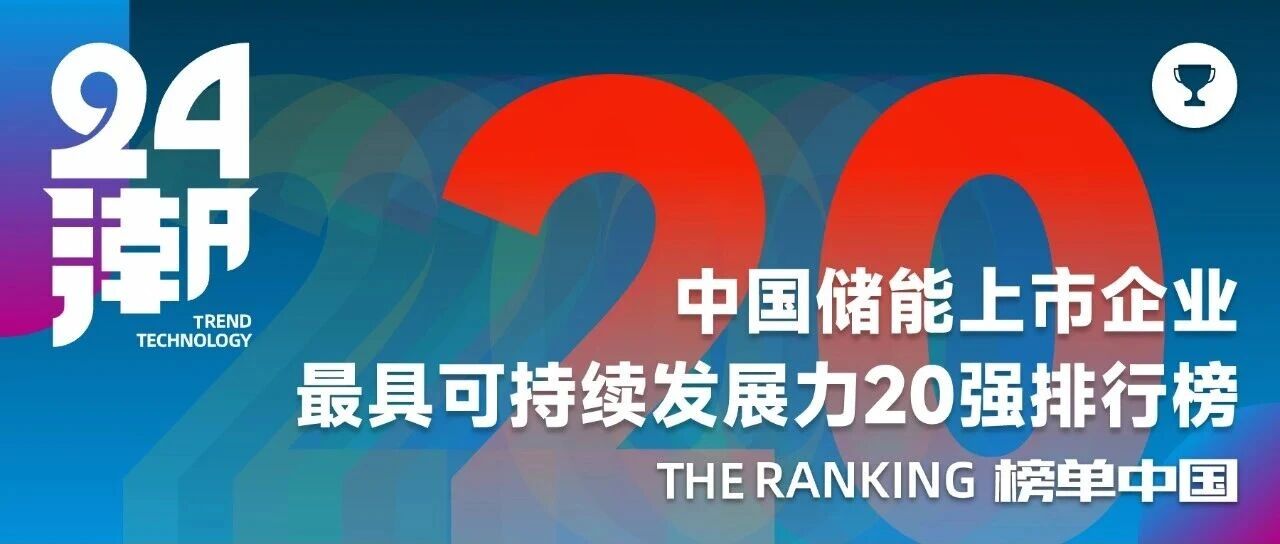
Core Viewpoint - The photovoltaic (PV) sector is expected to enter a sustained capacity clearing cycle by 2026, with improvements in product pricing, mergers and acquisitions, and higher industry entry barriers anticipated to enhance the competitive landscape and ecosystem of the industry [1] Group 1: Market Performance - On November 28, 2025, the Huaxia Photovoltaic ETF (515370) rose by 0.33%, with major holdings such as Maiwei Co. increasing over 7%, Hongyuan Green Energy up over 3%, and both Sunshine Power and Jing Sheng Machinery up over 1% [1] Group 2: Policy and Infrastructure Development - The Tianjin Municipal Committee released recommendations for the 15th Five-Year Plan, emphasizing the optimization of oil, gas, electricity, and heating networks, and the enhancement of new energy infrastructure including wind, solar, and hydrogen energy [1] Group 3: Industry Outlook - Zhongyuan Securities predicts that the photovoltaic industry will experience a continuous capacity clearing cycle starting in 2026, with the effects of "anti-involution" pricing measures, corporate mergers, and improved product quality standards gradually becoming evident [1] - The competitive landscape and ecosystem of the photovoltaic industry are expected to improve, leading to a gradual enhancement in the performance of existing photovoltaic companies [1] - Public funds currently have low allocations in the photovoltaic sector, but the anticipated improvements in valuation and supply-demand dynamics are likely to attract more capital [1] Group 4: ETF and Industry Representation - The Huaxia Photovoltaic ETF (515370) tracks the CSI Photovoltaic Industry Index, encompassing upstream, midstream, and downstream companies in the photovoltaic supply chain, including silicon wafers, polysilicon, solar cells, cables, photovoltaic glass, battery modules, inverters, photovoltaic brackets, and solar power stations, providing a comprehensive reflection of the overall performance of the photovoltaic industry [1]
2026年股权投资市场怎么走?最新研判来了
Shang Hai Zheng Quan Bao· 2025-11-28 13:29
Core Insights - The 19th China Investment Annual Conference highlighted trends in the private equity market, emphasizing the importance of economic, political, and technological drivers in asset allocation, with expectations for stability until 2026 [1] - The report indicated a significant increase in newly established venture capital funds, reaching 1.78 trillion yuan in the first three quarters of 2025, a year-on-year increase of 10.25%, and investment events totaling 912 billion yuan, up 19.98% [1] Group 1: Investment Trends - The report predicts three major trends in asset allocation: industry concentration, regional decoupling, and stable allocation [1] - The participation of state-owned capital in venture capital has reached a stable phase, with state-owned platforms and guiding funds accounting for 59% of the funding structure by Q3 2025 [2] - The willingness of listed companies to invest in private equity funds has decreased, with average annual contributions dropping from 288 million yuan to 192 million yuan from 2022-2023 to 2024 [3] Group 2: M&A and Fund Dynamics - The Chinese M&A fund market is expected to grow significantly, with a focus on cash flow and operational management, presenting numerous opportunities due to a favorable financing environment and increasing demand for corporate restructuring [4] - S funds are becoming a critical component of the market, with a peak in global S transactions in the first half of 2025, indicating a growing demand for secondary fund transactions [5][6] - The report suggests that the Chinese hard technology sector will undergo a competitive phase, with a shift from scale to technological innovation and a focus on building systematic capabilities [7][8]
电力设备及新能源行业双周报:全国电源规模最大“沙戈荒”大基地项目开工-20251128
Dongguan Securities· 2025-11-28 13:29
Investment Rating - The report maintains an "Overweight" rating for the power equipment and new energy industry [2][47]. Core Viewpoints - The opening of the "Shago Desert" clean energy base project in Qinghai, which is the largest approved new energy installation in the country, is expected to create a certain demand for the domestic new energy industry chain [3][42]. - The power equipment sector has experienced a decline of 10.21% over the past two weeks, underperforming the CSI 300 index by 6.24 percentage points, ranking 31st among 31 sectors [11][10]. - The report suggests focusing on leading new energy companies with advanced technology and scale due to the significant investment in the new energy base project [42]. Summary by Sections 1. Market Review - As of November 27, 2025, the power equipment sector has seen a year-to-date increase of 38.23%, outperforming the CSI 300 index by 23.47 percentage points, ranking 5th among 31 sectors [11][10]. - The wind power equipment sector declined by 4.29%, the photovoltaic equipment sector by 9.98%, and the grid equipment sector by 11.12% in the last two weeks [11][19]. 2. Valuation and Industry Data - As of November 27, 2025, the price-to-earnings (PE) ratio for the power equipment sector is 32.19 times, with sub-sectors like electric motors at 55.76 times and photovoltaic equipment at 29.60 times [24][5]. - The report provides detailed valuation metrics for various sub-sectors, indicating a range of PE ratios from 27.51 times for grid equipment to 55.76 times for electric motors [24][5]. 3. Industry News - The "Shago Desert" clean energy base project has a total planned capacity of 19.44 million kilowatts, with over 80% from renewable sources, and is expected to stabilize power supply [37][42]. - The project will utilize a ±800 kV ultra-high voltage direct current transmission line to deliver power to the Guangdong-Hong Kong-Macao Greater Bay Area [37][42]. 4. Company Announcements - The report highlights several companies to watch, including Guodian NARI, Sunshine Power, and Goldwind Technology, which are noted for their technological advancements and market positions in the new energy sector [43][42].
高工储能年会前瞻:锂电池抢夺全球长时储能“大蛋糕”
高工锂电· 2025-11-28 12:05
Core Viewpoint - The article highlights the normalization of negative electricity prices in various regions, including China, Europe, and Australia, driven by the imbalance between electricity supply and demand due to the rapid increase in wind and solar power installations. This situation is creating a new demand for medium to long-duration energy storage solutions, particularly in the 4-12 hour range [2][3]. Group 1: Market Trends and Developments - The phenomenon of negative electricity prices is becoming commonplace, prompting a shift towards medium to long-duration energy storage solutions [2][3]. - The global competition for energy storage systems with a capacity of 6MWh and above is intensifying, with a focus on long-duration storage solutions [3][4]. - By 2024, the penetration rate of 4-hour energy storage systems reached 15%, and this segment is becoming mainstream in 2025 [3][4]. Group 2: Technological Advancements - Major Chinese companies are rapidly increasing the production of large-capacity energy storage systems to seize market opportunities in the long-duration storage era [4][5]. - Companies like Ningde Times and Envision Energy are leading the charge with the mass production of high-capacity energy storage cells, such as the 587Ah cell [5][7]. - The competition is not limited to lithium batteries; flow battery technology is also gaining traction, with strategic partnerships being formed to develop large-scale storage projects [8][9]. Group 3: Competitive Landscape - The market is witnessing a split between companies focusing on large capacity cells using different manufacturing processes, namely the stacking and winding techniques [10][11]. - The stacking process is favored for its high space utilization and low-temperature performance, while the winding process benefits from established production efficiency [11][12]. - Companies are adopting differentiated strategies based on their technological capabilities, with some focusing on rapid deployment of 500+Ah cells and others on the long-term potential of 600+Ah cells [12][13]. Group 4: System Variability and Customization - The differences in cell technology are reflected in the energy storage systems, with various companies targeting different container sizes (10ft, 20ft, 30ft) to meet diverse application needs [14][15]. - Companies like Sungrow and BYD are launching multiple size versions of their energy storage systems to cater to specific market demands [15][16]. - The trend towards customized solutions is becoming more pronounced, as companies recognize the need for tailored energy storage solutions to address varying requirements in the market [17][19].


又签2GW订单!大储PCS供应持续紧张
行家说储能· 2025-11-28 11:33
Core Insights - The article discusses the rapid growth and opportunities in the energy storage industry, particularly in the context of power market reforms and digitalization [2][3]. Group 1: Industry Trends - The global energy storage market is entering a "blowout period," with an increase in both project numbers and product specifications, leading to a tight supply of energy storage PCS (Power Conversion Systems) [3]. - The mainstream price range for 2.5MW PCS is between 0.075-0.078 yuan/W, with a penetration rate rapidly increasing to 70%-80%, making it the current industry standard [7][8]. Group 2: Company Developments - CRRC Zhuzhou Electric Locomotive Co., Ltd. (中车时代电气) has received over 2GW in orders for its liquid-cooled centralized storage PCS-2.5MW, which has passed national standard certification [4][8]. - Other companies such as Sungrow Power Supply, Shenghong Electric, and Kehua Data have also actively positioned themselves in the energy storage market [5]. Group 3: Product Innovations - The 2.5MW liquid-cooled centralized storage PCS developed by CRRC Zhuzhou Electric features a response time of 5 milliseconds and can handle overload outputs of three times the rated current within 10 seconds [4][7]. - The industry is transitioning towards 3MW+ PCS models, with companies like Xingyun Co., Ltd. and CRRC Zhuzhou Electric releasing models ranging from 3.2MW to 3.5MW to match larger capacity storage systems [10]. Group 4: Market Challenges - Transitioning from 2.5MW to 3MW+ PCS involves overcoming multiple technical challenges, including increased cooling requirements and the need for more complex control algorithms [11]. - The delivery cycle for large PCS has extended from 45 days to 75 days due to increased demand and supply chain constraints [13].