
三花智控

Search documents
华龙证券:25Q3乘用车业绩分化 市场年底前有望迎来抢购潮
Zhi Tong Cai Jing· 2025-11-13 07:38
Core Viewpoint - The automotive sector is experiencing mixed performance, with passenger vehicles showing revenue growth but declining profits, while commercial vehicles and parts suppliers are benefiting from improved fundamentals and new product launches [1][2][3]. Passenger Vehicles - In Q3 2025, the passenger vehicle sector achieved a revenue growth of 7.4% year-on-year, which is lower than the consolidated sales growth of 14.4%, primarily due to a price war that led to a decrease in average selling price by 0.99 million yuan per vehicle [2]. - The sector's net profit attributable to the parent company was 9.49 billion yuan, down 25.1% year-on-year [2]. - New product launches and a shift towards high-end models are driving revenue growth for car manufacturers, with companies like Xpeng Motors and Leap Motor seeing rapid sales growth due to low base effects and significant new vehicle releases [2]. Commercial Vehicles - The commercial vehicle market is showing continuous improvement, with significant sales growth since June 2025, contributing to a recovery in sector valuations [1]. - The heavy truck segment reported a revenue of 108 billion yuan in Q3 2025, reflecting a year-on-year increase of 26.9%, with net profit rising 55.3% to 3.84 billion yuan [5]. - The bus segment also performed well, with a revenue increase of 30.6% year-on-year, driven by higher single-vehicle income [4]. Auto Parts - The auto parts sector achieved a revenue of 368.37 billion yuan in Q3 2025, up 10.4% year-on-year, with net profit increasing by 22.6% to 19.64 billion yuan [3]. - Nearly 80% of auto parts companies reported revenue growth in Q3 2025, driven by strong terminal sales and effective cost control measures [3]. - The introduction of several key new models in the passenger vehicle market is expected to boost the performance of core suppliers in the supply chain [3]. Recommendations - Companies in a strong new product cycle such as Great Wall Motors, Seres, SAIC Motor, and Xpeng Motors are recommended for attention [6]. - Strong supply chain players and those involved in humanoid robotics and intelligent driving, such as Longsun Technology and Joyson Electronics, are also highlighted as potential investment opportunities [6]. - For commercial vehicles, leading companies like Weichai Power and Yutong Bus are suggested as beneficiaries of the industry's recovery [6].
锂电板块继续上行,新能车ETF(515700)涨超6.0%冲击年内新高
Xin Lang Cai Jing· 2025-11-13 03:13
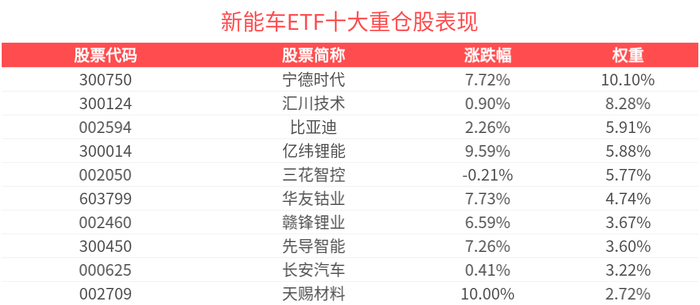
Group 1 - The China Securities New Energy Vehicle Industry Index (930997) has surged by 5.96% as of November 13, 2025, with significant gains in constituent stocks such as Xinzhou Bang (300037) up 17.19%, Wukuang New Energy (688779) up 16.90%, and Tianhua New Energy (300390) up 12.50% [1] - The New Energy Vehicle ETF (515700) increased by 5.89%, reaching a latest price of 2.61 yuan, benefiting from the recovery in lithium battery demand and advancements in solid-state batteries [1] - The New Energy Vehicle ETF closely tracks the China Securities New Energy Vehicle Industry Index, reflecting the overall performance of leading listed companies in the new energy vehicle sector [1] Group 2 - As of October 31, 2025, the top ten weighted stocks in the China Securities New Energy Vehicle Industry Index include CATL (300750), Huichuan Technology (300124), and BYD (002594), collectively accounting for 53.56% of the index [2] - The weightings of the top stocks are as follows: CATL at 10.10% with a rise of 7.72%, Huichuan Technology at 8.28% with a rise of 0.90%, and BYD at 5.91% with a rise of 2.26% [4] - Other notable stocks include EVE Energy (300014) at 5.88% with a rise of 9.59%, and Ganfeng Lithium (002460) at 3.67% with a rise of 6.59% [4]







涨超4.4%,新能车ETF(515700)近6个月强势上涨
Xin Lang Cai Jing· 2025-11-13 03:02
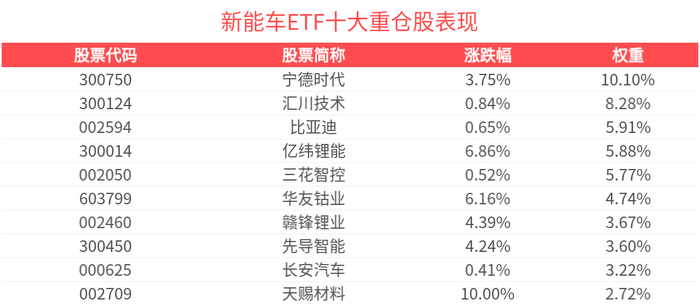
Core Insights - The China Securities New Energy Vehicle Industry Index (930997) has seen a strong increase of 4.49% as of November 13, 2025, with significant gains in constituent stocks such as Xinzhou Bang (300037) up 14.43%, Wukuang New Energy (688779) up 14.23%, and Xingyuan Material (300568) up 12.25% [1] Group 1 - The New Energy Vehicle ETF (515700) rose by 4.47%, with the latest price at 2.57 yuan, and has accumulated a 0.53% increase over the past week as of November 12, 2025 [1] - The New Energy Vehicle ETF closely tracks the China Securities New Energy Vehicle Industry Index, which includes 50 listed companies involved in various sectors of the new energy vehicle industry [1] Group 2 - As of October 31, 2025, the top ten weighted stocks in the China Securities New Energy Vehicle Industry Index are CATL (300750), Huichuan Technology (300124), Sanhua Intelligent Control (002050), BYD (002594), Yiwei Lithium Energy (300014), Huayou Cobalt (603799), Ganfeng Lithium (002460), Xian Dao Intelligent (300450), Changan Automobile (000625), and Tianqi Lithium (002466), collectively accounting for 53.56% of the index [2] - The weightings of the top stocks are as follows: CATL at 10.10%, Huichuan Technology at 8.28%, BYD at 5.91%, Yiwei Lithium Energy at 5.88%, Sanhua Intelligent Control at 5.77%, Huayou Cobalt at 4.74%, Ganfeng Lithium at 3.67%, Xian Dao Intelligent at 3.60%, Changan Automobile at 3.22%, and Tianqi Lithium at 2.72% [3]





拥抱人形机器人时代-首次覆盖双环传动、禾赛科技、拓普集团、三花智控及利达光电-Asia Emerging Robotics Embrace the Humanoid Era - Initiating Coverage of Shuanghuan, Hesai, Tuopu, Sanhua and Leader Drive
2025-11-13 02:49
Summary of the Conference Call on Asia Emerging Robotics Industry Overview - **Industry**: Humanoid Robotics - **Growth Forecast**: The humanoid robot industry is expected to grow significantly, with annual shipments projected to reach approximately 1 million units by 2031 (Total Addressable Market: ~USD 20 billion) and around 50 million units by 2050 (Total Addressable Market: ~USD 800 billion) [2][34] Key Companies Covered - **Shuanghuan**: Rated Outperform, recognized as a global leader in gears and reducers, well-prepared for the humanoid era [8][20] - **Hesai**: Rated Outperform, a frontrunner in "laser eyes" technology, expected to benefit from intelligent vehicles and robotics [11][20] - **Tuopu**: Rated Outperform, a leading auto parts supplier with strong capabilities in robotics [11][20] - **Sanhua**: Rated Market-Perform, has a high-quality core business but limited robotics experience [11][20] - **Leader Drive**: Rated Underperform, concerns over long-term market share and margins [11][20] Core Insights - **Investment Strategy**: Emphasizes investing in companies with broad robotics exposure, proven expertise expansion, and high-quality core businesses. The overarching theme is to "Make No Bet" on specific humanoid robots due to the industry's early-stage nature [4][7][64] - **China's Advantage**: China is positioned as a leader in the humanoid robot industry, benefiting from rapid product iteration, a broad user base, and a well-established supply chain. The approach contrasts with Western companies, which often pursue idealistic solutions [3][34][48] Market Dynamics - **Technological Maturity**: The humanoid robot industry is still evolving, with significant technological barriers remaining, particularly in robotic intelligence and cost [33][34] - **Competition**: The industry faces challenges from non-humanoid robots, which are already deployed in various applications. This competition may impact the adoption and market share of humanoid robots [64][78] Investment Recommendations - **Characteristics of Target Companies**: 1. **Upstream Winners**: Focus on key component suppliers rather than downstream players, as the latter are still too early to identify [9][66] 2. **Broad Robotics Exposure**: Companies should have capabilities beyond humanoid robots to mitigate risks from competition [9][66] 3. **Expertise Expansion**: Companies with a strong ability to adapt to technological changes are preferred [9][66] 4. **High-Quality Core Businesses**: Essential for sustainable cash flows and reasonable valuations [9][66] Conclusion - The humanoid robot industry presents substantial long-term potential, with significant growth expected in the coming decades. Investment strategies should focus on established companies with diversified capabilities and a strong market presence to navigate the evolving landscape effectively [7][64][66]




资金回归中国制造业股
日经中文网· 2025-11-13 02:46
Group 1 - The core viewpoint of the article indicates that the Chinese manufacturing sector is experiencing a recovery, with manufacturing profits increasing by 22% year-on-year in September, marking the highest growth rate since November 2023 [2][8] - The Shanghai Composite Index has risen approximately 20% compared to the end of 2024, with semiconductor company Cambricon Technologies seeing its stock price more than double this year, driven by advancements in AI and technology-related stocks [4] - The trend of rising manufacturing stock prices is expanding, with about 90% of the top 100 stocks projected to increase by mid-2025 being from the manufacturing sector [4] Group 2 - The background of this trend is the Chinese leadership's push to correct excessive competition, referred to as "involution," with policies introduced to limit unproductive price-based competition [5] - The expectation of profit recovery due to the elimination of excess capacity is evident, as seen in the stock price surges of companies like Sungrow Power Supply, which increased nearly threefold in the second half of the year [7] - Overall, the industrial stock price index on the Shanghai Stock Exchange rose over 20% in the second half of the year, surpassing the 16% increase of the Shanghai Composite Index, indicating a shift in market focus from shareholder returns to manufacturing performance recovery [7] Group 3 - Macroeconomic statistics show that fixed asset investment decreased by 7% year-on-year in August and September, indicating a significant reduction in manufacturing investment activities [8] - The Chinese government is focusing on boosting consumption as part of its economic strategy for 2026-2030, with the effectiveness of the "anti-involution" policy being crucial for stimulating domestic demand [10] - The sustainability of stock price increases remains uncertain, as the balance between eliminating inefficient production and stimulating consumption is delicate [10]
工控进一步复苏,电网景气度保持 | 投研报告
Zhong Guo Neng Yuan Wang· 2025-11-13 01:20
Core Viewpoint - The industrial control and power equipment industry shows strong growth in Q3 2025, with significant increases in revenue and net profit, indicating a high level of industry prosperity [1][2]. Group 1: Industry Performance - The industry reported a revenue of 480.9 billion yuan for Q1-Q3 2025, a year-on-year increase of 11%, and a net profit of 40 billion yuan, up 17% year-on-year [1][2]. - In Q3 2025, the revenue reached 171.5 billion yuan, reflecting a 9% year-on-year growth, while net profit was 14.5 billion yuan, up 15% year-on-year [1][2]. - The overall gross margin for the industry in Q3 2025 was 22.7%, showing a decrease of 0.8 percentage points year-on-year and 0.5 percentage points quarter-on-quarter [1][2]. Group 2: Cash Flow and Liabilities - The operating cash flow for Q3 2025 was a net inflow of 23.4 billion yuan, representing a 23% increase year-on-year [1][2]. - Contract liabilities and inventory increased by 9% and 24% respectively compared to the beginning of the year [1][2]. Group 3: Segment Analysis - The industrial control sector saw a revenue of 101.7 billion yuan for Q1-Q3 2025, with a 21% year-on-year increase, and a net profit of 8.8 billion yuan, also up 21% year-on-year [3]. - In Q3 2025, the industrial control segment achieved a revenue of 38.5 billion yuan, a 21% year-on-year increase, and a net profit of 2.95 billion yuan, up 14% year-on-year [3]. - The power cable segment experienced a revenue increase of 6.36% year-on-year, but net profit decreased by 42.46% [4]. - The ultra-high voltage/high voltage segment saw a revenue increase of 5.37% year-on-year, with net profit rising by 48.51% [4]. Group 4: Future Outlook - The second equipment segment is showing signs of accelerated growth, with Q3 2025 revenue reaching 26.9 billion yuan, a year-on-year increase of 18.5% [5]. - The gross margin for the second equipment segment in Q3 2025 was 26.4%, down 2.7 percentage points year-on-year, while the net profit margin was 10.3%, down 1.0 percentage point year-on-year [5].
外资密集调研A股公司 资本市场开放大门越开越大
证券时报· 2025-11-12 23:59
Group 1 - The article highlights a new phase of "dual-directional engagement" between China's capital market and foreign institutions, with regulatory bodies signaling accelerated high-level opening-up and foreign investors increasing their positions in Chinese stocks [2][4] - UBS analysts believe that the mid-term upward driving forces for the market remain unchanged, supported by overall profit recovery, net inflows of external funds, technology narratives aiding valuation reconstruction, and improvements in capital market construction [2][4] - Foreign institutional investors have significantly increased their holdings in Chinese stocks, with the top 40 global investment institutions raising their positions to the highest level in over two years, indicating a positive outlook for the Chinese stock market [4][5] Group 2 - In the third quarter, QFII (Qualified Foreign Institutional Investor) showed a tendency to increase holdings, with a total of 10.18 billion shares valued at approximately 21.283 billion yuan, reflecting a growing interest in cyclical sectors such as non-ferrous metals and electricity [4][5] - A total of 236 A-share listed companies have QFII among their top ten circulating shareholders, with 93 new heavy positions and 67 stocks seeing varying degrees of increases in holdings during the third quarter [4][5] - Foreign institutions have conducted nearly a thousand investigations into A-share companies since October, focusing on performance, R&D directions, and AI applications, indicating a deepening interest in the Chinese market [6][7] Group 3 - Continuous deepening of capital market reforms and opening-up measures are crucial for attracting and retaining foreign investment, with the China Securities Regulatory Commission (CSRC) enhancing policies to facilitate efficient capital flow and reasonable resource allocation [9][10] - The CSRC plans to introduce more robust opening measures, including improving cross-border investment facilitation and enhancing cooperation between mainland and Hong Kong capital markets, which will create a more favorable environment for foreign investors [10] - The dual high-level opening is expected to transform the A-share market, improving pricing efficiency and driving corporate governance upgrades, ultimately positioning A-shares as a core hub for global capital allocation [10]

外资密集调研A股公司 资本市场开放大门越开越大
Zheng Quan Shi Bao· 2025-11-12 18:32
Group 1: Market Overview - The Chinese capital market is experiencing a "dual-direction" development, with regulatory bodies signaling accelerated openness and foreign institutions increasing investments in Chinese stocks [1][6] - UBS analysts highlight that the mid-term upward momentum of the market remains unchanged, supported by factors such as overall profit recovery, net inflow of external funds, and improvements in capital market construction [1][2] Group 2: Foreign Investment Trends - Foreign institutional investors have significantly increased their holdings in Chinese stocks, with the top 40 global investment institutions raising their positions to the highest level in over two years [2] - QFII (Qualified Foreign Institutional Investor) data shows that 236 A-share companies have QFII among their top ten shareholders, with a total holding of 1.018 billion shares valued at approximately 21.283 billion yuan [2] Group 3: Sector Focus - Foreign institutions are focusing on cyclical sectors, particularly non-ferrous metals and electricity, with QFII increasing positions in these areas [2][3] - Global financial institutions are diversifying their investments across key sectors such as technology, healthcare, and chemical materials, indicating a positive outlook for these industries [3] Group 4: Research and Engagement - Foreign institutions have conducted nearly a thousand research visits to A-share companies since October, with major firms like Goldman Sachs and Citigroup participating [4] - The focus of these research efforts includes company performance, R&D directions, and advancements in AI applications, indicating a deep interest in innovation and growth potential [4] Group 5: Regulatory Environment - The continuous improvement of capital market reforms and openness is crucial for attracting and retaining foreign investment [6][7] - The China Securities Regulatory Commission (CSRC) plans to introduce more substantial measures to enhance cross-border investment facilitation and improve the investment environment for foreign investors [6][7]
年内超80家A股公司递表港交所
Shang Hai Zheng Quan Bao· 2025-11-12 17:51
Group 1 - A-share companies are increasingly seeking listings on the Hong Kong Stock Exchange, with over 80 companies having submitted applications this year alone [1][3] - The number of A+H listed companies has reached 160, with 16 companies successfully listing in Hong Kong this year, surpassing the total from the previous five years [2][3] - Major A-share companies that have recently listed include Ningde Times, which raised nearly 40 billion HKD, and others like Sails and Sany Heavy Industry, each raising over 10 billion HKD [2] Group 2 - The sectors attracting A-share companies to Hong Kong include biomedicine, technology, and consumer goods, reflecting investor interest in these areas [3][4] - The Hong Kong Stock Exchange has optimized its listing mechanisms, making it easier for companies to access capital, which is crucial for their growth [4] - The trend of A+H listings is driven by the desire of mainland companies to enter international markets, leveraging Hong Kong's unique position and regulatory environment [5] Group 3 - The Hong Kong Stock Exchange has seen record revenue and net profit in the first three quarters of the year, driven by high trading activity and a surge in new listings [6] - There are currently around 300 listing applications being processed, with half from new economy sectors such as electric vehicles and biotechnology [6] - Despite the overall positive trend, some new listings have faced challenges, with instances of stocks dropping below their issue price on debut, leading to delays in some IPOs [6][7]


调研中国人形机器人供应链后,高盛感慨:他们对订单的预期比我们的预测更乐观
智通财经网· 2025-11-12 13:39
Core Insights - Goldman Sachs conducted a survey on the rapidly growing humanoid robot sector in China, involving nine key supply chain companies, reflecting a positive outlook on future demand despite the absence of large orders currently [1] Part 1: Capacity Planning and Growth Expectations - Most suppliers are actively planning production capacity in China and overseas (primarily Thailand and Mexico) to support potential mass production of humanoid robots, with projected annual robot output ranging from 100,000 to 1,000,000 units [2] - Goldman Sachs predicts a global humanoid robot shipment of 1.38 million units by 2035, indicating a significant difference in outlook between supply chain companies and market forecasts [2] - Current capacity planning does not necessarily indicate an imminent risk of oversupply, but it does reflect a forward-looking optimism within the supply chain [2] Part 2: Product Matrix Upgrade and New Growth Engines - Suppliers are expanding their product matrices from single components to integrated modules, aiming to increase market share by leveraging existing production synergies [3] - Companies emphasize their technological capabilities and readiness for scalable production, with a focus on rapid design-to-product conversion cycles as a core competitive advantage [3] Part 3: Key Clients and Market Validation - Key clients mentioned during the survey include Tesla's Optimus, Zhiyuan, Leju, and Xiaopeng, which are expected to be early adopters of external suppliers for humanoid robot mass production, anticipated to begin in the second half of 2026 [4] Monitoring Key Nodes - Goldman Sachs maintains a positive long-term outlook on humanoid robot technology but emphasizes the need to monitor core product performance and specific end applications to determine if a technological inflection point is approaching [4] Company-Specific Insights Sanhua Intelligent Control - Plans to utilize additional land in Thailand for humanoid robot actuator assembly, with a focus on a single global client rather than broad customer expansion [7] - Maintains a dominant market share of 50% in the actuator assembly sector [7] Top Group - Plans to establish production capacity in Thailand, Mexico, and the U.S., with a projected annual capacity of 1 million units in Thailand, contingent on customer demand [8] - Engages in open collaboration with various clients, including joint development projects [8] Zhejiang Rongtai - Recently acquired a majority stake in a precision machinery company to enhance its capabilities in supplying components for humanoid robots [9] - Plans to shift production capacity to Thailand by 2025, emphasizing high precision and consistency in manufacturing [10] Dual Ring Transmission - Developing innovative solutions for domestic humanoid robot manufacturers, with plans to start mass production in the third quarter of 2026 [11] - Engaged with several domestic startups to provide planetary gear solutions [11] Minth Group - Targets a revenue of 5 billion RMB from humanoid robots by 2030, with a current production line capable of 10,000 units annually [13] - Collaborating with AgiBot on various technological developments [14] Joyson Electronics - Focuses on head assembly for humanoid robots, with plans to start capacity construction in the second quarter of next year [15] - Anticipates a gross margin of 25%-30% once production stabilizes [15] Zhaowei Electromechanical - Provides core micro-components for humanoid robots, with a focus on high power density and miniaturization [17] - Plans to achieve 100 million RMB in revenue from dexterous hands by 2026 [18] Best - Expanding its product line to include structural components and linear modules for humanoid robots, with current contributions to revenue being minimal [19] Shuanglin Co. - Plans to increase production capacity significantly by 2025 to meet domestic and international demand for humanoid robot components [21]

