
博时基金

Search documents
“924”行情一周年,99%主动权益基金实现正收益,超800只产品成“翻倍基”
Bei Jing Shang Bao· 2025-09-25 14:32
Core Viewpoint - The A-share market has experienced a significant rally following a series of policy measures, with the Shanghai Composite Index reaching a nearly ten-year high, indicating a potential shift from a localized bull market to a comprehensive bull market [1][11]. Market Performance - The Shanghai Composite Index rose to 3336.5 points by September 30, 2024, with a record trading volume of 2.59 trillion yuan, and has since continued to climb, reaching a recent high of 3899.96 points [3][11]. - Over the past year, the Shenzhen Composite Index increased by 65%, and the ChiNext Index surged by 108%, reflecting strong performance in the equity market [3]. - A remarkable 99.8% of the 7621 active equity funds reported positive returns, with 857 funds achieving over 100% returns [3][4]. Fund Performance and Growth - The top-performing fund, Debon Xinxing Value Flexible Allocation Mixed Fund A/C, achieved a return of 271.51%, leading the list of funds with significant gains [4]. - The total issuance scale of active equity funds reached 1196.43 billion yuan, marking a 55.6% increase compared to the same period in the previous year [4]. ETF Market Expansion - The total scale of ETFs surpassed 3.5 trillion yuan by the end of Q3 2024, with stock ETFs contributing significantly to this growth [7]. - By September 24, 2025, the scale of stock ETFs reached 3.6 trillion yuan, while cross-border ETFs grew by 145.42% year-on-year [7][8]. Investment Trends - The strong performance of active equity funds and ETFs has attracted more capital into the market, reinforcing the profitability effect and aligning with regulatory efforts to promote long-term capital inflow [9]. - The focus on technology and AI sectors has been a key driver of fund performance, with many top funds heavily investing in these areas [6][10]. Future Market Outlook - Analysts express cautious optimism about the A-share market, citing stable domestic fundamentals and the positive impact of recent policies aimed at boosting demand and reducing competition [10]. - The market is expected to continue its upward trajectory, supported by favorable macroeconomic policies and a potential revaluation of Chinese assets [10][11].


ETF收评 | A股指数分化,创业板指涨1.58%,AI硬件+应用全天强势,云50ETF涨4%,半导体设备ETF跌1.42%
Sou Hu Cai Jing· 2025-09-25 07:45
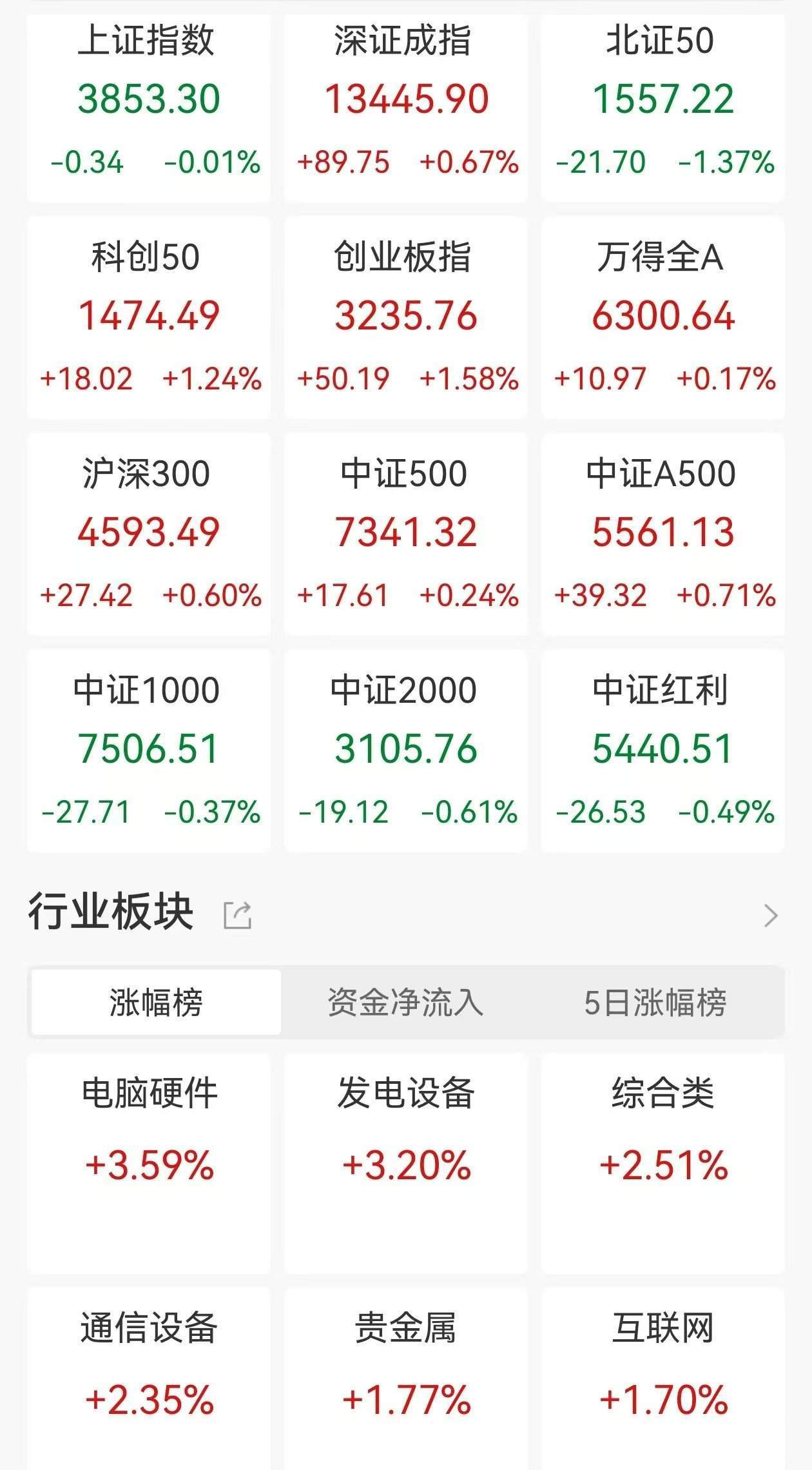
Market Overview - The A-share market showed mixed performance with the Shanghai Composite Index down by 0.01% and the Shenzhen Component Index up by 0.67% [1] - The total trading volume across Shanghai and Shenzhen markets reached 23,918 billion yuan, an increase of 446 billion yuan compared to the previous day [1] Sector Performance - AI concept stocks resumed their upward trend, with CPO, liquid cooling, and intelligent body concepts leading the gains [1] - The gaming, controllable nuclear fusion, copper metal, and film and television sectors also saw increases [1] - The semiconductor industry chain experienced a general pullback, while gold, oil and gas, and real estate sectors remained sluggish [1] Index Performance - The Shanghai Composite Index closed at 3,853.30, down 0.01% [2] - The Shenzhen Component Index closed at 13,445.90, up 0.67% [2] - The ChiNext Index rose by 1.58%, closing at 3,235.76 [2] ETF Performance - The cloud computing sector led the ETF market with significant gains, including the Xinhua Fund Cloud 50 ETF rising by 4.02% [3] - The Huabao Fund Big Data Industry ETF and the CMB Cloud Computing ETF both increased by 3.6% [3] - The semiconductor equipment sector saw a decline, with the semiconductor equipment ETF dropping by 1.42% [3]

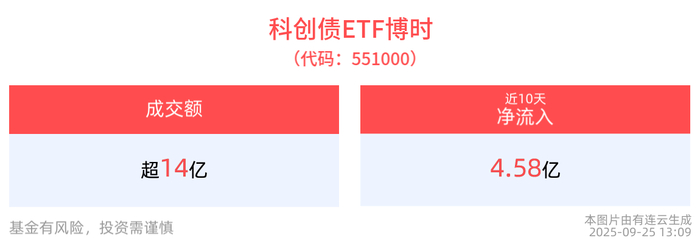
第二批14只科创债ETF上市首日成交活跃,科创债ETF博时(551000)近10日“吸金”合计4.58亿元
Xin Lang Cai Jing· 2025-09-25 05:38
Core Insights - The recent issuance of Sci-Tech Innovation Bonds by local banks indicates a growing support for technology innovation enterprises, which is expected to provide funding for small and medium-sized tech companies [3] Group 1: Market Performance - As of September 25, 2025, the Sci-Tech Bond ETF from Bosera (551000) has decreased by 0.26%, with the latest price at 99.02 yuan [2] - The trading volume for the Sci-Tech Bond ETF was active, with a turnover of 13.75% and a transaction value of 1.434 billion yuan [2] - Over the past year, the average daily transaction volume for the Sci-Tech Bond ETF has been 2.166 billion yuan [2] Group 2: Issuance and Growth - On September 19, Qingdao Bank successfully issued "25 Qingdao Bank Sci-Tech Bond" with a scale of 1 billion yuan, and Chongqing Three Gorges Bank issued "25 Three Gorges Bank Sci-Tech Bond 01" with a scale of 2 billion yuan from September 22 to 24 [2] - As of September 23, 2023, a total of 54 Sci-Tech Bonds have been issued by banks this year, with a cumulative issuance scale of 271 billion yuan [2] - More than 30 local banks have participated in the issuance of Sci-Tech Bonds, becoming a significant force in expanding the market [2] Group 3: Fund Size and Flow - The latest size of the Bosera Sci-Tech Bond ETF has reached 10.454 billion yuan [4] - The fund has seen a balance in inflows and outflows recently, with a total of 458 million yuan raised over the last 10 trading days [4] - The ETF closely tracks the Shanghai Stock Exchange AAA Technology Innovation Company Bond Index, which reflects the overall performance of eligible bonds [4]
美新屋销售数据大涨,金价高位承压回落,黄金ETF基金(159937)连续3日“吸金”合计近5亿元
Sou Hu Cai Jing· 2025-09-25 02:56
Group 1 - The core viewpoint of the articles highlights the recent fluctuations in gold prices and the performance of gold ETFs, influenced by economic data and Federal Reserve statements [1][2]. - As of September 25, 2025, the gold ETF (159937) decreased by 0.62%, with a latest price of 8.12 yuan, while it saw a cumulative increase of 2.74% over the past week [1]. - The liquidity of the gold ETF was notable, with a turnover rate of 1.47% and a transaction volume of 4.33 billion yuan, ranking it among the top two comparable funds in terms of average daily trading volume of 10.87 billion yuan over the past week [1]. Group 2 - Federal Reserve Chairman Jerome Powell's recent comments indicated that U.S. stock valuations are "quite high," and he reiterated the dual challenges of rising inflation and declining employment, which negatively impacted market sentiment [2]. - The U.S. Commerce Department reported that new home sales for August reached an annualized total of 800,000 units, significantly exceeding expectations of 650,000 units, marking a month-over-month increase of 20.5% [1][2]. - The gold ETF experienced a net inflow of funds over the past three days, with a peak single-day inflow of 347 million yuan, totaling 497 million yuan, and an average daily net inflow of 166 million yuan [2].
桦加沙”来袭!风雨中的金融守夜人:广深公募启动“驻楼模式
Zheng Quan Shi Bao Wang· 2025-09-24 22:38
Core Insights - The article discusses the response of financial institutions in Guangzhou and Shenzhen to Typhoon "Haikui," highlighting their preparedness and operational continuity during extreme weather conditions [1][2][5]. Group 1: Emergency Response Mechanisms - Financial companies activated emergency protocols, forming "on-site emergency teams" to ensure business continuity during the typhoon [2][3]. - Key personnel were stationed at offices while other employees worked remotely, ensuring that trading and investment operations remained uninterrupted [2][3]. - Companies had established remote working systems during the pandemic, which facilitated a smooth transition to online operations during the typhoon [5][6]. Group 2: Operational Continuity - Despite the typhoon, at least 44 fund companies continued to conduct research and maintain investor communication, demonstrating resilience in operations [5][6]. - Companies organized online meetings and maintained investor services through digital platforms, ensuring that clients could access information and complete transactions [6][8]. - The trading systems of the Shenzhen and Hong Kong stock exchanges remained stable, with no disruptions reported during the typhoon [7][8]. Group 3: Market Performance - The stock market showed positive performance during the typhoon, with the Shanghai Composite Index rising by 0.83% and the ChiNext Index increasing by 2.28% [7][8]. - The stability of the market during adverse weather conditions helped bolster investor confidence, reflecting the effectiveness of the financial institutions' emergency measures [8][9]. Group 4: Commitment to Stakeholders - Financial institutions emphasized their responsibility to protect investors' interests, ensuring that services remained available and operations continued smoothly [8][9]. - The actions taken by fund companies during the typhoon illustrated their commitment to maintaining market stability and supporting investor confidence [9].
芯片主题ETF迎大丰收 产业周期上行成基金共识
Zheng Quan Shi Bao· 2025-09-24 22:15
Core Viewpoint - The semiconductor industry is experiencing a significant rally, driven by strong market sentiment and positive industry developments, leading to substantial gains in related ETFs and stocks [1][2][4]. Group 1: Market Performance - On September 24, A-shares saw all major indices rise, with the Shanghai Composite Index up 0.83% and the Shenzhen Component Index up 1.8%, while the ChiNext Index reached a three-year high [2]. - Over 20 stocks in the semiconductor sector hit the daily limit up, including Chengbang Co., Zhangjiang Hi-Tech, and Tongfu Microelectronics [2]. - The trading volume for semiconductor-related ETFs surged, with the Guotai Fund's semiconductor ETF achieving a record daily trading volume of 1.987 billion yuan [3]. Group 2: Industry Catalysts - The semiconductor equipment sector's recent performance is attributed to a market shift towards more certain investment directions, supported by frequent industry benefits [1][6]. - Goldman Sachs raised the 12-month target price for SMIC's H-shares from 73.1 HKD to 83.5 HKD, citing a clearer long-term demand growth outlook for AI chips in China [4]. - Alibaba's CEO announced plans to invest 380 billion yuan in cloud computing and AI infrastructure over the next three years, indicating a significant increase in demand for AI-related semiconductor products [4][5]. Group 3: Investment Trends - The semiconductor industry is entering a second upward cycle, with increasing domestic production rates expected to enhance company performance [6]. - The recent rally in semiconductor stocks is partly due to a catch-up effect, as previous gains were concentrated in chip design companies, while equipment and materials sectors are now experiencing accelerated growth [5][6]. - Fund managers emphasize the importance of identifying high-quality companies that demonstrate sustained growth and technological breakthroughs in the semiconductor sector [6].


市场震荡不改向上趋势 投顾调仓“发车”两不误
Zhong Guo Zheng Quan Bao· 2025-09-24 20:23
Core Viewpoint - Multiple public fund institutions are adjusting their investment portfolios in response to the changing market environment, with a focus on balancing asset allocation between equity and fixed-income funds [1][2][6]. Group 1: Portfolio Adjustments - The "招商灵活进取" fund has significantly reduced its allocation to mixed funds and increased its investment in cross-border fixed-income QDII funds, with these new QDII funds accounting for approximately 20% of the portfolio [2]. - The "中欧超级股票全明星" fund has increased its exposure to Hong Kong internet theme products and medical theme funds, benefiting from the Federal Reserve's interest rate cuts [2][3]. - The "博时价值精选" fund has replaced underperforming funds with higher-quality balanced funds to enhance portfolio stability [3]. Group 2: Market Sentiment and Strategy - The frequent "发车" (launch) actions by various investment advisory products are seen as a positive market signal, indicating active management in response to market conditions [4]. - Year-to-date returns for several equity advisory products have been strong, with "中欧超级股票全明星" achieving a return of 35.66%, outperforming its benchmark by approximately 6 percentage points [5]. - Despite short-term market volatility, long-term prospects for the A-share market remain positive, supported by low interest rates, long-term capital inflows, and favorable policies [6][7]. Group 3: Investment Recommendations - Investment advisors recommend maintaining a balanced portfolio and avoiding impulsive trading in hot sectors, as the market is currently in a consolidation phase [6][7]. - The technology sector, while previously a leading investment theme, is experiencing increased volatility, suggesting a need for careful selection of investments based on supply-demand dynamics and reasonable valuations [6].
市场震荡不改向上趋势投顾调仓“发车”两不误
Zhong Guo Zheng Quan Bao· 2025-09-24 20:17
Group 1 - Multiple public fund institutions have initiated a new round of portfolio adjustments to respond to the changing market environment, with some reducing equity fund positions and increasing allocations to fixed-income funds [1][2] - The adjustments include a significant reduction in mixed fund positions and an increase in cross-border fixed-income QDII funds, with specific funds accounting for approximately 20% of the portfolio [1] - The market sentiment remains optimistic about the long-term upward trend of the equity market despite short-term fluctuations, encouraging a balanced asset allocation approach [1][3] Group 2 - The "launch" function of investment advisory products has been frequently utilized, indicating a potentially positive market signal as multiple products announce new plans [2][3] - Year-to-date returns for several equity advisory products have been strong, with notable performances exceeding benchmarks, such as the China Europe Super Stock All-Star achieving a return of 35.66% [3] - The current market is experiencing significant volatility, with a recommendation against chasing hot sectors, suggesting a focus on maintaining a balanced portfolio and flexible asset allocation [4][5]
25Q2理财的基金投资有何变化?:银行理财资产配置专题分析
Hua Yuan Zheng Quan· 2025-09-24 07:43
Group 1: Investment Rating - No investment rating for the industry is provided in the report. Group 2: Core Views - The bank wealth - management industry has entered the era of wealth - management companies, with regulatory requirements approaching those of the public fund industry. The scale of wealth management increased in 25Q2 compared to 25Q1, and the net - breaking rate decreased slightly in 25Q2 but increased since late July. The industry increased its allocation to public funds in 25H1, mainly increasing positions in money - market and bond funds in 25Q2 [2][6][10]. - Different types of wealth - management companies have different performance and asset - allocation characteristics. Large - bank wealth - management companies generally increased their allocation to public funds, and their overall scale and proportion of public - fund investment rose. Joint - stock bank wealth - management companies also generally increased their allocation to public funds and slightly increased their allocation to deposit - type assets. Most urban and rural commercial bank wealth - management companies increased their allocation to deposit - type and public - fund assets and reduced their allocation to bond assets [37][39][42]. - The indirect investment ratio of wealth - management companies has increased in recent years, which may be related to the configuration of deposits through insurance asset management and trust plans and bond investment through SPV [45]. Group 3: Summary by Directory 1. 25H1 Wealth - Management Scale Steady Growth 1.1 Bank Wealth Management Enters the Era of Wealth - Management Companies - Regulatory requirements for bank wealth management are getting closer to those of the public fund industry. Since 2018, a series of regulatory policies have been introduced, narrowing the gap between the two industries. As of September 2025, 32 wealth - management companies have been approved for establishment and all are in operation. It is expected that there will be about 40 wealth - management companies in the future, and small and medium - sized banks without wealth - management companies will gradually withdraw from the wealth - management business [6][10]. - In the first half of 2025, the net profit of wealth - management companies showed stable growth. The overall net profit increased by 1.7% year - on - year, with large - bank and joint - stock bank wealth - management companies seeing growth of 7.2% and 0.2% respectively, while urban and rural commercial bank wealth - management companies' net profit decreased by 7.3% [12]. 1.2 25Q2 Wealth - Management Scale Slightly Increased Compared to 25Q1 - As of June 2025, the wealth - management scale was 30.67 trillion yuan. In 25Q1, the scale decreased by 0.8 trillion yuan, and in 25Q2, it increased by about 1.5 trillion yuan. In July 2025, the scale increased seasonally, and the growth slowed down in August [15][17]. - In 25Q2, the wealth - management scale of most wealth - management companies increased, with large - bank, joint - stock bank, and urban and rural commercial bank wealth - management companies seeing increases of 7.8%, 4.6%, and 10.9% respectively compared to 25Q1. By type, the scale of fixed - income and hybrid products of various wealth - management companies increased in Q2 compared to Q1 (except for the hybrid products of joint - venture wealth - management companies) [20][23]. - The net - breaking rate of wealth - management products decreased slightly in 25Q2 but increased since late July. As of September 14, 2025, the net - breaking rate of public wealth - management products of wealth - management companies was about 2.28%, higher than that at the beginning of the year. The average performance comparison benchmark of newly issued RMB fixed - income wealth - management products of wealth - management companies has been declining [25][28]. 2. Bank Wealth Management Increased Allocation to Public Funds in 25H1 2.1 Wealth Management's Investment Proportion in Public Funds Increased Significantly in 25Q2 - In 25H1, bank wealth - management products increased their allocation to public funds. As of June 2025, the proportion of bank wealth - management products invested in bonds, deposits, non - standard assets, equities, and public funds was 55.6%, 24.8%, 5.5%, 2.4%, and 4.2% respectively, with changes of - 1.8, + 1.5, - 0.1, - 0.2, + 1.2 percentage points compared to 25Q1 [32]. - In 25Q2, most wealth - management companies increased their allocation to public funds. Bohai Bank Wealth Management and Huaxia Bank Wealth Management had relatively large increases in the proportion of public - fund investment [33]. 2.2 Asset - Allocation Changes of Wealth - Management Companies' Wealth Management in the First Half of 2025 - Large - bank wealth - management companies generally increased their allocation to public funds, with the total scale rising to 0.4 trillion yuan and the proportion rising to 3.8%. Except for Jianxin and Jiaotong Wealth Management, the proportion of deposit - type assets decreased, and except for Jianxin and Nongyin Wealth Management, the proportion of bond assets decreased [37]. - Joint - stock bank wealth - management companies generally increased their allocation to public funds, with the overall proportion rising from 2.6% at the end of 2024 to 3.8%. Bohai Bank Wealth Management and Huaxia Bank Wealth Management had relatively large increases in the proportion of public - fund investment. They also slightly increased their allocation to deposit - type assets [39]. - Most urban and rural commercial bank wealth - management companies increased their allocation to deposit - type and public - fund assets and reduced their allocation to bond assets. The three urban and rural commercial bank wealth - management companies with the highest proportion of public - fund allocation were Qingyin, Huiyin, and Shangyin [42]. - The indirect investment ratio has increased. As of H1 2025, the indirect investment scale of 20 wealth - management companies was 10.97 trillion yuan, accounting for 65.8%, and the proportion has increased in recent years [45]. 3. Wealth Management Increased Allocation to Money - Market and Bond Funds in 25Q2 - In 25Q2, the scale of wealth management's allocation to public funds increased significantly. As of June 2025, the scale was about 1.3 trillion yuan, accounting for 4.2%, the highest since 2020, an increase of 1.2 percentage points compared to 25Q1 [49]. - Bond funds are still the main type of public funds allocated by bank wealth management. In 25Q2, bank wealth management mainly increased its allocation to money - market and bond funds, with increases of about 0.05 trillion yuan and 0.29 trillion yuan respectively. It reduced its allocation to hybrid, stock, and alternative investment funds, and slightly reduced its allocation to REITs and QDII/international funds [50]. - In terms of the breakdown of bond funds, in 25Q2, the investment proportion of medium - and long - term pure - bond funds and first - class hybrid bond funds decreased, while the investment proportion of passive index - type bond funds and short - term pure - bond funds increased. In 25Q2, wealth management increased its allocation to medium - and long - term pure - bond funds, short - term pure - bond funds, and passive index - type bond funds by 0.08, 0.1, and 0.1 trillion yuan respectively [55]. - Wealth - management products prefer to invest in bond funds with large scales. The top three bond funds in terms of wealth - management holdings as of June 2025 were Fuguo Two - Year Financial Management Bond, Huitianfu Changtianli Fixed - Open Bond, and Huitianfu China Bond Preferred Investment - Grade Credit Bond Index Initiation [62]. - In terms of the breakdown of stock and hybrid funds, in 25Q2, the investment proportion of flexible - allocation funds increased, while the investment proportion of passive index - type and common stock funds decreased. The investment scale in stock and hybrid funds decreased, with reductions of about 100 million yuan, 380 million yuan, and 70 million yuan in flexible - allocation, passive index - type, and partial - debt hybrid funds respectively [64]. - Wealth management's investment in stock and hybrid funds prefers flexible - allocation and passive index - type funds. As of June 2025, the top three stock and hybrid funds in terms of wealth - management holdings were Penghua Hongkang Hybrid, Guangfa Anying Hybrid, and Dongfanghong CSI Dongfanghong Dividend Low - Volatility Index [69]. 4. Differences in Public - Fund Investment of Different Types of Wealth Management - Fixed - income wealth management has the largest absolute scale of public - fund holdings, while hybrid and equity wealth management have relatively high proportions of public - fund allocation. As of June 2025, fixed - income and hybrid wealth management held public funds worth 1.22 trillion yuan and 0.08 trillion yuan respectively, accounting for 90.1% and 5.98% of the total public - fund investment scale of wealth management. The proportion of public - fund investment in hybrid wealth management was about 11%, higher than the 5% of fixed - income wealth management [71].
天岳先进股价涨5.06%,博时基金旗下1只基金重仓,持有14.89万股浮盈赚取62.85万元
Xin Lang Cai Jing· 2025-09-24 05:16
Group 1 - Tianyue Advanced experienced a stock price increase of 5.06%, reaching 87.59 CNY per share, with a trading volume of 9.62 billion CNY and a turnover rate of 2.64%, resulting in a total market capitalization of 424.48 billion CNY [1] - The company, Shandong Tianyue Advanced Technology Co., Ltd., specializes in the research, production, and sales of silicon carbide substrates, with its main business revenue composition being 82.83% from silicon carbide semiconductor materials and 17.17% from other supplementary sources [1] Group 2 - According to data from the top ten holdings of funds, Bosera Fund has one fund heavily invested in Tianyue Advanced, specifically the Bosera SSE Sci-Tech Innovation Board New Materials ETF (588010), which reduced its holdings by 21,600 shares in the second quarter, now holding 148,900 shares, accounting for 3.41% of the fund's net value, ranking as the seventh largest holding [2] - The Bosera SSE Sci-Tech Innovation Board New Materials ETF (588010) was established on September 30, 2022, with a current scale of 256 million CNY, achieving a year-to-date return of 44.28%, ranking 779 out of 4,220 in its category, and a one-year return of 99.6%, ranking 594 out of 3,814, while experiencing a loss of 20.01% since inception [2]
