阿里

Search documents
马斯克说“中国将最终赢得AI竞争”,有什么深意?
创业邦· 2026-01-23 10:15
Core Viewpoint - Musk's assertion that "China will be the biggest winner in AI competition" is based on the premise that electricity is the bottleneck for AI development, and China possesses the largest power infrastructure globally, which will enable it to surpass other regions in AI computing power [6]. Group 1: AI Competition Landscape - The AI competition has shifted from a focus on chips to the entire industrial infrastructure, revealing electricity shortages as a critical issue [8]. - From 2023 to 2025, the AI arms race centers around chip capabilities, particularly Nvidia's GPU architecture, which has seen limited power improvements [10]. - Despite advancements in domestic chip production, challenges such as ecological constraints and high-end equipment embargoes hinder progress, resulting in major AI firms like ByteDance and Alibaba not meeting their capital expenditure plans for AI [10]. Group 2: Electricity as a Bottleneck - By mid-2025, the focus of AI infrastructure development will pivot to electricity, as the power demands of AI systems outpace chip advancements [11]. - China has a total installed power capacity of 3.8 billion kilowatts, with projected electricity consumption of approximately 10.4 trillion kilowatt-hours in 2025, indicating a significant surplus even if global data centers were to rely solely on Chinese power [12]. - In contrast, the U.S. has an installed capacity of about 1,300 GW, with electricity generation only half that of China, and a lower redundancy level compared to China [14]. Group 3: Future Electricity Demand - The U.S. electricity consumption has stagnated over the past 20 years, with industrial electricity demand declining, leading to a projected increase in electricity prices due to rising AI power consumption [15][17]. - By 2030, AI electricity demand in the U.S. is expected to reach 10% of total consumption, potentially rising to 800-1,000 TWh by 2035, which could account for nearly 20% of total electricity use [17]. - The U.S. faces a structural electricity supply issue, with a significant risk of power shortages by 2027 if new capacity is not added [22]. Group 4: China's Electricity Advantage - China's electricity development strategy has resulted in a robust and redundant power supply system, with a projected total generation of 15 trillion kilowatt-hours by 2035, significantly outpacing the U.S. [25]. - The electrification rate in China is expected to reach 35% by 2030, surpassing the OECD average by 8 percentage points [25]. - In contrast, the U.S. is experiencing rising electricity prices, with residential and industrial rates higher than in China, indicating a shift away from historically low prices [28]. Group 5: U.S. Electricity Market Challenges - The U.S. electricity market is characterized by regional disparities and a lack of cohesive infrastructure, complicating the resolution of electricity supply issues [19][30]. - Proposed solutions include allowing large tech companies to build localized power grids, but this approach does not address the underlying generation and grid issues [28]. - The U.S. is exploring options such as gas turbines and nuclear power to meet future electricity demands, but these solutions face significant implementation challenges [30].



20cm速递|创业板人工智能ETF国泰(159388)回调超1.2%,近10日净流入超1亿元,关注科技自主与AI应用进展
Mei Ri Jing Ji Xin Wen· 2026-01-23 07:16
Core Insights - The article discusses the recent performance of the ChiNext AI ETF Guotai (159388), which has seen a decline of over 1.2% on January 23, while experiencing a net inflow of over 100 million yuan in the past 10 days, highlighting the focus on technological independence and AI application progress [1] Group 1: AI and Cloud Developments - The report mentions that Qianwen App has integrated with Alibaba's ecosystem, launching AI Agent capabilities and achieving AI shopping functionality [1] - OpenAI and Google are actively investing in the AI + healthcare sector [1] - A BCG survey indicates that over 90% of enterprises plan to maintain long-term investments in AI, with some intending to double their AI investments by 2026 [1] Group 2: Market Outlook and Index Information - Alibaba Cloud aims to capture 80% of the incremental AI cloud market in China by 2026 [1] - The ChiNext AI ETF tracks the ChiNext AI Index (970070), which has a daily price fluctuation limit of 20% and selects listed companies involved in AI technology and applications from the ChiNext market [1] - The index focuses on high-tech growth companies, emphasizing innovation capability and future development potential [1]

2026,南京AI进化之路全面提速
Yang Zi Wan Bao Wang· 2026-01-23 04:02
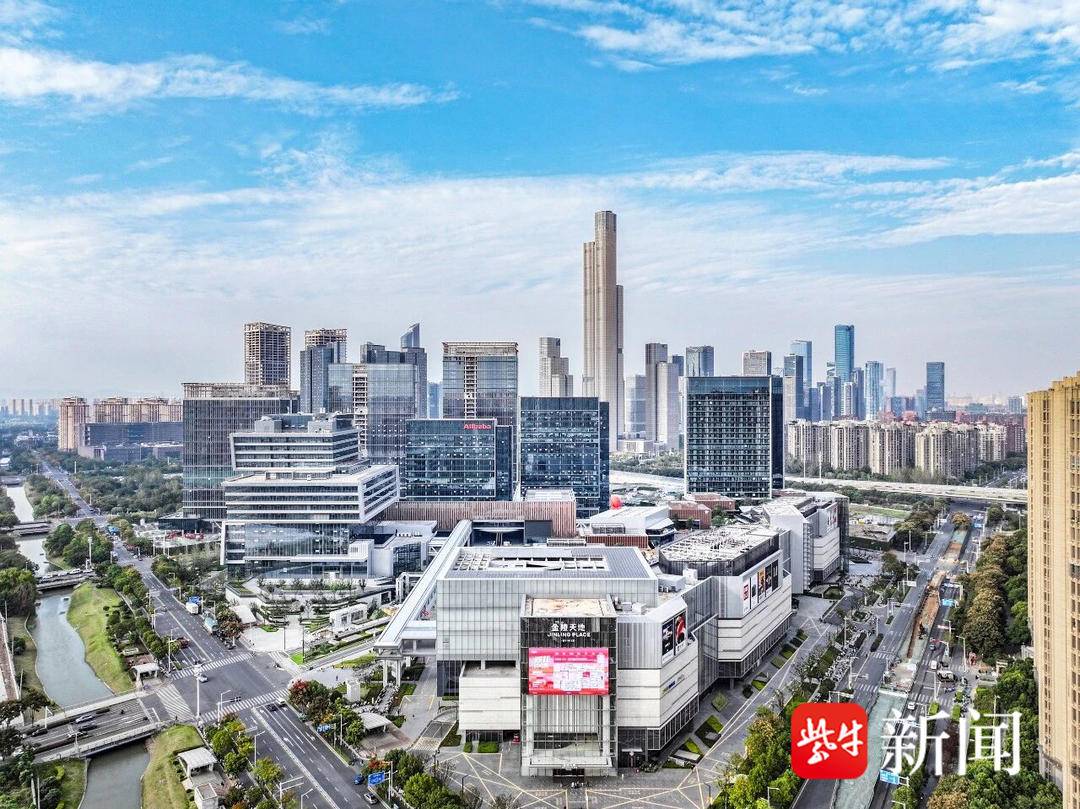
1月19日,《AI时空.南京人工智能国际社区建设三年行动计划(2026-2028)》正式发布,到2028年,这里将引入超1000家相关企业与团队,集聚超过2万名 人才,剑指千亿级产业集群——这是2026年南京AI产业加速起跑的最新注脚。 从政策蓝图的密集落地到企业产能的持续爆发,开年以来的南京AI赛道热度攀升。从科创园区的生态集聚到实体产业的智能迭代,南京的AI进化,从来 都不是孤立的政策推动,而是一场扎根产业土壤、联动政企产学研的全链变革。 一、时间线里的布局:从筑基到冲刺的AI征程 南京对AI的布局,藏在一步步扎实的规划里,每一步都精准踩中产业发展的脉搏,让政策与市场形成同频共振。 早在2025年,南京就已启动河西中央科创区建设,聚焦"数×智+"赛道发力,南京阿里中心建成开园,小米科技园升级为超级研发中心,宝马全球研发中 心注册落地,京东南京研发中心创造了集团项目落地最快纪录,"头部引领、链式发展"的产业模式初步成形,为AI生态筑牢根基。 二、全链进阶的底气:从传统根基到生态闭环 南京能在AI赛道上稳步领跑,根源在于产业根基的深厚与生态体系的完善。从算力底座、硬件制造到场景应用、人才培养,一条完整的AI产 ...
光环新网:无双科技2026年起不再是阿里核心代理商
Zheng Quan Ri Bao Wang· 2026-01-22 09:40
证券日报网讯1月22日,光环新网(300383)在互动平台回答投资者提问时表示,公司子公司无双科技 2021年-2025年是阿里的核心代理商。2026年因无双科技战略调整,加大对优势媒体的投入及信息流媒 体的开发,不再是阿里核心代理商。 ...

计算机行业月报:AI应用全面加速,DeepSeekV4有望深刻改变全球AI的竞争格局-20260122
Zhongyuan Securities· 2026-01-22 08:53
Investment Rating - The report maintains an "Outperform" rating for the computer industry, indicating a positive outlook compared to the market [1]. Core Insights - The acceleration of AI applications is expected to significantly alter the global AI competitive landscape, particularly with the anticipated release of DeepSeek's V4 model [7]. - The Chinese AI cloud market is projected to reach 51.8 billion yuan by 2025 and 193 billion yuan by 2030, with Alibaba aiming to capture 80% of the market's incremental growth in 2026 [7]. - The report highlights the ongoing trend of domestic chip manufacturers gaining market share due to restrictions on foreign competitors like NVIDIA [7]. Summary by Sections Industry Data - From January to November 2025, the software industry revenue reached 13.98 trillion yuan, growing by 13.3% year-on-year, marking a continuous recovery over nine months [13]. - The IC design sector showed a robust growth of 16.5% during the same period, outperforming the overall software industry growth [18]. AI Developments - Major AI models such as OpenAI's GPT-5 and DeepSeek's V3.2 are leading the market, with DeepSeek's models expected to challenge established players significantly [39][44]. - The report notes that the trend of using domestic chips for training large models is anticipated to grow in 2026, with DeepSeek already optimizing its models for compatibility with local hardware [63]. Domestic Market Trends - The report emphasizes the increasing importance of domestic chip manufacturers, as restrictions on foreign technology create opportunities for local firms [7]. - The number of devices running Huawei's HarmonyOS has surpassed 36 million, indicating strong growth in the domestic software ecosystem [7]. Investment Opportunities - The report suggests focusing on companies like Runze Technology, Sugon, and Huada Jiutian, which are positioned well within the AI and chip sectors [7]. - The ongoing IPOs of companies like Changxin Technology and Chipone Semiconductor are highlighted as potential investment opportunities in the semiconductor space [7].




GenAI系列报告之68:2026大模型幻觉能被抑制吗?
Shenwan Hongyuan Securities· 2026-01-22 08:27
Investment Rating - The report maintains a positive outlook on the industry, specifically highlighting the potential for effective control of AI model hallucinations by 2026 [2]. Core Insights - The report emphasizes that while hallucinations in AI models are inevitable, advancements in algorithms, data quality, and engineering practices can significantly reduce their occurrence. The top 25 global models have achieved a hallucination rate below 8% [5][6]. - The report identifies three key areas for investment: mature AI applications, marketing AI that is less sensitive to hallucinations, and data plus AI infrastructure [6]. Summary by Sections 1. Hallucinations - The Lower Bound of Model Capability - The report defines hallucinations as overconfident errors produced by language models, which can include fabrications, factual inaccuracies, contextual misunderstandings, and logical fallacies. For instance, GPT-3.5 had a hallucination rate of approximately 40%, while GPT-4's rate was 28.6% [14][15]. 2. Sources of Hallucinations - Hallucinations arise from several factors, including model architecture, toxic data, lack of accuracy in reward objectives, and context window limitations. Addressing these factors is crucial for controlling hallucinations [7][8]. 3. Reducing Hallucinations: From Models, Data, Engineering, and Agents - The report discusses various strategies to mitigate hallucinations, such as using larger training datasets, extending context windows, and incorporating human feedback through reinforcement learning (RLHF) [25][26]. - Engineering practices like Retrieval-Augmented Generation (RAG) are becoming standard, with Gartner predicting a 68% adoption rate by 2025 [56][57]. 4. 2B Application Penetration and Evolution - The report notes that the control of hallucinations in mainstream models has made significant progress, with the top 25 models in the Vectara HHEM ranking achieving hallucination rates below 8%. For example, the Finix model developed by Ant Group has a hallucination rate of only 1.8% [72].



计算机行业周报:千问App接入阿里生态业务
Guoxin Securities Co., Ltd· 2026-01-21 13:25
Investment Rating - The report gives a "Positive" rating for the computer industry, expecting the industry index to outperform the market index by over 5% in the next six months [33]. Core Insights - The computer industry index rose by 3.82% from January 12 to January 16, outperforming the CSI 300 index by 4.39 percentage points, making it the top-performing sector among other industries [2][11]. - Key stocks that performed well include Tongda Hai with a 39.73% increase, Haohan Deep with a 30.57% increase, and Jiechuang Intelligent with a 28.95% increase. Conversely, *ST Lifang saw a decline of 33.66%, followed by Aerospace Information at -14.46% and Haixia Innovation at -13.40% [14][15]. - Significant developments include the announcement of the integration of Qianwen App into Alibaba's ecosystem, enabling AI-driven services for tasks like ordering food and booking flights [3][31]. Market Performance - The computer industry has a total of 335 listed companies, with 234 companies seeing a rise, accounting for 69.85% of the sector [14]. - The report highlights the performance of individual stocks, with notable gains and losses during the specified period [15]. Recent Developments - Elon Musk announced the open-sourcing of the latest recommendation algorithm for X, promising updates every four weeks [3]. - Apple and Google have entered a partnership where Google's Gemini will support Apple's AI initiatives, with Apple expected to pay around $1 billion annually for this technology [18][19]. - Meta's CEO Mark Zuckerberg announced the Meta Compute initiative, aiming to build a GW-level AI infrastructure over the next decade [21][22]. - The U.S. has relaxed export controls on NVIDIA's H200 chips to China, which is expected to restart shipments to Chinese customers [24].




国泰海通:智能眼镜产业链有望步入快速成长期 推荐明月镜片(301101.SZ)等
智通财经网· 2026-01-21 07:21
Core Viewpoint - The AI glasses industry is expected to enter a rapid growth phase, driven by technological breakthroughs and new product launches, benefiting companies within the supply chain [1][2]. Group 1: Industry Overview - The AI glasses supply chain is larger and more complex than traditional eyewear, incorporating various electronic components and a wider range of participating manufacturers [2]. - Key players in the AI glasses market include smartphone manufacturers, internet companies, XR firms, traditional eyewear brands, and 3C companies, with XR startups collaborating with traditional eyewear manufacturers [2]. Group 2: Sales Growth - Domestic AI glasses sales are projected to reach 210,000 units by Q3 2025, reflecting a quarter-on-quarter growth of approximately 200%, primarily driven by brands like Xiaomi and Ray-Ban Meta [3]. - Notable product launches include Xiaomi AI glasses, which are expected to surpass total sales of 300,000 units by the end of 2025, and Alibaba's Quark AI glasses, which have seen strong pre-sale demand [3]. - Ray-Ban Meta's global sales are anticipated to reach 1.12 million units by Q3 2025, with a quarter-on-quarter growth of nearly 50% [3].


智能眼镜行业跟踪报告:智能眼镜产品力系列深度一:AR的崛起,不是偶然
GUOTAI HAITONG SECURITIES· 2026-01-21 05:20
Investment Rating - The report rates the smart glasses industry as "Buy" [1] Core Insights - The smart glasses industry is expected to enter a rapid growth phase, with related companies poised to benefit from an upturn in market conditions. Recommended companies include Mingyue Lens, which is actively collaborating with leading brands in the industry, and Inpai, which is accelerating its layout in the smart sports equipment sector [2][66] - The launch of the Ray-Ban Meta smart glasses marks a new cycle in smart glasses products, featuring improved audio and video quality, and integration with Meta's social platforms [2][66] - The supply chain for smart glasses has expanded significantly, incorporating more electronic components compared to traditional eyewear, with a diverse range of manufacturers involved [2] Summary by Sections New Product Developments - The domestic AI glasses market has seen a rapid increase in sales, with 210,000 units sold in Q3 2025, a 200% quarter-on-quarter growth. Major contributors include Xiaomi, Ray-Ban Meta, and others [5][8] - Xiaomi's AI glasses are projected to surpass 300,000 units sold by the end of 2025, while the Ray-Ban Meta has achieved global sales of 1.12 million units in Q3 2025, reflecting a nearly 50% increase [5][6] Key Players and Products - Major AR glasses manufacturers are actively launching new products, including: - Ray-Ban V3 by FFALCON, released in January 2025 - INMO Air 3, set to launch in November 2024 - Rokid Glass, expected to be available in June 2025 [6][15] - The report highlights the emergence of unicorn brands in the AI glasses sector, with valuations exceeding 1 billion RMB for companies like INMO and Rokid [11] Market Trends and Projections - The CES 2026 event is expected to showcase a significant increase in AI glasses exhibitors, with 55 companies participating, up from over 30 in 2025 [11][14] - The report anticipates continued innovation in 2026, with major tech companies like Google and Apple planning to release new AI glasses [14] Financial Projections - Financial forecasts for key companies in the smart glasses sector indicate a positive outlook, with Mingyue Lens and Inpai both rated as "Buy" based on their earnings per share (EPS) projections for 2025 to 2027 [68]
从康波周期,看AI进入大规模应用阶段的重要信号
Sou Hu Cai Jing· 2026-01-21 00:55
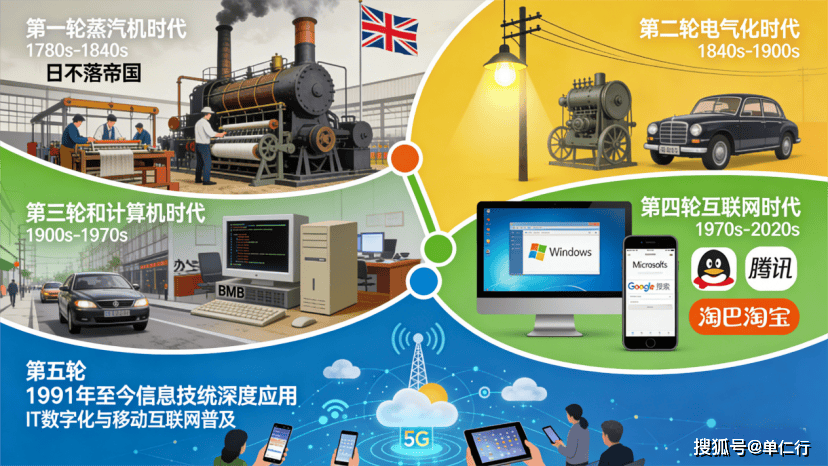
我在最近一个月研究中,越来越确定一件事。 AI,已经不是实验室里的花架子,而是进入到大规模应用,我们正站在一个比2000年互联网、2010年移动互联网更猛的大风口上。 我们用"康波周期"的规律,就能看得更明白。 02 我们先来看康波周期什么?跟我们有什么关系? 康波周期由苏联经济学家尼古拉・康德拉季耶夫在1920年代提出,他通过分析英、法、美等国1780年以来的价格、利率、工业产出等数据,发现经济存在 一种"50-60年"的长期波动规律,这就是康波周期。 它有两个要点: 1、经济每隔50-60年就会换个发动机,这个发动机就是新技术,而非短期政策或市场波动。 01 2、周期内最大的财富机会,出现在"新技术从实验室走向大规模应用"的阶段,比如说我们当前AI所处的关键节点。 我们看前几轮的康波周期就更直观了。 第一轮是蒸汽机时代(1780s-1840s):以前织布靠人工,在纺织机、蒸汽机的帮助下,工业效率大幅提升,英国也成了"日不落帝国"。 第二轮是电气化时代(1840s-1900s):电灯、电报以及内燃机的出现,让德、美逐步超过英国,当时搞电力设备、汽车的,比如福特,就是那轮周期的 龙头。 第三轮是汽车和计算机时 ...