
Blue Owl Capital Inc.

Search documents
关于2026年的四个猜想和三十八张图
虎嗅APP· 2026-01-07 00:56
Core Viewpoint - The article discusses the investment landscape in 2025, highlighting a year of significant growth across various asset classes, with exceptions in digital currencies, government bonds, and oil. The author reflects on the unpredictability of market movements and the challenges in making accurate predictions in such a dynamic environment [4][5]. Group 1: Economic and Market Trends - The Chinese government aims to reduce local government hidden debt from 14.3 trillion RMB to 7 trillion RMB by the end of 2025, indicating progress in debt management [6]. - China achieved a trade surplus of 1 trillion USD in 2025, a significant increase compared to previous years, where a quarterly surplus now matches the annual surplus of a decade ago [10]. - The prices of major commodities, excluding oil, have risen, alleviating the "no profit prosperity" situation for upstream and midstream manufacturing sectors [13]. Group 2: Geopolitical Influences - The external environment has shifted dramatically, with the U.S. under Trump's administration becoming more aggressive in foreign policy, impacting China's focus on external challenges [7][8]. - The article notes a divergence in industrial strategies between China and the U.S., particularly in sectors like semiconductors and AI, with China rapidly advancing in domestic production capabilities [15][16]. Group 3: AI and Employment Concerns - A significant prediction is made regarding a potential backlash against AI in the U.S., driven by concerns over job losses and the concentration of wealth among tech oligarchs [22][23]. - The article references a report by Bernie Sanders, highlighting the potential for AI to displace nearly 100 million jobs in the U.S. over the next decade, raising ethical and economic concerns about the future of work [24][25]. Group 4: Private Equity and Credit Markets - The private equity and private credit markets in the U.S. have grown significantly, with 72% of non-financial corporate loans now sourced from private markets, indicating a shift away from traditional public financing [46][54]. - The article warns of potential bubbles forming in private credit markets, where valuation practices may obscure true risks, similar to conditions leading up to the 2008 financial crisis [66][76]. Group 5: Chinese Household Savings and Stock Market Dynamics - Chinese households have accumulated 48.7 trillion RMB in excess savings from 2022 to 2024, driven by a decline in real estate investment and low returns on traditional savings [81][82]. - There is a growing possibility that these savings will flow into the stock market, particularly through insurance companies, as they seek better returns amid low interest rates [88][90]. Group 6: Foreign Investment and Perceptions of China - The article highlights a disconnect between Western investors and the current realities of the Chinese market, with many foreign entities lacking a nuanced understanding of China's economic landscape [109][110]. - It suggests that a shift in perception may occur in 2026, potentially driven by improved economic indicators or a favorable shift in the global investment climate [119][120].


Blue Owl Capital Inc. Sued for Securities Law Violations - Contact The Gross Law Firm Before February 2, 2026 to Discuss Your Rights - OWL
Prnewswire· 2026-01-05 14:00
Core Viewpoint - The Gross Law Firm has issued a notice to shareholders of Blue Owl Capital Inc. regarding a class action lawsuit due to alleged misleading statements and undisclosed liquidity issues during a specified class period [1][2]. Group 1: Allegations - The complaint alleges that Blue Owl was under significant pressure on its asset base from redemptions by business development companies [1]. - It is claimed that the company faced undisclosed liquidity issues as a result of these pressures [1]. - The lawsuit suggests that Blue Owl may limit or halt redemptions of certain business development companies due to these liquidity concerns [1]. - Positive statements made by the defendants about the company's business and prospects were allegedly materially misleading and lacked a reasonable basis [1]. Group 2: Class Action Details - The class period for the lawsuit is defined as February 6, 2025, to November 16, 2025 [1]. - Shareholders are encouraged to register for the class action by February 2, 2026, to potentially be appointed as lead plaintiffs [2]. - Once registered, shareholders will receive updates through a portfolio monitoring software regarding the case's status [2]. Group 3: Law Firm Background - The Gross Law Firm is recognized nationally for its commitment to protecting investors' rights against deceit and fraud [3]. - The firm aims to ensure companies adhere to responsible business practices and seeks recovery for investors who suffered losses due to misleading statements [3].


Top & Flop ETF Areas of 2025 (Revised)
ZACKS· 2026-01-04 17:00
Market Overview - The year 2025 began with optimism post-election, but faced challenges from low-cost AI initiatives from China, adverse impacts on U.S. Big Tech, Trump tariffs, sticky inflation, and high interest rates [1] - Market stabilization occurred in May after a turbulent April due to tariffs [1] - Midyear market euphoria solidified with easing trade tensions and three Fed rate cuts starting in September, but momentum faded due to a government shutdown and overvaluation concerns in the AI sector [2] AI Market Dynamics - By mid-December, the AI market was experiencing a mix of optimism and caution, highlighted by Oracle's $10 billion data center project facing funding issues, impacting tech stocks like Nvidia and Broadcom, while Micron's strong earnings boosted its shares [3] ETF Performance - Wall Street showed positive performance in 2025, with SPDR S&P 500 ETF Trust (SPY) up 18.1%, Invesco QQQ Trust (QQQ) up 22.3%, and SPDR Dow Jones Industrial Average ETF Trust (DIA) up 15% year-to-date as of December 26, 2025 [4] Gainers in ETFs - Silver Miners: iShares MSCI Global Silver and Metals Miners ETF (SLVP) up 220.3% and Amplify Junior Silver Miners ETF (SILJ) up 202.1% due to high demand and supply tightness [5] - Gold Miners: Global X Gold Explorers ETF (GOEX) up 199.3% and VanEck Junior Gold Miners ETF (GDXJ) up 190.6% driven by a 70% increase in gold prices, Fed rate cuts, and central bank demand [6] - Platinum: GraniteShares Platinum Trust (PLTM) up 165.3% and abrdn Physical Platinum Shares ETF (PPLT) up 165.1% as platinum futures surged above $2,400 per ounce amid industrial demand recovery [7] Losers in ETFs - Meme Stocks: Roundhill Meme Stock ETF (MEME) down 42.6% as investors shifted focus to profitable firms amid market volatility [10] - Volatility: ProShares VIX Short-Term Futures ETF (VIXY) down 41.9% reflecting market expectations of near-term volatility, underperforming despite a steady Wall Street [11]
AI Debt Spree Is Fueling a Credit Trading Frenzy: Credit Weekly
Yahoo Finance· 2026-01-03 20:00
Group 1 - The growth in artificial intelligence spending and the private credit market is driving increased borrowing by companies and setting new records for corporate-bond trading [1][3] - An average of $50 billion in investment-grade and high-yield bonds was traded daily last year, a record high, up from $46 billion in 2024, reflecting the benefits of longer-term changes like electronic trading [2] - Major dealers, including Morgan Stanley and JPMorgan Chase & Co., anticipate record issuance of high-grade US corporate debt, partly due to companies funding AI infrastructure investments [3][4] Group 2 - Companies like Meta Platforms Inc. and Blue Owl Capital Inc. raised approximately $27 billion in high-grade debt for a data center project, indicating a trend of borrowing in private markets [4] - The issuance of longer-dated bonds by tech companies and utilities to fund AI-related investments is expected to increase trading activity [5] - The volatility in bond prices, influenced by shifts in the yield curve, is attracting hedge funds and active traders [6] Group 3 - As companies increase borrowing for AI projects, investors are becoming more cautious about their exposure to tech companies and utilities, leading to heightened hedging activity in the credit default swap market [7]
Market Rotation Alert: Positioning For A Potentially Tumultuous Year
Seeking Alpha· 2026-01-02 13:50
Group 1 - The High Yield Investor has invested significant resources, including thousands of hours and over $100,000 annually, to identify profitable investment opportunities, resulting in nearly 200 five-star reviews from members [1] - The organization is celebrating its fifth anniversary by offering new members a 30-day money-back guarantee, coinciding with the upcoming release of their Top Picks for 2026 [1] - There is an ongoing intra-market rotation, which has been increasingly discussed in recent months, supported by hard data [2] Group 2 - Samuel Smith, the lead analyst of High Yield Investor, has a diverse background in dividend stock research and engineering, and he collaborates with Jussi Askola and Paul R. Drake to balance safety, growth, yield, and value in investment strategies [3] - High Yield Investor provides various services, including real-money core, retirement, and international portfolios, along with regular trade alerts and educational content for investors [3]

Lloyd: Gold Still a Buy, GOOGL & MSFT to Outperform AMZN in 2026
Youtube· 2025-12-29 23:00
Market Overview - The S&P 500 and NASDAQ experienced a rebound in December after being down approximately 7% from their peak a month prior, driven by increased liquidity in the market [2] - The Federal Reserve is actively injecting liquidity into the stock market on a weekly basis, contributing to a favorable market environment [3] Commodities Insights - Gold prices have seen a significant drop of $131, raising questions about whether this presents a buying opportunity; generally, it is viewed as such despite potential volatility [4][5] - The demand for commodities, particularly copper, is expected to rise significantly due to its essential role in AI infrastructure, with copper prices projected at $12,000 per ton [8][9] AI and Technology Sector - The AI trade is anticipated to expand in 2026, with a focus on second and third derivative plays as liquidity flows into various sectors [11] - Companies like MEI, which operates in the fintech and AI space, are seen as potential investment opportunities, especially as they are currently down about 20% from their highs [12] Stock Picks and Predictions - Microsoft and Google are favored over Amazon in the "MAG 7" stocks due to their growth potential, particularly in cloud services and chip infrastructure [14] - Blue Owl Capital is highlighted as a bullish asset management firm, benefiting from a lower rate environment and strong liquidity for acquisitions [15] - Coreweave, a high beta name in the AI space, is noted for its potential to benefit from strong liquidity, although it carries significant risk [17] Market Forecast - The S&P 500 is projected to end the year close to 7,000, with an expected increase of 5-10% from current levels, although the MAG 7 may not perform as well as other stocks [18][19]


降息周期冲击,美国私募信贷上市基金迎来五年最差表现
Hua Er Jie Jian Wen· 2025-12-29 13:53
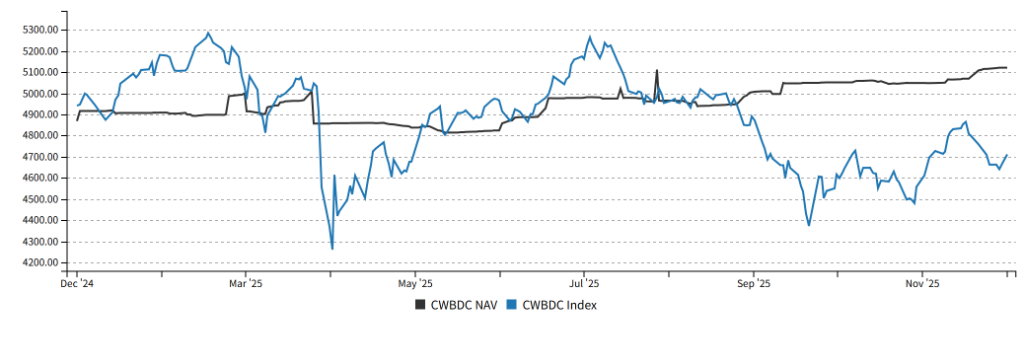
Core Insights - The performance of U.S. listed Business Development Companies (BDCs) has significantly lagged behind the S&P 500 index, marking the worst annual performance since 2020, prompting investors to reassess the outlook for this asset class within the $1.7 trillion private credit market [1][3] Group 1: Performance and Market Sentiment - The Cliffwater BDC Index, tracking 41 direct lending investment tools, has declined approximately 6.6% as of December 24, contrasting sharply with the S&P 500's rise of about 18.1% during the same period [1] - The shift in market sentiment has directly impacted investor confidence and capital flows, with some large funds facing increased redemption requests, leading to a reassessment of return expectations [3][4] - The traditional double-digit return era for BDCs may be coming to an end, with expectations shifting towards mid-to-high single-digit returns [3][4] Group 2: Investor Concerns and Fund Dynamics - The underperformance of BDCs has raised widespread skepticism among investors regarding the ability of large, widely distributed investment tools to maintain past return levels [4] - Despite stable fundraising for non-traded private credit funds, redemption requests are increasing for some large institutions, indicating growing investor concerns [4][5] - Blue Owl's BDC product faced redemption requests exceeding 5% of its net asset value, while Blackstone Private Credit Fund anticipated redemption requests of 4.5% of its net asset value for Q4 [5] Group 3: Future Outlook and Structural Changes - With the Federal Reserve expected to continue lowering interest rates, private credit managers must convince investors that their BDCs remain worthwhile investments [6] - The average spread for private credit transactions has narrowed from 650 basis points in Q1 2023 to below 500 basis points, leading to a decline in expected returns [6] - There is a shift towards launching interval funds, which allow for continuous financing and provide better liquidity for investors compared to traditional BDCs [6][7] Group 4: Market Pressures and Short Selling - The weak performance of the BDC market has attracted short sellers, with total short positions on 47 publicly traded BDCs reaching approximately $1.83 billion, a 38% increase from the previous year [8] - There is a rising trend in payment-in-kind (PIK) debt income within BDCs, indicating potential cash flow issues for borrowers, with PIK debt income reaching 7.9% in Q3 [9] - The increasing scrutiny and pressure in the market highlight the importance of management choices during periods of credit weakness [9]
ROSEN, A LEADING LAW FIRM, Encourages Blue Owl Capital Inc. Investors to Secure Counsel Before Important Deadline in Securities Class Action – OWL
Globenewswire· 2025-12-28 17:27
Core Viewpoint - Rosen Law Firm is reminding investors who purchased securities of Blue Owl Capital Inc. during the specified class period of the upcoming lead plaintiff deadline for a class action lawsuit [1] Group 1: Class Action Details - The class period for the Blue Owl securities is from February 6, 2025, to November 16, 2025 [1] - Investors may be entitled to compensation without any out-of-pocket fees through a contingency fee arrangement [1] - A class action lawsuit has already been filed, and interested parties must move the Court by February 2, 2026, to serve as lead plaintiff [2] Group 2: Law Firm Credentials - Rosen Law Firm has a strong track record in securities class actions, having achieved the largest securities class action settlement against a Chinese company [3] - The firm was ranked No. 1 by ISS Securities Class Action Services for the number of settlements in 2017 and has consistently ranked in the top 4 since 2013 [3] - In 2019, the firm secured over $438 million for investors, showcasing its capability in recovering significant amounts for clients [3] Group 3: Case Allegations - The lawsuit alleges that Blue Owl made false or misleading statements regarding its asset base and liquidity issues, particularly related to business development companies (BDCs) [4] - It is claimed that Blue Owl was likely to limit or halt redemptions of certain BDCs, which was not disclosed to investors [4] - The misleading statements about Blue Owl's business operations led to investor damages when the true situation was revealed [4]


美国AI基建遭遇“缺钱”和“缺电”双重困境:私募信贷成新“金主”,独立天然气发电成首选方案
Mei Ri Jing Ji Xin Wen· 2025-12-25 14:46
Core Insights - A trillion-dollar investment race in AI infrastructure is unfolding globally, driven by major tech companies' demand for clean energy and concerns over potential investment bubbles [1][6] Group 1: Investment Landscape - Major tech firms like Amazon, Google, Microsoft, and Meta are responsible for approximately 90% of global clean energy purchases for data centers, raising questions about whether this is a necessary investment for productivity or a high-risk bubble driven by FOMO [1] - S&P Global predicts that global data center investment demand will exceed $900 billion by 2029, while JPMorgan estimates that the entire AI infrastructure sector may require $5 trillion in investment, with a $1.4 trillion funding gap needing to be filled by private credit or government funds [1][2] - Traditional financing methods are insufficient for the massive capital needs, leading tech giants to explore new financing paths, with private credit markets becoming key players [1][2] Group 2: Risk Transfer and Construction Challenges - The new financing structure effectively shifts AI infrastructure investment risks from tech giants' balance sheets to the private credit market, ultimately affecting ordinary investors like pension funds and mutual funds [2] - Data center operators are taking on more construction risks, with some offering completion guarantees for large AI projects, while tenants (often backed by wealthy tech firms) may have the right to terminate contracts due to construction delays, creating significant credit risks for operators [2] Group 3: Power Supply Constraints - The rapid growth of AI is putting pressure on multiple supply chain segments, with data center construction being the fastest-growing source of electricity demand, potentially reshaping global electricity demand patterns [3] - The core challenge in power supply lies in the lengthy construction cycles of new power generation assets, which can take five years or more, far exceeding the typical construction timelines for tech company data centers [3][4] - Over 70% of U.S. transmission lines are over 25 years old, and the slow upgrade of the grid could lead to significant delays in integrating new renewable energy projects [3] Group 4: Alternative Energy Solutions - "Behind-the-Meter" (BTM) solutions are emerging as a preferred option, allowing data centers to obtain power independently through methods like natural gas generation, bypassing lengthy grid approval processes [4] - However, some BTM solutions lack the performance records necessary to support high-density AI loads, which could result in tech giants incurring substantial leasing obligations without achieving stable data center operations [5] Group 5: Market Dynamics and Bubble Concerns - Despite numerous constraints, demand for AI-driven data centers remains strong, with Bain & Company forecasting a 13% to 20% annual increase in global IT power capacity by 2030 [6] - Concerns about a potential bubble are rising, particularly due to uncertainties in energy supply, with fears of overbuilding leading to unutilized power generation assets [6][7] - The physical limitations of the power grid may act as a regulator rather than a breaker, with operators seeking creative solutions to balance growth and system stability [7]
表外融资1200亿美元!科技巨头联手华尔街玩转AI基建,风险正向私募信贷转移
Hua Er Jie Jian Wen· 2025-12-24 09:35
Core Insights - The article discusses how Silicon Valley tech giants are using complex financial instruments to transfer significant infrastructure spending off their balance sheets while maintaining strong financial statements [1][3] - Companies like Meta, xAI, Oracle, and CoreWeave have utilized Special Purpose Vehicles (SPVs) to shift over $120 billion in data center financing debt to Wall Street investors, raising concerns about risk transparency and potential financial contagion [1][2] Financing Strategies - Tech companies are leveraging SPVs to raise funds for AI data centers without significantly increasing their on-balance-sheet debt, thus protecting their credit ratings [3][4] - Major financial institutions, including Pimco, BlackRock, and JPMorgan, have injected at least $120 billion into these SPV-structured projects, allowing companies to secure necessary funding for AI infrastructure [1][3] Specific Transactions - Meta raised $30 billion through an SPV named "Beignet Investor" for its Louisiana Hyperion facility, with $27 billion coming from loans by major financial firms, enabling it to borrow without showing debt on its balance sheet [4] - Oracle has also engaged in significant debt transactions through SPVs, including a $13 billion investment from Blue Owl and JPMorgan for its Texas data center [4][5] Private Credit Market Concerns - The private credit market has seen a surge in project financing, with tech companies borrowing approximately $450 billion from private funds, reflecting a $100 billion year-over-year increase [6][7] - Concerns are rising about the $1.7 trillion private credit industry, particularly regarding asset valuation, liquidity issues, and borrower concentration risks [7] Risk Exposure and Differentiation - Despite the intention to isolate risks through SPVs, tech companies may still bear financial risks if AI service demand declines, as seen in the "Beignet Investor" case where Meta holds a 20% stake and provides a "residual value guarantee" [8] - Not all tech giants are adopting off-balance-sheet financing; companies like Google, Microsoft, and Amazon continue to fund their data center expansions through cash or direct bond issuance, indicating varied risk management strategies [8]

