
联影医疗

Search documents
医药生物行业今日净流出资金34.30亿元,广生堂等8股净流出资金超亿元
Zheng Quan Shi Bao Wang· 2025-07-07 10:27
资金面上看,两市主力资金全天净流出143.37亿元,今日有10个行业主力资金净流入,轻工制造行业主 力资金净流入规模居首,该行业今日上涨1.52%,全天净流入资金9.30亿元,其次是房地产行业,日涨 幅为1.68%,净流入资金为9.17亿元。 主力资金净流出的行业有21个,电子行业主力资金净流出规模居首,全天净流出资金44.75亿元,其次 是医药生物行业,净流出资金为34.30亿元,净流出资金较多的还有通信、计算机、机械设备等行业。 医药生物行业今日下跌0.97%,全天主力资金净流出34.30亿元,该行业所属的个股共474只,今日上涨 的有176只,涨停的有6只;下跌的有277只。以资金流向数据进行统计,该行业资金净流入的个股有171 只,其中,净流入资金超5000万元的有5只,净流入资金居首的是联环药业,今日净流入资金1.15亿 元,紧随其后的是宝莱特、联影医疗,净流入资金分别为8373.92万元、7667.30万元。医药生物行业资 金净流出个股中,资金净流出超亿元的有8只,净流出资金居前的有广生堂、长春高新、京新药业,净 流出资金分别为2.28亿元、1.51亿元、1.37亿元。(数据宝) 医药生物行业资金 ...


财政部出手!限制欧盟进口医疗器械
思宇MedTech· 2025-07-07 09:38
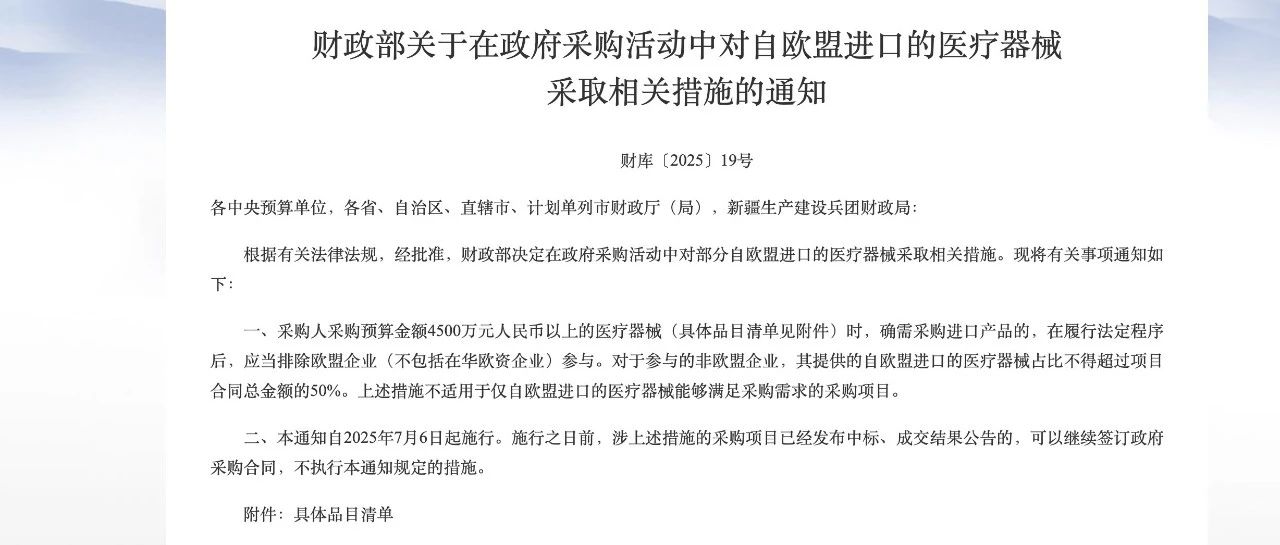
招商通知: 第三届全球手术机器人大会 2025 年 7 月 3 日, 财政部 发布《财政部关于在政府采购活动中对自欧盟进口的医疗器械采取相关措施的通知》(财库〔2025〕19 号)。 该通知自 2025 年 7 月 6 日 起正式施行。 本次通知针对部分自欧盟进口的医疗器械,在政府采购中作出限制,文件明确涉及采购预算金额、产品范围、以及在华欧资企业等多个关键要素。 # 政策核心内容 根据《通知》内容,核心要求包括以下几方面: 通知随文发布了《具体品目清单》,列明受影响的产品范围。 通知明确, 此次限制措施不适用于在中国境内生产的欧资企业产品。 即在华欧资企业,其在中国境内生产并获得相应注册和生产资质的医疗器械产品,不在此次 限制之列,仍可正常参与政府采购项目。 这一条款保证了在华欧资企业正常的本土化经营,也避免了对中国现有医疗供应链的过度冲击。 # 政策背景:对 等回 应与贸易环 境 近年来,欧盟针对中国医疗器械产品采取了多项市场准入、合规及供应链监管措施。例如: 预算门槛 :针对采购预算在 4500 万元人民币 及以上的医疗器械政府采购项目。 排除欧盟企业 :若采购人确需采购进口产品,履行法定程序后,应当排 ...

“移动医疗大篷车”开进罗平:车载CT守护基层健康
Huan Qiu Wang· 2025-07-07 09:30
Core Viewpoint - The article highlights the launch of a large-scale public welfare initiative by United Imaging Healthcare in Luoping County, Yunnan Province, focusing on mobile medical services and early disease screening, particularly for lung-related conditions [1][5][6]. Group 1: Initiative Overview - The "Change in the County" mobile medical public welfare initiative has reached its fourth stop in Luoping County, Yunnan, supported by local health authorities and medical associations [1]. - The initiative includes grassroots training and public screening conducted at local hospitals and community health centers [1][5]. Group 2: Health Concerns and Screening Focus - Luoping County's primary industries, such as rapeseed and coal mining, expose workers to respiratory diseases, necessitating targeted health screenings [5]. - The public screening primarily focuses on lung function tests, utilizing United Imaging's mobile CT technology to detect conditions like lung nodules and emphysema [5][6]. Group 3: Early Detection and Community Impact - The initiative has successfully identified several early-stage lung cancer patients, emphasizing the importance of early diagnosis in improving treatment outcomes and reducing healthcare costs [6]. - United Imaging's local director expressed commitment to enhancing healthcare access through mobile services and comprehensive cancer care management [6]. Group 4: Broader Goals and Achievements - Since its launch in August 2024, the initiative has expanded to various rural areas, aiming to deliver high-quality medical resources to underserved regions [6]. - The mobile medical bus has facilitated early diagnosis and screening for thousands of residents, focusing on diseases like lung cancer [6].

医疗器械两大利好来袭!药监局十项举措支持创新,中方限制欧盟医疗器械进口!医疗器械ETF基金(159797)回调再“吸金”!
Sou Hu Cai Jing· 2025-07-07 03:42
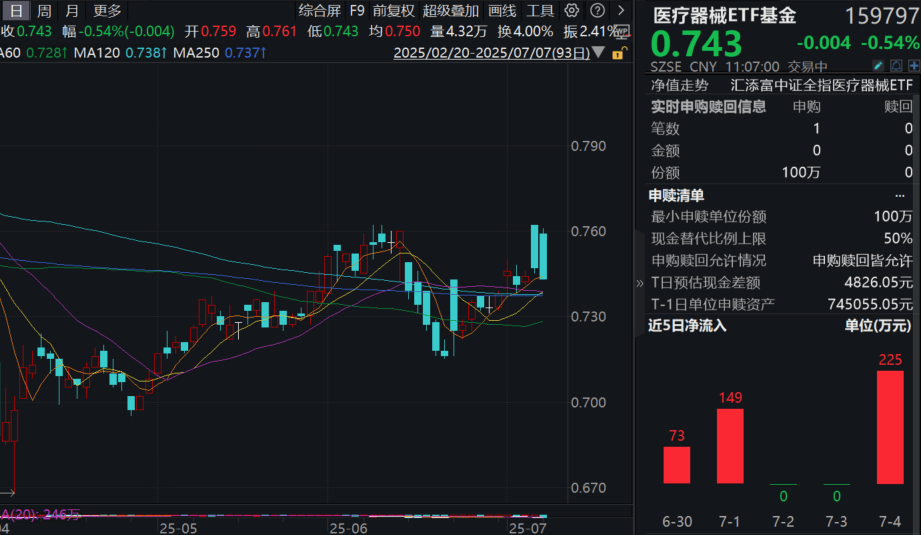
Core Viewpoint - The recent positive news regarding high-end medical devices has led to increased attention and investment in the medical device sector, particularly in the medical device ETF fund (159797) which experienced fluctuations in trading volume and price [1][6]. Group 1: Policy Developments - The National Medical Products Administration (NMPA) has announced measures to optimize the regulatory framework for high-end medical devices, focusing on special approval processes and classification principles to support innovation [1][4]. - New policies emphasize the importance of global innovation and the establishment of a comprehensive regulatory and quality assurance system for high-end medical devices [4][5]. - Specific areas of focus for innovation include medical robots, advanced medical imaging equipment, AI medical devices, and new biomaterials [4][5]. Group 2: Market Reactions - The medical device ETF fund (159797) saw a slight decline of 0.54% after an initial increase of nearly 2%, indicating volatility in investor sentiment despite positive news [1][3]. - Major stocks within the ETF, such as Hotgen Biotech and Mindray Medical, experienced declines, while a few others like United Imaging Healthcare saw slight gains [3]. Group 3: Future Outlook - The medical device sector is expected to recover as procurement activities resume, with government policies potentially boosting market demand for medical equipment in 2025 [5]. - The issuance of long-term bonds and local special bonds is anticipated to provide financial support for hospital procurement of medical devices, contributing to industry growth [5].

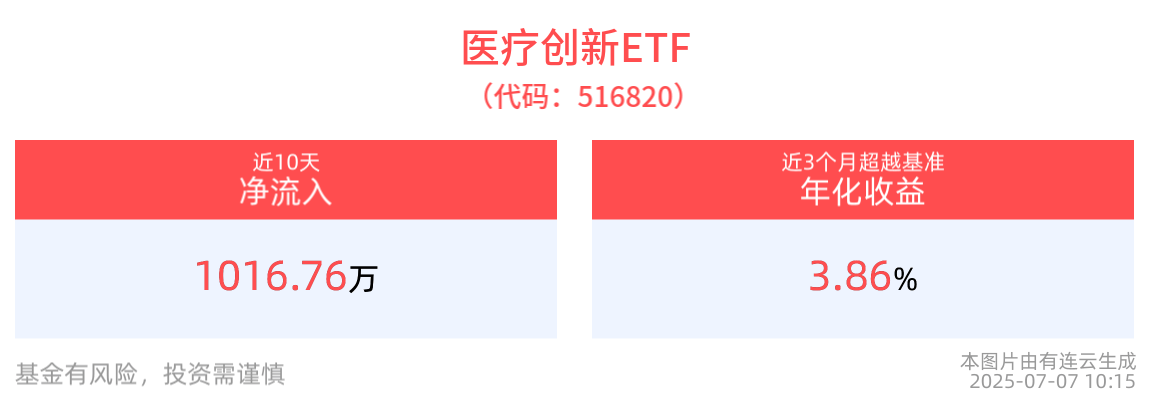
港股医药ETF(159718)交投活跃,医疗创新ETF(516820)盘中整固,机构:创新药板块到了反击时刻
Sou Hu Cai Jing· 2025-07-07 02:51
Group 1 - The core viewpoint indicates that the Chinese pharmaceutical sector, particularly the innovative drug segment, is poised for a rebound in the second half of the year, with significant growth in the approval of innovative drugs and medical devices [1][2] - As of July 4, the Hong Kong pharmaceutical ETF has seen a net value increase of 71.46% over the past year, reflecting strong market performance [1] - In the first half of the year, China approved 43 innovative drugs and 45 innovative medical devices, marking year-on-year growth of 59% and 87% respectively, showcasing the positive impact of reform policies on industry development [1] Group 2 - The CSI Hong Kong Stock Connect Healthcare Index consists of 50 liquid and large-cap healthcare companies, with the top ten stocks accounting for 59.44% of the index [4] - The top ten weighted stocks in the CSI Hong Kong Stock Connect Healthcare Index include companies like Innovent Biologics and WuXi Biologics, with varying performance in terms of stock price changes [6] - The CSI Medical and Medical Device Innovation Index includes 30 companies with strong profitability and growth potential, with the top ten stocks representing 63.62% of the index [7] Group 3 - The latest scale of the Medical Innovation ETF has reached 1.478 billion yuan, indicating a growing interest in the sector [2] - The performance of individual stocks within the Medical Innovation ETF shows mixed results, with some stocks like TianTan Bio leading gains while others like Sangfor Technologies are experiencing declines [9] - The index aims to reflect the overall performance of profitable and growth-oriented pharmaceutical and medical device companies [7]
中信建投 医药每周谈
2025-07-07 00:51
Summary of Key Points from Conference Call Records Industry Overview - The conference call discusses the **domestic medical device industry**, highlighting advancements in various companies and their innovative products. Key Companies and Their Innovations 1. **Peijia Medical** - The shockwave balloon technology shows a **30%-50% efficacy** in early clinical trials for treating aortic valve calcification [1] - The transcatheter aortic valve replacement product **Mona Q** has enrolled **9 patients** in the global Fame clinical trial, with no deaths or strokes reported during long-term follow-up. It has received **IDE clinical approval** in the U.S. and is expected to advance to U.S. clinical trials within the year [2][4] 2. **Jianxi Technology** - The tricuspid valve replacement product has completed clinical registration trials in Europe with a **97% success rate** and is expected to receive CE certification by **2025** [1][3] 3. **Xenon Medical** - The self-expanding intracranial drug-eluting stent has a **restenosis rate of only 1.7%-1.87%** and a **100% surgical success rate**. Approval is anticipated this year, with a market exclusivity period of **1.5 to 2 years** [1][6][7] 4. **HeartTech Medical** - Leading market share in domestic occluder products with a series of **four generations of biodegradable occluders**. The aortic valve product has been approved for commercialization since Q1 [1][8] 5. **Qiming Medical** - Four TAVI products have been approved and marketed in over **ten countries**. New TAVI products are under development, with expectations for a tricuspid valve replacement product to be approved in Europe by **2027** [1][9] Market Trends and Future Outlook - The medical device sector is expected to see a **catalyst for growth** in the second half of the year due to potential equipment upgrades, particularly in **3.0T MRI and 64-slice CT** products [2][17] - Companies like **Huitai Medical** are projected to have strong performance due to new product launches and market expansion [11][23] Competitive Strategies - Domestic medical device companies are enhancing their international competitiveness through: - **Patent breakthroughs** and early clinical trials [4] - Focusing on less crowded market segments for differentiation [4] - Collaborations with international firms to leverage global networks for faster commercialization [5] Financial Performance Expectations - Companies such as **Huitai Medical** and **Mingrui Medical** are expected to show strong growth in the second half of the year, despite some companies facing short-term pressures due to high bases from previous years [10][11][15] - The **IVD sector** is experiencing pressure from policy changes, but improvements are anticipated in the latter half of the year as companies adjust pricing strategies [28] Regulatory and Policy Impact - The medical industry is facing challenges from **DRG cost control policies** and increased compliance requirements, impacting overall performance and cash flow [33] Conclusion - The domestic medical device industry is poised for growth with innovative products and strategic collaborations, despite facing regulatory challenges and market competition. Companies are actively seeking to enhance their international presence and capitalize on emerging market opportunities.



10大产业41类“卡脖子”技术国产替代全景图
材料汇· 2025-07-06 13:22
Core Viewpoint - The article emphasizes the urgency of domestic substitution for "choke point" technologies in various industries due to escalating Sino-US trade tensions and the need for self-sufficiency in critical sectors [2][3]. Group 1: Research Framework & Key Industries - A comprehensive research framework is established, focusing on ten key industries: electronics, computers, communications, pharmaceuticals, medical, automotive, machinery, military, metals, and chemicals [3]. - The framework combines top-down and bottom-up approaches to assess the current state, challenges, and prospects of domestic substitution in these industries [3]. Group 2: Key Areas of Domestic Substitution - The report identifies 41 categories of critical technologies for domestic substitution across the ten industries, highlighting the importance of these areas for attracting investment [2][3]. - The analysis categorizes the difficulty of domestic substitution into five levels, ranging from extremely difficult to easy, based on factors such as market share and technological barriers [8][11]. Group 3: Electronics Industry - The semiconductor sector is highlighted as a key area for domestic substitution, with a focus on storage chips, CPUs, and GPUs, where current domestic market shares are below 5% [11][14]. - The article notes that the government is expected to increase support for key technologies in the semiconductor industry, particularly in overcoming manufacturing and equipment limitations [14][15]. Group 4: Computer Industry - The article discusses the development of a self-controlled IT ecosystem driven by policies aimed at enhancing domestic capabilities in hardware and software [19][20]. - The industrial software market is identified as a significant area for growth, with domestic companies gradually making inroads in CAD, EDA, and other software segments [20][21]. Group 5: Communication Industry - The communication equipment sector has seen significant domestic market penetration, with leading companies like Huawei and ZTE holding substantial global market shares [26][28]. - The report emphasizes the potential for domestic substitution in core communication chips, particularly in the FPGA market, which is currently dominated by foreign firms [27][31]. Group 6: Pharmaceutical and Medical Industries - The scientific instruments sector is highlighted for its low domestic substitution rates, with significant opportunities for growth driven by supportive policies [33][34]. - The article points out the challenges in the production of borosilicate glass for pharmaceuticals, indicating a need for technological advancements to reduce reliance on imports [38][40].
华创医药周观点:2025Q2医药业绩前瞻2025/07/05
华创医药组公众平台· 2025-07-05 14:52
Market Review - The CITIC Pharmaceutical Index rose by 3.57%, outperforming the CSI 300 Index by 2.03 percentage points, ranking 4th among 30 CITIC first-level industry indices [5] - The top ten stocks by increase this week include: Seer Medical (51.55%), Guangsheng Tang (48.64%), Shenzhou Cell (45.01%), and others [5][30] - The top ten stocks by decrease include: Linuo Medical (-5.73%), New Ganjing (-5.53%), ST Zhongzhu (-4.79%), and others [5][30] Overall Viewpoint and Investment Themes - The current valuation of the pharmaceutical sector is low, with public funds (excluding pharmaceutical funds) having low allocation to this sector. The outlook for the pharmaceutical industry growth in 2025 remains optimistic due to macroeconomic factors and the driving effect of major categories [9] - In the innovative drug sector, there is a shift from quantity logic to quality logic, emphasizing the importance of products that can generate profits. Companies with differentiated domestic and international pipelines are recommended for attention [9] - In the medical device sector, there is a notable recovery in bidding volumes for imaging equipment, and the home medical device market is benefiting from subsidy policies. Companies in this space are expected to see growth [9][16] - The innovation chain (CXO + life science services) is expected to see a recovery in overseas investment and a bottoming out in domestic investment, leading to a new wave of innovation [9] - The pharmaceutical industry is expected to enter a new growth cycle, particularly in the specialty raw materials sector, which is currently at a near ten-year low in valuation [9][22] Industry and Company Events - The blood products sector is expected to grow significantly during the 14th Five-Year Plan period, with a loosening of plasma station approvals and an increase in product variety and capacity [12] - The IVD market, particularly in chemical luminescence, is projected to grow rapidly, with domestic brands increasing their market share due to accelerated domestic substitution [14] - The medical device market is expected to see significant growth in 2025, driven by a recovery in procurement and the introduction of new products [16] - The pharmaceutical retail sector is anticipated to benefit from the acceleration of prescription outflow and an improved competitive landscape, with a focus on chain pharmacies [12][20] - The life science services sector is recovering, with an increase in demand from both domestic and overseas markets, and a trend towards consolidation through mergers and acquisitions [21] Earnings Forecast for Q2 2025 - Companies such as Maipu Medical and Bide Pharmaceutical are expected to see revenue growth rates of around 30% and 20%+, respectively, in Q2 2025 [11] - The medical device sector is projected to have varied growth rates, with companies like Mindray Medical expected to experience a decline, while others like Huayi Medical are expected to see stable growth [11] Investment Recommendations - Focus on companies in the neuro-interventional and peripheral interventional sectors that are benefiting from procurement policies and have a comprehensive product lineup [19] - The pharmaceutical retail sector is recommended for investment due to the expected acceleration of prescription outflow and improved competitive dynamics [20] - Companies in the life science services sector are advised for attention due to the anticipated recovery in demand and the potential for high profit elasticity as they enter the return on investment phase [21]
中证全指医疗保健设备与服务指数上涨0.21%,前十大权重包含爱美客等
Sou Hu Cai Jing· 2025-07-04 15:33
Core Viewpoint - The performance of the CSI All Index for Medical Care Equipment and Services has shown mixed results, with a slight increase on the day but a decline over the past month, three months, and year-to-date [1]. Group 1: Index Performance - The CSI All Index for Medical Care Equipment and Services rose by 0.21% to 13,548.3 points, with a trading volume of 19.92 billion [1]. - Over the past month, the index has decreased by 1.41%, by 2.78% over the past three months, and by 1.24% year-to-date [1]. Group 2: Index Composition - The index is composed of listed companies in the medical care sector, reflecting the overall performance of these securities [1]. - The index was established on December 31, 2004, with a base point of 1,000.0 [1]. Group 3: Top Holdings - The top ten holdings in the index are as follows: Mindray Medical (9.65%), United Imaging (8.18%), Aier Eye Hospital (7.43%), Aimeike (3.42%), Huatai Medical (3.23%), Yuyue Medical (2.81%), New Industry (2.79%), Lepu Medical (2.69%), Meinian Onehealth (2.06%), and Shandong Pharmaceutical Glass (1.9%) [1]. Group 4: Market Distribution - The index's holdings are primarily listed on the Shenzhen Stock Exchange (60.10%) and the Shanghai Stock Exchange (39.90%) [1]. - The entire sample of the index is focused on the pharmaceutical and healthcare sector, with a 100% allocation [1]. Group 5: Index Adjustment and Fund Tracking - The index samples are adjusted biannually, with changes implemented on the next trading day following the second Friday of June and December [2]. - Public funds tracking the index include various Southern and Tianhong funds, as well as ETFs from multiple asset management companies [2].



联影医疗(688271)2024年年报及2025年一季报业绩点评:需求复苏驱动业绩修复 海外突破深化增长动能
Xin Lang Cai Jing· 2025-07-04 08:26
Core Viewpoint - The company reported a decline in revenue and profit for 2024, but showed signs of recovery in Q1 2025, with a focus on both domestic and international market expansion [1][2][3]. Financial Performance - In 2024, the company achieved revenue of 10.3 billion yuan, a decrease of 9.73%, and a net profit of 1.262 billion yuan, down 36.1% [1]. - Q4 2024 revenue was 3.35 billion yuan, down 15.91%, with a net profit of 591 million yuan, down 35.1% [1]. - In Q1 2025, revenue increased to 2.478 billion yuan, up 5.42%, with a net profit of 370 million yuan, up 1.87% [1]. Business Segments - Domestic sales of medical imaging and radiation therapy equipment generated 8.445 billion yuan, a decline of 14.93%, while the service segment grew by 26.81% to 1.356 billion yuan [2]. - International revenue reached 2.266 billion yuan, an increase of 35.08%, accounting for 22% of total revenue, driven by market penetration in high-end segments [2]. R&D and Innovation - The company invested 2.261 billion yuan in R&D in 2024, representing 21.95% of revenue, and 568 million yuan in Q1 2025, accounting for 22.92% of revenue [3]. - The company has achieved significant advancements in technology across various product lines, establishing a competitive edge in the market [3]. Market Strategy - The company is focusing on a dual strategy of high-end product development and comprehensive market penetration domestically, while enhancing localized operations internationally [3]. - The global service network now covers over 85 countries and regions, supporting the operational needs of more than 34,500 devices [3].