
谷歌

Search documents
海内外云厂商发展与现状(二):AI投入、算力建设梳理与ROI测算
Sou Hu Cai Jing· 2025-11-08 03:37
Group 1: AI Investment and Capital Expenditure - Global cloud vendors are significantly increasing their investments in AI, with capital expenditures and computing power construction showing remarkable growth characteristics [1][2] - Overseas cloud vendors began accelerating investments from Q3 2023, while domestic vendors are expected to start growth around mid-2024, with both maintaining a year-on-year growth rate of over 50% in capital expenditures [1][12] - Leading cloud vendors are investing more than 100% of their net profits and over 60% of their operating cash flow into AI infrastructure, indicating a strong commitment to capital investment [1][22] Group 2: Computing Power Construction - The global data center investment scale is rapidly increasing, projected to reach $600 billion by 2025 and potentially $3-4 trillion by 2030 [2][39] - Major overseas vendors like Microsoft plan to double their data center capacity to 10GW in the next two years, while Google has invested over $170 billion in three years, with GPU and TPU computing power each accounting for half [2][39] - Domestic vendors, such as Alibaba, plan to invest 380 billion yuan in AI infrastructure over the next three years, with energy consumption expected to reach 15GW by 2032 [2][39] Group 3: Chip Development and Layout - ASIC products are expected to be launched intensively in the coming years, with NVIDIA currently holding over 80% market share in the computing power market, especially in training scenarios [2][39] - Cloud vendors are pursuing supply chain autonomy and cost reduction through self-developed or collaboratively developed ASIC chips, with domestic chip manufacturers continuously catching up in performance [2][39] Group 4: Commercialization and ROI - AI cloud services encompass GPU leasing, MaaS/API services, and PaaS/SaaS services, with overseas vendors like Microsoft and Google experiencing rapid revenue growth in AI-related services [3][39] - Domestic vendors primarily derive AI cloud revenue from GPU leasing, with significant growth in the MaaS layer [3][39] - By 2030, leading cloud vendors are expected to achieve positive cash flow contributions from their AI businesses, with a return on invested capital (ROIC) of over 10% and an investment recovery period of approximately six to ten years [3][39]


深夜,美股大反转,英伟达V型反弹,中概股多数下挫!特斯拉市值一夜蒸发超3800亿元,加密币市场超25万人爆仓
Mei Ri Jing Ji Xin Wen· 2025-11-08 00:51
Core Viewpoint - The U.S. stock market experienced a "V-shaped reversal" as signs of a resolution to the government shutdown emerged, with the S&P 500 and Dow Jones Industrial Average turning positive towards the end of trading [1]. Market Performance - As of the market close, the Nasdaq Composite fell by 0.21%, with a weekly decline of 3.04%. The S&P 500 rose by 0.13%, with a weekly decline of 1.63%. The Dow Jones increased by 0.16%, with a weekly decline of 1.21% [2]. Individual Stock Movements - Nvidia, a leading AI trading stock, saw a nearly 5% drop during the day but managed to close slightly up. Microsoft missed the opportunity to turn positive, marking its longest losing streak since November 2011, with a total market value loss exceeding $330 billion [8]. - Tesla's stock dropped over 3%, resulting in a market value loss of $54.5 billion (approximately 388.2 billion RMB) [10]. - Major Chinese stocks listed in the U.S. mostly declined, with the Nasdaq Golden Dragon China Index falling by 0.95% and a weekly decline of 2.62%. Xpeng Motors dropped over 6%, while other companies like Tencent Music and NIO saw declines exceeding 4% [12]. Economic Indicators - The U.S. consumer confidence index fell to its lowest level since June 2022, dropping from 53.6 to 50.3, influenced by concerns over the government shutdown and high inflation [18]. - Concerns about rising unemployment have increased, with 71% of respondents expecting a rise in the unemployment rate over the next year, more than double the proportion from the previous year [19].

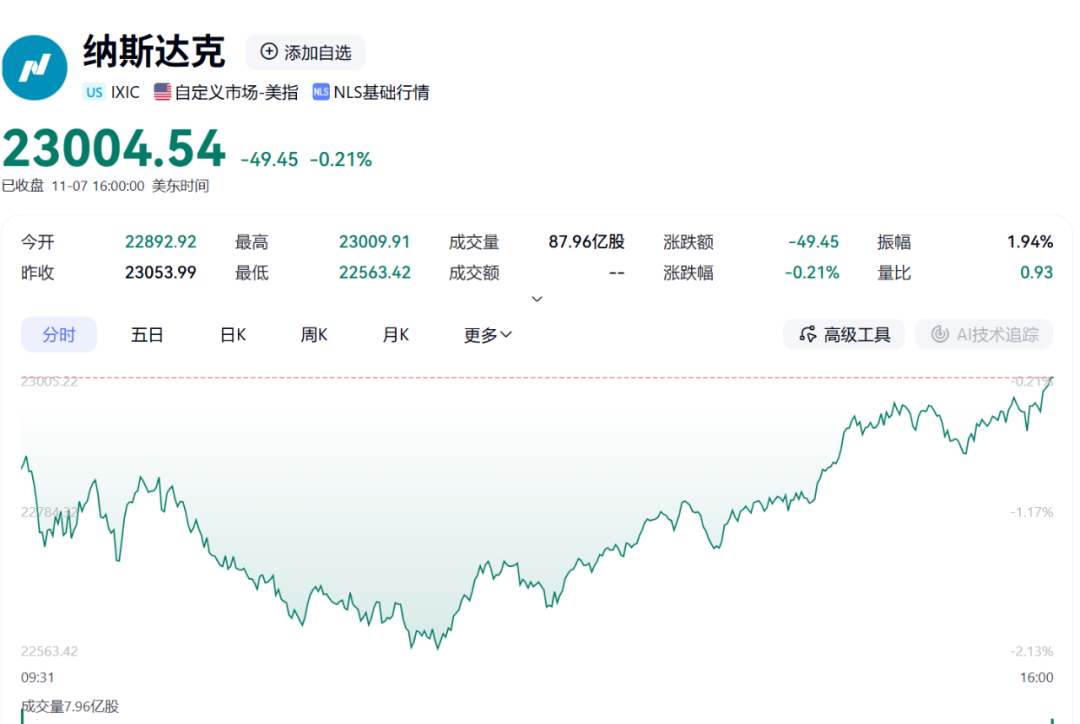
中概股多数下挫,小鹏跌超6%,蔚来跌超4%,特斯拉跌超3%,微软连跌8天
2 1 Shi Ji Jing Ji Bao Dao· 2025-11-07 23:32
Market Overview - The three major U.S. stock indices closed mixed, with the Dow Jones up 0.16%, the S&P 500 up 0.13%, and the Nasdaq down 0.21% [1] - Large-cap tech stocks showed mixed performance, with the Wande American Tech Giants Index down 0.56% [2] Individual Stock Performance - Tesla fell over 3%, Google down over 2%, and Apple down 0.48%. In contrast, Amazon rose 0.56%, Facebook up 0.45%, and Nvidia slightly increased by 0.04% [2][3] - Energy stocks collectively rose, with ExxonMobil up over 2%, Chevron up over 1%, and ConocoPhillips up over 1% [2] Sector Performance - Airline stocks mostly increased, with American Airlines up over 3% and Southwest Airlines up 3%, while Boeing fell nearly 1% [4] - Semiconductor stocks generally declined, with the Philadelphia Semiconductor Index down 1.01% [4] Chinese Stocks - Chinese stocks mostly fell, with the Nasdaq Golden Dragon China Index down 0.95% and the Wande Chinese Tech Leaders Index down 0.98% [4] Precious Metals - Spot gold rose 0.58% to $4000.29 per ounce, while COMEX gold futures increased by 0.42% to $4007.8 per ounce [5] Economic Context - There is a growing consensus of risk in the U.S. capital markets regarding the sustainability of the AI narrative, primarily due to uncertainty surrounding the path to achieving General Artificial Intelligence (AGI) [6] - The U.S. government shutdown has entered its 37th day, impacting economic reporting, including the delay of the October non-farm payroll report [6]

中概股多数下挫,小鹏跌超6%,蔚来跌超4%,特斯拉跌超3%,微软连跌8天
21世纪经济报道· 2025-11-07 23:31
记者丨黎雨桐 编辑丨曾静娇 美国三大股指收盘涨跌不一,道指涨0.16%,标普500指数涨0.13%,纳指跌0.21%。 能源股集体上涨,埃克森美孚涨超2%,雪佛龙涨逾1%,康菲石油涨超1%,斯伦贝谢涨近1%,西方石油涨超2%。 航空股多数上涨,波音跌近1%,美国航空涨超3%,达美航空涨近2%,西南航空涨3%,美联航涨超1%。 芯片股多数下跌,费城半导体指数跌1.01%,微芯科技跌逾5%,ARM跌超3%,迈威尔科技跌逾2%,英特尔涨超2%。 中概股多数下跌,纳斯达克中国金龙指数跌0.95%,万得中概科技龙头指数跌0.98%。 个股方面, 个股方面,小鹏汽车跌超6%,再鼎医药、小马智行跌超5%,腾讯音乐、禾赛科技,跌超4%;大全新能源涨超9%,阿特斯太阳能 涨超6%,唯品会、华住集团涨逾2%,百胜中国涨逾1%。 大型科技股涨跌互现,万得美国科技七巨头指数下跌0.56%。 个股方面,特斯拉跌超3%,谷歌跌超2%,苹果跌0.48%,亚马逊涨0.56%,脸书涨0.45%,微软跌0.06% 连跌8天,创2011年11月以来最长连 跌天数。 英伟达涨0.04%。 | 资彩 成分 | 资讯 | 相关基金 | 月度收益 | | ...

PCB上游材料短缺 龙头厂商赚钱效应显现
Zhong Guo Jing Ying Bao· 2025-11-07 20:34
Core Insights - The PCB supply chain is facing significant shortages of upstream materials, particularly affecting high-end substrates like ABF and BT boards, with expectations of shortages lasting for another year [2] - The demand for PCBs is projected to remain strong over the next 2-3 years, with a peak expected in Q4, despite the ongoing material shortages [2][3] - The shortage is attributed to a surge in demand from the recovering global electronics industry and the vulnerabilities in the supply chain [2][5] Industry Overview - The global demand for AI servers is driving a substantial increase in capital expenditures among major cloud service providers, with a forecasted total exceeding $420 billion by 2025, representing a 61% increase from previous years [3][4] - The price of PCBs for AI training servers can exceed $200,000, significantly higher than traditional server PCBs, which range from $3,000 to $15,000 [3][4] - The supply shortage is affecting the entire PCB industry, particularly in core materials like copper foil, which has a projected demand of 850 tons per month by 2025 against a current production capacity of only 700 tons [4][5] Financial Performance - Leading PCB manufacturers are experiencing substantial revenue growth, with companies like Huadian achieving a 39.92% increase in revenue to 5.019 billion yuan and a 46.25% rise in net profit to 1.035 billion yuan in Q3 [6] - Willgo reported a 41.33% increase in revenue to 407 million yuan and a remarkable 175.75% increase in net profit [6] Market Trends - The global PCB market is expected to enter a new growth cycle, with a projected market value of $73.565 billion in 2024, reflecting a 5.8% year-on-year growth [7] - By 2029, the global PCB market value is anticipated to reach $94.661 billion, with a compound annual growth rate (CAGR) of approximately 5.2% from 2024 to 2029 [7] Capacity Expansion - At least 11 PCB companies have announced expansion plans, with significant investments aimed at increasing high-end production capacity to meet rising demand [9] - Companies like Jingwang Electronics and Shengyi Technology are investing heavily in expanding their production capabilities, with plans to invest 5 billion yuan and 1.9 billion yuan, respectively [9] Strategic Insights - While leading companies are expanding capacity to capture AI market opportunities, there is a risk of overcapacity if demand growth slows down post-2026 [10] - Smaller manufacturers are advised to focus on niche markets and technological differentiation to avoid direct competition with larger firms and mitigate risks associated with overcapacity [10][11]

一句话炸掉5000亿美元市值!OpenAI紧急“救火”
Di Yi Cai Jing· 2025-11-07 09:52
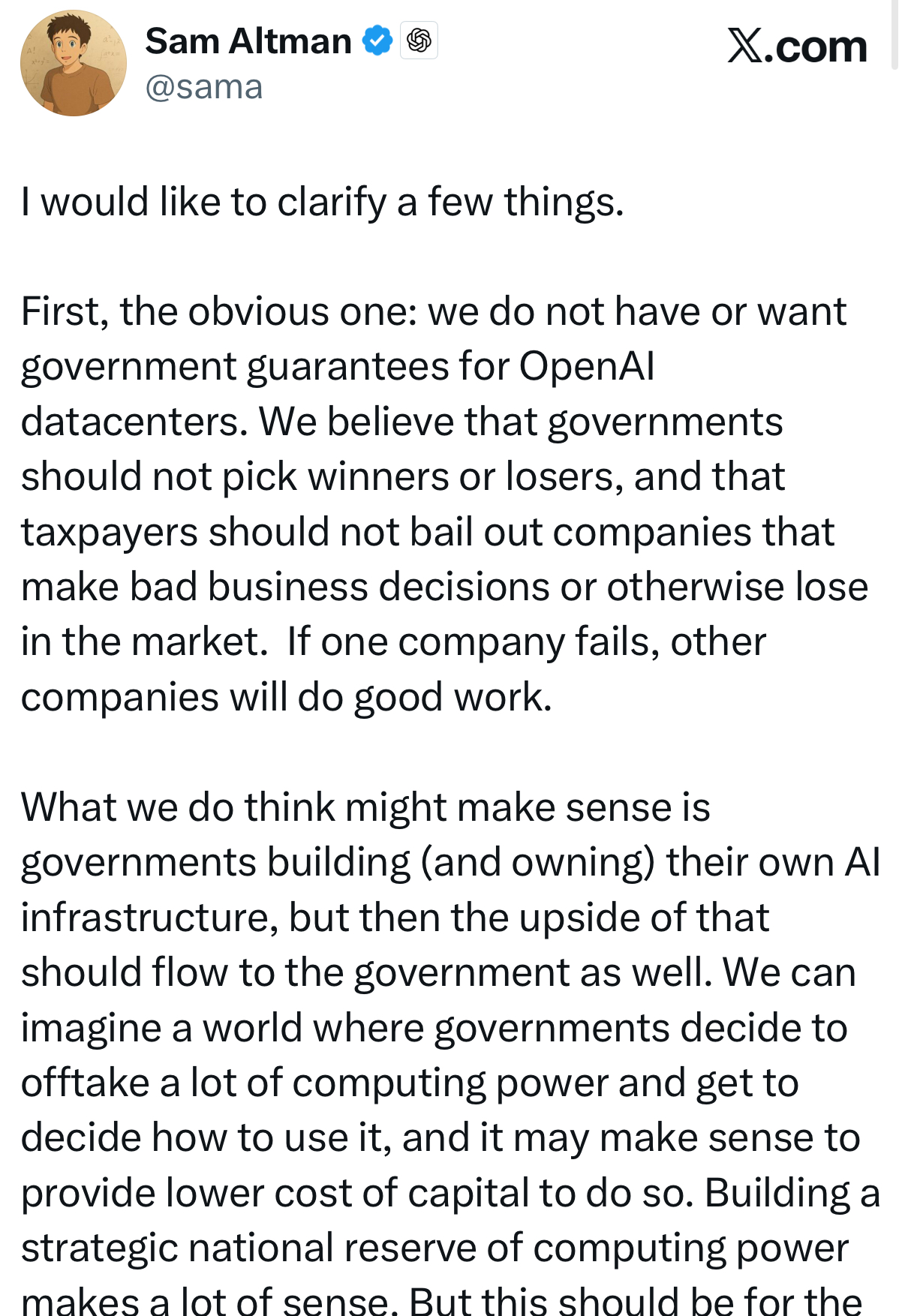
2025.11.07 本 文字数:2337,阅读时长大约4分钟 作者 | 第一财经 刘晓洁 OpenAI高管一句"需要政府为AI投资担保",在美股市场掀起巨浪。当地时间周四,美国科技股集体重 挫,六大科技巨头及多家与OpenAI合作的算力厂商总市值一夜蒸发近5000亿美元。 11月7日凌晨,OpenAI CEO奥尔特曼(Sam Altman)发布近2000字长文回应,不仅澄清"不需要也不想 要美国政府担保",还首度披露公司收入预期——预计今年年化收入将超200亿美元,2030年将达数千亿 美元,试图以此挽回市场信心。 尽管美股盘后部分科技股出现小幅反弹,例如英伟达盘后上涨约0.85%,微软盘后上涨0.12%,但相比 一夜蒸发的巨额市值,这样的反弹无异于杯水车薪。 美股今年一路上涨,自4月低点以来涨幅超过30%,但市场从未打消对科技圈AI泡沫的疑虑,也担忧上 世纪90年代末的互联网泡沫再现,而众多华尔街机构的态度和行动也印证了这一点,这也是这次言论能 引发美股巨震的根本原因。 一夜蒸发近5000亿美元 这场风暴的起点,是OpenAI首席财务官萨拉·弗里尔(Sarah Friar)在一场公开活动中的发言。她提到, ...

一句话炸掉5000亿美元市值!OpenAI紧急“救火”
第一财经· 2025-11-07 09:40
2025.11. 07 本文字数:2337,阅读时长大约4分钟 作者 | 第一财经 刘晓洁 OpenAI高管一句"需要政府为AI投资担保",在美股市场掀起巨浪。当地时间周四,美国科技股集体 重挫,六大科技巨头及多家与OpenAI合作的算力厂商总市值一夜蒸发近5000亿美元。 11月7日凌晨,OpenAI CEO奥尔特曼(Sam Altman)发布近2000字长文回应,不仅澄清"不需要 也不想要美国政府担保",还首度披露公司收入预期——预计今年年化收入将超200亿美元,2030年 将达数千亿美元,试图以此挽回市场信心。 11月7日收盘,美股三大指数集体下跌,科技股成为重灾区。万得美国科技七巨头指数跌1.91%。具 体来看,英伟达跌3.65%,特斯拉跌3.5%,亚马逊跌2.86%,Meta跌2.67%,领跌七巨头。另外微 软已连续七个交易日下跌,昨夜跌1.98%,创2022年以来最长连跌天数,苹果微跌0.14%。七巨头 中仅谷歌微涨0.21%。 尽管美股盘后部分科技股出现小幅反弹,例如英伟达盘后上涨约0.85%,微软盘后上涨0.12%,但相 比一夜蒸发的巨额市值,这样的反弹无异于杯水车薪。 美股今年一路上涨,自4 ...

十年五倍,纳斯达克100的泡沫,究竟有多大?
雪球· 2025-11-07 08:05
Core Viewpoint - The article discusses the perceived "bubble" in the Nasdaq 100 index, arguing that the index's performance is primarily driven by substantial earnings growth rather than inflated valuations [3][4][5]. Valuation and Earnings Growth - The Nasdaq 100 index currently has a five-year PE ratio of 36.8, which is above the median of 34.4, indicating a relatively high valuation [8]. - The total profit of Nasdaq 100 constituents grew from $256.5 billion in the first three quarters of 2020 to $718.2 billion in 2025, representing a 180% increase, while the index itself rose approximately 170% [9][10]. - The article emphasizes that if only valuation were considered, the Nasdaq should have been sold off five years ago, but the sustained high valuation has been justified by significant earnings growth [10][11]. Performance of Individual Stocks - A detailed analysis of individual stocks within the Nasdaq 100 shows remarkable profit growth over five years, with companies like Nvidia achieving a 3400% increase in net profit, and Tesla seeing a 1500% increase [15][16]. - Other notable performers include Apple (82%), Microsoft (119%), and Amazon (353%), indicating that many tech companies have thrived due to continuous innovation and investment [15][16]. Factors Behind Strong Performance - The article attributes the strong performance of U.S. tech stocks to a combination of technological innovation and a robust business model that generates recurring cash flow [19][20]. - The presence of a protective environment for private property and patents in the U.S. has facilitated significant returns on new industry investments, reinforcing the success of the tech sector [21]. AI and Future Outlook - The discussion raises the question of whether AI represents a bubble, suggesting that those at the forefront of AI technology are unlikely to view it as such due to its vast potential applications [22][23]. - The article warns that while the current tech revolution is significant, historical patterns indicate that growth cycles will eventually slow, leading to potential declines in both growth rates and stock valuations [24][25].

一句话炸掉5000亿美元市值!OpenAI紧急“救火”,AI泡沫临近?
Di Yi Cai Jing· 2025-11-07 07:59
市场从未打消对科技圈AI泡沫的疑虑。 OpenAI高管一句"需要政府为AI投资担保",在美股市场掀起巨浪。当地时间周四,美国科技股集体重挫,六大科技巨头及多家与OpenAI合作的算力厂商总 市值一夜蒸发近5000亿美元。 11月7日凌晨,OpenAI CEO奥尔特曼(Sam Altman)发布近2000字长文回应,不仅澄清"不需要也不想要美国政府担保",还首度披露公司收入预期——预计 今年年化收入将超200亿美元,2030年将达数千亿美元,试图以此挽回市场信心。 $$\mathbf{X}_{\circ}\mathbf{C}\mathbf{0}$$ 尽管美股盘后部分科技股出现小幅反弹,例如英伟达盘后上涨约0.85%,微软盘后上涨0.12%,但相比一夜蒸发的巨额市值,这样的反弹无异于杯水车薪。 美股今年一路上涨,自4月低点以来涨幅超过30%,但市场从未打消对科技圈AI泡沫的疑虑,也担忧上世纪90年代末的互联网泡沫再现,而众多华尔街机构 的态度和行动也印证了这一点,这也是这次言论能引发美股巨震的根本原因。 一夜蒸发近5000亿美元 这场风暴的起点,是OpenAI首席财务官萨拉·弗里尔(Sarah Friar)在一场 ...
“AI泡沫”引发市场恐慌之际 花旗高呼逢低买入“AI贝塔+周期贝塔”
智通财经网· 2025-11-07 03:28
Group 1 - The core viewpoint of the articles suggests that the recent stock market pullback, attributed to concerns over an "AI bubble," is seen as a healthy adjustment rather than a sign of a looming crisis [1][3][2] - Analysts from UBS believe that while conditions for an AI bubble are emerging, the market is still in the early stages and far from a critical peak similar to the 2000 internet bubble [2][3] - Drew Pettit from Citigroup emphasizes that the market's long-term bullish narrative driven by AI fundamentals remains intact, providing significant buying opportunities during the pullback [1][5] Group 2 - Nvidia's CEO Jensen Huang highlighted a projected revenue visibility of $500 billion from data center business for 2025-2026, which excites Wall Street analysts [4] - Pettit recommends maintaining exposure to both growth and cyclical investment sectors, suggesting a strategy of buying small-cap ETFs during market pullbacks [6][5] - Specific investment opportunities identified include Nvidia (NVDA), Amazon (AMZN), and various semiconductor ETFs, with Amazon's recent $38 billion AI computing agreement with OpenAI being a notable highlight [7][8] Group 3 - In the cyclical investment sector, Pettit points out companies that could benefit from significant productivity gains, including Boston Scientific (BSX), Capital One (COF), and Equifax (EFX), anticipating improvements in the mortgage market by 2026 [8]