
牧原股份

Search documents
牧原实业集团有限公司党委书记、总裁秦英林——“民营企业发展要与国家需求结合”
Ren Min Ri Bao· 2025-11-11 22:34
Core Viewpoint - The support from the central government for the private economy is clear and firm, boosting confidence and motivation for entrepreneurship in the industry [2] Group 1: Company Development - The company, founded in 1992, has grown from 22 piglets to the world's largest pig farming enterprise, with an annual output of 70 million pigs [2] - The company emphasizes aligning its development with national needs, particularly in supporting the country's food security strategy by promoting grain-saving actions in livestock farming [2] - The company has adopted innovative breeding techniques, reducing reliance on imported breeding stock and achieving cost reduction and efficiency improvement [2] Group 2: Technological Innovations - The company has implemented advanced air filtration systems in pig farms, which not only prevent diseases but also address environmental concerns related to odor [3] - A digital farming model has been established, where waste from pig farming is converted into organic fertilizer and biogas, promoting a circular economy [3] Group 3: Industry Collaboration - The company is working to professionalize pig farming by providing breeding stock, feed, and technical support to small farmers, thus creating a shared prosperity model [4][5] - The company plans to supply 10 million discounted piglets to support 6,300 farming households this year [5] Group 4: Legal and Regulatory Environment - The implementation of the Private Economy Promotion Law is seen as a positive step towards creating a better business environment, with the company committed to legal and responsible operations as it grows [5]


农林牧渔行业点评报告:年前生猪供给压力逐步积累,猪价低位运行去化延续
KAIYUAN SECURITIES· 2025-11-11 15:19
Investment Rating - The industry investment rating is "Positive" (maintained) [1] Core Viewpoints - The industry is experiencing increasing supply pressure of live pigs as the year-end approaches, with low prices continuing to decline. In October 2025, the national average selling price of live pigs was 11.69 yuan/kg, down 10.74% month-on-month and 33.56% year-on-year. The slaughter volume in October was 5.0352 million heads, up 10.40% month-on-month and 9.55% year-on-year. The actual output in October exceeded the planned output by 5.70%, but the planned output for November is expected to decrease by 3.27% compared to October [3][14][24] Summary by Sections Industry Overview - The supply pressure of live pigs is gradually accumulating as the year-end approaches, with low prices continuing to decline. The average selling price in October 2025 was 11.69 yuan/kg, reflecting a significant decrease [3][14] - The slaughter volume in October was 5.0352 million heads, indicating a month-on-month increase of 10.40% and a year-on-year increase of 9.55% [3][14] Market Dynamics - The proportion of large pigs (over 150kg) in the slaughter structure was 4.89%, which is lower than the same period in 2024. The stock of large pigs is expected to increase, leading to a more relaxed supply in the future [4][18] - The winter pork consumption is expected to improve, which may drive the price difference between lean and fatty pork. However, the high inventory rate of frozen products may suppress future prices [4][19][23] Financial Performance - In October, the industry faced deepening losses, with self-breeding losses reaching 167.97 yuan per head. The breeding stock decreased by 0.77% month-on-month [5][24] - The average selling price of major listed pig companies decreased month-on-month, with prices ranging from 10.97 to 11.87 yuan/kg, reflecting declines of 9.9% to 13.9% [6][7][34]




旺季不旺:10月猪企“增量不增价”,高成本猪企亏损加剧
Feng Huang Wang· 2025-11-11 12:45
Core Insights - The pig farming industry is facing significant challenges as many companies are experiencing losses despite increased output during the traditional peak season for pig sales [1][2][3] - The average selling prices of pigs have dropped to their lowest levels of the year, leading to a situation where companies are selling pigs at a loss [3][5] - Companies with lower breeding costs are better positioned to withstand price declines, while those with higher costs are under severe financial pressure [5][6] Industry Performance - In October, major pig farming companies reported substantial increases in the number of pigs sold, with Muyuan Foods selling 7.076 million pigs (up 13.17% year-on-year) and Wens Foodstuffs selling 3.8928 million pigs (up 45.69% year-on-year) [2][3] - Despite the increase in sales volume, the average selling prices for major companies like Muyuan and Wens fell by approximately 32.73% and 34.41% year-on-year, respectively [3][4] Cost Dynamics - The cost of pig farming varies significantly among companies, with leading firms like Muyuan and Wens reporting costs below 12.5 yuan/kg, while others like Huazhong and Jinxinnong have costs exceeding 13.5 yuan/kg [5][6] - The industry is currently experiencing an overall loss, with average breeding costs maintained between 12.5 and 13 yuan/kg, and losses per pig reaching 161.69 yuan for self-breeding and 283.92 yuan for piglets [5][6] Future Outlook - The demand for pork is expected to increase as the southern regions begin their seasonal consumption, which may provide some support for prices in the coming months [4] - However, the overall price trend is expected to remain weak due to the cyclical nature of the pig market [4]
养殖业板块11月11日跌0.45%,牧原股份领跌,主力资金净流出4.96亿元
Zheng Xing Xing Ye Ri Bao· 2025-11-11 08:38
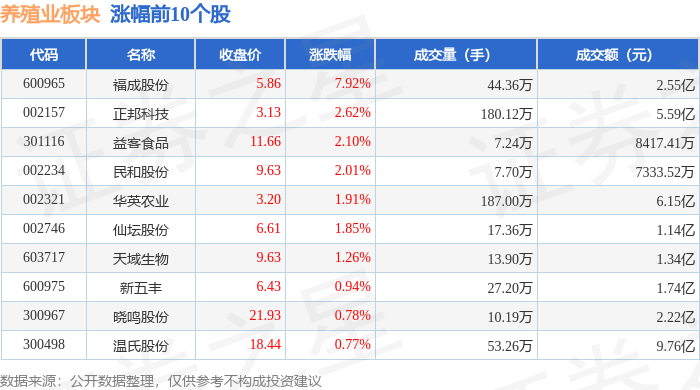
Market Overview - The livestock sector declined by 0.45% on November 11, with Muyuan Foods leading the drop [1] - The Shanghai Composite Index closed at 4002.76, down 0.39%, while the Shenzhen Component Index closed at 13289.0, down 1.03% [1] Stock Performance - Notable gainers in the livestock sector included: - Fucheng Co., Ltd. (600965) with a closing price of 5.86, up 7.92% on a trading volume of 443,600 shares [1] - Zhengbang Technology (002157) closed at 3.13, up 2.62% with a trading volume of 1,801,200 shares [1] - Yike Foods (301116) closed at 11.66, up 2.10% with a trading volume of 72,400 shares [1] - Major decliners included: - Muyuan Foods (002714) closed at 50.58, down 2.11% with a trading volume of 373,400 shares [2] - Luoniushan (000735) closed at 8.26, down 1.90% with a trading volume of 668,700 shares [2] Capital Flow - The livestock sector experienced a net outflow of 496 million yuan from institutional investors, while retail investors saw a net inflow of 184 million yuan [2] - Key stocks with significant capital flow included: - Zhengbang Technology had a net inflow of 85.26 million yuan from institutional investors, but a net outflow of 53.12 million yuan from retail investors [3] - Fucheng Co., Ltd. saw a net inflow of 26.91 million yuan from institutional investors, with a net outflow from retail investors [3]
2025 年三季报业绩总结:畜禽养殖盈利回落,宠物食品内销景气延续
Shenwan Hongyuan Securities· 2025-11-11 06:49
Investment Rating - The report maintains a "positive" outlook on the agricultural, forestry, animal husbandry, and fishery sectors, with specific attention to the potential for value reassessment in leading pig farming companies [2][3]. Core Insights - The agricultural sector's net profit for the first three quarters of 2025 increased by 11% year-on-year, with five sub-sectors showing profit growth, including animal health (+96%) and agricultural processing (+50%) [11][12]. - The pig farming industry is experiencing significant challenges, with a notable decline in pig prices leading to widespread losses among companies, although some are still managing to maintain profitability due to cost advantages [3][19]. - The pet food sector continues to show strong domestic sales growth, while exports are negatively impacted by increased tariffs, highlighting a divergence in performance between domestic and international markets [3][6]. Summary by Sections 1. Agricultural Sector Overview - The agricultural sector's net profit for Q1-Q3 2025 reached CNY 369.4 billion, reflecting an 11% increase year-on-year, with most sub-sectors reporting profit growth [11][12]. - In Q3 2025, the sector's net profit dropped by 58% year-on-year, with significant declines in the feed and breeding industries [13][14]. 2. Key Sub-Sectors Performance 2.1 Pig Farming - The pig farming sector saw a 30% increase in the number of pigs slaughtered in the first three quarters of 2025, but Q3 prices fell sharply, leading to a 68.4% drop in net profit for the quarter [21][16]. - The average profit per pig for self-breeding operations was approximately CNY 60 per head, but this dropped to CNY 43 in Q3, indicating a significant decline in profitability [32][33]. 2.2 Chicken Farming - The white feather chicken segment is facing price declines, but downstream companies are seeing profit recovery due to improved cost structures [53][59]. - The yellow feather chicken segment is experiencing a significant downturn, with profits down by 75.2% year-on-year for the two listed companies in this category [3][59]. 2.3 Pet Food - The domestic pet food market remains robust, with a 17.7% increase in revenue for the first three quarters of 2025, while exports to the U.S. fell by 25.6% due to tariffs [3][6]. - Leading domestic brands are gaining market share, with significant growth in online sales [5][6]. 2.4 Animal Health - The animal health sector reported a 70.2% increase in net profit, driven by high livestock inventory levels and the introduction of new products [4][3].


农林牧渔行业2025年三季报业绩总结:畜禽养殖盈利回落,宠物食品内销景气延续
Shenwan Hongyuan Securities· 2025-11-11 05:42
Investment Rating - The report maintains a "Positive" outlook on the agricultural, forestry, animal husbandry, and fishery industry for the third quarter of 2025 [2] Core Insights - The agricultural, forestry, animal husbandry, and fishery sector's net profit increased by 11% year-on-year in the first three quarters of 2025, with five sub-industries showing profit growth [16][17] - The overall performance of the sector declined in Q3 2025, with a 58% year-on-year drop in net profit, primarily due to significant losses in the breeding industry [18][19] - The pig farming sector faced a downturn with falling prices and a return to industry-wide losses, while the poultry sector showed mixed results with white feathered chickens stabilizing and yellow feathered chickens experiencing a significant decline [22][58] - The pet food segment continues to thrive domestically, although exports have been negatively impacted by increased tariffs [22][58] - The animal health sector benefited from high livestock inventory levels, leading to substantial revenue growth for companies in this space [22][58] Summary by Sections 1. Overview of Agricultural, Forestry, Animal Husbandry, and Fishery Sector - The sector's net profit for Q1-Q3 2025 reached 369.4 billion, marking an 11% increase year-on-year [16] - In Q3 2025, the sector's net profit was 95.9 billion, reflecting a 58% decrease year-on-year and a 27% decrease quarter-on-quarter [18] 2. Key Sub-Industry Performance 2.1 Pig Farming - The pig farming sector's revenue for Q1-Q3 2025 was 3036.4 billion, with a 9.9% year-on-year increase, but Q3 saw a significant profit drop of 68.4% [22] - The average profit per head for self-bred pigs was approximately 60 yuan, with significant variations among companies [36][38] 2.2 Poultry Farming - White feathered chicken companies reported a revenue of 243.4 billion in the first three quarters of 2025, with a net profit increase of 104.6% [64] - Yellow feathered chicken prices declined significantly, leading to a challenging market environment [58] 2.3 Pet Food - The pet food sector achieved a revenue of 103.0 billion in the first three quarters of 2025, with a year-on-year growth of 17.7% [22] - Domestic brands are gaining market share, while exports to the U.S. have decreased by 25.6% due to tariffs [22] 2.4 Animal Health - The animal health sector's revenue reached 132.7 billion in Q1-Q3 2025, with a 70.2% increase in net profit [22] - New product launches have contributed to above-average growth for some companies in this sector [22]
10月物价数据反应消费回暖拐点?消费ETF(159928)昨日净流入超5.28亿元,盘中再度“吸金”超2.2亿份!机构:消费企稳信号明确!
Xin Lang Cai Jing· 2025-11-11 03:44
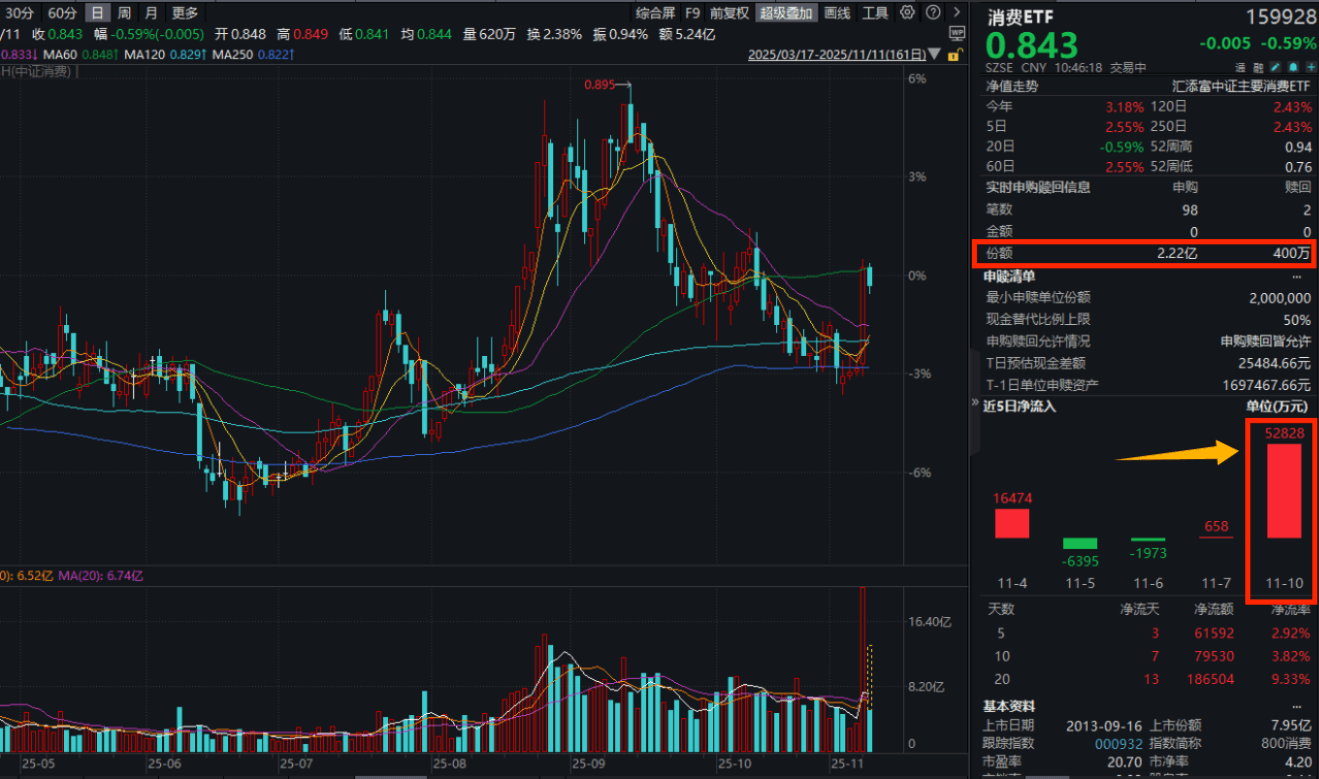
Group 1: Market Performance - The consumer ETF (159928) experienced a slight decline of 0.59% after a significant increase of over 3% the previous day, with a trading volume of 600 million [1] - The consumer ETF attracted substantial capital inflow, with over 528 million yuan on the previous day and a net inflow of over 224 million yuan today, reaching a new high of over 22.1 billion yuan [1][3] - The majority of the weighted stocks in the consumer ETF saw a decline, with notable drops in Luzhou Laojiao (over 2%) and Muyuan Foods (over 1%), while Yili maintained a slight increase [3] Group 2: Valuation and Market Trends - The valuation of the consumer ETF remains attractive, with a TTM price-to-earnings ratio of 20.54, which is at the 7.2% percentile over the past decade, indicating it is cheaper than 92% of the historical time [3] - Seasonal trends suggest that Q4 often sees changes in market style, with December being a period where low valuation stocks may gain more attention [3] Group 3: Economic Indicators - The October CPI showed a positive growth trend, driven by strong service consumption, indicating a recovery in domestic demand [7] - Core CPI increased from 1.0% to 1.2%, marking the sixth consecutive month of growth, with notable price increases in services such as airline tickets and hotel accommodations [9] - The PPI also showed signs of improvement, with a month-on-month increase for the first time this year, suggesting a potential recovery in industrial profitability [7][9] Group 4: Sector Analysis - The liquor industry is currently in a destocking phase, with signs of recovery as companies report easing pressure on their financials [11] - The restaurant supply chain is expected to improve, with new product launches and channel expansions potentially enhancing profitability [11] - The snack food sector is benefiting from health trends and innovation, with strong growth anticipated for products like oats and konjac [11][12]
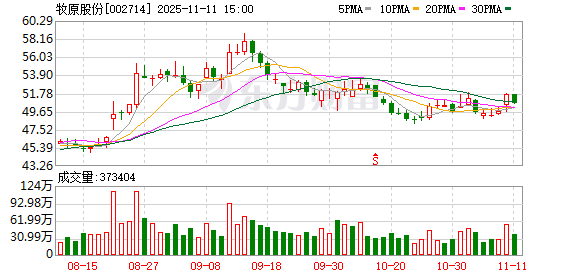
牧原股份跌2.01%,成交额7.81亿元,主力资金净流出7470.74万元
Xin Lang Cai Jing· 2025-11-11 02:58
Core Viewpoint - The stock price of Muyuan Foods Co., Ltd. has shown fluctuations, with a recent decline of 2.01% and a year-to-date increase of 36.99%, indicating volatility in the market [1] Financial Performance - For the period from January to September 2025, Muyuan Foods achieved a revenue of 111.79 billion yuan, representing a year-on-year growth of 15.52% [2] - The net profit attributable to shareholders for the same period was 14.78 billion yuan, reflecting a significant year-on-year increase of 41.01% [2] Shareholder Information - As of September 30, 2025, the number of shareholders for Muyuan Foods was 185,600, a decrease of 11.19% from the previous period [2] - The average number of circulating shares per shareholder increased by 12.60% to 20,534 shares [2] Dividend Distribution - Since its A-share listing, Muyuan Foods has distributed a total of 26.58 billion yuan in dividends, with 16.59 billion yuan distributed over the past three years [3] Institutional Holdings - As of September 30, 2025, Hong Kong Central Clearing Limited was the third-largest circulating shareholder, holding 183 million shares, an increase of 33.70 million shares from the previous period [3] - Huatai-PB CSI 300 ETF was the seventh-largest circulating shareholder, holding 46.55 million shares, a decrease of 2.10 million shares [3] - New institutional shareholder, E Fund CSI Major Consumption ETF, entered the top ten circulating shareholders with 34.53 million shares [3]
农业会是高低切换的重点方向之一吗?
2025-11-25 01:19
Summary of Agricultural Sector Conference Call Industry Overview - The agricultural sector is currently undervalued, with a PB percentile ranking low among the 31 sub-industries in the Shenwan index, indicating potential investment opportunities due to low valuations in various sub-sectors [1][3][6] Key Insights and Arguments - **Animal Health Sector**: This sub-sector has seen the highest growth, driven by specific events rather than a broad sector effect, with a 73% increase since September 2024 [4][5] - **Swine Farming**: Expected government interventions to address falling pig prices and production capacity reduction, with a focus on increasing imports of U.S. agricultural products like soybeans and wheat, which could lower feed costs and improve market expectations for swine farming [1][6][8] - **Seed Industry**: Potential investment opportunities driven by policy changes and a rebound in grain prices, particularly during the year-end policy announcement period [1][10] - **Pet Food Industry**: Facing intensified domestic competition and impacts from the U.S.-China tariff war, but leading companies like Guai Bao and Zhong Chong are expected to emerge stronger [1][13] - **Poultry Farming**: The high incidence of avian influenza during the peak season (October to February) may create investment opportunities, particularly in regions like France and the U.S. [2][14] Market Performance - The agricultural sector's performance has been relatively weak, ranking 22nd in terms of price changes since September 2024, but improved to 17th since April 2025 [3] - Specific stocks have shown significant gains, often driven by unique events rather than core business logic, indicating a lack of consistent performance across the sector [5] Future Investment Opportunities - The agricultural sector may benefit from ongoing anti-involution policies and low valuations across sub-sectors, particularly in swine farming, where supply increases, cost reductions, and consumption recovery are anticipated [6][9] - Recommended stocks include leading companies in swine farming like Muyuan and Wens, as well as low-cost or growth-oriented firms [9] Additional Insights - The seed industry may see price recovery due to recent declines in corn prices, which were driven by weather-related issues rather than supply increases [10][11] - The rubber industry is currently stable but faces short-term challenges; however, long-term prospects remain positive [12]


消费:牛市的下一站风景
2025-11-11 01:01
Summary of Key Points from Conference Call Industry Overview - **Industry Focus**: Consumer sector, including hospitality, duty-free markets, food and beverage, agriculture, and pharmaceuticals [1][2][3][4][5][6][7][8][9][10][11][12][13][14][15][16][17][18][19][20][21][22][23][24][25][26][27][28][29][30][31][32][33][34][35][36][37][38][39][40][41][42][43][44][45] Core Insights and Arguments - **Market Style Shift**: In Q4, funds are transitioning from previous hot sectors to traditional value sectors, revealing valuation opportunities in the consumer sector [1][5] - **Improving Consumer Fundamentals**: High-end brand sales are increasing, and extended holiday periods are expected to boost travel frequency, with potential policy measures to enhance service consumption [1][13] - **Hotel Industry Recovery**: RevPAR decline is narrowing, with some weekly data turning positive; notable stock performance from companies like Atour and Jin Jiang [1][10] - **Duty-Free Market Growth**: Hainan's duty-free market revenue turned positive, with a 35% increase in early November, driven by electronics sales [1][11][12] - **Food and Beverage Opportunities**: Low base, low institutional holdings, and low valuations suggest a potential increase in allocation, with expectations to outperform the CSI 300 index [1][23][24][25] - **Agricultural Sector Turning Point**: Beef prices are rising, expected to maintain an upward trend over the next three years; raw milk market is at historical lows but is set for gradual improvement [1][31][32] - **Pharmaceutical Sector Focus**: Recommendations for innovative drug companies and CRO leaders, with attention to chain pharmacies and traditional Chinese medicine [1][40][41] Additional Important Insights - **Consumer Sector Performance**: A-shares and Hong Kong stocks in the consumer sector have performed well this year, with a notable rally in A-shares [2] - **Investment Strategy for Q4**: A balanced approach is recommended, increasing allocation to traditional consumer sectors while maintaining a long-term view on technology [3][6] - **Social Services Sector Outlook**: The social services sector is showing growth potential, with recent activity in the duty-free market attracting investor interest [7][8] - **Impact of New Listings**: The successful financing of Shaanxi Tourism indicates regulatory support for direct financing, reflecting a positive trend in the current economic environment [9] - **Consumer Spending Recovery**: The recovery in consumer spending is closely tied to economic stabilization, with high-net-worth individuals positively impacted by the ongoing bull market [13] - **Traditional vs. New Consumption**: Both traditional and new consumption sectors show positive growth prospects, with funds shifting towards traditional sectors due to underperformance in tech [14] - **Beauty and Retail Sector Dynamics**: The beauty and retail sectors typically perform well at the start of market rallies, supported by seasonal demand and improved consumer sentiment [15] - **Jewelry Sector Growth**: Companies like Chao Hong Ji are expected to see good growth prospects due to low store counts and positive sales feedback [17][18] - **Online Penetration in Personal Care**: Companies benefiting from increased online penetration include Ru Yuchen and Qingmu Keman Duo, with strong growth expected [19] - **Supermarket Sector Outlook**: The supermarket sector may rebound, with some regional players showing profit improvements [20] - **Cosmetics Industry Focus**: Companies like Proya and Shanghai Jahwa are highlighted for their growth potential, with low valuations and strong market positions [21] - **Hong Kong Jewelry Brands**: Brands like Chow Tai Fook and Luk Fook are at low valuations but show signs of upward trends [22] - **Food and Beverage Sector Performance**: The food and beverage sector has shown strong recent performance, with expectations for continued growth [23][24][25] - **Digital Transformation Impact**: Digital transformation is enhancing operational efficiency in the food and beverage sector, with companies like Nongfu Spring benefiting [28] - **Reform Opportunities**: 2026 is expected to be a pivotal year for many companies, with potential for significant value release [29] - **White Spirit Industry Outlook**: The white spirit industry is expected to stabilize, with a focus on reasonable valuations and dividend yields [30] - **Livestock Sector Trends**: The livestock sector is approaching a significant turning point, with rising beef and raw milk prices anticipated [31][32][33] - **Dairy Farming Innovations**: Dairy farms are exploring new business models to enhance profitability, particularly in the meat and milk systems [34] - **Pork Sector Challenges**: The pork sector faces challenges, with prices expected to bottom out in the first half of next year [35] - **Textile and Apparel Opportunities**: Structural opportunities exist in the textile and apparel sector, particularly in sports and outdoor categories [36][37] - **Home Appliance Sector Outlook**: The home appliance sector is expected to face pressure in Q4 but has long-term growth potential [38][39] - **Pharmaceutical Sector Developments**: The pharmaceutical sector is focusing on innovative drugs and CROs, with significant growth potential in these areas [40][41][42][43][44]