
一汽集团

Search documents
新能源产业重塑:中国500强比亚迪首超上汽,宁德时代排名下滑
Bei Ke Cai Jing· 2025-09-16 04:22
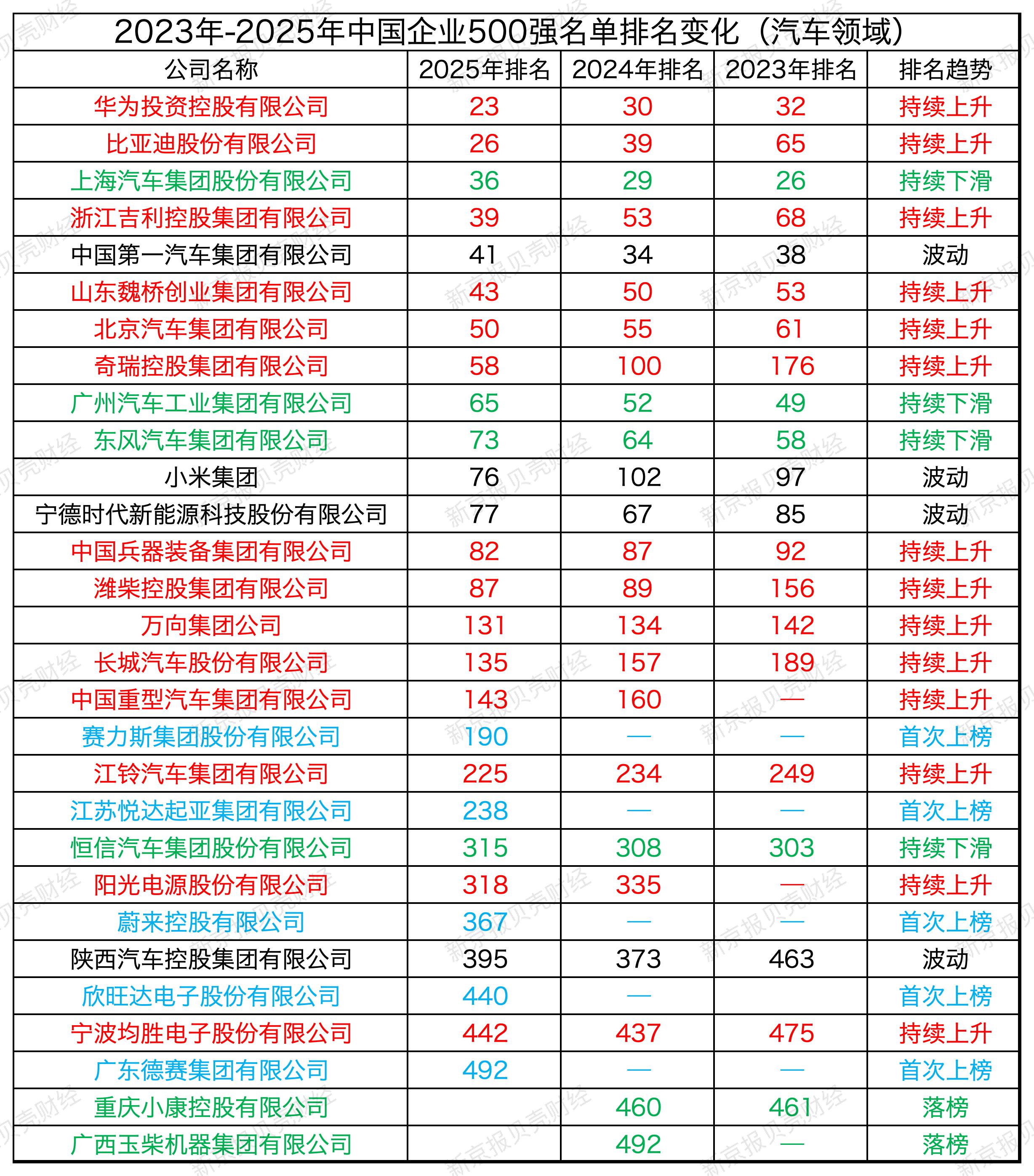
Core Insights - BYD has emerged as the top automotive company in China, ranking 26th overall in the "2025 China Top 500 Enterprises List" with a revenue of 777.1 billion yuan, surpassing SAIC for the first time [1][6] - The rankings reflect a significant shift towards new energy and intelligent transformation within the automotive industry, with traditional automakers experiencing declines [1][9] - Chery Holdings made a remarkable leap from 176th in 2023 to 58th in 2025, showcasing the impact of technological advancements and overseas market expansion [1][11][12] Automotive Industry Rankings - BYD's revenue growth allowed it to rise from 65th in 2023 to 26th in 2025, overtaking FAW and SAIC [6] - SAIC's ranking has consistently declined, dropping from 26th in 2023 to 36th in 2025, indicating a loss of competitive edge [7] - FAW also fell from 34th in 2024 to 41st in 2025, while Geely rose from 68th in 2023 to 39th in 2025, replacing FAW in the top three [8] New Energy Vehicle Sector - The rise of new energy vehicles (NEVs) is reshaping the automotive landscape, with companies like Seres and NIO making their debut on the list [9][14] - Seres ranked 190th and NIO ranked 367th, both representing the new wave of intelligent automotive companies [14] - The shift in value from traditional components to batteries and intelligent systems is evident, with over 60% of value in NEVs coming from these areas [9][10] Chery's Performance - Chery's significant rise is attributed to its accelerated transition to new energy and successful overseas market penetration, with NEV sales increasing from 17% in 2023 to 35% in 2024 [12] - Chery became the top exporter in 2024, with 1.145 million units exported, a 21.4% increase year-on-year [13] Industry Trends - The automotive supply chain is undergoing rapid restructuring, with battery manufacturers like CATL experiencing a decline in ranking, now at 77th overall [19] - New entrants in the battery sector, such as Xinwangda Electronics, made their first appearance on the list at 440th, reflecting the fast expansion of the power battery market [20] - The overall trend indicates a reduction in traditional automakers on the list, while core component manufacturers in electric driving and intelligent systems are rising [22][23] Market Dynamics - The Chinese automotive market is entering a phase of deep integration, with several brands exiting the market, leading to increased concentration [24] - Despite the growth of large enterprises, there is a call for improvement in international competitiveness and the establishment of world-class companies [24]



绘制自动驾驶“零事故”的安全线路图
Ke Ji Ri Bao· 2025-09-15 23:32
Core Insights - The rapid development of intelligent connected vehicles in China has raised concerns about traffic safety incidents caused by intelligent driving systems, highlighting safety "pain points" in the process of automotive intelligence and connectivity [1] - The Ministry of Industry and Information Technology and eight other departments issued the "Automotive Industry Stabilization and Growth Work Plan (2025-2026)", which conditionally approves the production access of L3-level vehicles [1] - The 2025 World Intelligent Safety Conference held in Xi'an focused on the trends and safety challenges of autonomous driving technology, with experts emphasizing the need for collaboration in the industry to continuously improve the safety roadmap towards "zero accidents" [1] Group 1: Safety and Testing - The ultimate goal of autonomous driving systems is to achieve "zero traffic accidents," which can be guided by the evolution path of achieving "near-zero emissions" in automotive emissions [2] - Key points of safety testing differ from environmental testing, as some autonomous driving systems may function well during the day but fail at night due to a lack of necessary environmental factor testing and calibration during training [2] - A team from Tsinghua University has collaborated with companies like Changan Automobile and FAW Group since 2020 to develop a scene collection that includes 100 types of scenarios and evaluation standards, forming a Safety of the Intended Functionality (SOTIF) index [2] Group 2: Technological Innovations - To train AI effectively, a laboratory has been established using virtual simulation technology to simulate extreme sudden situations, helping AI accumulate experience and promote system iteration towards the "zero traffic accident" goal [3] - The evaluation system developed is expected to be adopted as a standard for production access in China, contributing to the improvement of international safety assessment regulations for autonomous driving systems [3] Group 3: Industry Development and Collaboration - The penetration rate of L2-level assisted driving in China's passenger vehicles reached 62.1% in the first half of the year, while the approval and testing trials for L3/L4-level autonomous driving are steadily advancing [4] - There is a need to promote the development of policies and regulations that adapt to industry safety requirements, strengthen safety testing and evaluation technology research, and build a global collaborative industrial ecosystem [4] - The development of safety chips and network security for intelligent connected vehicles is crucial, with efforts in Shaanxi focusing on the autonomous research and development of vehicle-grade safety chips and the commercialization of L4-level intelligent heavy trucks [4]
中美就妥善解决TikTok问题达成基本框架共识;谷歌市值突破3万亿美元;中汽协发布倡议,17车企表态;西贝致歉!罗永浩放弃追究丨每经早参
Mei Ri Jing Ji Xin Wen· 2025-09-15 21:57
Group 1 - US stock markets saw collective gains, with the Dow Jones up 0.11%, S&P 500 up 0.47%, and Nasdaq up 0.94%, marking new closing highs for S&P 500 and Nasdaq [4] - Major tech stocks performed well, with Google rising over 4% to become the fourth US company with a market cap exceeding $3 trillion, while Tesla and Oracle also saw gains of over 3% [4] - Chinese concept stocks mostly rose, with the Nasdaq Golden Dragon China Index up 0.87%, and notable gains from Li Auto (over 6%), Bilibili (over 5%), and NIO (over 4%) [4] Group 2 - International precious metal futures generally rose, with COMEX gold futures up 0.90% to $3719.50 per ounce, and COMEX silver futures up 0.84% to $43.19 per ounce [5] - International oil prices saw slight increases, with WTI crude oil up 0.94% to $63.28 per barrel, and Brent crude oil up 0.69% to $67.45 per barrel [6] Group 3 - The Chinese Ministry of Commerce announced a basic framework consensus with the US to address the TikTok issue and reduce investment barriers, promoting economic cooperation [8] - The Ministry of Commerce expressed opposition to US unilateral trade restrictions related to Russian oil imports, labeling it as economic coercion that could disrupt global trade [8][9] Group 4 - The National Foreign Exchange Administration of China announced reforms to enhance cross-border investment, including allowing foreign investors to reinvest foreign exchange profits domestically [10] - The National Bureau of Statistics reported that the real estate market in China is stabilizing, with a narrowing decline in sales and prices, indicating progress towards recovery [11] Group 5 - Nvidia is under further investigation by China's market regulator for violating antitrust laws related to its acquisition of Mellanox Technologies [12] - The China Automobile Industry Association released a payment standard initiative for automotive suppliers, aiming to improve payment practices and collaboration within the industry [13][14] Group 6 - Baidu and Huawei have upgraded their collaboration to a strategic community, focusing on a comprehensive ecosystem for the automotive industry, with plans to invest 20 billion yuan over three years [21] - Xiaomi's new 17 series smartphones are set to directly compete with Apple's iPhone, showcasing significant upgrades and innovations [27] Group 7 - Silver Lake Capital completed the acquisition of 51% of Altera's shares, previously held by Intel, positioning Altera as a leading independent provider of FPGA solutions [33] - Merck's new antiviral drug for CMV prevention has been approved in China, potentially impacting the market for antiviral treatments [35] - Elon Musk purchased over 2.5 million shares of Tesla stock, valued at approximately $1 billion, indicating confidence in the company's future [37]


中汽协明确“60天账期”!东风集团、上汽集团、奇瑞等多家车企响应
Bei Jing Shang Bao· 2025-09-15 15:03
Core Viewpoint - The China Automobile Industry Association (CAAM) has released the "Supplier Payment Norms Initiative" to standardize payment practices between automobile manufacturers and suppliers, aiming to protect the rights of suppliers, especially small and medium-sized enterprises, and promote a healthier automotive industry ecosystem [3][9]. Group 1: Initiative Details - The initiative outlines norms for order confirmation, delivery and acceptance, payment and settlement, and contract duration between automobile manufacturers and suppliers [3]. - In the order confirmation section, it specifies that both parties must agree on order details and any changes must be mutually consented [3]. - For delivery and acceptance, manufacturers are required to complete acceptance within three working days and notify suppliers of any discrepancies [6]. Group 2: Payment Terms - The initiative states that payment terms should not exceed 60 calendar days from the date of delivery and acceptance [6][9]. - For continuous supply from non-small and medium-sized enterprises, manufacturers can negotiate concentrated billing periods [6]. - If pricing is not agreed upon, manufacturers should make an initial payment based on the most recent contract price, with adjustments made once a price is established [6]. Group 3: Industry Context - The automotive market has become increasingly competitive, leading to pressure on suppliers through lower procurement prices and extended payment periods, negatively impacting the supply chain [7]. - In the first four months of this year, China's automotive production and sales exceeded 10 million units, but industry profit margins have declined to 4.1% despite increased sales [7]. - The initiative is part of a broader effort to enhance cooperation between manufacturers and suppliers, with 17 major manufacturers committing to the 60-day payment term [9][10].




赛力斯、蔚来、东风、长安、上汽齐齐发声,汽车产业链多股暴涨
Mei Ri Jing Ji Xin Wen· 2025-09-15 12:17
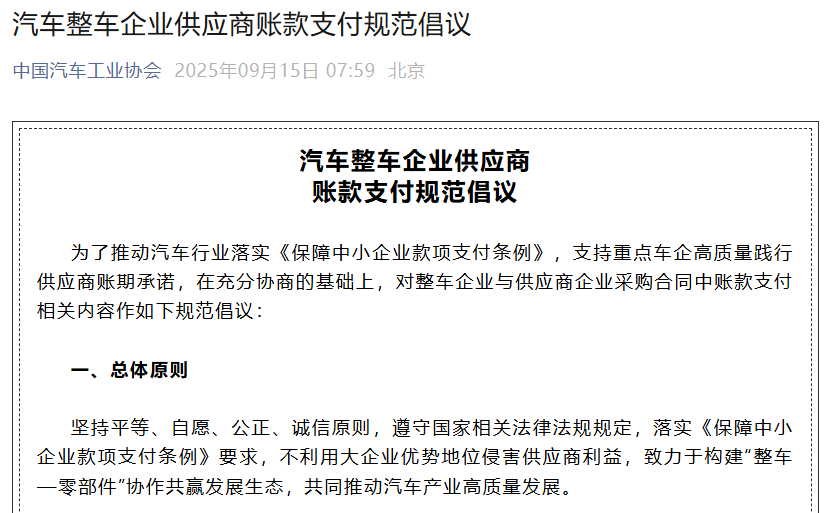
Core Viewpoint - The "60-day payment commitment" initiative among 17 automotive companies continues to evolve, with the China Automotive Industry Association releasing the "Payment Norms Initiative for Automotive OEMs and Suppliers" on September 15, which aims to standardize payment terms and enhance supplier rights [1][3]. Group 1: Initiative Details - The initiative specifies that payment terms should not exceed 60 calendar days from the date of delivery and acceptance by the OEM [3]. - It encourages cash payments or bank acceptance bills, especially for small and medium-sized enterprises, to alleviate financial pressure on suppliers [5][6]. - The initiative includes provisions for advance payments based on previous contract prices if pricing agreements are not reached [5]. Group 2: Industry Response - Major automotive companies such as Dongfeng, Changan, and SAIC have committed to implementing the initiative, ensuring supplier rights and stabilizing expectations within the supply chain [6][8]. - The Ministry of Industry and Information Technology emphasized the importance of this initiative for promoting healthy and sustainable development in the automotive industry [8]. Group 3: Market Impact - Following the announcement of the initiative, automotive stocks saw significant gains, with several companies reaching their daily price limits [3]. - In the Hong Kong market, shares of electric vehicle manufacturers like NIO and BYD also experienced notable increases [4]. Group 4: Historical Context and Future Outlook - Since the initial "60-day payment commitment" declaration in June, some companies have already begun to optimize their payment terms, with reports indicating that several firms have successfully implemented the 60-day payment policy [9]. - The Ministry of Industry and Information Technology has previously issued guidelines to regulate payment terms in the automotive sector, highlighting the ongoing challenges in achieving compliance across the industry [9][10].





中汽协发布《汽车整车企业供应商账款支付规范倡议》后,多家车企“发声”,汽车产业链多股涨停
Mei Ri Jing Ji Xin Wen· 2025-09-15 08:53
Core Viewpoint - The "60-day payment commitment" initiative among automotive manufacturers and suppliers continues to evolve, with the China Automotive Industry Association releasing a new guideline to standardize payment practices within the industry [1][4]. Group 1: Initiative Details - The new initiative specifies that payment terms should not exceed 60 calendar days from the date of delivery and acceptance by the automotive manufacturers [4][5]. - It encourages cash payments or bank acceptance bills, especially for small and medium-sized enterprises, to alleviate financial pressure on suppliers [5][9]. - The initiative aims to enhance the execution of payment commitments and promote the healthy development of the automotive industry [5][10]. Group 2: Industry Response - Major automotive companies, including Dongfeng, Changan, and SAIC, have committed to implementing the initiative's requirements to protect supplier rights [6][9]. - As of the announcement, several automotive stocks saw significant gains, indicating positive market sentiment towards the initiative [4][10]. - The Ministry of Industry and Information Technology has emphasized the importance of adhering to payment commitments to support innovation and stability within the supply chain [10][11]. Group 3: Financial Impact - In the first half of the year, 14 automotive companies reported a decrease in accounts payable compared to the end of the previous year, with Changan, SAIC, and Geely showing the largest reductions [10]. - The initiative is seen as a critical step in addressing cash flow challenges within the automotive supply chain, which is still maturing [10][11]. - The potential obstacles to implementing the 60-day payment term include the financial management capabilities of some companies and the need for better internal coordination among departments [11].

2025年中国车企最新销量目标完成率分化
Huan Qiu Wang· 2025-09-12 09:14
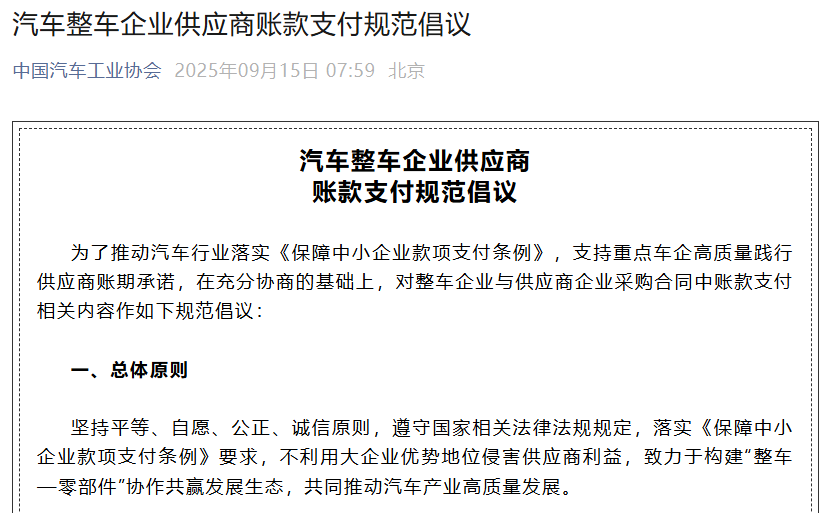
Core Insights - The Chinese automotive market is undergoing a structural transformation, with the retail penetration rate of new energy vehicles (NEVs) reaching a record high of 55.3% in August, marking six consecutive months above 50% [1] - The sales performance of leading automotive companies from January to August shows significant differentiation, with NEVs becoming the main growth driver [1] Group 1: Sales Performance - BYD leads the market with cumulative sales of 2.86 million units, achieving 62% of its annual target of 4.6 million units [1] - Geely Automotive has also performed well, with sales of 1.9 million units, reaching 63% of its annual target of 3 million units, the highest completion rate among the top ten companies [1] - SAIC, FAW, and Changan have sales of 2.75 million, 2.08 million, and 1.8 million units respectively, achieving 61%, 60%, and 60% of their annual targets [1] Group 2: Strategic Factors - The performance of NEV businesses is a key factor influencing the target completion rates of automotive companies [1] - BYD's strategy of "technology equality + overseas expansion" has led to NEV exports of 630,700 units from January to August, surpassing the total for the entire year of 2024 [1] - Technological innovations such as the "Heavenly Eye" driver assistance system and the Super e-platform have helped BYD consolidate its competitive advantage [1] Group 3: Market Outlook - The upcoming fourth quarter is critical for automotive companies to achieve their annual targets, with comprehensive competitiveness in system capabilities, technological strength, and global layout being decisive for market positioning [2] - The effectiveness of advancing NEV businesses will remain an important variable affecting the industry landscape [2]
高端化渐成气候 出口支棱起来 ——上半年车企财报解读
Zhong Guo Qi Che Bao Wang· 2025-09-10 08:02
Core Viewpoint - The profitability of Chinese automotive companies is increasingly driven by high-end product strategies and export growth, with significant financial results reported in the first half of 2025, highlighting a clear industry divide and emerging winners in the market [4][9]. Group 1: High-End Strategy and Performance - High-end strategies have become a core driver of performance growth for several automotive companies, significantly contributing to revenue, profit, and brand premium [4]. - Geely's high-end transformation has led to impressive performance, with total revenue reaching ¥150.28 billion, a year-on-year increase of 27%, and a net profit of ¥9.29 billion, up 102% [5]. - The high-end models from Geely, such as Zeekr and Lynk, have seen substantial sales, with Zeekr 007 GT achieving a monthly sales record of over 8,000 units, boosting the overall gross margin to 18% [5]. Group 2: Export Growth and Localization - Export growth has been a key factor in enhancing automotive performance, with a total of 3.083 million vehicles exported in the first half of 2025, a year-on-year increase of 10.4% [7]. - BYD's revenue surged to ¥371.28 billion, with net profit reaching ¥15.51 billion, driven by overseas sales of 552,400 new energy vehicles, accounting for 21.63% of total sales [7]. - Chery led the export market with 546,000 units, solidifying its position globally, while SAIC Motor's MG brand performed well in Western Europe [8]. Group 3: New Forces and Profitability - New energy vehicle startups are showing signs of profitability, with companies like Leap Motor achieving a net profit of ¥33.03 million for the first half of 2025, marking their first half-year profit [9]. - Xiaopeng Motors reported a revenue of ¥34.09 billion, a year-on-year increase of 132.5%, with vehicle deliveries reaching 197,200 units, a 279% increase [10]. - NIO, despite a net loss of ¥4.99 billion in the second quarter, anticipates a significant increase in vehicle deliveries and revenue in the upcoming quarters [10]. Group 4: Challenges for Joint Ventures - The profitability and sales contributions of joint venture brands are declining, with GAC Group reporting a net loss of ¥2.54 billion in the first half of 2025, a significant drop from the previous year's profit [11]. - Dongfeng Motor's net profit fell by 90% to between ¥30 million and ¥70 million, primarily due to declining sales and profits from non-luxury joint venture brands [11]. - FAW Group faces challenges as its joint venture brands struggle to keep pace with market demands, leading to increased reliance on fuel vehicle sales and reduced profit margins [11]. Group 5: Commercial Vehicle Sector Performance - The commercial vehicle sector is benefiting from electric transformation and export growth, with new energy heavy truck sales reaching 75,200 units, a year-on-year increase of 195.16% [12]. - Foton Motors reported overseas sales of 78,500 units, with a net profit of approximately ¥777 million, reflecting an 87.5% increase [12]. - Zhongtong Bus achieved a revenue growth of 43.02% and a net profit increase of 71.61%, driven by overseas sales and product innovation [13].

汽车早报|比亚迪8艘滚装船中已有7艘投入运营 特斯拉Robotaxi应用向公众开放
Xin Lang Cai Jing· 2025-09-05 00:42
中国广告协会:呼吁对无底线的汽车广告营销"踩刹车" 据北京日报,9月4日,针对一些汽车厂商在广告和营销宣传中的问题引起公众质疑,中国广告协会发文 呼吁,汽车厂家、经销商和营销机构千万不能忽略法律和道德的基本底线,要给正常的广告和营销传播 系上法律和道德的"安全带",汽车厂商和社会要对无底线的广告和营销传播踩下"刹车板"。 比亚迪:8艘滚装船中已有7艘投入运营 比亚迪在机构调研时表示,比亚迪在全球布局超112个国家和地区,2025年上半年在意大利、土耳其、 西班牙、巴西等多个国家新能源(汽车)销量第一。此外,比亚迪8艘滚装船中已有7艘投入运营。 将年度销量目标下调16%?比亚迪:不予回应 日产进出口(广州)有限公司成立,注册资本10亿 知情人士:捷达品牌新合资公司计划四季度成立 据智通财经,从知情人士处获悉,将引入地方投资的捷达新合资公司计划于今年四季度成立。不过该人 士并未透露投资方的具体信息。8月28日,大众汽车集团(中国)、一汽集团与成都经济技术开发区正 式签署《捷达事业发展合作协议》,宣布将在一汽-大众成都生产基地的布局基础上,通过引入本地投 资,成立捷达品牌新公司。 禾赛科技:再获美国Motional ...