
鸿蒙智行

Search documents
造车新势力9月销量:零跑破6万领跑,新能源渗透率达58.1%
Jing Ji Guan Cha Wang· 2025-10-05 00:42
Core Insights - The automotive market in September experienced significant growth, driven by new energy vehicle (NEV) sales and supportive government policies, with NEV penetration reaching a record high of 58.1% [5] Group 1: New Energy Vehicle Sales - Leap Motor achieved a record delivery of 66,657 units in September, marking a year-on-year increase of 97% and becoming the second new energy vehicle manufacturer in China to reach a cumulative production of 1 million vehicles [2] - Hongmeng Zhixing delivered 52,916 units in September, a month-on-month increase of 18.7%, with a total of 344,000 units delivered from January to September, reflecting strong sales from its flagship model, the Wenjie [2] - Zeekr Technology, following its merger with Lynk & Co, delivered 51,159 units in September, maintaining a steady performance with a 79.3% share of new energy models [3] Group 2: Other Key Players - Xiaomi Auto surpassed 40,000 units in September, with the YU7 model contributing nearly half of the sales, while the company has 402 stores nationwide to support order conversion [3] - XPeng Motors delivered 41,581 units in September, a 95% year-on-year increase, with the MONA M03 model being a significant contributor [3] - NIO delivered 34,749 units in September, a 64% increase year-on-year, with the Ladao brand accounting for over 44% of total deliveries [3] Group 3: Market Trends and Factors - The overall retail sales of narrow passenger cars in September are expected to reach 2.15 million units, a month-on-month increase of 6.5% and a year-on-year increase of 2% [5] - The growth in sales is attributed to national vehicle scrappage policies, local trade-in incentives, and increased demand at the end of the quarter, supported by over 50 local auto shows [5]


国庆档电影总票房破11亿元;高市早苗当选日本自民党总裁|南财早新闻
2 1 Shi Ji Jing Ji Bao Dao· 2025-10-04 23:08
Macro Economy - During the National Day and Mid-Autumn Festival holiday from October 1 to 4, the total cross-regional population flow in China is expected to reach 1.249 billion, a year-on-year increase of 5.7% [4] - The total box office for the National Day film season has exceeded 1.1 billion yuan, with top films including "The Volunteer Army: Blood and Peace," "731," and "Assassination Novelist 2" [4] - The number of music festivals held during the first three days of the holiday was 12, 27, and 22, respectively, with total box office revenue exceeding 220 million yuan, although ticket prices are declining [4] - The passenger car market has not seen any hydrogen fuel models launched since the second half of 2024, while 2025 is expected to see a significant number of extended-range vehicles [4] Investment News - The Hong Kong stock market performed well in September, with the Hang Seng Technology Index rising by 13.9%, leading among major global indices. However, there are differing opinions on future trends, with expectations of a short-term adjustment after the holiday [6] - During the 14th Five-Year Plan period, the A-share market has undergone a significant restructuring, with the technology sector's market capitalization share increasing from 19.86% at the end of the 13th Five-Year Plan to 28.60%, surpassing the combined market capitalization of traditional sectors like banking and real estate [6] - The domestic ETF market continues to attract investment, with a total scale of approximately 5.5 trillion yuan, making it the largest ETF market in Asia, with over 70% of the scale in the Shanghai market [6] Company Movements - OpenAI's AI video generation application Sora reached the top of the free app chart in the Apple App Store in the U.S. within four days of its launch, surpassing ChatGPT and Google's Gemini [9] - Hongmeng Zhixing reported that its total pre-orders for all models during the first three days of the National Day holiday reached 18,500 units [10] - Toyota's two factories in Brazil, which were previously shut down due to severe weather, are set to resume automobile production [11] - Fujitsu is expanding its strategic partnership with NVIDIA to jointly develop a full-stack AI infrastructure, focusing on industry-specific AI platforms for healthcare, manufacturing, and robotics [11] International Dynamics - Japan's ruling Liberal Democratic Party held a presidential election, with former Minister of Economic Security Sanae Takaichi winning the majority of votes, likely becoming the new Prime Minister [13] - Ukrainian President Volodymyr Zelensky announced new sanctions against Russia, targeting Russian entrepreneurs, the military industry, and the oil sector [13] - Former U.S. President Donald Trump stated that Israel has agreed to a preliminary withdrawal plan in Gaza, which will be shared with Hamas, leading to an immediate ceasefire and the initiation of prisoner exchanges [13]
9月车市的权力转移:从“比亚迪一家独大”到“群雄并起”
Jing Ji Guan Cha Wang· 2025-10-02 04:00
Core Insights - The Chinese automotive market in September continues to be dominated by new energy vehicles (NEVs), but there is a noticeable internal structural differentiation [2][3] - The market has shifted from a "universal growth phase" to a "structural competition phase," with BYD's decline serving as a significant uncertainty signal [3][7] Market Performance - BYD's NEV sales in September reached 396,000 units, a year-on-year decrease of 5.5%, marking a rare pullback in its years of rapid growth [3] - Changan and Geely showed robust performance, with Changan's sales at 266,000 units (up 25% year-on-year) and Geely's at 273,000 units (up 35% year-on-year) [3][4] - Great Wall Motors sold 134,000 units, a year-on-year increase of 23.3%, with NEV sales of 46,000 units [4] New Entrants and Technology Brands - New entrants and tech brands showed significant growth, with Leap Motor delivering 66,700 units (up nearly 100% year-on-year) and Xiaopeng delivering 41,600 units (up 95%) [5] - NIO delivered 34,700 units (up 64%), while Xiaomi's automotive deliveries exceeded 40,000 units, maintaining momentum since its launch [5] Joint Ventures and Traditional Brands - Joint ventures remain conservative, but some brands are finding support; FAW-Volkswagen sold 146,000 units, with Audi leading the luxury fuel vehicle market [6] - GAC Aion delivered 29,100 units, a year-on-year decline of 18.6%, but showed a 7.6% increase compared to the previous month [6] Export and Internationalization - Exports and internationalization are becoming new growth pillars for Chinese automakers, with Changan's overseas sales exceeding 60,000 units (up 23% year-on-year) [6][7] - Great Wall's overseas sales reached 50,000 units, and SAIC-GM-Wuling's cumulative sales for the first three quarters were 1.175 million units, with significant contributions from NEV exports [6][7] Competitive Landscape - The market is now characterized by a "multi-polar" competitive landscape, with BYD's decline being a key variable for industry observation [7] - The next steps for the Chinese automotive market will depend not only on the speed of NEV adoption but also on advancements in intelligence and globalization [7]

多家车企冲刺百万俱乐部
第一财经· 2025-10-01 15:42
Core Viewpoint - The new energy vehicle market is experiencing intense competition among emerging car manufacturers, with several companies achieving record sales in September, marking a significant milestone in their delivery capabilities [3][4]. Group 1: Sales Performance - Several new energy vehicle manufacturers, including Leap Motor, Zeekr, and NIO, have all surpassed 30,000 units in sales for September, indicating a strong market presence [3]. - Leap Motor achieved a remarkable delivery of 66,657 units in September, maintaining its lead among new energy vehicle companies for seven consecutive months [4]. - Xiaomi and Xpeng both crossed the 40,000 unit delivery mark in September, with Xpeng reporting a 95% year-on-year increase in deliveries [5]. Group 2: Milestones and Targets - Leap Motor celebrated the production of its one-millionth vehicle in September, becoming the second new energy vehicle manufacturer to join the "million club" after Li Auto [4]. - NIO aims to deliver 150,000 vehicles in Q4 to reach the one-million delivery milestone for the year, with a current total of 872,800 vehicles delivered [6]. - Li Auto, despite being the first to enter the "million club," faced a 36.8% year-on-year decline in September sales, delivering 33,951 units [7]. Group 3: Market Dynamics - Hongmeng Zhixing reported a total delivery of 52,916 units in September, with cumulative deliveries exceeding 950,000, while maintaining the highest average transaction price among new energy brands [8]. - Zeekr and Lynk & Co combined sales reached 51,519 units in September, but their annual target completion rate stands at only 54.24% [8]. - Lantu Motors delivered 15,224 units in September, reflecting a 12.73% month-on-month increase [9].
冲上热搜!小米汽车卖爆了,9月销量超4万!小鹏也卖疯了,前9月销量暴涨218%;零跑月销量破6万,继续领跑
Mei Ri Jing Ji Xin Wen· 2025-10-01 14:24
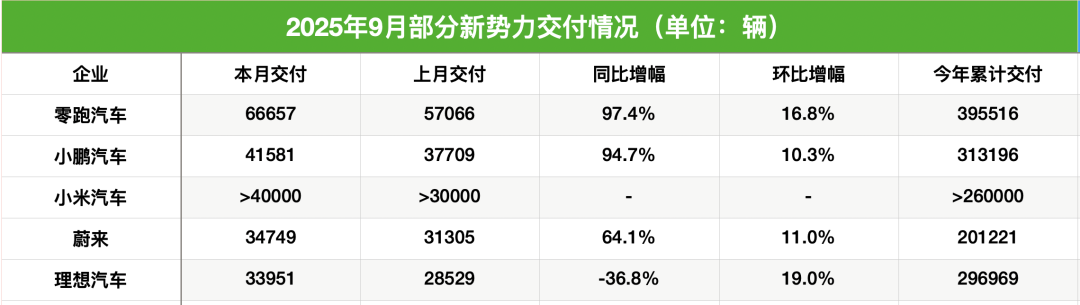
Core Insights - In September, multiple new energy vehicle brands reported significant delivery numbers, with Leap Motor leading the pack with a record-breaking delivery of 66,657 vehicles, marking a year-on-year increase of over 97% [1][2] - The overall performance of the new energy vehicle market in September met expectations, with a total retail market for narrow passenger cars estimated at around 2.15 million units, reflecting a month-on-month growth of 6.5% and a year-on-year growth of 2.0% [11] Company Performance - **Leap Motor**: Delivered 66,657 vehicles in September, achieving a year-on-year growth of 97.4% and a cumulative delivery of 395,516 vehicles for the year, up 128.8% [2][1] - **Xpeng Motors**: Reported 41,581 vehicle deliveries in September, a year-on-year increase of approximately 95% and a cumulative total of 313,196 vehicles for the year, up 218% [2][3] - **Xiaomi Motors**: Exceeded 40,000 vehicle deliveries in September, with a total of over 260,000 vehicles delivered this year [2][3] - **NIO**: Delivered 34,749 vehicles in September, a year-on-year increase of 64%, with a cumulative total of 872,785 vehicles delivered [6] - **Li Auto**: Reported 33,951 vehicle deliveries in September, with a cumulative total of 1,431,021 vehicles delivered [8] - **Zeekr Technology**: Achieved 51,159 vehicle deliveries in September, marking a year-on-year growth of 8.5% [9] - **Lantu Motors**: Delivered 15,224 vehicles in September, a year-on-year increase of 52% [9] Market Trends - The new energy vehicle market is experiencing a surge in demand, driven by seasonal factors such as back-to-school purchases and wedding-related vehicle needs, alongside promotional activities by dealers [11] - The penetration rate of new energy vehicles reached approximately 58.1% in September, indicating a strong market presence [11] - The upcoming product launches and new model deliveries are expected to further boost market growth, with the industry entering a new phase of rapid expansion [11]
新势力七雄鏖战“金九”,多家车企冲刺百亿俱乐部
Di Yi Cai Jing· 2025-10-01 13:33
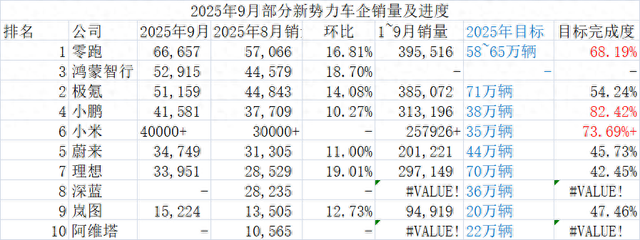
Core Insights - The new energy vehicle market is experiencing intense competition among seven key players, with each achieving sales of over 30,000 units in September [1] - The term "million club" is expected to be a significant focus in the latter half of the year, with several companies aiming to reach this milestone [1] - Leap Motor has become the second new energy vehicle company to reach the "million club" with its 1 millionth vehicle produced [1][4] Sales Performance - Leap Motor delivered 66,657 vehicles in September, maintaining its leading position among new energy vehicle companies for seven consecutive months [1][3] - NIO delivered 34,749 vehicles in September, with a year-to-date total of 872,800 vehicles, aiming for 150,000 deliveries in Q4 to reach the 1 million target [4] - Ideal Auto's September sales were 33,951 vehicles, showing a 19.01% month-over-month increase but a 36.8% year-over-year decline [5] Target Completion Rates - Leap Motor has achieved a cumulative delivery of 395,516 vehicles, with a completion rate of 68.19% against its adjusted target of 580,000 [2][3] - Xiaopeng Motors has delivered 313,196 vehicles year-to-date, achieving an 82.42% completion rate against its target of 380,000 [2][3] - Xiaomi's estimated deliveries are at least 257,926 vehicles, with a completion rate of 73.69% against its annual target of 350,000 [2][3] Competitive Landscape - Hongmeng Zhixing reported 52,916 vehicle deliveries in September, with total deliveries surpassing 950,000 [7] - Zeekr (part of Geely) sold 51,519 vehicles in September, with a year-to-date total of 385,072, achieving a completion rate of 54.24% against its target of 710,000 [7] - Other companies like Lantu and Avita have not disclosed their sales figures for September, while Deep Blue has lowered its annual target from 500,000 to 360,000 [7]
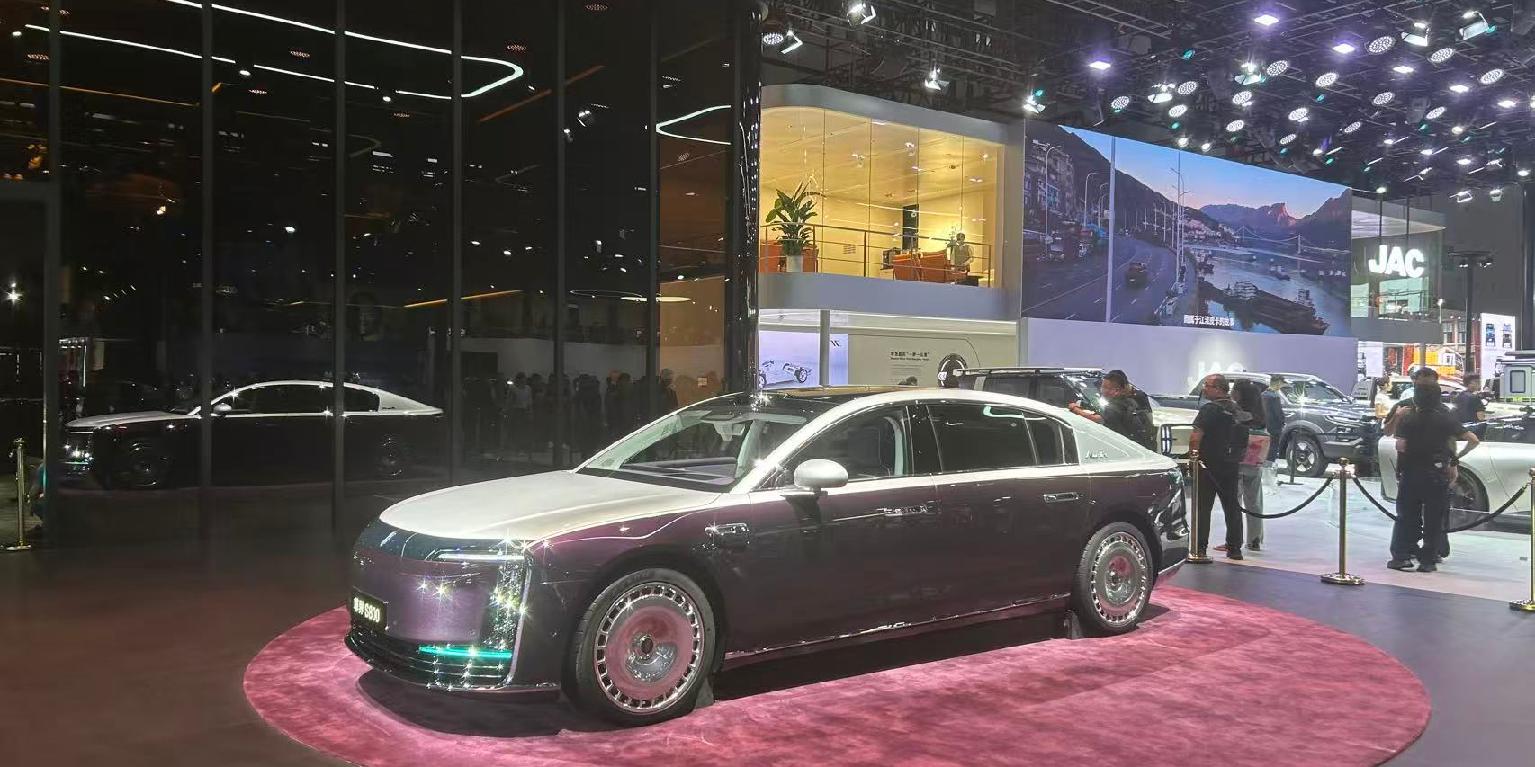
鸿蒙智行全系9月共交付新车52916台
Zheng Quan Shi Bao Wang· 2025-10-01 11:24
Core Insights - The core message highlights the significant growth in vehicle deliveries and orders for Hongmeng Zhixing, indicating a strong market performance and consumer interest in their offerings [1] Group 1 - As of September 2025, Hongmeng Zhixing has delivered a total of 52,916 vehicles [1] - In September 2025, new vehicle orders exceeded 110,000, setting a historical record for the company [1]
鸿蒙智行:9月全系共交付新车52916台
Mei Ri Jing Ji Xin Wen· 2025-10-01 11:24
Core Insights - The company, Hongmeng Zhixing, reported strong sales momentum with a total delivery of 52,916 new vehicles in September 2025, contributing to a cumulative delivery exceeding 950,000 units [1] - The average transaction price remains the highest among new force brands, indicating a successful combination of volume and price growth, thereby leading the Chinese automotive market [1] Summary by Categories - **Sales Performance** - Total new vehicle deliveries in September 2025 reached 52,916 units [1] - Cumulative deliveries surpassed 950,000 units [1] - **Market Position** - The average transaction price continues to lead among new force brands [1] - The company is successfully achieving both volume and price growth, reinforcing its leadership in the Chinese automotive sector [1]
当友商在追新时,鸿蒙智行选择「回头看」
36氪· 2025-10-01 04:11
Core Insights - The core competition in the smart car industry is shifting from a "hardware arms race" to "user experience operations" [2][5] - The industry is facing a "dual dilemma" due to a mismatch between supply and demand [3][4] - Consumers are moving from chasing technological novelty to practical experiences, indicating a significant change in demand [5] Industry Dynamics - The release of new vehicles is increasing, with a heated competition in hardware specifications like LiDAR, reminiscent of the early smartphone era [4] - Despite the industry's prosperity, market reactions are subdued, with many users not fully utilizing smart features, leading to a paradox of excess functionality and insufficient experience [4] User Experience and Brand Loyalty - Issues like "discrimination against old models" and "function isolation" are prevalent, where automakers focus on new models for exclusive features, neglecting older models despite their hardware capabilities [7] - This short-sighted approach risks alienating early supporters, damaging brand trust as users feel abandoned by rapid technological iterations [7][9] Evolution of Value Metrics - The core difference between traditional and tech-driven automakers is shifting from manufacturing efficiency to user lifecycle value operations [11] - Experience yield is becoming the primary metric for car purchasing decisions, replacing traditional parameters like horsepower and computing power [12] Enhanced User Experience Features - The Huawei QianKun Intelligent Driving ADS 4 system exemplifies a higher level of user experience, focusing on real-world performance rather than just theoretical data [13] - The system addresses common challenges, such as the "last mile" issue in autonomous driving, enhancing user convenience with features like "parking from parking space 2.0" [15] Emotional Connection and Social Interaction - The latest upgrades include emotional interaction features that cater to younger consumers' desires for connection and social sharing, enhancing the overall user experience [18] - These features create engaging family discussions and social media sharing opportunities, evolving the value proposition from generic to personalized [18] Strategic Direction for the Industry - As competition shifts from manufacturing scale to ecosystem and user experience capabilities, software-driven, continuously evolving experiences are becoming crucial assets for brands [20] - The commitment to providing a "constantly new" experience is essential for guiding the smart car industry's future competition, emphasizing the importance of ongoing value creation for users [20]
汽车会“成长”:鸿蒙智行与老用户的一场双向奔赴
Feng Huang Wang· 2025-09-30 12:02
Core Insights - The future of vehicles is determined by hardware setting the lower limits and software defining the upper limits, with evolutionary capabilities determining the overall potential of a vehicle [1] Group 1: Product Upgrades - Hongmeng Zhixing has announced a significant upgrade, including the Huawei Qian Kun Intelligent Driving ADS 4 and over 30 experience optimizations, enhancing core functions like intelligent driving and human-machine interaction [1][2] - The ADS 4 system features a new WEWA architecture that reduces end-to-end latency by 50%, improves traffic efficiency by 20%, and decreases emergency braking rates by 30%, providing safety and comfort that can match or exceed human drivers [2] Group 2: Market Performance - In the 38th week of 2025, Hongmeng Zhixing achieved sales of 13,446 units, ranking first among new force brands, with cumulative annual sales also leading the new force brand list [1] - The company has adopted a "five realms and ten vehicles" strategy, achieving explosive growth with weekly orders reaching 35,000 units, covering both mainstream and ultra-luxury markets [2] Group 3: User Experience and Brand Loyalty - The upgrade emphasizes a long-term user experience, allowing even older models to enjoy the latest intelligent features, addressing the common anxiety of "buying outdated technology" [3][4] - This approach fosters brand loyalty and encourages word-of-mouth marketing, as users begin to view their vehicles as lifelong companions rather than one-time purchases [4]