
中国生物制药

Search documents
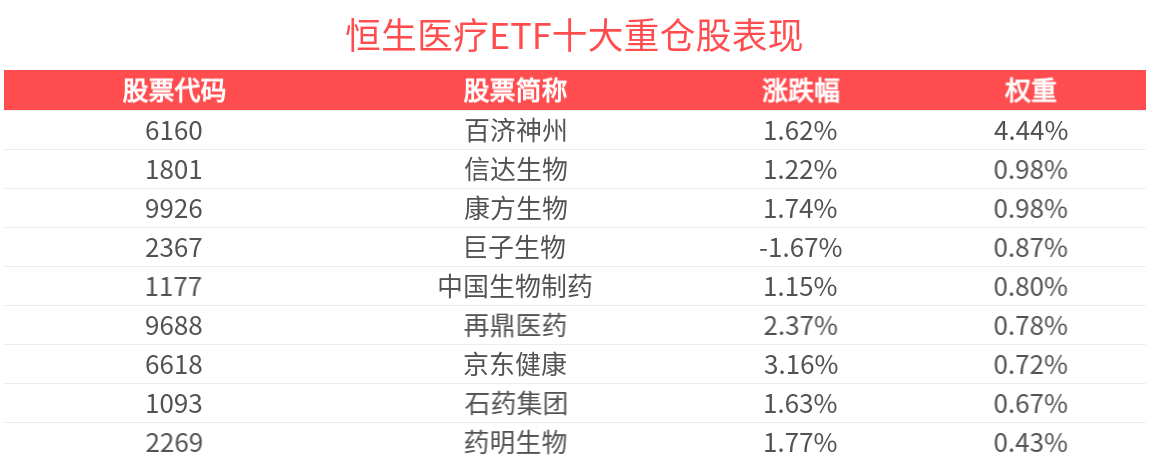
恒生医疗ETF(513060)上涨1.58%,云顶新耀涨超4%,机构:把握政策催化下创新药估值修复机会
Sou Hu Cai Jing· 2025-06-25 02:07
Core Viewpoint - The healthcare sector is experiencing positive momentum driven by favorable policy signals and strong performance of the Hang Seng Healthcare Index and related ETFs [2][3]. Group 1: Market Performance - As of June 25, 2025, the Hang Seng Healthcare Index (HSHCI) rose by 1.37%, with notable increases in stocks such as Cloudmed (01952) up 4.52% and JD Health (06618) up 3.16% [1]. - The Hang Seng Healthcare ETF (513060) also saw a rise of 1.58%, marking its fourth consecutive increase, with a latest price of 0.58 yuan [1]. - The ETF recorded a turnover of 3.26 billion yuan, with a turnover rate of 3.98% during the trading session [1]. Group 2: Policy and Industry Insights - Recent policies from the National Medical Products Administration (NMPA) aim to streamline clinical trial approval processes, potentially reducing the time and costs associated with drug development [2]. - The China Drug Evaluation (CDE) reported a steady increase in clinical trials in oncology and autoimmune fields, indicating a growing demand for innovative drug companies and the CXO industry [2]. - The China Securities Regulatory Commission (CSRC) has introduced new listing standards for the ChiNext board, enhancing financing opportunities for unprofitable biotech companies [2]. Group 3: ETF Performance Metrics - The Hang Seng Healthcare ETF has seen a net value increase of 17.35% over the past two years, with a maximum monthly return of 28.34% since inception [3]. - The ETF's Sharpe ratio for the past year is reported at 1.66, indicating strong risk-adjusted returns [3]. - The ETF has the lowest drawdown among comparable funds, with a relative drawdown of 0.45% year-to-date [4]. Group 4: Valuation and Holdings - The Hang Seng Healthcare Index's latest price-to-earnings ratio (PE-TTM) stands at 27.44, which is below the historical average, suggesting a potentially undervalued market [4]. - The top ten weighted stocks in the Hang Seng Healthcare Index account for 58.34% of the index, with notable companies including Innovent Biologics (01801) and BeiGene (06160) [4].

中证港股通创新药指数上涨3.4%,前十大权重包含康方生物等
Jin Rong Jie· 2025-06-24 12:04
Group 1 - The core viewpoint of the article highlights the performance of the CSI Hong Kong Stock Connect Innovative Drug Index, which rose by 3.4% to 955.16 points, with a trading volume of 16.275 billion yuan [1] - The index has shown significant growth, increasing by 15.52% over the past month, 30.95% over the past three months, and 58.83% year-to-date [1] - The index comprises 50 listed companies involved in innovative drug research and development, reflecting the overall performance of innovative drug companies within the Hong Kong Stock Connect [1] Group 2 - The top ten weighted companies in the index include Innovent Biologics (10.14%), BeiGene (9.67%), WuXi Biologics (9.53%), and others, indicating a concentration in leading firms within the innovative drug sector [1] - The index is exclusively composed of companies listed on the Hong Kong Stock Exchange, with a 100% representation from this market [1] - The industry composition of the index shows that drug formulations account for 42.00%, other biopharmaceuticals for 38.03%, pharmaceutical and biotechnology services for 19.53%, and vaccines for 0.44% [2] Group 3 - The index undergoes adjustments every six months, specifically on the second Friday of June and December, with weight factors adjusted accordingly [2] - In special circumstances, the index may be adjusted temporarily, such as when a sample company is delisted or undergoes mergers or acquisitions [2] - Changes in the Hong Kong Stock Connect eligibility may also lead to adjustments in the index samples [2]

中证港股通医疗主题指数上涨3.01%,前十大权重包含阿里健康等
Sou Hu Cai Jing· 2025-06-24 10:35
Core Points - The China Securities Index for Hong Kong Stock Connect Medical Theme Index has shown a significant increase, with a rise of 3.01% to 896.72 points on June 24, with a trading volume of 13.184 billion [1] - Over the past month, the index has increased by 7.54%, by 6.79% over the last three months, and has risen by 30.22% year-to-date [1] Index Composition - The index consists of 50 listed companies involved in medical devices, medical business and services, pharmaceuticals, and biotechnology services, reflecting the overall performance of the medical sector within the Hong Kong Stock Connect [1] - The index was established on December 31, 2018, with a base point of 1000.0 [1] Top Holdings - The top ten weighted stocks in the index are: WuXi Biologics (14.49%), JD Health (10.5%), WuXi AppTec (5.95%), Alibaba Health (5.78%), Sinopharm (5.12%), Genscript Biotech (4.67%), Weigao Group (3.39%), MicroPort Scientific (2.5%), China Biologic Products (2.25%), and CanSino Biologics (2.24%) [1] Sector Allocation - The index's holdings are entirely from the Hong Kong Stock Exchange, with sector allocations as follows: Medical Business and Services (35.09%), Pharmaceutical and Biotechnology Services (31.59%), Medical Devices (12.87%), Chemical Drugs (12.53%), and Biological Drugs (7.91%) [2] Index Adjustment - The index samples are adjusted semi-annually, with adjustments occurring on the next trading day after the second Friday of June and December each year [2] - Weight factors are generally fixed until the next scheduled adjustment, with special circumstances allowing for temporary adjustments [2]

中证港股通生物科技主题指数报1513.97点,前十大权重包含康方生物等
Jin Rong Jie· 2025-06-24 09:55
金融界6月24日消息,上证指数低开高走,中证港股通生物科技主题指数 (港股通生物科技,932253)报 1513.97点。 数据统计显示,中证港股通生物科技主题指数近一个月上涨15.00%,近三个月上涨27.95%,年至今上 涨60.32%。 据了解,中证港股通生物科技主题指数从港股通范围内选取50只业务涉及生物药品、制药与生物科技服 务等领域的上市公司证券作为指数样本,以反映港股通范围内生物科技主题上市公司证券的整体表现。 该指数以2018年12月28日为基日,以1000.0点为基点。 资料显示,指数样本每半年调整一次,样本调整实施时间分别为每年6月和12月的第二个星期五的下一 交易日。每次调整的样本比例一般不超过20%。权重因子随样本定期调整而调整,调整时间与指数样本 定期调整实施时间相同。在下一个定期调整日前,权重因子一般固定不变。特殊情况下将对指数进行临 时调整。当样本退市时,将其从指数样本中剔除。样本公司发生收购、合并、分拆等情形的处理,参照 计算与维护细则处理。当港股通范围发生变动导致样本不再满足互联互通资格时,指数将相应调整。 本文源自:金融界 作者:行情君 从指数持仓来看,中证港股通生物科技主 ...
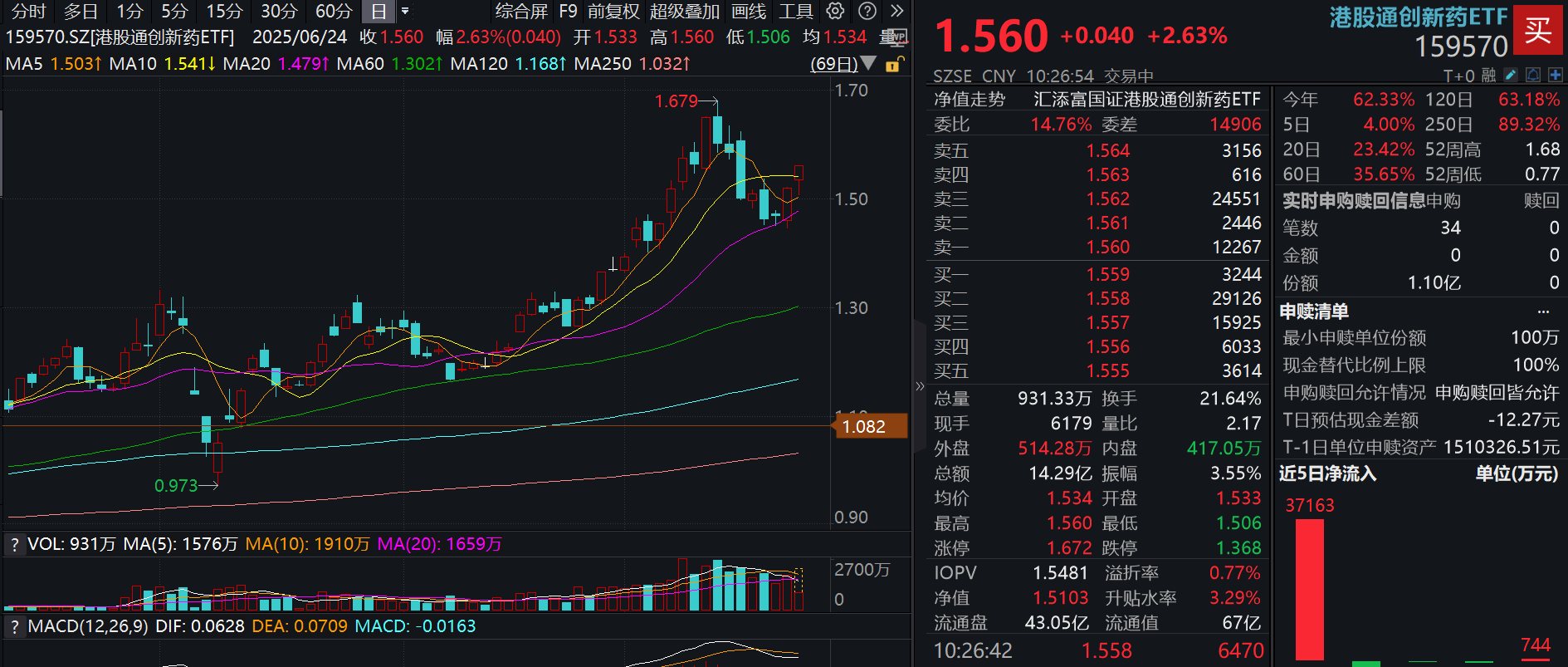
港药回调后连续大涨!港股通创新药ETF(159570)再涨近3%,资金汹涌流入!创新药再获政策支持,把握每一次调整机会!
Xin Lang Cai Jing· 2025-06-24 02:55
Group 1 - The Hong Kong stock market is experiencing a collective rise, with the Hong Kong Stock Connect Innovative Drug ETF (159570) surging over 2% and achieving a trading volume exceeding 1.4 billion yuan [1] - As of 10:25, most constituent stocks of the Hong Kong Stock Connect Innovative Drug ETF (159570) are performing well, with Rongchang Bio rising over 6% and several other companies like CSPC Pharmaceutical, WuXi Biologics, and BeiGene increasing by over 2% [3] - Recent policies have provided support for innovative drugs and medical devices, including discussions on the adjustment of the national medical insurance drug list and optimization of clinical trial approvals [4] Group 2 - The pharmaceutical and biotechnology sector experienced significant declines last week, but the innovative drug sector has shown strong performance year-to-date, indicating a potential for medium to long-term investment opportunities despite short-term adjustments [5] - The China Securities Regulatory Commission has proposed measures to expedite the review and approval process for innovative drug clinical trials, aiming to encourage the development and market entry of innovative drugs [5] - The 2025 mid-term investment strategy emphasizes the importance of both domestic stability and international expansion, highlighting China's competitive advantages in population, manufacturing, and innovation capabilities [6][8] Group 3 - The Hong Kong Stock Connect Innovative Drug ETF (159570) has a strong focus on the innovative drug industry, with nearly 72% of its top ten holdings in leading companies [8] - The ETF is characterized by a high concentration in innovative drugs, with an 85% weight in this category, and is currently undervalued compared to historical price-to-sales ratios [8] - The ETF allows for T+0 trading and is positioned as a medium-risk investment suitable for balanced investors [8]
对外授权交易大单频现中国创新药闪耀全球舞台
Zheng Quan Shi Bao· 2025-06-23 18:44
Core Insights - Chinese innovative pharmaceutical companies are increasingly engaging in large-scale business development (BD) transactions, signaling a shift from being "followers" to "participants" and "contributors" in the global pharmaceutical landscape [1][6][10] Group 1: Major BD Transactions - Recently, major BD deals have been reported, including a $60 billion deal by 3SBio and a $53.3 billion strategic collaboration between CSPC and AstraZeneca [1][3] - In January, Innovent Biologics licensed its DLL3 ADC to Roche for $800 million upfront and potential milestone payments up to $1 billion [1][2] - In March, HAPO announced a global strategic partnership with AstraZeneca, receiving $175 million upfront and potential milestone payments up to $4.4 billion [2][3] Group 2: Market Trends and Growth - The total value of BD transactions for Chinese innovative drugs is projected to reach $52.3 billion in 2024, with an upfront payment of $4.1 billion, both setting historical records [3][5] - As of May 27, 2024, the total value of BD transactions for Chinese innovative drugs has already reached $45.5 billion, indicating a strong growth trajectory [3][5] Group 3: Policy and Regulatory Support - The Chinese government has implemented a series of reforms to support innovative drug development, including a significant reduction in drug approval times from an average of 3 years to 60 days [6][7] - The recent proposal to further reduce clinical trial approval times to 30 working days aims to enhance the efficiency of drug development [7][8] Group 4: Competitive Advantages - Chinese innovative drugs are becoming increasingly attractive to multinational pharmaceutical companies due to their cost-effectiveness and faster development timelines [10][11] - The average R&D cost for innovative drugs in China is significantly lower than in the U.S., with estimates suggesting costs are 20% to 30% of those in the U.S. [11][12] Group 5: Industry Positioning - China has emerged as a leader in the global pharmaceutical innovation landscape, with the number of innovative drugs entering clinical trials surpassing that of the U.S. [8][9] - The number of innovative drugs approved in China has increased dramatically, from 3 in 2015 to 39 in 2024, marking a twelvefold increase [7][8]
康缘药业创始人提前离任董事长,企业近年掉队明显
Xin Lang Cai Jing· 2025-06-23 07:25
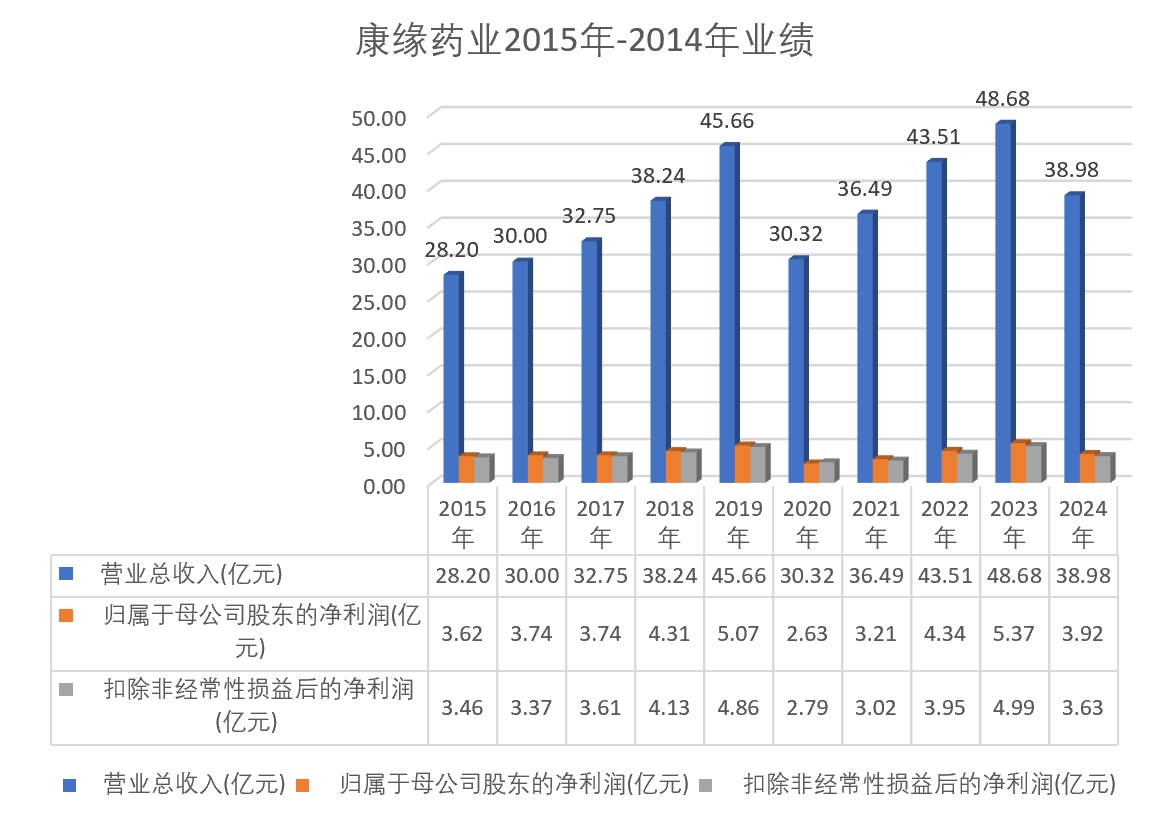
Core Viewpoint - The sudden resignation of Chairman Xiao Wei from Kangyuan Pharmaceutical has raised industry concerns, as he was a long-standing leader and founder of the company, having served for over 20 years [1][2][3] Company Leadership Changes - Xiao Wei resigned as Chairman on June 20, 2023, but will continue to serve as a board member and committee member [1] - His term was expected to end on June 25, 2026, indicating an unexpected early departure [2] - Gao Haixin has been appointed as the new legal representative of the company, with a background in engineering and various roles within Kangyuan since 2014 [3] Market Reaction - Following the announcement of Xiao Wei's resignation, Kangyuan Pharmaceutical's stock opened lower on June 23 but stabilized, closing at 14.93 yuan per share, a 1.36% increase, with a market capitalization of approximately 8.453 billion yuan [2] Company Background - Kangyuan Pharmaceutical is recognized as one of the leading modern traditional Chinese medicine companies in China, having developed 57 new traditional Chinese medicine products [4] - The company was established from the Lianyungang Traditional Chinese Medicine Processing Plant and went public in 2002 [4] Financial Performance - Kangyuan Pharmaceutical reported a revenue of 3.898 billion yuan for 2024, a year-on-year decrease of 19.86%, with net profit and adjusted net profit also declining by 15.58% and 27.29%, respectively [7] - The company has experienced significant revenue fluctuations over the past decade, with peak revenue nearing 5 billion yuan and net profit exceeding 500 million yuan [7]

宽幅震荡延续,短期或探底回升,关注科技反弹与中报预期方向
Haitong Securities International· 2025-06-22 14:31
Investment Focus - The market has entered a second phase of broad consolidation, with heightened volatility risks in micro-caps, new consumption, and innovative pharma sectors [1][8] - The Hang Seng Index dropped 1.5% and the Hang Seng Tech Index fell 2.0%, while A-shares also experienced declines [1][8] - Liquidity in the tech sector has been diverted towards innovative pharma and new consumption, but both sectors saw notable pullbacks this week [1][8] Hong Kong Market Dynamics - The sustainability of rallies in new consumption and innovative pharma depends on continued HKD liquidity and steady southbound inflows [2][9] - Recent pullbacks in innovative pharma have increased the AH premium from a 10-year average of 136 to 139, indicating H-shares are underperforming A-shares [2][9] - The liquidity in the Hong Kong market is tightening, influenced by large IPOs and upcoming listings [2][9] Southbound Capital Flows - This week saw a net inflow of HKD 16.3 billion, but only HKD 4.2 billion flowed in during the last three trading days of market decline [3][10] - Significant selling pressure was observed in Pop Mart, with HKD 1.8 billion sold, nearly erasing the past month's inflows [3][10] - Southbound capital mainly flowed into banks, healthcare, and consumer services, with limited outflows in communication services [3][10] A-Shares Performance - The liquor index rebounded 2.7% this week, supported by favorable media commentary, but the overall downtrend remains unaltered [4][11] - The banking sector continued to perform well, rising 2.6%, which helped stabilize large-cap defensives [4][11] - Micro-caps fell 2.2%, underperforming the broader market but still remain at elevated levels [4][11] Market Outlook - The broad consolidation pattern in the market is expected to continue, with high-flying sectors like micro-caps, new consumption, and innovative pharma yet to fully deflate [4][12] - The expiration of the 90-day tariff grace period on July 9 may lead to renewed pressure from U.S.-China negotiations [4][12] - Investors are advised to wait for better entry points, particularly near 21,000 on the Hang Seng Index and 3,200 on the Shanghai Composite [4][12] Short-Term Market Sentiment - Recent U.S. military actions against Iran may extend market downward momentum early next week [5][13] - If the market declines to key support levels, a bottoming rebound may occur [5][13] - The tech sector, after sufficient pullback, is believed to hold stronger rebound potential, particularly in edge AI and application software [5][13]
创新药重返泡沫时代
投资界· 2025-06-21 07:40
Core Viewpoint - The innovative drug sector has rebounded significantly within six months, indicating a completed valuation repair and a shift towards event-driven phases in business development and clinical trials [3][4]. Group 1: Market Dynamics - The price-to-sales ratio (PS) for innovative drugs is currently at 14 times, close to the five-year average, suggesting a recovery in valuations [3]. - The Hong Kong market has become a primary venue for innovative drugs and new consumer products, with 28 new listings raising HKD 77.36 billion in the first five months of the year, a 707% increase year-on-year [7]. - Southbound capital has been a major force in driving up the stock prices of innovative drugs and new consumer sectors, with net inflows of HKD 55.14 billion and HKD 18.32 billion respectively throughout the year [9]. Group 2: Investment Sentiment - The innovative drug sector is experiencing a bubble, characterized by unrealistic expectations for companies lacking overseas expansion plans or self-research capabilities [3][4]. - Despite the risks associated with bubbles, they can stimulate investment in the sector, as the original innovation capabilities are strengthening, with China leading in the number of research pipelines [4][5]. - The trading congestion in the innovative drug sector has reached a high point, with trading volume nearing 4.8%, indicating a potentially overheated market [11]. Group 3: Future Outlook - The Chinese market is expected to see a surge in innovative drug supply, driven by regulatory changes that expedite clinical trial reviews, with timelines reduced from 60 days to 30 days for certain drugs [16]. - The potential for large business development (BD) opportunities in the second half of the year is significant, with a focus on companies that have demonstrated strong BD capabilities in the past [28]. - The innovative drug sector is projected to continue its growth trajectory, with major academic conferences scheduled for the latter half of the year, which will likely showcase new clinical data and further stimulate interest [28].

“越跌越买”,创新药ETF天弘(517380)连续5日“吸金”,近5、10、20、60日净流率居沪深港创新药同类产品第一
2 1 Shi Ji Jing Ji Bao Dao· 2025-06-20 04:23
Group 1 - The market experienced fluctuations with mixed performance among the three major indices, while the Hang Seng-Hushen Hong Kong Innovative Drug Selected 50 Index fell by 0.39% [1] - Notable gainers among the constituent stocks included Nuotai Bio, which rose over 5%, along with other companies such as CanSino, China National Pharmaceutical Group, and Shanghai Pharmaceuticals [1] - The Tianhong Innovative Drug ETF (517380) has seen a continuous decline for five consecutive days, dropping by 0.47% in the morning session [1] Group 2 - The Tianhong Innovative Drug ETF (517380) is the largest ETF in the market that spans across the Shanghai, Shenzhen, and Hong Kong markets, and is the only ETF tracking the Hang Seng-Hushen Hong Kong Innovative Drug Selected 50 Index [2] - As of the first quarter of 2025, the ETF achieved a net value growth rate of 24.96% over the past year, outperforming its benchmark by 5.45% [2] - The American Diabetes Association (ADA) conference, recognized as the largest diabetes conference globally, is set to take place from June 20-23, showcasing over 200 specialized reports, particularly focusing on GLP-1 class drugs [2] Group 3 - The ADA conference is considered a significant platform for Chinese innovative drug companies to showcase their research capabilities in the GLP-1 field, potentially boosting the related industry chain [3] - The innovative drug sector has garnered high market attention due to various factors including policy support, international expansion, and performance, despite some individual stock performance divergence [3] - The innovative drug sector remains a crucial investment theme in the industry, as highlighted by the ongoing developments and market interest [3]