欣旺达

Search documents
理想汽车与欣旺达成立电池合资公司 背后或暗含业绩压力考量
Da Zhong Ri Bao· 2025-09-26 03:41
Core Viewpoint - The establishment of a joint venture between Xinwanda Power Technology Co., Ltd. and Li Auto marks a significant step in Li Auto's strategy to enhance its supply chain through self-research and manufacturing, particularly in the context of rising battery costs impacting overall vehicle expenses [1][7]. Group 1: Joint Venture Details - The joint venture, Shandong Li Auto Battery Co., Ltd., will focus on the production, manufacturing, and sales of lithium-ion power batteries for electric vehicles, with both companies holding a 50% stake [1]. - This collaboration builds on an 8-year history of partnership between Xinwanda and Li Auto, which has included deep cooperation in R&D, quality, manufacturing, delivery, and customer service [3]. Group 2: Financial Context - Li Auto's Q2 2025 financial report indicated a revenue of RMB 30.246 billion, a year-on-year decline of 4.5%, with net profit remaining nearly unchanged at RMB 10.97 billion [8]. - The company has experienced a continuous decline in vehicle sales for three consecutive months, prompting the need for supply chain optimization to support operations [7][10]. Group 3: Industry Trends - The trend of automakers forming joint ventures with battery manufacturers is becoming more common, as seen with other companies like Dongfeng Group and CATL, to ensure supply chain security and improve profit structures [4][5]. - The battery segment has increasingly concentrated industry profits, with significant profit margins available as the electric vehicle market expands [6]. Group 4: Future Outlook - Li Auto's third-quarter guidance suggests a projected vehicle delivery of 90,000 to 95,000 units, representing a year-on-year decrease of 37.8% to 41.1%, with expected revenue between RMB 24.8 billion and RMB 26.2 billion, down 38.8% to 42.1% [10]. - Despite recent sales challenges, Li Auto maintains a strong gross margin, with expectations to sustain a vehicle gross margin around 19% in the upcoming quarter [10][11].



电池板块震荡走强
Di Yi Cai Jing· 2025-09-26 03:28
Group 1 - Fangyuan Co., Ltd. experienced a 20% limit-up in stock price [1] - Penghui Energy saw an increase of over 9% in its stock price [1] - Other companies such as Wanrun New Energy, Huabao New Energy, Xinwanda, Tianhong Lithium Battery, and Zhongwei Co., Ltd. also experienced stock price increases [1]


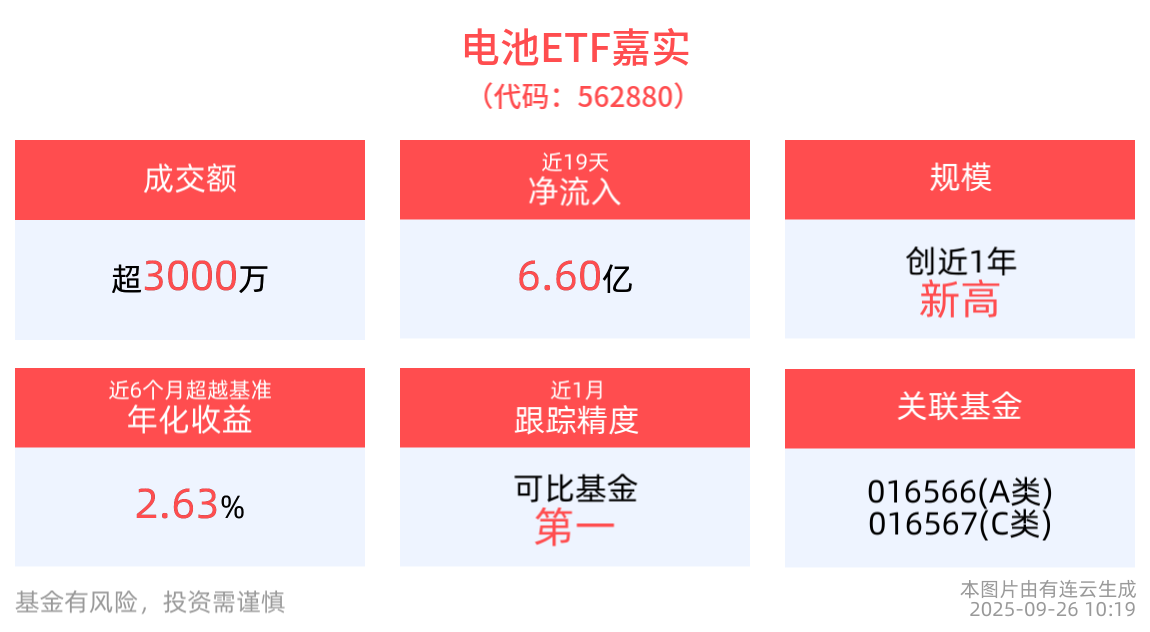
固态相关新产品有望陆续发布,电池ETF嘉实(562880)规模创成立以来新高!
Xin Lang Cai Jing· 2025-09-26 02:57
Core Insights - The battery theme index has shown a slight decline of 0.06% as of September 26, 2025, with mixed performance among constituent stocks, highlighting the volatility in the sector [1] - The battery ETF managed by Harvest has seen a significant increase in net inflows and trading volume, indicating strong investor interest and confidence in the battery industry [3] - Solid-state batteries are emerging as the next generation of battery technology, driven by advancements in energy density and safety, which are expected to accelerate industrialization and capital expenditure across the supply chain [4] Group 1: Market Performance - The battery ETF Harvest has recorded a 5.70% increase over the past week as of September 25, 2025, reflecting positive market sentiment [1] - The ETF's trading volume reached 37.96 million yuan with a turnover rate of 2.96%, indicating active trading [3] - The ETF's net asset value has increased by 99.90% over the past year, ranking it 417th out of 3031 index equity funds, placing it in the top 13.76% [3] Group 2: Investment Trends - The latest scale of the battery ETF Harvest has reached 1.269 billion yuan, marking a new high since its inception [3] - Over the past 19 trading days, there have been 12 days of net inflows totaling 660 million yuan, showcasing strong investor confidence [3] - Wood Mackenzie forecasts that global energy storage capacity will grow more than sevenfold over the next decade, requiring an investment of 1.2 trillion USD in battery systems by 2034 [3] Group 3: Industry Developments - The top ten weighted stocks in the battery theme index account for 53.03% of the index, with significant players including Sungrow Power, CATL, and EVE Energy [4][6] - Solid-state battery technology is expected to lead to new product releases and capacity expansions, enhancing performance validation in the market [4] - The entire supply chain, including equipment, materials, and batteries, is anticipated to undergo iterative upgrades, increasing capital expenditure [4]


重申看好固态电池板块!
2025-09-26 02:28
Summary of Conference Call Records Industry Overview - **Industry Focus**: Solid-state battery sector and lithium battery industry - **Growth Drivers**: China's 2035 renewable energy targets, with wind and solar capacity expected to exceed six times that of 2020, and the rise of electric vehicles as mainstream sales vehicles [1][2] Key Insights - **Energy Storage Battery Sector**: - Major energy storage battery manufacturers have implemented price increases, improving supply-demand dynamics. - Anticipated 40% year-on-year growth in orders for leading manufacturers by 2026 due to tax incentives and demand surges in both domestic and U.S. markets [1][2] - **Solid-State Battery Industrialization**: - Confidence in solid-state battery performance from leading manufacturers, with prototype vehicle testing and small-scale production expected to accelerate industrialization. - Market forecasts predict demand exceeding 100 GWh by 2036, with potential for earlier realization if performance improvements and cost reductions exceed expectations [1][4] - **Hunan Youneng's Profit Recovery**: - Expected increase in self-supply rate of phosphate rock to 30-40%, leading to a profit increase of 300-400 RMB per ton. - Projected profits for next year could reach 2 billion RMB, supported by cost reduction and new product structures [1][7] - **Longpan Technology's Overseas Expansion**: - Anticipated profits of approximately 600 million RMB from 120,000 tons of iron-lithium capacity in Indonesia, with overall profit projections for next year around 900 million RMB [1][8] Market Dynamics - **Lithium Battery Sector**: - Strong performance in the lithium battery sector, with leading companies like CATL seeing significant stock price increases and market capitalization exceeding 1.8 trillion RMB [2] - The sector is characterized by robust fundamentals and attractive valuations, making it suitable for investment [2] - **Lithium Hexafluorophosphate Price Recovery**: - Improved supply-demand dynamics leading to higher processing fees, with expectations of an increase of 10,000 to 20,000 RMB next year, benefiting leading companies like Tianci Materials [3][14] - **Negative Electrode Material Valuation**: - Companies like Shanshan Technology and Putailai are highlighted for their low valuations and potential for profit recovery, with Shanshan expected to increase profits significantly post-integration of production capacity [3][9] Investment Recommendations - **Investment Priorities**: - Equipment sector prioritized, followed by materials with inflation attributes or new product iterations, and finally the battery sector with strong growth certainty [5] - Specific recommendations include CATL for battery production, and companies like Yiwei Lithium Energy and Zhuhai Guanyu for second-tier energy storage [5][6] - **Material Sector Outlook**: - The material sector is at a turning point, with strong demand in the energy storage industry and expected price increases due to limited new capacity [12][13] - **Solid-State Battery Material Focus**: - Key areas include electrolytes, lithium metal anodes, and current collectors, with a focus on high-purity lithium sulfide and nickel-copper alloy solutions [10][11] Conclusion - The solid-state battery and lithium battery sectors are poised for significant growth driven by favorable market conditions, technological advancements, and supportive government policies. Key players in these sectors are expected to benefit from increased demand and improved profitability in the coming years.
锂矿概念震荡走高 柘中股份、芳源股份涨停
Mei Ri Jing Ji Xin Wen· 2025-09-26 02:14
Group 1 - The lithium mining sector experienced significant fluctuations, with companies like Zhezhong Co., Ltd. hitting the daily limit up, and Fangyuan Co., Ltd. previously reaching a 20% limit up [1] - Other companies in the sector, such as Xinwangda, Zhongwei Co., Ltd., Huayou Cobalt, and Tibet Mining, also showed notable gains [1]


国内储能深度:配储退出,独储登台,高质量需求爆发且持续
Soochow Securities· 2025-09-26 02:06
Investment Rating - The report maintains a positive outlook on the independent energy storage sector, highlighting the economic viability and significant demand growth in the market [2][3]. Core Insights - The transition from mandatory energy storage to independent energy storage is underway, with local governments implementing capacity price compensation policies to establish a market-oriented revenue mechanism [2][3]. - The domestic energy storage demand forecast has been revised upward, with expectations of continued strong growth, particularly in regions like Xinjiang and Inner Mongolia [2][3]. - The supply of energy storage cells is expected to remain tight until the second half of 2026, benefiting leading companies in the industry [2][3]. - The report emphasizes the importance of innovative business models and integrated system solutions, which are expected to enhance profitability for companies with technological and resource advantages [2][3]. Summary by Sections PART 1: Capacity Price Policies and Independent Storage Models - The shift from mandatory energy storage to independent storage is supported by new policies that provide stable cash flow through capacity price compensation [2][3]. - The report outlines the differences in revenue structures and economic viability between mandatory and independent storage models, with independent storage showing superior profitability potential [11][36]. PART 2: Revised Domestic Energy Storage Demand Forecast - The report projects that domestic energy storage installations will reach 149 GWh in 2025 and 194 GWh in 2026, with a long-term forecast of 340 GWh by 2030 [2][3]. - The demand for energy storage is significantly driven by the development of data centers, which are expected to account for one-third of total energy storage demand by 2030 [2][3]. PART 3: Supply Constraints and High-Quality Development - The report anticipates a continued shortage of energy storage cells until the second half of 2026, with global demand expected to reach 521 GWh in 2025 and 710 GWh in 2026 [2][3]. - The focus on high-quality development in the energy storage industry is expected to benefit leading companies, as well as improve the performance of second-tier players [2][3]. PART 4: Valuation Comparison and Investment Recommendations - The report recommends investing in leading companies such as CATL, Sungrow, and others, while also highlighting the potential of emerging players in the market [2][3]. - The overall sentiment is bullish on the large-scale energy storage sector, driven by strong demand in Europe and emerging markets, as well as favorable policies in the U.S. [2][3].




小米17向高端化迈进 供应链公司加速协同布局
Shang Hai Zheng Quan Bao· 2025-09-25 18:15
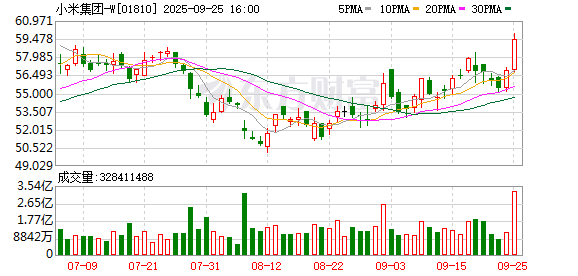
Core Insights - The smartphone market is entering a phase of stock competition, with high-end positioning becoming essential for domestic brands to seek breakthroughs and growth [3] - Xiaomi launched its flagship Xiaomi 17 series, which aims to directly compete with the iPhone, marking a significant product strategy upgrade [4] Group 1: Xiaomi's High-End Strategy - Xiaomi's CEO Lei Jun described the Xiaomi 17 series as a "stunning transformation," emphasizing a cross-generational upgrade in product capabilities [4] - The Xiaomi 17 series includes three models: Xiaomi 17, Xiaomi 17 Pro, and Xiaomi 17 Pro Max, skipping the "Xiaomi 16" naming to signify a leap in product evolution [4] - Over the past five years, Xiaomi has invested over 100 billion yuan in R&D, with plans to increase this investment to 200 billion yuan over the next five years [4] Group 2: Imaging Technology Advancements - The imaging system is a focal point in the competition among high-end flagship smartphones, with Xiaomi's 17 Pro series introducing advanced technology to tackle backlight photography challenges [4] - The series features the third-generation mobile imaging technology LOFIC, achieving the highest dynamic range for sensors in Xiaomi's history [4] Group 3: Supply Chain Developments - The launch of the Xiaomi 17 series reflects a broader trend of domestic smartphones targeting the high-end market, supported by an efficient and innovative supply chain [6] - Companies within Xiaomi's supply chain are showcasing new products and technologies, indicating robust growth and innovation in the consumer electronics sector [6] Group 4: Industry Trends and Company Performance - O-film highlighted three future upgrade directions in the mobile optics industry: larger sensors for main and telephoto cameras, faster adoption of periscope telephoto modules, and broader application of hybrid lens structures [5] - BOE reported a 7.5% year-on-year increase in OLED shipments, with a focus on high-end product structure transformation [7] - Several companies, including O-film and STMicroelectronics, reported significant revenue growth in their smartphone-related businesses, driven by innovative product launches and increased market demand [7][6]

锂电股异动 “宁王”创新高!固态电池产业化进程加速
Zheng Quan Shi Bao· 2025-09-25 13:30
Group 1 - The lithium battery concept stocks have shown strong performance, with significant movements in the A-share market on September 25, particularly in lithium mines and solid-state batteries [1][2] - Notable individual stock performances include Ningde Times, which saw a nearly 6% increase, reaching a historical high and a market capitalization exceeding 1.8 trillion yuan, surpassing Kweichow Moutai to become the third-largest by market cap in A-shares [2][4] - The Hong Kong market also experienced activity, with the Hang Seng Technology Index rising nearly 2% before retracting, while individual stocks like Ningde Times and XPeng Motors saw gains of over 5% [2] Group 2 - The solid-state battery industrialization process is accelerating, with expectations that 2027 may mark the year of full-scale commercialization [3][10] - Major companies like Panasonic and Toyota are planning to launch solid-state battery samples and applications in electric vehicles by 2027-2028, indicating a competitive push in the market [8] - Chinese companies are also making significant progress, with Guoxuan High-Tech reporting a 90% yield rate in their solid-state battery production and plans for mass production [8][9] Group 3 - Recent strategic partnerships involving Ningde Times, such as agreements with Li Auto and China Huaneng, aim to enhance battery safety and technology innovation [5] - Analysts from Morgan Stanley and Bank of America have noted that Ningde Times is positioned favorably in the market, with its valuation being attractive compared to competitors [5][7] - The demand for energy storage batteries is expected to remain strong, with projections indicating that China's cumulative installed capacity could reach 240 GW by 2030 [6] Group 4 - The solid-state battery market is projected to see significant growth, with estimates suggesting a market size of 45.5 billion yuan by 2030, driven by advancements in technology and policy support [10] - The transition from liquid to solid-state battery production is expected to enhance the value of related equipment, creating new growth opportunities for companies in the sector [10] - The demand for high-purity lithium products is anticipated to increase as solid-state battery production scales up, leading to structural changes in the lithium market [11]
第四代高压实LFP供不应求,二三线企业窗口期何在?
高工锂电· 2025-09-25 10:20
Core Viewpoint - The demand for high-pressure lithium iron phosphate (LFP) is increasing due to the performance improvements in energy storage and power batteries, while the supply is constrained by the complexity of production processes and the limited number of companies capable of mass production [1][2][4]. Group 1: Market Demand and Supply Dynamics - High-pressure LFP is in high demand due to the scaling of large-capacity, high-energy, and fast-charging batteries [1]. - The production of high-pressure LFP requires strict raw material purity and particle size distribution, with only a few companies mastering mass production technology [1][2]. - The pricing mechanism for LFP has shifted to a model based on "raw material market price + processing fee," with high-pressure LFP commanding an additional processing fee of 2000-5000 yuan per ton compared to standard products [1]. Group 2: Competitive Landscape - The production capacity for fourth-generation high-pressure LFP (≥2.6g/cm³) is concentrated among leading companies such as Fulin Precision, Hunan Youneng, Longpan Technology, and Defang Nano, which limits the survival space for smaller firms [2]. - Despite the capacity of leading firms, actual production and future capacity ramp-up will take time, leading to a significant demand gap in the short term [2][4]. - The market for fourth-generation LFP is expected to see concentrated supply once leading companies complete their capacity expansions, potentially altering the competitive landscape [2]. Group 3: Industry Trends and Innovations - The performance of energy storage batteries is improving, with average capacity utilization rates for leading battery companies reaching 70%-80%, and some even exceeding 80% [5][6]. - The domestic energy storage market saw a cumulative installed capacity of 23.03 GW/56.12 GWh in the first half of 2025, a year-on-year increase of 68% [6]. - The mainstream density for LFP materials is currently between 2.5-2.55 g/cm³, with ongoing technological iterations pushing for larger capacities and longer cycle lives [6]. Group 4: Strategic Moves by Companies - Leading LFP companies are accelerating their fourth-generation product layouts, with Fulin Precision's subsidiary signing a prepayment agreement with CATL to enhance high-pressure LFP supply [10][11]. - Hunan Youneng has introduced its fourth-generation LFP products, achieving batch supply after important customer certifications [11]. - Smaller firms are also making moves, with companies like Pengbo New Materials and Wanhua Chemical planning to invest in high-pressure LFP production projects [13].

电池厂绑定新势力再+1,理想与欣旺达合资落定
高工锂电· 2025-09-25 10:20
Core Viewpoint - The establishment of a joint venture between Li Auto and Sunwoda Power Technology marks a deepening of their partnership, reflecting a strategic move to enhance supply chain stability in the electric vehicle industry [1][2]. Group 1: Joint Venture Formation - Li Auto and Sunwoda Power Technology have formed a joint venture named Shandong Li Auto Battery Co., Ltd., with a 50:50 investment ratio, focusing on the production and sales of lithium-ion batteries for electric vehicles [1]. - This joint venture is a continuation of their collaboration that began in 2017, indicating a shift towards a more integrated partnership [2]. Group 2: Historical Context and Strategic Importance - In 2022, Li Auto invested 400 million yuan in Sunwoda, acquiring a 3.22% stake, which established a dual role as both a customer and shareholder, laying a solid foundation for future cooperation [3]. - As of March 2025, Li Auto has become one of Sunwoda's top five customers, contributing 5.8% to its revenue, with key models like L6, L7 Air, and L8 Air utilizing Sunwoda batteries [3]. Group 3: Industry Dynamics and Supply Chain Strategy - The joint venture is seen as a necessary response to industry changes, with Li Auto aiming to stabilize its supply chain where battery costs account for 30%-40% of vehicle production costs [3][4]. - Sunwoda's strategy involves deepening ties with leading automakers to secure stable sales and transition from a supplier to a profit-sharing partner [4]. Group 4: Operational Goals and Market Positioning - The joint venture will be led by Li Auto in product, process, and material design, with a target to achieve mass production of self-developed batteries by 2026 [4]. - The collaboration reflects a broader trend in the electric vehicle sector where automakers and battery manufacturers are forming joint ventures to ensure supply chain security and enhance production efficiency [5]. Group 5: Competitive Landscape and Risks - The partnership model has been validated by other industry examples, such as BYD and FAW, indicating a mature paradigm for supply chain collaboration [5]. - However, risks associated with deep integration exist, such as potential impacts on short-term orders if vehicle models change, highlighting the need for a balanced supply chain strategy [5][6]. - Li Auto's simultaneous agreement with CATL for a five-year strategic partnership underscores the importance of supply chain diversification while maintaining competitive pressure on Sunwoda [6].