天弘基金

Search documents
公募基金33.74万亿规模创新高,告别明星时代转向平台化运营
Sou Hu Cai Jing· 2025-06-29 23:18
Core Insights - The public fund industry in China is undergoing a significant transformation from a star-driven model to a platform-based operation, with total assets reaching 33.74 trillion yuan by May 2025, marking a historical high [1] - The China Securities Regulatory Commission (CSRC) has issued a plan to promote high-quality development in public funds, emphasizing the need for a "platform-based, integrated, multi-strategy" research and investment system [1] Industry Challenges - The active equity investment research system faces five core pain points: over-reliance on individual fund managers, lack of systematic management mechanisms, ineffective management tools for star managers, misalignment of talent assessment and incentive mechanisms, and absence of digital talent training [3] - The industry is challenged by market volatility and intense competition, leading to instability in excess returns, prompting a shift towards reducing dependence on individual capabilities for sustainable operations [3] Transformation Initiatives - Fund companies are responding to the CSRC's action plan by leveraging AI and big data to build research and investment platforms, initiating a wave of "three transformations" (professionalization, standardization, and digitalization) [4] - Companies like China Europe Fund are integrating industrialization concepts into their research systems, focusing on specialized roles and standardized processes to enhance efficiency [4] Technological Advancements - Emerging technologies such as AI and big data are becoming the foundation for building next-generation research and investment platforms [5] - For example, Fortune Fund has developed an intelligent research system that integrates data, algorithms, and computing power, significantly improving research efficiency and reducing the time for investment decision-making [5]


公募看好下半年市场 青睐创新药、AI与新消费
Shen Zhen Shang Bao· 2025-06-29 17:23
Group 1 - The core viewpoint is that Chinese equity assets are showing long-term allocation value amid global asset rebalancing, with a focus on sectors like innovative pharmaceuticals, AI, and new consumption [1][2] - Jiashi Fund expresses optimism for the next 6-12 months, citing China's stable growth policies and the ongoing development of new industries as key drivers for global economic growth [1] - Jiashi Fund recommends a "barbell" strategy for equity assets, focusing on high-growth technology assets supported by liquidity and high-dividend, cyclical assets [1] Group 2 - Hu Yu, manager at Tianhong Fund, emphasizes the importance of the rotation between consumption and technology as a core strategy for the second half of the year, highlighting the early stage of consumption recovery [2] - Fuguo Fund notes that the AI sector is expected to be a central theme for technology investment in the second half, driven by significant cost reductions and a surge in domestic AI investments [2] - The report indicates that the upstream of the AI industry chain is experiencing a convergence of advantages compared to the mid and downstream sectors, suggesting potential for broader market growth [2]
基金周报:年内多家公司对旗下ETF更名,科创板ETF纳入基金投顾配置范围-20250629
Guoxin Securities· 2025-06-29 14:07
证券研究报告 | 2025年06月29日 基金周报 年内多家公司对旗下 ETF 更名,科创板 ETF 纳入基金投顾配置范围 核心观点 金融工程周报 上周市场回顾。上周A股市场主要宽基指数全线上涨,创业板指、中证 1000、中证 500 指数收益靠前,收益分别为 5.69%、4.62%、3.98%, 上证综指、沪深 300、中小板指指数收益靠后,收益分别为 1.91%、 1.95%、2.55%。 从成交额来看,上周主要宽基指数成交额均有所上升。行业方面,上周 综合金融、计算机、综合收益靠前,收益分别为 14.48%、8.09%、7.55%, 石油石化、食品饮料、交通运输收益靠后,收益分别为-1.45%、0.02%、 0.25%。 截至上周五,央行逆回购净投放资金 10672 亿元,逆回购到期 9603 亿 元,净公开市场投放 20275 亿元。除 1 年期和 3 年期外,不同期限的国 债利率均有所上行,利差扩大 1.66BP。 上周共上报 28 只基金,较上上周申报数量有所减少。申报的产品包括 3 只FOF,2 只REITs,天弘国证港股通消费主题ETF、嘉实上证科创板人 工智能ETF、华宝港股通恒生消费ETF ...
3只,超200亿元大关
Zhong Guo Ji Jin Bao· 2025-06-29 07:24
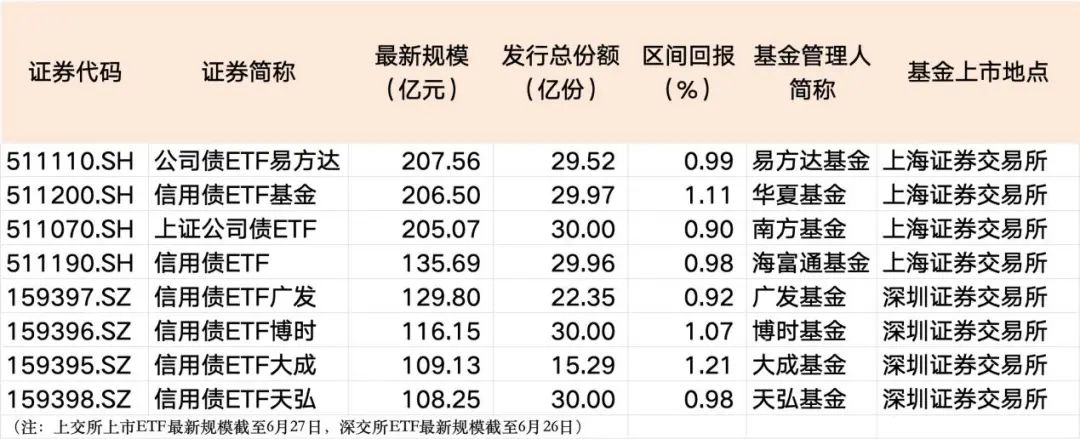
Core Insights - The first batch of benchmark market-making credit bond ETFs has seen explosive growth, with three ETFs now exceeding 20 billion yuan in scale [1][3][8] - The total scale of the first eight benchmark market-making credit bond ETFs has surpassed 120 billion yuan, reflecting a growth of over 460% from the initial fundraising amount of 21.71 billion yuan [3][9] - The popularity of credit bond ETFs is attributed to their relatively lower credit risk and higher tracking efficiency, indicating significant future growth potential [2][9] Fund Performance - As of June 27, the scale of the E Fund Company Bond ETF reached 20.756 billion yuan, marking a historical high and a net inflow of approximately 1.6 billion yuan on June 26 alone [3][7] - The Southern Fund's Shanghai Stock Exchange Company Bond ETF also surpassed 20.507 billion yuan, achieving this milestone just one month after crossing the 10 billion yuan mark [4][7] - The Huaxia Fund's credit bond ETF reached 20.650 billion yuan as of June 27, having crossed the 10 billion yuan threshold less than two weeks prior [5][7] Market Trends - The current market now has three ETFs tracking the Shanghai benchmark market-making company bond index exceeding 20 billion yuan, with others like the Hai Futong Credit Bond ETF exceeding 13.569 billion yuan [6][9] - Credit bond ETFs have attracted over 130 billion yuan in net inflows this year, accounting for over 80% of the total net inflow into bond ETFs [9] - The total scale of credit bond ETFs has exceeded 215 billion yuan, representing an increase of over 160 billion yuan from the end of the previous year, and now constitutes over 57% of the total bond ETF market [9] Investor Participation - Various types of investors, including pension funds, bank wealth management, and insurance asset management, are actively participating in the investment of benchmark market-making company bond ETFs [10] - The introduction of credit bond ETFs as collateral for general repurchase transactions since June 6 has enhanced their appeal, allowing investors to leverage these products for more efficient capital use [10] - The growing variety of credit bond ETF products provides investors with more options for selection and duration, making bond ETFs a significant investment vehicle for both long-term allocation and short-term trading needs [9][10]
中国个人养老金演进与养老理财透视:养老理财稳中求进,未来可期
Hua Yuan Zheng Quan· 2025-06-27 13:06
1. Report Industry Investment Rating No relevant content provided. 2. Core Viewpoints of the Report China's personal pension system has been fully implemented for half a year, and pension wealth - management products are rising rapidly in the multi - level pension system with low - risk and stable returns as core advantages, showing investment potential of "seeking progress while maintaining stability and promising future" [1]. 3. Summary According to Related Catalogs 3.1 China's Personal Pension System's Full - scale Implementation and Global Insights 3.1.1 China's Pension System: From "Multi - level" to "Multi - pillar" China's pension system is structured around the internationally - recognized "three - pillar" framework. By the end of 2024, the total scale of China's multi - level pension security system was about 18.8 trillion yuan, a 12.77% increase from the previous year. The first pillar (social security fund + basic pension) accounted for about 63.9% (about 12 trillion yuan), the second pillar 35.8%, and the third pillar about 0.3%, showing the characteristics of "dominated by basic security and the supplementary level awaiting breakthrough" [2][11]. 3.1.2 Full - scale Implementation of Personal Pension The personal pension system was fully implemented in December 2024, with core breakthroughs in national coverage, diversified product systems, and flexible services and withdrawals. By the end of May 2025, the number of account - opening exceeded 72 million, and the number of products increased to 1,031, but the phenomenon of "hot account - opening and cold deposit" was prominent [15][16]. 3.1.3 International Comparison of Personal Pension Systems The core of the US personal pension system is the Individual Retirement Account (IRAs), with an asset scale of about 17 trillion US dollars by the end of 2024. The UK's personal pension started in 1986, and by the end of 2021, its scale was about 470 billion pounds. Japan's personal pension system consists of iDeCo and NISA. Different countries have different tax mechanisms, access conditions, annual payment limits, investment ranges, and withdrawal conditions [17][21][22]. 3.2 Domestic Personal Pension Product Hierarchical Competition and Global Experience 3.2.1 Formation of the Domestic Personal Pension Product Hierarchical Competition Pattern As of the end of May 2025, savings, insurance, wealth - management, and fund products accounted for 45%, 23%, 3%, and 29% respectively in terms of product quantity. The market is dominated by leading institutions, and small and medium - sized institutions seek breakthroughs through characteristic products [33]. 3.2.1.1 Savings Products with Stable Returns As of June 4, 2025, joint - stock banks were the main issuers of savings products, accounting for 58% of the total product quantity. The interest rate of long - term savings products was generally about 0.6 percentage points higher than that of short - term products [40]. 3.2.1.2 Insurance Products: Coexistence of Guaranteed Stability and Return Elasticity As of the end of May 2025, there were 233 insurance products. The market was dominated by leading institutions, and professional pension insurance companies performed prominently. Some products of National Pension Insurance had a settlement interest rate of over 4% in 2024 [45]. 3.2.1.3 Steady Development of Wealth - management Products As of the end of May 2025, there were 35 wealth - management products, mainly from large bank - affiliated wealth - management subsidiaries. The average one - year return rate as of June 6, 2025, was 2.7%, and the average annualized return rate since establishment was 3.1% [54][58]. 3.2.1.4 New Index Products in the Fund Category, with Leading Funds Dominating the Market Pattern As of the end of May 2025, there were 297 fund products. R3 (medium - risk) products dominated, and pension target FOF accounted for the main proportion. Index funds were included in the product catalog in December 2024, and leading institutions dominated the market [61]. 3.2.2 Higher Allocation Ratio of Equity Assets in Developed Countries' Personal Pensions The US IRA's asset allocation has shifted from deposits to equity assets. The UK's Vanguard target funds had an average annualized return rate of about 7.3% (target risk funds) and 7.8% (target date funds) from 2012 - 2024. Japan's iDeco has increased foreign stock allocation, and NISA has a higher risk preference. Compared with developed countries, domestic personal pension products have a lower allocation ratio of equity assets and relatively lower returns [73][79][81]. 3.3 Pension Wealth - management Products Promising in the Future 3.3.1 Overview of Pension Wealth - management Products As of the end of May 2025, 10 out of 11 approved wealth - management companies had issued 51 pension wealth - management products. The market was dominated by state - owned large banks and leading wealth - management companies. There were 271 pension target funds with a management scale of about 60 billion yuan at the end of 2024, and 1,018 annuity pension products with a management scale of about 2.3 trillion yuan at the end of 2024 [87][91][93]. 3.3.2 Structure of Pension Wealth - management Products As of the end of May 2025, pension wealth - management products were mainly fixed - income, with R2 - level (low - medium risk) products accounting for 96.1%. They had lower management and custody fees compared to pension target funds [98][100]. 3.3.3 Bond - based Asset Allocation in Pension Wealth - management As of Q1 2025, pension wealth - management products mainly allocated fixed - income assets (75.3%), with bonds and non - standard debt assets as the main components. Pension target funds highly relied on public funds, and annuity pension products were mainly allocated to fixed - income assets [101].



ETF英雄汇:亚太精选ETF(159687.SZ)领涨、标普消费ETF(159529.SZ)溢价明显-20250627
Xin Lang Cai Jing· 2025-06-27 10:12
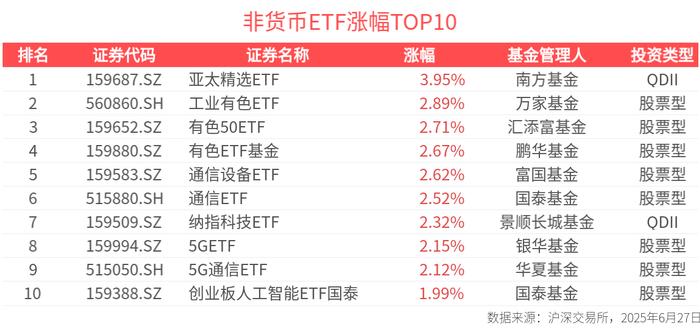
Market Overview - As of June 27, 2025, A-shares showed mixed performance with the Shanghai Composite Index down by 0.70% at 3424.23 points, while the Shenzhen Component Index rose by 0.34% to 10378.55 points, and the ChiNext Index increased by 0.47% to 2124.34 points [1] - The total trading volume across both markets reached 1.54 trillion yuan, with northbound capital trading balanced for the day [1] Sector Performance - Industrial metals, other electronics, and communication equipment were the top gainers, with increases of 3.49%, 3.10%, and 2.56% respectively [1] - Conversely, rural commercial banks, large state-owned banks, and city commercial banks were the biggest losers, declining by 3.40%, 3.06%, and 2.90% respectively [1] ETF Performance - A total of 571 non-currency ETFs rose, accounting for 49% of the market [1] - The China Securities Communication Equipment Theme Index increased by 2.36%, while the Communication Equipment ETF rose by 2.62% [1] - The China Securities Industrial Nonferrous Metals Theme Index saw a rise of 2.22%, with the Industrial Nonferrous ETF increasing by 2.89% [1] Specific ETF Details - The Asia Pacific Select ETF (159687.SZ) has a latest share size of 325 million, closely tracking the FTSE Asia Pacific Low Carbon Select Index, which emphasizes low carbon companies [4] - The Industrial Nonferrous ETF (560860.SH) has a share size of 455 million and tracks the China Securities Industrial Nonferrous Metals Theme Index, with a current P/E ratio of 14.62, below the historical average [4] - The Nonferrous 50 ETF (159652.SZ) has a share size of 256 million and tracks the China Securities Sub-Industry Nonferrous Metals Theme Index, with a current P/E ratio of 17.83, also below the historical average [5] Declining ETFs - A total of 520 non-currency ETFs declined, representing 45% of the market [5] - The China Securities 800 Bank Index and the China Securities Bank Index were among the largest decliners, down by 2.95% and 2.94% respectively [5] Premium Rates - The S&P 500 Consumer Select Index had a premium rate of 25.79%, while the S&P 500 Index had a premium of 12.87% [8] - The top three ETFs by premium rate included the S&P Consumer ETF (25.79%), S&P 500 ETF (12.87%), and Saudi ETF (4.77%) [9]
科技制造板块或将迎来配置窗口期
Quan Jing Wang· 2025-06-27 02:59
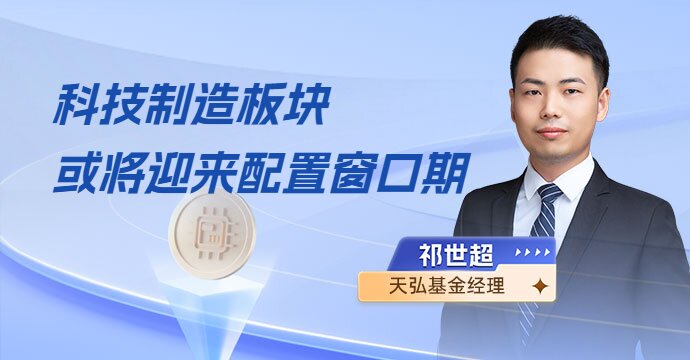
Group 1 - The market sentiment has significantly improved due to the strong catalyst from the fintech sector, leading to accelerated capital inflow towards technology manufacturing [2] - The impact of recent external risk events is gradually diminishing, and the growth-themed sectors have reached key support levels after previous corrections, laying a solid foundation for future rebounds [2] - The AI industry chain contains rich catalytic momentum across all segments: in the upstream semiconductor sector, breakthroughs in chip materials and equipment, as well as advancements in lithography technology, are continuously progressing, with the domestic substitution process speeding up [2] - In the midstream AI application sector, there are strong expectations for the iteration and upgrade of leading models such as ChatGPT and DeepSeek [2] - In the downstream sectors like robotics and smart vehicles, which are pioneers in the application of AI technology, both industrial policies and technological innovations are expected to provide dual benefits for future growth [2] - Recent market trading volume has increased, and technical indicators such as moving averages are signaling positive trends, indicating the emergence of trend-based opportunities [2] - If the market's risk appetite continues to rise, the technology manufacturing sector may have a short-term window for allocation, warranting close attention from investors [2] Group 2 - The Tianhong CSI Robotics ETF closely tracks the CSI Robotics Index, which selects 70 companies involved in system solutions, digital workshops, production line integration, automation equipment manufacturing, and other robotics-related sectors to reflect the overall performance of listed companies in this field [3] - Interested parties can search for Tianhong CSI Artificial Intelligence (Class A: 011839, Class C: 011840) and Tianhong CSI Robotics ETF (Class A: 014880, Class C: 014881) on the Alipay app for more details [3]
QDII额度再度获批,资金出海按下“加速键”
Huan Qiu Wang· 2025-06-27 02:35
Group 1 - The recent approval of QDII quotas injects new momentum for domestic institutions to invest overseas, with a total of $2.12 billion allocated to 60 qualified domestic institutional investors [1] - Major beneficiaries include 22 institutions like E Fund, GF Fund, and others, each receiving $50 million, while other institutions received varying amounts from $10 million to $40 million [1] - E Fund has accumulated over $7 billion in QDII quotas, while other major players like Huaxia and Southern Funds have also surpassed $6 billion [1] Group 2 - The scale of QDII funds has been increasing, reaching approximately 644.02 billion yuan by the end of May, with a year-to-date growth of 32.71 billion yuan, marking a 5.35% increase [2] - In 2024, the total scale of QDII funds surged by 194.34 billion yuan, reflecting a year-on-year growth rate of 46.61%, maintaining positive growth for six consecutive years [2] - Following the new quota approval, companies are expected to allocate these quotas across different product lines, focusing on expanding popular investment categories [4]
两市ETF两融余额减少9860.71万元丨ETF两融日报
Sou Hu Cai Jing· 2025-06-27 02:32
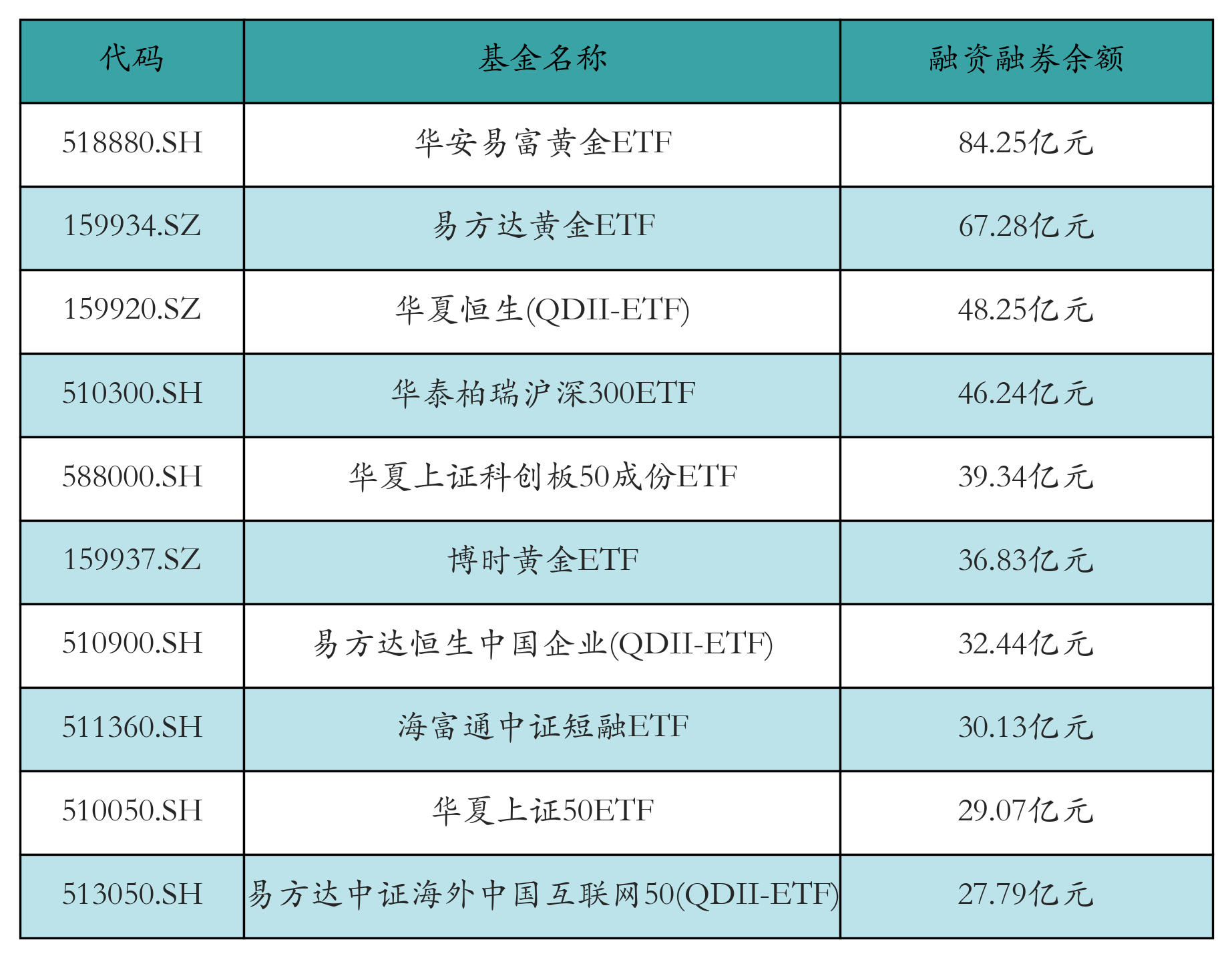
6月26日ETF两融余额前三位分别为:华安易富黄金ETF(84.25亿元)、易方达黄金ETF(67.28亿元)和华夏恒生(QDII-ETF)(48.25亿元),前10具体见下表: | 代码 | 基金名称 | | --- | --- | | 518880.SH | 华安易富黄金ETF | | 159934.SZ | 易方达黄金ETF | | 159920.SZ | 华夏恒生(QDII-ETF) | | 510300.SH | 华泰柏瑞沪深300ETF | | 588000.SH | 华夏上证科创板50成份ETF | | 159937.SZ | 博时黄金ETF | | 510900.SH | 易方达恒生中国企业(QDII-E' | | 511360.SH | 海富通中证短融ETF | | 510050.SH | 华夏上证50ETF | | 513050.SH | 易方达中证海外中国互联网50(QD | ETF融资买入额 6月26日ETF融资买入额前三位分别为:易方达中证香港证券投资主题ETF(17.36亿元)、海富通中证短融ETF(10.82亿元)和华夏上证科创板50成份ETF(7.09亿 元),前10具体见下表 ...
股票型ETF总规模重回3万亿元丨ETF晚报
2 1 Shi Ji Jing Ji Bao Dao· 2025-06-26 10:28
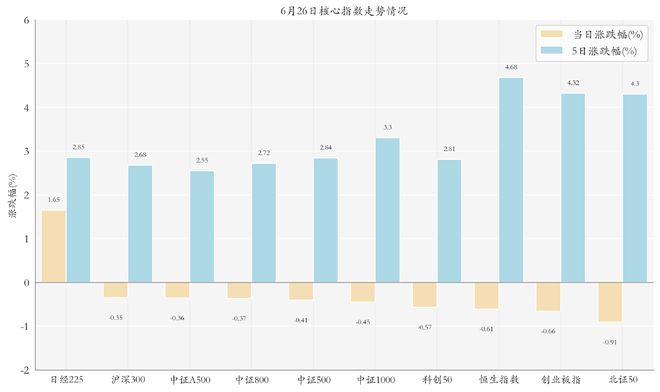
ETF Industry News - The three major indices experienced fluctuations and declines, with the Shanghai Composite Index down by 0.22%, the Shenzhen Component Index down by 0.48%, and the ChiNext Index down by 0.66%. Several computer sector ETFs saw increases, including the Cloud 50 ETF (560660.SH) which rose by 1.64% and the Cloud Computing Hong Kong-Shenzhen ETF (517390.SH) which increased by 1.05%. Conversely, multiple pharmaceutical and biotechnology ETFs declined, with the Tianhong Innovative Drug ETF (517380.SH) down by 2.11% and the Hong Kong-Shenzhen Innovative Drug ETF (159622.SZ) down by 2.03% [1][2]. - The total scale of stock ETFs has returned to over 3 trillion yuan, with the number of stock ETFs reaching 975 and a total net asset value of approximately 3.05 trillion yuan, accounting for 70.76% of the entire ETF market [1][2]. Market Overview - On June 26, the three major indices collectively fell, with the Shanghai Composite Index closing at 3448.45 points, the Shenzhen Component Index at 10343.48 points, and the ChiNext Index at 2114.43 points. The highest intraday points were 3462.75, 10440.73, and 2142.21 respectively. The Nikkei 225, CSI 300, and CSI A500 ranked higher in performance, with daily changes of 1.65%, -0.35%, and -0.36% respectively [3]. Sector Performance - In the performance of various sectors, banking, telecommunications, and defense industries ranked higher with daily increases of 1.01%, 0.77%, and 0.55% respectively. In contrast, the automotive, non-bank financial, and pharmaceutical sectors lagged behind with declines of -1.37%, -1.2%, and -1.05% respectively. Over the past five trading days, non-bank financial, computer, and defense industries showed strong performance with increases of 7.69%, 6.15%, and 4.75% respectively [6]. ETF Market Performance - The overall performance of ETFs was analyzed based on their scale and daily changes. Commodity ETFs performed the best with an average increase of 0.11%, while cross-border ETFs had the worst performance with an average decrease of -0.72% [8]. - The top five performing ETFs today included the Communication Equipment ETF (159583.SZ), Cloud 50 ETF (560660.SH), and Gold Stock ETF (159322.SZ), with returns of 1.83%, 1.64%, and 1.44% respectively [10]. Trading Volume of Different ETF Categories - The trading volume of various ETF categories was reported, with the top three stock ETFs by trading volume being the CSI 300 ETF (510300.SH) at 3.746 billion yuan, A500 ETF (512050.SH) at 3.740 billion yuan, and A500 ETF by Harvest (159351.SZ) at 3.324 billion yuan [12].