零跑汽车

Search documents
MEGA召回,冲击“理想”!
Zhong Guo Ji Jin Bao· 2025-11-26 15:04
Core Viewpoint - Li Auto reported a net loss of 6.24 billion RMB in Q3 2025, marking a significant shift from profit to loss year-on-year and quarter-on-quarter due to the impact of the MEGA recall event, resulting in losses exceeding 1.1 billion RMB [1][3]. Financial Performance - Vehicle sales revenue for Q3 2025 was 25.87 billion RMB, a decrease of 37.4% year-on-year and 10.4% quarter-on-quarter [2]. - Total revenue for Q3 2025 was 27.36 billion RMB, down 36.2% year-on-year and 9.5% quarter-on-quarter [4]. - Gross profit for Q3 2025 was 4.47 billion RMB, reflecting a 51.6% decline year-on-year and a 26.3% decline quarter-on-quarter [2]. - The gross margin for Q3 2025 was 16.3%, down 5.2 percentage points year-on-year [9]. Delivery and Market Position - Li Auto was the only new energy vehicle manufacturer among its peers to report a decline in revenue for Q3 2025, while competitors like NIO, Xpeng, and Leap Motor reported revenue growth [5][6]. - The total delivery volume for Q3 2025 was 93,200 units, a decrease of 39.0% year-on-year [8]. - In comparison, NIO, Xpeng, and Leap Motor reported delivery volumes of 87,000, 116,000, and 173,900 units respectively, with significant year-on-year growth [8][12]. Recall Impact - The MEGA recall involved 11,411 vehicles and was initiated following a fire incident, leading to an estimated impact of approximately 1.11 billion RMB on Li Auto's gross profit for Q3 2025 [9][11]. - The company plans to replace cooling liquid, power batteries, and front motor controllers for the recalled vehicles at no cost to customers [8]. Future Outlook - Li Auto's CEO indicated that the company is focusing on its electric vehicle transition, with strong order numbers for the new models i8 and i6, exceeding 100,000 units [10][11]. - For Q4 2025, Li Auto expects delivery volumes to range between 100,000 to 110,000 units, representing a year-on-year decline of 30.7% to 37.0% [11][12].


国泰海通 · 晨报1127|宏观、军工、汽车
国泰海通证券研究· 2025-11-26 13:12
Group 1: Macroeconomic Overview - The current state of the US economy is characterized by a "weak employment + strong growth" combination, which is historically rare, with labor force growth projected at only 0.3-0.5% annually over the next decade, significantly lower than the 1.3% seen in the past five years [2][6] - The strong economic growth despite weak employment is attributed to the marginal productivity of labor declining, with most job growth occurring in low-GDP-contributing sectors like education and healthcare, while AI investment and its wealth effect drive consumption [3][6] Group 2: Employment Dynamics - Various factors contributing to the employment slowdown include the impact of high interest rates, corporate labor hoarding during the pandemic, and reduced immigration, with high interest rates being the most significant factor [6] - The transition to a capital-driven growth model is identified as the root cause of declining employment demand in the medium to long term [6] Group 3: Inflation and Asset Pricing Implications - The "weak employment + strong growth" environment is expected to suppress inflation, as capital-driven economic growth typically leads to lower inflation due to reliance on marginal capital costs [7] - This economic scenario also exerts downward pressure on term premiums, as low volatility and low inflation create a favorable environment for government bonds, enhancing their defensive asset characteristics [7] Group 4: Defense and Aerospace Sector Insights - The military sector is experiencing fluctuations, with recent declines in defense indices and ongoing recovery efforts for downed military aircraft in the South China Sea [8] - The geopolitical landscape is becoming increasingly complex, necessitating advanced military capabilities, which suggests a long-term positive trend for the defense industry [9] Group 5: Automotive Industry Developments - The Guangzhou International Auto Show showcased significant advancements in electric and intelligent vehicles, with a notable focus on humanoid robots and new energy vehicles, reflecting the industry's ongoing transformation [12][14] - Several automakers, including XPeng and Changan, unveiled new models emphasizing technological innovation and smart features, indicating a competitive shift towards product definition and technological self-reliance [13][14]

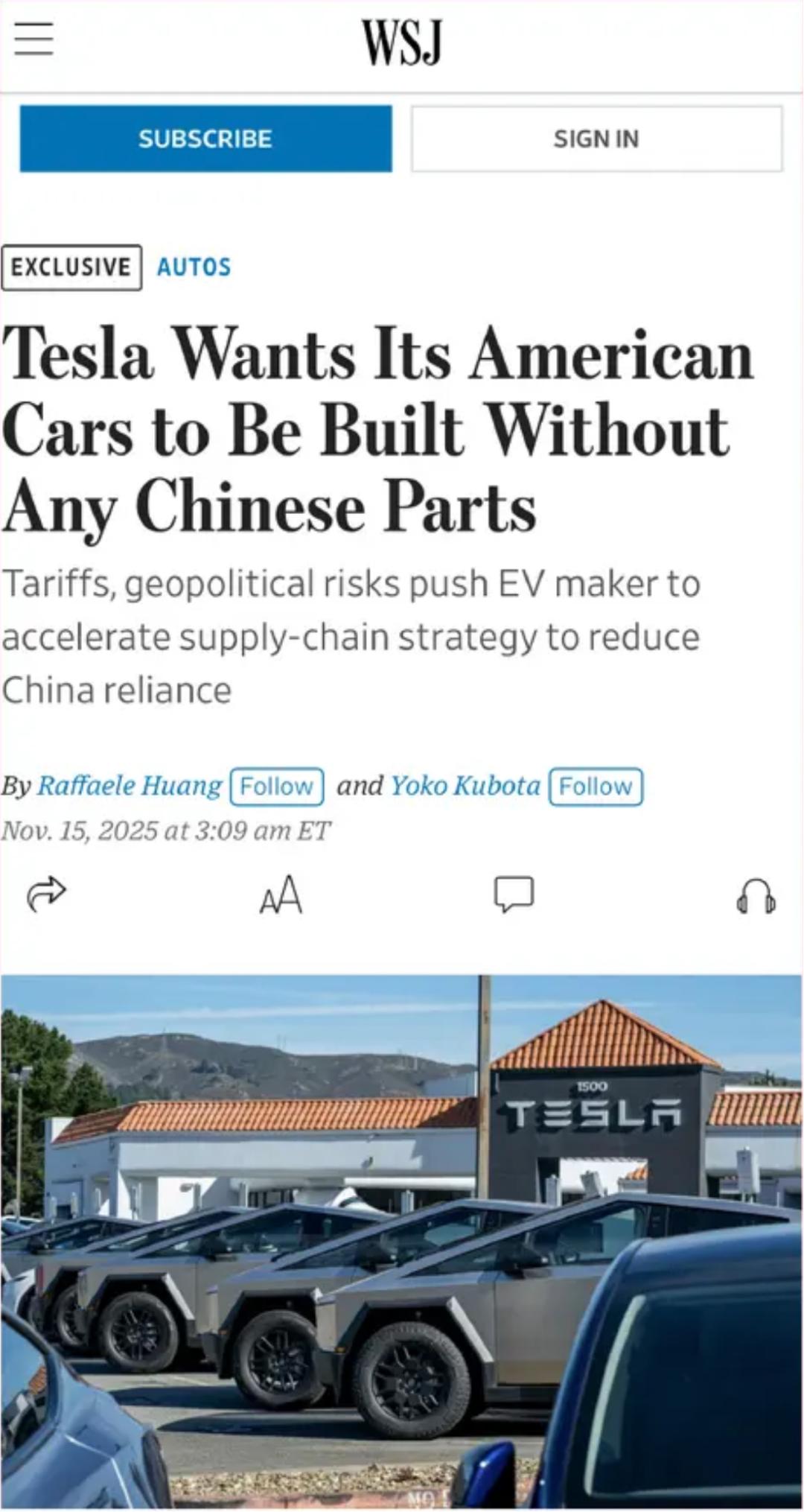
高管紧急回应“去中国化”,特斯拉会滑落为二三线品牌吗?
3 6 Ke· 2025-11-26 11:23
Core Viewpoint - Tesla is at a critical crossroads, facing significant challenges in the Chinese market, where its market share is declining and sales growth is slowing, prompting a controversial decision to eliminate Chinese components from its supply chain for U.S. factories [1][5]. Group 1: Market Performance - Tesla's sales in China have seen a dramatic decline, with combined sales of Model Y and Model 3 dropping to 26,006 units in October 2025, a year-on-year decrease of 35.76% and a month-on-month decrease of 63.64%, marking the lowest since November 2022 [6]. - The production data reflects a similar downward trend, with Tesla's production in China falling below 60,000 units in October 2025, a significant drop from previous years [9]. - The decline in sales and production is attributed to reduced consumer demand and potential production adjustments due to model updates, leading to longer delivery times for customers [9][13]. Group 2: Consumer Sentiment and Brand Image - Consumer complaints regarding product quality have surged, with nearly 4,000 complaints on platforms like Black Cat Complaints, highlighting issues such as material degradation and warranty disputes [14][19]. - The perception of Tesla among consumers is shifting, with a noticeable decline in brand loyalty and enthusiasm, as consumers now have more competitive options in the growing Chinese EV market [13][28]. Group 3: Strategic Shift and Financial Impact - Tesla's strategic focus appears to be shifting towards AI and related technologies, as indicated by CEO Elon Musk's comments on prioritizing AI development over traditional vehicle manufacturing [19][20]. - The company's R&D expenses surged by 56.9% to $1.63 billion in Q3 2025, while profitability metrics worsened, with net income dropping by 37% to $1.373 billion, indicating financial strain from heavy investments in new business areas [27]. - The transition to a "de-China" supply chain strategy may lead to increased production costs and inefficiencies, further complicating Tesla's competitive position in the market [36]. Group 4: Competitive Landscape - Tesla faces intense competition from domestic brands, with its sales lagging significantly behind leading competitors like BYD, which sold seven times more vehicles in October 2025 [28]. - The penetration rate of new energy vehicles in China reached 57.2%, with domestic brands accounting for 77.9%, highlighting the increasing competitiveness of local manufacturers [33]. - In the emerging AI and autonomous driving sectors, Tesla is contending with formidable rivals, including Xiaopeng Motors and Baidu, which are advancing rapidly in these fields [33][36].

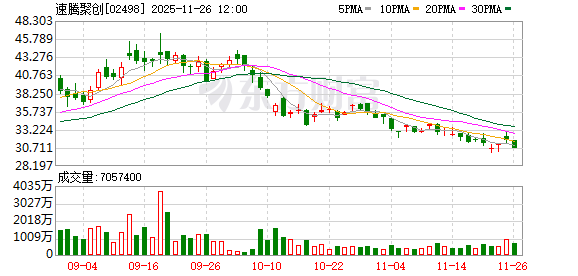
速腾聚创斥资千万港元回购股份 已斩获多家顶级车企合作项目
Zhi Tong Cai Jing· 2025-11-26 11:19
Group 1 - The company, SUTENG JUCHUANG (02498), announced a share buyback of 323,000 shares at a cost of approximately HKD 10.0115 million, with a buyback price ranging from HKD 30.72 to HKD 31.2, reflecting management's confidence in the business outlook [1] - In Q3, the company reported total revenue of approximately CNY 407 million, with expectations for a significant increase in digital lidar deliveries in Q4, aiming for the first quarterly profit [1] - The total sales of lidar units reached approximately 185,600, representing a year-on-year growth of 34.0%, while sales in robotics and other sectors surged by 393.1% year-on-year in Q3 [1] Group 2 - The company has secured over 1 million units of orders from 12 overseas and joint venture brands, including Audi and Volkswagen, and has successfully entered a project with competitor Leap Motor, showcasing strong market competitiveness [1] - In the RoboTaxi sector, the company achieved a breakthrough by partnering with Didi Autonomous Driving for a new generation model that will utilize a combination of 10 lidar units for all-weather operational capabilities [2]
速腾聚创(02498)斥资千万港元回购股份 已斩获多家顶级车企合作项目
智通财经网· 2025-11-26 11:17
Group 1 - The company, Sutech Juchuang, announced a share buyback of 323,000 shares at a total cost of approximately HKD 10.01 million, with prices ranging from HKD 30.72 to 31.2 per share, reflecting management's confidence in the business outlook [1] - In Q3, the company reported total revenue of approximately CNY 407 million, with expectations for a significant increase in digital lidar deliveries in Q4, aiming for its first quarterly profit [1] - The total sales of lidar units reached approximately 185,600, representing a year-on-year growth of 34.0%, while sales in the robotics and other sectors surged by 393.1% year-on-year in Q3 [1] Group 2 - In the RoboTaxi sector, the company achieved a breakthrough by partnering with Didi Autonomous Driving for a new generation model, utilizing a combination of 10 lidar units for all-weather operational capabilities [2]
【快讯】每日快讯(2025年11月26日)
乘联分会· 2025-11-26 08:39
Domestic News - Beijing's "15th Five-Year Plan" aims to steadily increase the proportion of new energy vehicles, implement dual control of carbon emissions, and enhance the green energy structure [5] - Hangzhou is launching a new round of automotive consumption incentives, offering subsidies up to 11,000 yuan for new car purchases, with additional consumer vouchers [6][7][8][9] - Volkswagen has opened its first full-process R&D testing center outside Germany in Hefei, China, with a new lab set to be operational by mid-2026 [10] - BYD has established a new sales company for its "Fangchengbao" model in Guangzhou, focusing on electric vehicle sales and related services [11][12] - Leap Motor has officially entered the South American market, launching its C10 and B10 models in Brazil and Chile, with plans for extensive dealership coverage [13] - Li Xiang, CEO of Li Auto, announced the upcoming release of AI glasses as part of the company's expansion into smart accessories [14] - Xiaomi has rolled out an enhanced version of its HAD system, improving driving capabilities through advanced machine learning techniques [15][16] - Huawei's ADS Max system has been highlighted for its advanced safety features, including enhanced emergency steering and animal recognition capabilities [17][18] International News - In October, Malaysia's new car sales reached 75,992 units, a 7% increase from the previous year, driven by a surge in electric vehicle sales due to expiring tax exemptions [19] - Thailand's domestic car sales in October totaled 47,032 units, reflecting a year-on-year growth of 24.78%, with production also increasing by 14.17% [20] - Tata Motors launched a new mid-size SUV, Sierra, in India, targeting competition with established models from Hyundai and Maruti Suzuki [21] - Panasonic will supply its latest 2170 cylindrical batteries to Amazon's Zoox starting in early 2026, initially from Japan with plans for U.S. production [22] Commercial Vehicles - FAW Jiefang's annual sales of new energy vehicles in Changchun have surpassed 20,000 units, marking a significant milestone in the company's development in the sector [23] - Hebei province has introduced new regulations for freight vehicles, allowing a 20% overload without penalties, effective January 2026 [24] - The Remote Super VAN has achieved a remarkable 271% year-on-year sales increase, maintaining a dominant market position in the new energy light commercial vehicle sector [25] - Chery Commercial Vehicles launched its K series in Shijiazhuang, targeting local logistics needs with a modular design for diverse applications [26]

“月销12万台仅是起点” 速腾聚创业绩会释放扭亏反转信号
2 1 Shi Ji Jing Ji Bao Dao· 2025-11-26 04:35
Core Viewpoint - Robosense signals a strong turnaround potential with a focus on achieving profitability in Q4 2024, as indicated by CEO Qiu Chunchao during the Q3 earnings call [2]. Financial Performance - In Q3 2024, Robosense reported total revenue of approximately 407 million RMB, a slight decrease of 0.2% compared to 408 million RMB in the same period of 2023 [2]. - The company aims to achieve profitability in Q4 2024, highlighting confidence in future performance despite a challenging Q3 [2]. Product Development and Market Strategy - The company has been preparing for mass production of digital lidar, having launched five products this year and secured numerous orders [2]. - In October, Robosense achieved a record shipment of 120,000 lidar units, with expectations for higher shipment levels in the remaining months of Q4 [2]. Strategic Partnerships - Robosense announced a significant partnership with Didi Autonomous Driving for a new generation of Robotaxi models, indicating a trend towards using 8 to 10 lidar units per vehicle [3]. - The company has also secured lidar contracts with Leap Motor and Great Wall Motors, previously clients of competitor Hesai Technology, marking a strategic gain in market share [3][5]. Technological Advancements - Robosense emphasizes its technological edge in digital lidar, which operates on single-photon avalanche diode (SPAD) technology, allowing for direct digital signal output [5]. - The company contrasts digital lidar with analog lidar, suggesting that digital lidar offers superior efficiency in data processing and decision-making [5]. Future Growth Potential - The global Robotaxi market, projected to be worth hundreds of billions, is expected to drive demand for Robosense's digital lidar solutions, providing significant growth opportunities [6]. - The company is exploring additional growth avenues, including partnerships with overseas and joint venture brands, as well as potential in logistics and robotic applications [6].
“月销12万台仅是起点”,速腾聚创业绩会释放扭亏反转信号
2 1 Shi Ji Jing Ji Bao Dao· 2025-11-26 04:23
Core Viewpoint - Robosense has signaled a strong turnaround since its IPO, aiming for profitability in Q4 2023, as stated by CEO Qiu Chunchao during the Q3 earnings call [1]. Financial Performance - In Q3 2023, Robosense reported total revenue of approximately 407 million RMB, a slight decrease of 0.2% compared to 408 million RMB in the same period of 2024 [1]. - The company is focusing on improving its performance in Q4, with a goal of achieving profitability [1]. Product Development and Market Strategy - Robosense has been preparing for mass production of digital lidar, having launched five products this year and receiving numerous orders [1]. - In October, the company achieved a record shipment of 120,000 lidar units, with expectations for higher shipment levels in the remaining months of Q4 [1]. Strategic Partnerships - On November 24, Robosense announced a significant partnership with Didi Autonomous Driving for a new generation of Robotaxi models, indicating a trend towards using 8 to 10 digital lidar units per vehicle [2]. - The company also secured lidar contracts with Leap Motor and Great Wall Motors, previously clients of competitor Hesai Technology, marking a significant competitive breakthrough [2]. Technological Advancements - Robosense is positioned as a leader in digital lidar technology, utilizing single-photon avalanche diode (SPAD) technology for direct digital signal output, which is seen as superior to traditional analog lidar systems [4]. - The company emphasizes the efficiency of digital lidar compared to analog systems, likening the former to "climbing a mountain by helicopter" versus "taking a cable car" for the latter [7]. Future Growth Potential - The company anticipates continued growth driven by the expanding global Robotaxi market, projected to reach hundreds of billions of dollars [7]. - Robosense is exploring additional growth avenues, including partnerships with overseas and joint venture brands, as well as potential in logistics and robotic applications [7].
广发证券:26年乘用车政策核心目标或为提升ASP 建议着眼更长维度获利可能性
智通财经网· 2025-11-26 02:53
Core Viewpoint - The report from GF Securities indicates that the cumulative sales of passenger vehicles from January to October 2025 reached 18.769 million units, representing a year-on-year increase of 5.4%. The firm forecasts a year-on-year growth rate for passenger vehicle terminal sales in 2025 to be between 5% and 10% [1][2]. Group 1: Sales and Market Trends - The cumulative sales of passenger vehicles in 2025 from January to October were 18.769 million units, with a year-on-year increase of 5.4% [1]. - In October 2025, the domestic passenger vehicle insurance registrations were 2.086 million units, showing a year-on-year decrease of 9.2% and a month-on-month decrease of 6.4% [1]. - The ASP (Average Selling Price) of the passenger vehicle industry increased by 2.9% year-on-year in October 2025, marking a positive change in ASP growth [2]. Group 2: Policy and Future Outlook - The core policy goal for the passenger vehicle industry in 2026 may focus on increasing ASP to avoid deflation [2]. - The report suggests that if the vehicle replacement subsidy policy continues, it could contribute an estimated 2.1% elasticity to the terminal sales of passenger vehicles in 2026 [2]. - The expected year-on-year growth rate for domestic terminal sales of passenger vehicles in 2026 is projected to be around 1% under a neutral scenario [2]. Group 3: Inventory and Market Share - As of the end of October 2025, the inventory of the passenger vehicle industry was at a reasonable level, with a dynamic inventory-to-sales ratio of 2.1 [3]. - The inventory-to-sales ratio for new energy passenger vehicles was approximately 1.9, indicating a relatively normal inventory level [3]. - In October 2025, the market share of Chinese brand passenger vehicles reached 69.23%, reflecting a year-on-year increase of 3.7 percentage points [4]. Group 4: Investment Recommendations - The report suggests focusing on longer-term profit potential and timing operations based on ASP trends. Recommended stocks include Geely Automobile, BYD, and others in the passenger vehicle chain [5]. - Specific stocks identified as having potential turning points include Great Wall Motors and SAIC Motor [5].

速腾聚创预计Q4盈利:数字化激光雷达已获数百万订单,新增零跑、长城定点
IPO早知道· 2025-11-26 02:01
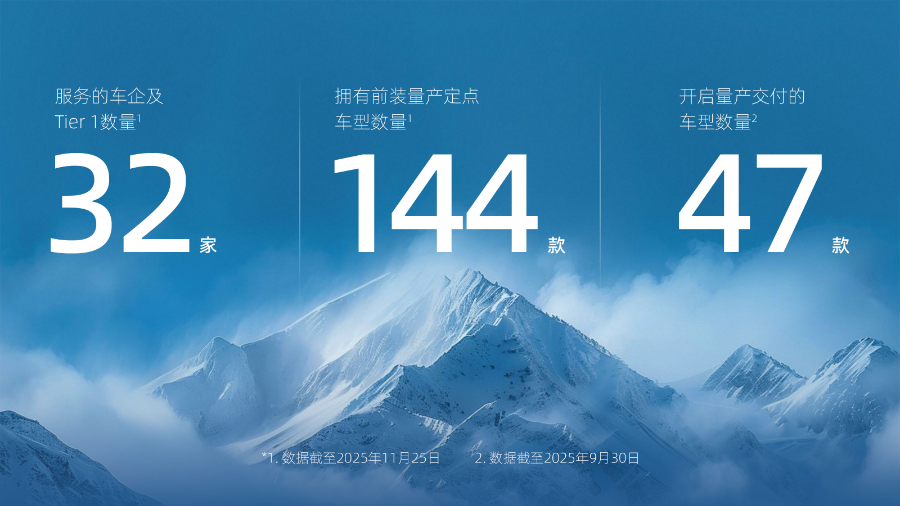
Core Viewpoint - The article highlights the strong performance and growth potential of SUTENG JUCHUANG, particularly in the laser radar market, driven by significant sales increases in various sectors, including robotics and autonomous driving [3][4]. Financial Performance - In Q3 2025, SUTENG JUCHUANG reported total revenue of approximately 407 million yuan, with overseas market revenue increasing by over 100% year-on-year [3]. - Gross profit reached approximately 97 million yuan, reflecting a year-on-year growth of about 36.8%, indicating continuous improvement in profitability [3]. Product Sales and Market Growth - The total sales of laser radars in Q3 amounted to 185,600 units, with the robotics sector experiencing explosive growth, with sales increasing by 393.1% year-on-year to approximately 35,500 units [3]. - Revenue from the robotics sector grew significantly by 157.8% year-on-year to approximately 142 million yuan, accounting for about 35% of total revenue [3]. Key Strategic Focus - The CEO emphasized two main focuses for Q3: "production guidance" for mass production of digital laser radars and "expanding victories" by securing more customer orders [4]. - The company launched five new digital products in 2025, which received high market recognition and resulted in substantial actual orders [4]. Customer Acquisition and Partnerships - SUTENG JUCHUANG has secured contracts with 32 automotive manufacturers and Tier 1 suppliers for 144 vehicle models, with 47 models achieving SOP as of September 30 [7]. - Recently, the company gained two major clients in the digital laser radar sector: Leap Motor and Great Wall Motors [5]. Technological Advancements - The company has developed a unique mass-producible digital laser radar matrix based on SPAD-SoC and VCSEL digital architecture, achieving stringent automotive electronic standards [9]. - The CEO noted that the ultimate competition in laser radar lies in the chip level, with a focus on digital signal generation for improved performance [11]. International Market Expansion - SUTENG JUCHUANG has received multiple contracts from major global automotive brands, including SAIC Audi and FAW Toyota, totaling over one million units [12]. - The company anticipates that overseas business will enter a growth phase starting in the second half of 2026, driven by high-performance product demand [14]. Robotics and AI Applications - In the robotics sector, SUTENG JUCHUANG has upgraded its product offerings, achieving mass production readiness for digital laser radars tailored for lawn mowing and delivery robots [21][23]. - The company is actively exploring various possibilities in physical AI, including key components and integrated hardware-software solutions [26].