天弘基金

Search documents
净流入近3000亿元!宽基ETF持续吸金,重视三大方向
券商中国· 2025-06-15 01:54
Core Viewpoint - The article highlights the continuous inflow of funds into ETFs, driven by the issuance of various thematic products such as free cash flow, healthcare, and consumer sectors, amidst a global trend of declining interest rates [1][3][11]. Fundraising and Market Trends - As of June 13, the newly established ETFs in the second quarter have raised over 30 billion yuan, with total net inflows into ETFs approaching 300 billion yuan [2][8]. - A total of 71 ETFs were established in the second quarter, raising 30.85 billion yuan, with 21 of these being free cash flow products, accounting for 40% of the total [4][5]. Product Types and Focus Areas - The newly launched ETFs include mainstream broad-based products and thematic products in technology and healthcare. Key categories are: - Free cash flow products, with 21 ETFs raising 12.35 billion yuan [5]. - Mainstream broad-based products like the CSI 300 and CSI A500, with several ETFs raising over 1.8 billion yuan each [5]. - Thematic ETFs in sectors such as healthcare and consumer, with multiple funds launched in the second quarter [6]. Fund Inflows and Performance - The inflow of funds into existing ETFs continues, with net inflows in the second quarter significantly higher than in the first quarter, particularly in stock-related ETFs [8]. - Notably, broad-based ETFs like the CSI 300 have seen net inflows exceeding 30 billion yuan [8]. Global ETF Market Trends - The global ETF market is experiencing a strong inflow trend, with cumulative net inflows reaching approximately 8.2 trillion USD from 2014 to April 2025, indicating a growing recognition of ETFs' long-term investment value [9][10]. - China's ETF market is particularly robust, with a significant share of the Asia-Pacific region's ETF assets and a net inflow of approximately 784.4 billion yuan over the past year [10]. Investment Directions - The article identifies three key investment directions based on optimistic market predictions: - Technology growth, particularly in AI and related sectors [11][12]. - Chinese manufacturing, focusing on high-quality companies in various industries [13]. - New consumption trends, especially in the rapidly expanding collectible toy market, projected to reach 110.1 billion yuan by 2026 [13].


公募千亿元“分红盛宴”:债基、QDII领衔,这只产品豪掷83亿元破纪录
Hua Xia Shi Bao· 2025-06-13 14:06
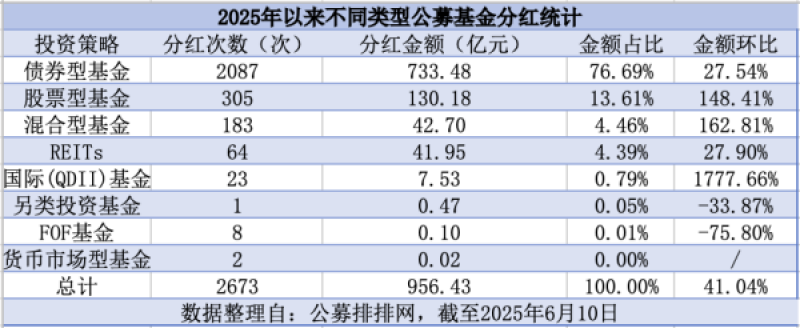
Core Viewpoint - The announcement of Huatai-PineBridge's flagship product, Huatai-PineBridge CSI 300 ETF, plans to distribute over 8.3 billion yuan in dividends, setting a new record for single dividend distribution in domestic ETFs, surpassing the previous record of 5.322 billion yuan held by E Fund's CSI 300 ETF [3][4] Fund Distribution Summary - As of June 10, the total dividend distribution of public funds in the year approached 100 billion yuan, with bond funds leading at 73.348 billion yuan, accounting for 76.69% of the total [2][4] - The bond funds had 2,087 distributions, showing a year-on-year increase of 27.54% [4] - QDII funds exhibited a remarkable growth rate of 1,777.66% in dividend distribution, becoming the biggest surprise of the year [2][4] Individual Fund Performance - Huatai-PineBridge CSI 300 ETF has a market size of 378.292 billion yuan and has distributed dividends 13 times since its inception in May 2012 [3] - The bond funds are recognized for their ability to provide stable cash flow, especially favored by institutional investors [4] - Stock funds distributed 13.018 billion yuan, with a significant increase of 148.41% in distribution frequency [4] - Mixed funds also saw a 162.81% increase, distributing 4.270 billion yuan [4] Management Company Performance - In terms of distribution frequency, Bosera Fund led with 148 distributions, followed by GF Fund with 129 distributions [5] - E Fund ranked third with 125 distributions, while the total amount distributed by E Fund reached 6.363 billion yuan [6][7] - Notably, Zhongyin Securities achieved 23.98 billion yuan in dividends with only 13 distributions, showcasing high efficiency [7] ETF and Bond Fund Insights - Broad-based ETFs and medium to long-term pure bond funds dominate the high dividend rankings, with Huatai-PineBridge CSI 300 ETF leading the way [8] - Among bond funds, 27 products distributed over 500 million yuan, with 21 being bond funds, highlighting their role as "cash cows" [8] - QDII funds are also gaining attention, with Guotai Nasdaq 100 Fund distributing 5.87 billion yuan, marking it as the only QDII product in the top 20 [9]

上证50指数ETF今日合计成交额20.56亿元,环比增加72.07%
Zheng Quan Shi Bao Wang· 2025-06-13 09:44
Core Points - The total trading volume of the SSE 50 Index ETF reached 2.056 billion yuan today, an increase of 861 million yuan from the previous trading day, representing a growth rate of 72.07% [1] - The Huaxia SSE 50 ETF (510050) had a trading volume of 1.788 billion yuan, up 706 million yuan from the previous day, with a growth rate of 65.29% [1] - The E Fund SSE 50 ETF (510100) saw a trading volume of 232 million yuan, an increase of 165 million yuan, with a remarkable growth rate of 245.43% [1] - The Wanji SSE 50 ETF (510680) recorded a trading volume of 8.9782 million yuan, up 1.3778 million yuan, with a growth rate of 18.13% [1] Trading Performance - The SSE 50 Index (000016) closed down 0.55%, while the average decline of related ETFs was 0.59% [1] - The ETFs with the largest declines included the E Fund SSE 50 Enhanced Strategy ETF (563090) and the Huaan SSE 50 ETF (510190), which fell by 0.86% and 0.83%, respectively [1] Detailed Trading Data - The trading volume changes for various ETFs on June 13 are as follows: - Huaxia SSE 50 ETF (510050): -0.51% change, 1.788 billion yuan trading volume, 706 million yuan increase, 65.29% growth [1] - E Fund SSE 50 ETF (510100): -0.48% change, 232 million yuan trading volume, 165 million yuan increase, 245.43% growth [1] - Wanji SSE 50 ETF (510680): -0.57% change, 8.9782 million yuan trading volume, 1.3778 million yuan increase, 18.13% growth [1] - Other ETFs also showed varying degrees of trading volume changes and performance [1]
ETF市场周报 | 指数走势出现分歧!创新药相关ETF估值修复持续
Sou Hu Cai Jing· 2025-06-13 09:21
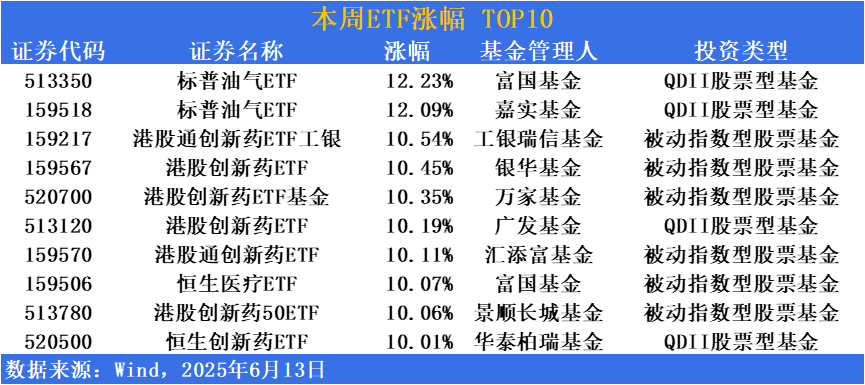
Market Overview - A-shares experienced steady growth in the first half of the week, followed by an overall adjustment in the latter half, with May CPI showing a month-on-month decline [1] - The three major indices had mixed performances, with the Shanghai Composite Index and Shenzhen Component Index down by 0.25% and 0.60% respectively, while the ChiNext Index rose by 0.22% [1] - Global uncertainty has led to increased interest in defensive assets, with high-dividend assets maintaining significant allocation value [1] ETF Performance - The top-performing ETFs this week included several related to innovative pharmaceuticals, with notable gains exceeding 10% for multiple funds [2] - Conversely, consumption and technology-related ETFs saw significant declines, with the top losers experiencing drops of over 4% [4][5] Investment Trends - China's share of global business development (BD) transactions has surged from 5% in 2021 to 42% by May 2025, indicating a growing international recognition of Chinese innovative pharmaceuticals [3] - Major transactions, such as the $60 billion collaboration between Heng Rui Medicine and Hercules, highlight the increasing trend of Chinese companies entering international markets [3] Fund Flows - The ETF market saw a net outflow of 43.36 billion yuan, with a notable preference for conservative investments, particularly in bond ETFs [6][8] - The top inflows were seen in bond ETFs, with the Credit Bond ETF leading with an inflow of over 30 billion yuan [8] Upcoming ETFs - Four new ETFs are set to launch next week, including the Changcheng CSI Dividend Low Volatility 100 ETF, which aims to provide a combination of high dividends and low volatility [10] - The Tianhong CSI A500 Enhanced Strategy ETF is also highlighted for its strong historical performance and potential for superior returns through active management [12]
每周基金发行前瞻:新发17只产品 指数型产品数据居前
Sou Hu Cai Jing· 2025-06-13 08:47
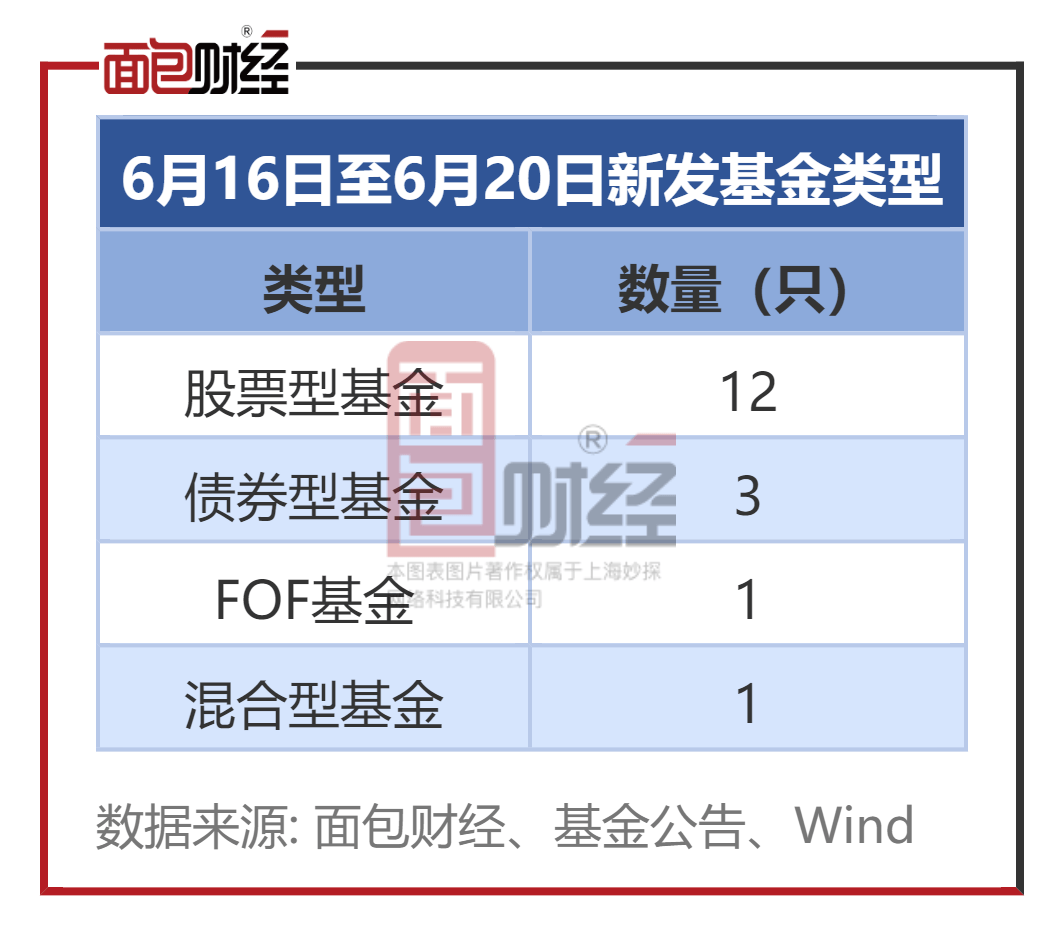
Group 1 - A total of 17 new public funds will be launched from June 16 to June 20, involving 15 fund companies, with an average fundraising period of approximately 21 days [1][5] - Among the new funds, equity funds dominate with 12 offerings, followed by 3 bond funds, primarily consisting of index funds [2][4] - The newly issued stock funds mainly include 10 passive index funds and 2 enhanced index products, featuring ETFs such as the Fortune Creation Board AI ETF and the Huabao Hang Seng Hong Kong Stock Connect Innovative Drug Selection ETF [2][4] Group 2 - Only one actively managed equity product will be issued during this period, which is the Huatai-PB Hong Kong Stock Connect Medical Selection Fund, focusing on quality listed companies in the medical industry [4] - The number of FOF funds issued is also limited to one, which is the Ping An Fund's Ping An Yingxuan 90-day Holding Bond FOF [4] - Notably, the issuance of new products includes two from E Fund and Tianhong Fund, with E Fund launching the E Fund National Certificate Value 100 ETF and the E Fund CSI A50 Enhanced Strategy ETF [5] Group 3 - The fundraising cap for 10 of the new products has been announced, with some reaching up to 8 billion units, such as the Southern CSI Hong Kong Stock Connect Technology ETF and the Morgan Shanghai-Shenzhen 300 Free Cash Flow Linked Fund [5][8] - The average fundraising duration for the 17 products is about 21 days, with the E Fund CSI A50 Enhanced Strategy ETF and the Invesco CSI Science and Technology Innovation Board 200 Index having a longer subscription period of 92 days [8] - The management fee for the Huatai-PB Hong Kong Stock Connect Medical Selection Fund is relatively high, reaching an annual rate of 1.2% [8]
多只创新指数基金发行在即!年内新成立基金规模已超4000亿份
Mei Ri Jing Ji Xin Wen· 2025-06-13 08:29
Group 1 - Index funds remain the main focus for new product launches by various fund companies, with multiple innovative index funds set to be issued, including those tracking free cash flow and the CSI A50 index [1][2] - The issuance of public funds has been strong since 2025, with a total of 4,183.95 million units issued as of June 12, 2023, indicating a robust market for index funds [1][4] - The rapid development of ETFs has led to an increasing proportion of index funds in the new product releases by public institutions, with many companies also launching enhanced index funds [2][3] Group 2 - The current low interest rate environment, with deposit rates dropping from 1.8% to 1.3%, is expected to boost market valuations, potentially increasing price-to-earnings ratios from around 50 to 70 [3] - The public fund issuance scale has exceeded 4,000 million units this year, with significant contributions from equity funds, particularly index funds, which have shown strong fundraising performance [4][5] - Recent market adjustments have provided opportunities for equity funds to build positions, with several funds ending their fundraising periods early due to high demand [5]
大跌板块,抄底!
Zhong Guo Ji Jin Bao· 2025-06-13 07:10
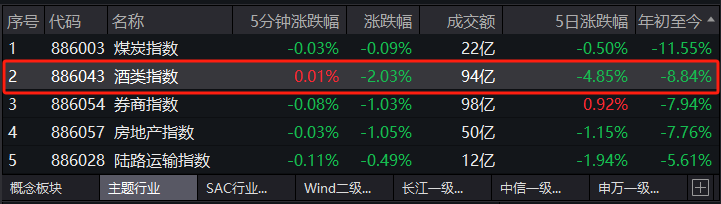
Core Viewpoint - The A-share market experienced a mixed performance with significant capital outflows from broad-based ETFs, while the wine ETF saw substantial net inflows, indicating a potential bottom-fishing strategy by investors in the wine sector [1][2][8]. ETF Market Overview - As of June 12, the total scale of 1116 stock ETFs in the market reached 3.53 trillion yuan, with a net outflow of approximately 55.93 billion yuan on that day [2]. - The wine ETF led the market with a net inflow of 4.16 billion yuan, reflecting investor interest despite the underlying index's five-year decline [3][4]. Performance of Wine Sector - The China Securities Wine Index has fallen over 12% this year, reaching a new low for the year, and is ranked second to last among industry indices in terms of performance [4][5]. - The wine ETF's recent performance is characterized by a significant drop in valuation, with dynamic price-to-earnings ratios indicating a low valuation advantage, attracting bottom-fishing capital [8]. Broader Market Trends - The broad-based ETFs, including those tracking the CSI 300 and ChiNext indices, experienced significant net outflows, with the CSI 300 ETF alone seeing a net outflow of 19.48 billion yuan [11][12]. - The recent market dynamics show a divergence between new consumption and traditional consumption sectors, with the latter facing challenges in capital market performance [10][13]. Fund Flows and Investment Strategies - Major fund companies, such as E Fund and Huaxia Fund, reported net inflows in their ETFs, indicating a continued interest in specific sectors like technology and low-volatility strategies [10][11]. - The market sentiment is influenced by external factors such as US-China trade negotiations, which have improved risk appetite, particularly for technology stocks [10].
12只ETF公告上市,最高仓位40.89%
Zheng Quan Shi Bao Wang· 2025-06-13 02:24
Core Insights - A total of 12 stock ETFs have announced their listing since June, with the highest allocation being 40.89% for the Great Wall CSI Dividend Low Volatility 100 ETF [1][2] - The average allocation for these newly announced ETFs is only 19.43%, indicating a generally conservative approach to investment during the current period [1][2] Group 1: ETF Listings and Allocations - The Great Wall CSI Dividend Low Volatility 100 ETF will be listed on June 18, 2025, with a total of 320 million shares [1] - The fund's asset allocation as of June 11, 2025, shows 59.08% in bank deposits and settlement reserves, while stock investments account for 40.89% [1] - Other ETFs with significant allocations include the Invesco Great Wall CSI 300 Enhanced Strategy ETF at 39.95%, the Huatai-PB SSE STAR Market New Materials ETF at 32.39%, and the Harvest SSE STAR Market Comprehensive Enhanced Strategy ETF at 26.95% [1] Group 2: Fund Sizes and Investor Composition - The average number of shares raised for the newly listed ETFs is 394 million, with the largest being the Huaan Hang Seng Index Hong Kong Stock Connect ETF at 590 million shares [2] - Institutional investors hold an average of 19.12% of the shares in these ETFs, with the highest proportions in the Xingyin SSE STAR Market Comprehensive Price ETF at 59.97%, the Bank of China CSI All Share Free Cash Flow ETF at 51.12%, and the Tianhong CSI A500 Enhanced Strategy ETF at 31.23% [2] - ETFs with lower institutional ownership include the Huaan Hang Seng Index Hong Kong Stock Connect ETF at 4.09%, the Guotai Chuangye Board New Energy ETF at 5.68%, and the Chuangye Board ETF Dongcai at 5.93% [2]
响应费率改革 公募基金公司密集自购
Nan Fang Du Shi Bao· 2025-06-12 23:10
Core Viewpoint - Dachen Fund Management Co., Ltd. announced a self-purchase of 20 million yuan in its newly launched floating-rate fund, Dachen Zhi Zhen Return Mixed Securities Investment Fund, reflecting a growing trend of self-purchases in the public fund industry as firms respond to regulatory fee reforms and strengthen ties with investors [1][2]. Group 1: Company Actions - Dachen Fund's self-purchase of 20 million yuan demonstrates confidence in the long-term stability and healthy development of China's capital market and the company's proactive investment capabilities [2]. - The Dachen Zhi Zhen Return Mixed Fund is one of the first floating-rate management fee products, managed by experienced fund manager Du Cong, who has 11 years of industry experience and a strong track record [2][3]. - Other institutions, including Jiao Yin Shi Luo De Fund and Zhong Ou Fund, have also announced similar self-purchase actions, indicating a collective movement within the industry [4][5]. Group 2: Fund Structure and Fee Mechanism - The Dachen Zhi Zhen Return Mixed Fund has a wide investment scope, including domestic stocks, bonds, and asset-backed securities, and employs a floating fee structure linked to fund performance [3]. - The management fee varies based on the holding period and performance, with rates ranging from 0.60% to 1.50%, depending on the fund's excess return relative to benchmarks [3]. - The floating fee mechanism aims to align the interests of fund companies with those of investors, promoting long-term investment and enhancing active management capabilities [3][5]. Group 3: Industry Trends - The self-purchase actions by Dachen Fund and other institutions signify a shift in the public fund industry towards a focus on returns and long-term performance [5]. - The implementation of floating fee mechanisms represents an innovation in fee structures and a reconfiguration of investment philosophies and assessment systems within the industry [5]. - As the regulatory framework evolves, fund companies' revenues will increasingly be tied to investor returns, influencing fund managers' compensation based on long-term performance [5].
多只银行可转债触发强赎,银行ETF天弘(515290)冲击五连涨,机构:重估净资产是银行股投资的核心逻辑
2 1 Shi Ji Jing Ji Bao Dao· 2025-06-12 06:02
Group 1 - The A-share market showed mixed performance on June 12, with the banking sector remaining active, particularly the Tianhong Bank ETF which rose by 0.47%, aiming for a five-day winning streak [1] - Notable gains were observed in constituent stocks such as Qingdao Bank, which increased by over 4%, along with Jiangsu Bank, Xi'an Bank, Nanjing Bank, and Hangzhou Bank [1] - Nanjing Bank announced the early redemption of its convertible bonds, which has triggered similar actions from other banks, indicating a potential supply-demand imbalance in the market that could lead to price increases for related securities [1] Group 2 - CITIC Securities emphasized that the revaluation of net assets will be the core logic for bank stock investments in 2025, driven by increased equity asset allocation by insurance funds and the high-quality development of public funds [2] - Current financial data indicates stable asset quality in banks, with a decline in the non-performing loan generation rate for public loans, although retail credit asset quality remains a concern [2] - Macro policies aimed at reducing systemic risks in the banking sector are expected to facilitate a re-evaluation of bank net assets, which could drive industry valuation increases in 2025 [2]