迎驾贡酒

Search documents
中国最大文具综合体落沪,“小而精”的文具为何开大店?
Hua Xia Shi Bao· 2025-12-01 14:19
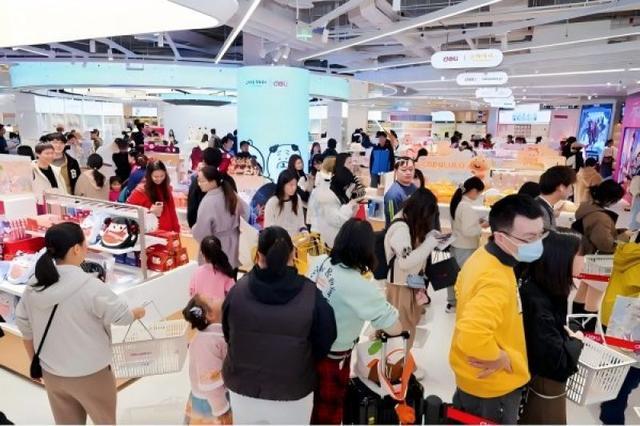
Core Insights - The traditional perception of stationery stores as small and specialized is being transformed by the emergence of large-scale "stationery megastores" driven by the consumption habits of Generation Z [2][3] - Deli Group's flagship store in Shanghai, covering 1,500 square meters, represents a significant shift in the stationery retail landscape, emphasizing experience over mere product sales [3][4] Company Strategy - Deli Group's decision to open a large-scale stationery experience store is part of a strategic upgrade aimed at deepening connections with consumers and enhancing brand engagement [3][4] - The flagship store is designed to be an immersive experience space, showcasing Deli's innovations in technology, design, and lifestyle, thus moving from "super manufacturing" to "super experience" [3][5] Market Trends - The flagship store features a wide range of products, including student stationery, premium stationery, and IP-related merchandise, catering to the evolving preferences of consumers [3][5] - The rise of IP collaborations, such as with popular Chinese animation, reflects a trend where stationery is becoming a medium for emotional expression and cultural trends among younger consumers [5][6] Consumer Behavior - Generation Z consumers prefer social, personalized, and content-driven shopping experiences, valuing brand stories and interactive experiences [5][9] - The transition from "functional" to "emotional" consumption in the stationery market indicates a shift where products are seen as expressions of identity and creativity rather than mere tools [9][10] Industry Evolution - The transformation of stationery stores from "small and refined" to "large and comprehensive" signifies a restructuring of the industry value chain, aligning with the experience economy [9][10] - The concept of "pan-stationery" is emerging, where the boundaries between learning, office, and lifestyle products are increasingly blurred, leading to a broader range of offerings [10]


免门票、送化妆品、抽奖送iPhone,A股超30家上市公司花式“宠股东”
3 6 Ke· 2025-12-01 10:38
Core Viewpoint - The trend of "physical dividends" is gaining momentum in the A-share market, with companies increasingly offering tangible benefits to shareholders as a way to enhance investor relations and stimulate consumption [1][2][7]. Group 1: Company Initiatives - Emei Mountain A announced a shareholder reward program allowing shareholders holding 500 shares or more to enjoy free admission to the scenic area and discounts on various services [1][3]. - The initiative aims to provide shareholders with a "immersive experience" of the company's cultural and ecological resources, while also addressing declining visitor numbers [3][4]. - The program is expected to have a marginal cost effect for the company, as the actual cost of allowing shareholders free access is low compared to the potential revenue from secondary consumption [3][4]. Group 2: Financial Performance - In the first three quarters of 2025, Emei Mountain A reported a revenue of 733 million yuan, a year-on-year decrease of 9.06%, and a net profit of 234 million yuan, down 3.98% [4][5]. - The decline in revenue and profit is attributed to a significant increase in visitors to free-entry areas and a growing proportion of hiking tourists [5]. - Visitor numbers for the scenic area have shown a downward trend, with a 7.9% year-on-year decrease in paid visitors compared to the previous year [4][5]. Group 3: Industry Trends - Over 60 A-share companies have implemented shareholder reward programs in the past decade, with more than 30 companies launching similar initiatives since 2025 [7]. - The trend includes various forms of rewards, such as free tickets, food products, and discounts, particularly prevalent among consumer companies [6][7]. - Companies are leveraging these rewards to transform shareholders into consumers, enhancing brand loyalty and potentially increasing sales through word-of-mouth marketing [8].

食品饮料2026年投资策略:拐点显现、板块次第筑底、积极布局
China Post Securities· 2025-11-28 13:40
Group 1: Economic Indicators and Consumer Trends - The CPI in October showed a slight improvement, with a year-on-year increase of 0.2% and a month-on-month increase of 0.2%, indicating a potential recovery trend that may continue into the first half of next year [6][10] - The retail sales of consumer goods in October reached 46,291 billion yuan, growing by 2.93% year-on-year, with significant improvements in essential consumption categories such as food and beverages [10] - The restaurant sector saw a monthly revenue of 5,199 billion yuan in October, reflecting a year-on-year growth of 3.8%, driven by the National Day and Mid-Autumn Festival holidays [10] Group 2: Frozen and Food Supply Industry - The frozen food and catering industry is witnessing a shift from price wars to product innovation and channel development, with companies focusing on quality and service rather than just price competition [11] - Major players like Anjiyuan and Qianwei Central Kitchen are transitioning their strategies to emphasize product quality and operational efficiency, leading to improved profitability [11][15] - The industry is entering a "hard strength reshuffle period," where companies are expected to enhance their product offerings and service capabilities to maintain competitiveness [11] Group 3: Snack Food Sector - The snack food sector is experiencing a weak recovery, with a clear differentiation in growth among brands and channels, driven by strategic adjustments and product innovations [33][34] - The emergence of the konjac category as a significant growth driver, with market potential expected to reach 300 billion yuan by 2025, indicates a strong consumer demand for healthy snacks [34][40] - Companies like Yummy Foods and Salted Fish are leveraging their core products and channel strategies to achieve substantial growth, with a focus on high-margin products and efficient cost management [34][42] Group 4: Specific Company Strategies - Anjiyuan is focusing on high-margin products and channel expansion, with significant growth in its core offerings like volcanic stone grilled sausages and high-end dumplings [12][13] - Qianwei Central Kitchen is seeing improvements in its direct sales and distribution channels, with a focus on enhancing profitability through strategic adjustments in customer structure and resource allocation [15][18] - Salted Fish is capitalizing on the konjac trend and optimizing its product mix to improve profitability, with a strong emphasis on high-margin products and efficient channel management [40][41]




茅台再次辟谣加盟骗局;今年白酒产量两位数下滑|观酒周报
2 1 Shi Ji Jing Ji Bao Dao· 2025-11-24 05:59
Core Viewpoint - The article highlights the ongoing issues in the liquor industry, particularly focusing on the fraudulent activities surrounding well-known brands like Moutai and Guotai, as well as the overall decline in liquor production and market value. Group 1: Fraudulent Activities - Moutai has recently refuted rumors about opening 850 direct sales stores and associated scams involving low-priced Moutai offers and fake promotional calls [2][3][4] - The fraudulent schemes often involve impersonating Moutai officials and creating a sense of urgency to deceive consumers into paying deposits or fees [3][4] - Guotai has also reported instances of trademark infringement and counterfeit products being marketed under its name, emphasizing that it has not authorized any such products [5] Group 2: Market Trends - The production of liquor has seen a significant decline, with October's output down 18.3% year-on-year, marking the fifth instance of double-digit declines this year [10][11] - For the first ten months of the year, the cumulative production of liquor has decreased by 11.5%, indicating a troubling trend for the industry [11] - The global liquor industry has lost approximately $830 billion in market value over the past four years, reflecting a structural change in consumer behavior [13] Group 3: Strategic Developments - China Resources Wine has entered a strategic partnership with China Resources Vientiane Life to develop a new sales channel for liquor products, targeting various customer segments [6][7] - Suntory has announced price increases for 187 of its products, effective April 1, 2026, due to rising costs of materials and production [8] - Guizhou Wuyou Wine has faced significant financial challenges, with a court order for over 62 million yuan in liabilities, leading to a reconsideration of potential partnerships [9]
京东双十一酒类商品销售双位数大涨!吃喝板块红盘震荡,机构:食饮板块基本面拐点或将至
Xin Lang Ji Jin· 2025-11-24 02:51
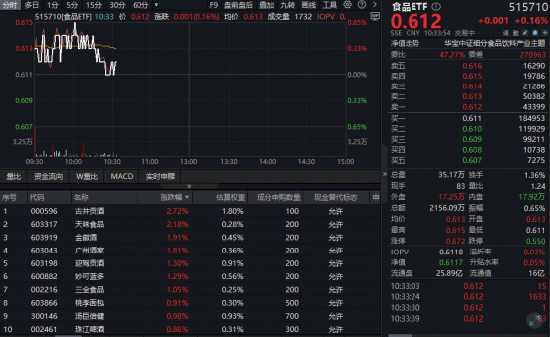
Core Viewpoint - The food and beverage sector is experiencing a period of consolidation, with the Food ETF (515710) showing a slight increase of 0.16% as of the latest report, indicating a potential recovery phase in the market [1][3]. Market Performance - The Food ETF (515710) fluctuated during the trading session, reaching a peak increase of 0.65% before settling at a 0.16% gain [1]. - Major consumer goods, particularly in the liquor segment, have shown strong performance, with stocks like Gujing Gongjiu and Tianwei Foods rising over 2% [1]. Sales Growth - JD.com reported an 18% year-on-year increase in sales of alcoholic beverages during the recent Double Eleven shopping festival, with brands like Moutai and Wuliangye achieving double-digit growth [2][4]. - The liquor industry is expected to benefit from trends such as online sales, lower alcohol content products, and internationalization, which may provide structural growth opportunities [2]. Valuation Insights - The food and beverage sector is currently at a historical low in terms of valuation, with the Food ETF's underlying index PE ratio at 20.86, placing it in the 9.41% percentile over the past decade, suggesting a favorable entry point for long-term investments [3][4]. - Analysts indicate that the food and beverage sector is in a "difficult to fall, easy to rise" phase, with expectations of a recovery in earnings and valuation improvements starting from 2026 [4]. Investment Strategy - The Food ETF (515710) is recommended for investors looking to gain exposure to high-end and mid-range liquor stocks, as well as other segments like beverages and condiments [5]. - The ETF's portfolio consists of approximately 60% allocation to leading liquor brands and 40% to other food and beverage sectors, making it a diversified investment option [5].

迎驾贡酒11月20日获融资买入2539.04万元,融资余额2.25亿元
Xin Lang Cai Jing· 2025-11-21 01:37
Core Insights - The stock of Yingjia Grape Wine increased by 1.63% on November 20, with a transaction volume of 255 million yuan [1] - The company reported a financing buy-in amount of 25.39 million yuan and a net financing buy of 2.96 million yuan on the same day [1] - As of November 20, the total financing and securities lending balance for Yingjia Grape Wine was 227 million yuan [1] Financing Summary - On November 20, the financing buy-in for Yingjia Grape Wine was 25.39 million yuan, with a current financing balance of 225 million yuan, representing 0.66% of the circulating market value [1] - The financing balance is below the 10th percentile level over the past year, indicating a low position [1] Securities Lending Summary - On November 20, 1,700 shares were repaid in securities lending, with 100 shares sold, amounting to 4,290 yuan at the closing price [1] - The remaining securities lending volume was 51,300 shares, with a balance of 2.20 million yuan, which is below the 40th percentile level over the past year, indicating a relatively low position [1] Company Overview - Yingjia Grape Wine Co., Ltd. is located in Huoshan County, Lu'an City, Anhui Province, established on November 28, 2003, and listed on May 28, 2015 [1] - The company's main business involves the research, production, and sales of liquor, with revenue composition as follows: high-end liquor 80.26%, ordinary liquor 14.31%, packaging materials 3.38%, and others 2.05% [1] Financial Performance - As of September 30, the number of shareholders for Yingjia Grape Wine was 57,100, a decrease of 14.56% from the previous period [2] - For the period from January to September 2025, the company achieved a revenue of 4.516 billion yuan, a year-on-year decrease of 18.09%, and a net profit attributable to the parent company of 1.511 billion yuan, down 24.67% year-on-year [2] - Since its A-share listing, the company has distributed a total of 7.28 billion yuan in dividends, with 3.12 billion yuan distributed over the past three years [2] Institutional Holdings - As of September 30, 2025, the second-largest circulating shareholder of Yingjia Grape Wine is the China Securities Index White Wine Index A (161725), holding 24.4568 million shares, an increase of 4.1366 million shares from the previous period [2] - The Wine ETF (512690) is the fourth-largest circulating shareholder, holding 7.5695 million shares, an increase of 2.5680 million shares from the previous period [2] - Hong Kong Central Clearing Limited is the sixth-largest circulating shareholder, holding 6.2332 million shares, a decrease of 2.7123 million shares from the previous period [2]
黄淮名酒这10年
Sou Hu Cai Jing· 2025-11-20 15:16
Core Insights - The Huanghuai famous liquor summit held in Zibo, Shandong, highlighted the significant growth and development of liquor enterprises from Anhui, Shandong, Henan, and Jiangsu over the past decade, with a market scale increase from approximately 1150 billion yuan in 2014 to 2369 billion yuan in 2024, more than doubling in size [2][3] Market Growth - The market scale of the Huanghuai liquor region has seen a substantial increase, with the total market size surpassing 2000 billion yuan by 2024, reaching 2369 billion yuan [2] - The number of large-scale enterprises in the Huanghuai liquor region decreased from 424 in 2014 to 283 in 2024, indicating a rise in market concentration and competitiveness [3] Brand Development - In 2014, only Yanghe had a sales scale exceeding 10 billion yuan, while by 2024, half of the top 10 listed liquor companies in China were from the Huanghuai region, with Gujing Gongjiu achieving 235.78 billion yuan in revenue and joining the top brands [3] - The successful upgrade of price bands has allowed Huanghuai liquor brands to break through previous limitations, with mainstream consumer prices rising from around 80 yuan in 2014 to 200 yuan and beyond by 2018 [3][4] Price Band Strategy - Huanghuai liquor companies have successfully established a complete pricing system covering mass-market, mid-range, and high-end products, with price ceilings reaching up to 2000 yuan by 2024 [3][4] - The introduction of high-quality products in the 100-600 yuan price range has allowed these companies to capture both the value-for-money and premium market segments [3][4] Innovation and Standards - The past decade has seen significant innovation in product categories, with various new fragrance types and industry standards being established, positioning Huanghuai liquor companies at the forefront of the industry [4] - Multiple national-level standards have been created for different types of Huanghuai liquor, enhancing the overall quality and marketability of the products [4] Production Capacity and Storage - The cancellation of the white liquor production limit in 2019 allowed Huanghuai liquor companies to expand their production capacity significantly, with many top enterprises doubling their capacity over the past decade [5][6] - Yanghe has achieved the highest production capacity for solid-state liquor and the largest storage capacity for high-quality original liquor globally [5][6]



《大驾光临》第二季开播!刘孝田重返家乡,用一只画笔解锁大别山的山水密码
凤凰网财经· 2025-11-20 09:00
刘孝田为家乡的美景创作了很多画作,大别山石窟、毛坦厂中学、毛坦厂老街、大别山风情谷等景点纷纷将他的画作印在门票上,如今这些画作成 了家乡的名片。 02 中西合璧:将精神元素注入画作 " 当时我就在思考,用什么样的绘画风格能够感动国外友人。 " 刘孝田回忆,在收到俄罗斯圣彼得堡美术展邀请后,他想把中国人民的精神融入到 画作中去打动外国友人。于是他想到了具有中国特色的江南渔乡,画了一副渔民在冰天雪地的寒冬中,不畏严寒,破冰出航的场景,这就是刘孝田 扬名海外的名作《破冰》。 文 | 凤凰网酒业 " 原来这里是穷山恶水……现在山都变成'城'了,把一座山变成城市,把出去的农民工变成了工人 " 近日,知名专家、国家一级美术师刘孝田返回家 乡,与著名主持人蔡紫一同走进 大别山门户霍山 。 得知画作拍出 1.49 亿元是何心情?家乡的山水如何塑造他的画风?如何将精神融入画作去感动外国观众?《大驾光临》第二季第五期栏目中,嘉宾 金句频出,带领大家以艺术视角探寻自然馈赠如何与人文创意碰撞出乡村繁荣的火花。 01 水墨乡愁:将画作变为家乡名片 " 大别山的生活经历,已经成为我记忆中独特的文化符号……是我创作的灵感源泉……"刘孝田站 ...

迎驾贡酒涨2.04%,成交额1.11亿元,主力资金净流入578.33万元
Xin Lang Zheng Quan· 2025-11-20 03:32
Group 1 - The core viewpoint of the news is that Yingjia Gongjiu's stock has experienced fluctuations, with a recent increase of 2.04% and a total market value of 34.456 billion yuan [1] - As of November 20, the stock price is reported at 43.07 yuan per share, with a trading volume of 1.11 billion yuan and a turnover rate of 0.33% [1] - The company has seen a year-to-date stock price decline of 17.87%, with a 1.85% drop over the last five trading days, a 6.48% increase over the last 20 days, and a 3.78% decline over the last 60 days [1] Group 2 - Yingjia Gongjiu's main business includes the research, production, and sales of liquor, with a revenue composition of 80.26% from mid-to-high-end liquor, 14.31% from ordinary liquor, 3.38% from packaging materials, and 2.05% from other sources [1] - As of September 30, the number of shareholders is reported at 57,100, a decrease of 14.56% from the previous period, while the average circulating shares per person increased by 17.05% to 14,015 shares [2] - For the period from January to September 2025, the company achieved operating revenue of 4.516 billion yuan, a year-on-year decrease of 18.09%, and a net profit attributable to shareholders of 1.511 billion yuan, down 24.67% year-on-year [2]
白酒板块11月19日跌0.55%,皇台酒业领跌,主力资金净流出6.91亿元
Zheng Xing Xing Ye Ri Bao· 2025-11-19 08:51
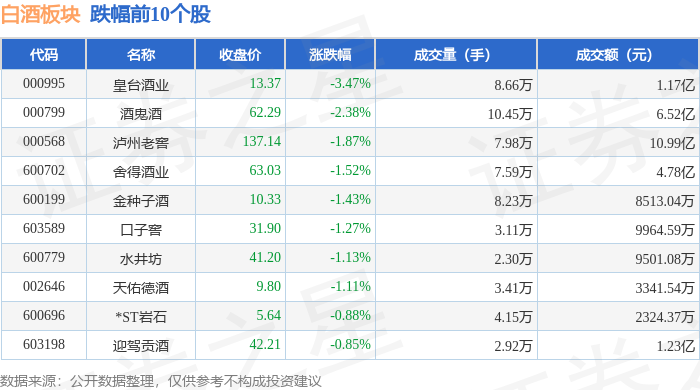
Core Insights - The liquor sector experienced a decline of 0.55% on November 19, with Huangtai Liquor leading the drop [1] - The Shanghai Composite Index closed at 3946.74, up 0.18%, while the Shenzhen Component Index closed at 13080.09, unchanged [1] Liquor Sector Performance - Key stocks in the liquor sector showed varied performance, with Qingdao Wenzhou down 3.47% to 13.37, and Jiu Gui Jiu down 2.38% to 62.29 [1] - Other notable declines included Luzhou Laojiao down 1.87% to 137.14 and Shede Liquor down 1.52% to 63.03 [1] Capital Flow Analysis - The liquor sector saw a net outflow of 6.91 billion yuan from main funds, while retail investors contributed a net inflow of 4.2 billion yuan [1] - The table of capital flow indicates that major stocks like Water Well and Huangtai Liquor experienced significant net outflows from main funds [2]