隆基绿能

Search documents
马斯克团队秘密接触光伏企业?业内:短期没有实际性帮助
Xin Lang Cai Jing· 2026-02-06 01:30
Core Viewpoint - Recent rumors indicate that Elon Musk's SpaceX team has been visiting multiple Chinese photovoltaic companies to explore solar equipment, silicon wafers, and battery cells, with a focus on heterojunction and perovskite technology [2][3][10]. Group 1: Market Reactions - On February 5, photovoltaic concept stocks experienced a significant downturn, with companies like Jiejia Weichuang and Maiwei shares dropping over 10%, while Jingao Technology fell by 7.3% and Longi Green Energy by 5.59% [2][3]. - Prior to this, from February 3 to 4, stocks such as Jingsheng Electromechanical surged over 30%, with Oriental Sunrise and Jinko Solar seeing increases of nearly 15% and 36%, respectively [2][3]. Group 2: Company Responses - Jingsheng Electromechanical stated they were unaware of the SpaceX team's activities, emphasizing that space photovoltaics are still in the exploratory phase [2][10]. - Oriental Sunrise confirmed they had not received any communication from SpaceX, noting their primary business focus is on ground-based photovoltaics [2][10]. - Jinko Solar issued a notice regarding unusual stock trading, clarifying that their main business remains focused on ground photovoltaics and that they have not received any orders related to space photovoltaics [11]. Group 3: Technological Insights - Musk has highlighted the importance of solar energy, aiming for SpaceX and Tesla to achieve an annual solar manufacturing capacity of 100GW within three years, intended for ground data centers and space AI satellites [11][12]. - The potential applications of space photovoltaics are categorized into three stages: the first involves solar wings for low Earth orbit satellites, the second focuses on powering space computing centers, and the third envisions solar power stations in space [12][13]. - The first stage is seen as the most feasible within five years, while the second stage is projected to take 5-10 years, and the third stage is considered far off due to significant technical challenges [12][13].

中国光伏产业链稳居全球主导地位,“反内卷”仍是重中之重
Bei Jing Ri Bao Ke Hu Duan· 2026-02-06 01:17
中国光伏产业链在全球稳居主导地位,行业整体依然在谷底深度调整,"反内卷"治理仍是今年的重中之 重。2月5日,中国光伏行业协会在京举行2025年发展回顾与2026年形势展望研讨会。作为每年行业开年 的首场活动,研讨会释放出大力促进行业健康发展的强烈信号。 中国光伏产业链仍占据全球主导地位 制造端年产值突破10000亿元;出口总额突破1800亿美元;累计装机突破1200吉瓦;组件出口超200个国 家和地区……回顾"十四五"光伏产业发展,中国光伏行业协会顾问王勃华表示,过去五年,光伏行业取 得诸多具有里程碑意义的突破。 我国光伏产业在规模、技术、市场、应用等方面实现跨越式的发展。其中,装机量、发电量等应用方面 的跨越式增长最令人瞩目。协会披露的最新数据显示,"十四五"期间,我国光伏累计新增装机量是"十 三五"的4.5倍,光伏累计新增发电量是"十三五"的3.6倍。2023至2025年连续三年,光伏每年新增装机量 均高于"十三五"期间累计量;2025年一年的发电量,就高于"十三五"期间累计量。 但与此同时,通威股份、天合光能、晶科能源2025年亏损金额则有所扩大,主要原因是产能规模大、原 材料成本高企及海外贸易壁垒加剧 ...
中金 | 氢基能源系列一:非电能源领域降碳重要路径,氢能产业或迎加速发展
中金点睛· 2026-02-05 23:41
Core Viewpoint - Hydrogen energy is an essential means for carbon reduction in non-electric energy sectors, and it is expected to accelerate development during the 14th Five-Year Plan period due to policy stimulation, technological advancements, and cost reductions [1][4]. Group 1: Hydrogen Energy as a Carbon Reduction Pathway - A portion of energy consumption cannot be replaced by electricity, necessitating alternative methods for carbon reduction in non-electric sectors. It is estimated that by 2060, 30% of energy will remain irreplaceable by electricity, indicating the need for new technologies like hydrogen energy [8]. - Hydrogen energy is considered a more viable solution compared to carbon capture and biomass due to its advantages in industrial development and technological iteration [8]. - The national policy framework has clearly defined the direction for renewable energy utilization in non-electric sectors, with hydrogen and green methanol being prioritized [8]. Group 2: Green Methanol and Its Market Potential - The shipping industry is driving demand for green methanol due to EU and IMO policies that impose carbon emission assessments, providing a green premium for methanol [11]. - The International Maritime Organization (IMO) aims for net-zero emissions in international shipping by around 2050, establishing legally binding measures to achieve this goal [11]. - The EU will include the shipping industry in its carbon emissions trading system starting in 2024, with increasing carbon quota submission requirements [12]. Group 3: Green Hydrogen Production and Electrolyzer Demand - The decline in electricity prices is expected to reduce the cost of green hydrogen production, leading to increased demand for electrolyzers [4][23]. - Current production costs for hydrogen from coal gasification, natural gas, and alkaline electrolysis are estimated at 9.3 CNY/kg, 17.8 CNY/kg, and 19.2 CNY/kg, respectively [23]. - The introduction of green electricity direct connection policies is anticipated to further lower the cost of green hydrogen production [27]. Group 4: Fuel Cell Vehicles and Market Dynamics - Fuel cell vehicles are transitioning from buses to commercial vehicles like heavy trucks, with policies enhancing their economic viability [34]. - The market for fuel cell vehicles is expected to grow significantly, particularly in the heavy-duty vehicle segment, as they are better suited for long-distance and heavy-load transportation [38]. - The competitive landscape for fuel cell systems is concentrated, with a few companies dominating the market share [43].
中国新能源产业点亮非洲
Jing Ji Ri Bao· 2026-02-05 22:04
Core Viewpoint - The 2026 Africa International Solar Energy Exhibition held in Nairobi, Kenya, showcases the significant impact of Chinese renewable energy products on local communities, enhancing quality of life and providing practical solutions to energy challenges in Africa [1][2]. Group 1: Impact of Chinese Renewable Energy - Chinese renewable energy products are improving the quality of life in Kenya, allowing children to study at night and adults to engage in small businesses [1]. - The introduction of solar and storage systems by companies like Ningbo Deye Energy Technology Co., Ltd. enables seamless power switching during outages, reducing fuel costs for local residents [1]. - Chinese companies are focusing on product designs suitable for the African environment, emphasizing features like high-temperature resistance and dust-proof capabilities [1]. Group 2: Local Engagement and Training - Companies are collaborating with universities and organizing competitions to stimulate local interest in renewable energy, fostering participation in installation, design, and entrepreneurship [2]. - The approach of Chinese enterprises to work closely with local industries and labor is positively received in Africa, addressing the need for sustainable development in the renewable energy sector [2]. - Chinese companies are establishing distribution networks and providing training for local distributors and industry participants, playing a crucial role in the development of the renewable energy industry in Africa [2]. Group 3: Future Prospects - The CEO of the Nigerian Renewable Energy Association anticipates that more factories will establish operations in Africa, contributing to training and technical support for sustainable development in the local renewable energy sector [3]. - The tangible changes brought by Chinese renewable energy technology are recognized by local communities, as stable and clean electricity becomes more accessible [3]. - The energy transition in Africa is moving from concept to practice, with Chinese renewable energy industries actively driving and witnessing this transformation [3].

“马斯克团队考察光伏产业链”,多家巨头回应
Nan Fang Du Shi Bao· 2026-02-05 16:21
2月4日,有市场传闻称,马斯克团队近期走访了中国多家光伏企业,考察项目涉及设备、硅片、电池组件等环节,其中重点考察了有异质结、钙钛矿技术 路线的光伏企业。当日,协鑫、晶科能源(688223.SH)、TCL中环(002199.SZ)等上市公司确认与马斯克团队有过接洽。 对此,多家光伏产业链公司在回应中强调,目前并未与马斯克团队达成实质性合作,并提示"太空光伏"仍处早期阶段,投资者应理性看待相关概念;且光 伏调整期下公司业绩处于大幅下滑或亏损态势,提醒投资者审慎投资。 光伏板块上市公司2月5日走势,截至5日午间收盘 上市公司回应: 尚未开展合作,"太空光伏"处于探索期 2月4日晚,晶科能源发布股票异动公告表示,公司关注到近期资本市场对"太空光伏"等概念关注度较高,相关板块二级市场表现较为活跃。目前"太空光 伏"尚处技术初步探索阶段,产业化进程受技术发展、行业政策、市场环境等多方面因素影响,未来技术应用与产业化落地仍需要一定的时间周期。截至 目前,公司主营业务产品仍聚焦于地面光伏领域,公司未有涉及"太空光伏"的订单收入,未对公司经营业绩造成影响,请投资者 注意理性判断。 晶科能源进一步指出,截至目前,公司未与马斯克 ...




事关“太空光伏” 天合光能、协鑫集成回应
2 1 Shi Ji Jing Ji Bao Dao· 2026-02-05 15:41
Core Viewpoint - The recent visit of SpaceX to several Chinese photovoltaic companies led to a surge in the space photovoltaic concept stocks on February 4, but the momentum could not be sustained, resulting in a significant decline in the space photovoltaic index on February 5 [2][3]. Group 1: Market Performance - On February 5, the space photovoltaic index (8841929) dropped by 4.86%, closing at 3837.43, with notable declines in stocks such as JunDa Co., JinCheng Co., and Shuangliang Energy, which hit the daily limit down [2][3]. - Other companies like GaoCe Co., JieJia WeiChuang, MaiWei Co., JingSheng JiDian, and HaiYou New Materials saw declines exceeding 9%, while Trina Solar fell over 7% and JinkoSolar dropped over 6% [2][4]. Group 2: Company Announcements - Trina Solar announced that it has not engaged in any cooperation with SpaceX and has no related orders in the "space photovoltaic" sector, clarifying that its main products are focused on ground photovoltaic applications [5][6]. - GCL-Poly Energy stated that it has not received any orders in the "space photovoltaic" field and emphasized that the technology is still in the exploratory phase, with uncertain commercial prospects [8]. - JinkoSolar confirmed it has not collaborated with SpaceX and highlighted that the "space photovoltaic" concept remains in the early exploration stage [10]. - Other companies like Guosheng Technology, Shuangliang Energy, and JingSheng JiDian also reported no involvement in "space photovoltaic" business, reiterating the uncertainty surrounding the commercialization of this technology [11][12][13]. Group 3: Financial Forecasts - Trina Solar projected a net loss of between 6.5 billion to 7.5 billion yuan for the year 2025 [7]. - GCL-Poly Energy expects a net loss of between 890 million to 1.29 billion yuan for the same year [8].




硅业分会:单晶硅需求疲软成交清淡 硅片价格承压下行
智通财经网· 2026-02-05 13:14
Core Insights - The silicon wafer prices are under pressure, with significant declines observed in various types of wafers, indicating a weak market demand [1][2] - The overall operating rates in the industry have slightly decreased, reflecting reduced production levels among major companies [1][2] Price Trends - N-type G10L monocrystalline silicon wafers (182*183.75mm/130μm) have an average transaction price of 1.20 yuan per piece, down 4.76% week-on-week [1][3] - N-type G12R monocrystalline silicon wafers (182*210mm/130μm) have an average price of 1.26 yuan per piece, down 4.55% week-on-week [1][3] - N-type G12 monocrystalline silicon wafers (210*210mm/130μm) have an average price of 1.45 yuan per piece, down 4.61% week-on-week [1][3] Market Conditions - The downstream demand remains weak, leading to a significant reduction in silicon wafer procurement [1][2] - The overall industry operating rate has been slightly adjusted, with major companies operating at rates of 50% and 46%, while integrated companies maintain rates between 50%-68% [1][2] Future Outlook - Short-term demand for silicon wafers is expected to remain weak, with a projected monthly production decrease of about 5% due to reduced battery cell production [2] - Post-holiday, as rigid orders from downstream gradually release, the supply-demand relationship for silicon wafers may gradually improve, potentially providing some market support [2]



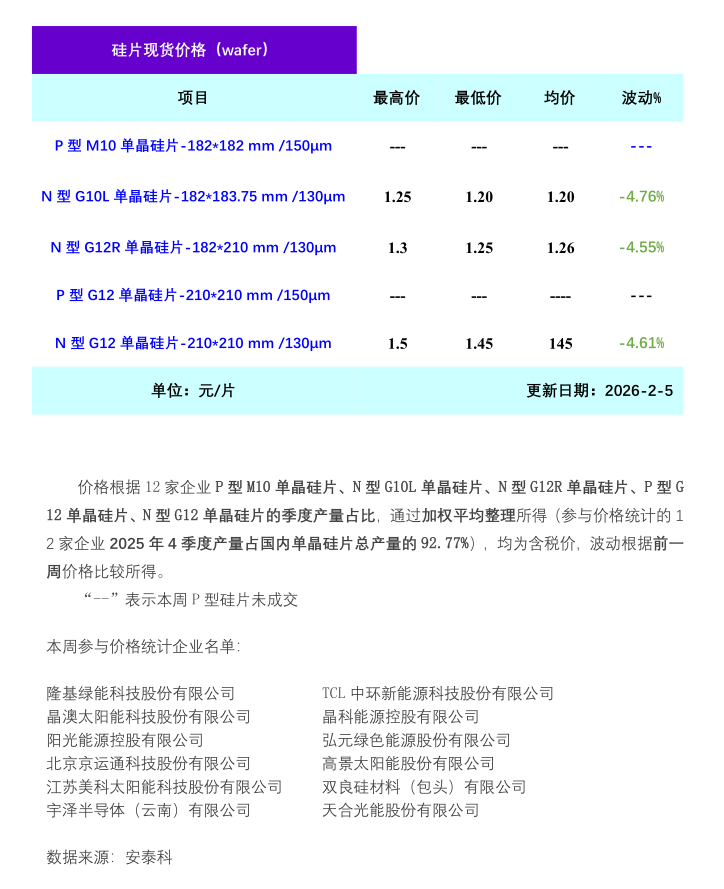
【安泰科】单晶硅片周评-需求疲软成交清淡 硅片价格承压下行(2026年2月5日)
中国有色金属工业协会硅业分会· 2026-02-05 12:44
Core Viewpoint - The silicon wafer market is experiencing downward pressure on prices due to weak downstream demand and high costs for battery manufacturers, leading to a significant reduction in procurement demand and production rates [1][2]. Price Trends - The average transaction prices for various types of silicon wafers have decreased: - N-type G10L (182*183.75mm/130μm) at 1.20 CNY/piece, down 4.76% week-on-week - N-type G12R (182*210mm/130μm) at 1.26 CNY/piece, down 4.55% - N-type G12 (210*210mm/130μm) at 1.45 CNY/piece, down 4.61% [1][3]. - The prices for downstream battery cells remain stable, with mainstream prices at 0.41-0.45 CNY/W and module prices at 0.71-0.75 CNY/W [1]. Market Dynamics - The market is characterized by weak demand, with terminal installation demand remaining soft and rising silver prices increasing cost pressures on battery companies, leading to a pessimistic industry sentiment and significant production cuts [1][2]. - The overall operating rate in the industry has slightly decreased, with leading companies operating at 50% and 46%, while integrated companies maintain rates between 50%-68% and other companies between 50%-70% [1]. Future Outlook - In the short term, silicon wafer demand is expected to remain weak, with a forecast of narrow fluctuations in the market due to adjustments in battery cell production and expectations of declining silicon material prices [2]. - Post-holiday, as rigid orders from downstream gradually release, the supply-demand relationship for silicon wafers is anticipated to improve, potentially providing some market support [2].
Q4风光业绩承压,看好盈利修复与太空光伏趋势
HTSC· 2026-02-05 11:01
Investment Rating - The report maintains an "Overweight" rating for the electric equipment and new energy sector [1]. Core Views - The report highlights that the wind and solar industries are facing performance pressures in Q4 2025, but there is optimism for profit recovery and trends in space photovoltaics [1][9]. - The report emphasizes that the profitability of companies in the solar industry is heavily reliant on gross margins and cash flow, especially in the context of rising silver prices impacting battery component costs [5][9]. - The development of space photovoltaics is seen as a new business model, with significant advancements expected from leading solar companies [6][9]. Summary by Sections Wind Power - In Q4 2025, wind turbine manufacturers experienced margin pressure due to low-priced domestic projects and a decline in profits from project transfers, leading to performance below consensus expectations [4]. - The report anticipates that the delivery of price-increased orders in 2026 will support profit recovery in the wind power supply chain, with accelerated construction of offshore wind projects laying the foundation for continued installation growth [4][9]. Solar Power - The report notes that the significant rise in silver prices has increased battery component costs, with the Shanghai silver index rising by 56% from the end of September to the end of December 2025, leading to a corresponding increase in costs of 5-6 cents per watt [5]. - Companies like JinkoSolar, LONGi Green Energy, and Trina Solar are expected to achieve mass production of low-silver products in the first half of 2026, which may benefit upstream material processing and powder manufacturers [5]. - The report suggests that in a context of weak demand, companies will focus on cost control and the introduction of high-power products to drive profit recovery [9]. Space Photovoltaics - SpaceX's acquisition of xAI is expected to create a space-ground-computing ecosystem, with advancements in space photovoltaics anticipated to continue [6]. - Leading solar companies are making significant R&D investments in space photovoltaics, with plans for commercial production of perovskite tandem solar cells expected between 2026 and 2028 [6]. - Companies like JinkoSolar, Trina Solar, and others are actively developing technologies and products for the space photovoltaic market, indicating a strong push towards commercialization [6][7].
报时中国经济丨钟宝申:技术创新的终点,是让每个人用上“放心电”
Sou Hu Cai Jing· 2026-02-05 10:43
Core Insights - The chairman and general manager of Longi Green Energy, Zhong Baoshen, emphasized that humanity is on the brink of a green industrial revolution, with a fundamental shift in the energy system from resource attributes to technological attributes [1][3] - The goal of this transformation is to build a more inclusive and resilient zero-carbon future [1] Group 1: Energy Transformation - The ultimate significance of energy is to spread development opportunities universally, akin to sunlight [3] - The transition to green electricity as a global infrastructure will reshape the underlying logic of industrial development and help bridge regional energy gaps, promoting global fairness and sustainable development [3] - Energy transformation is a complex system engineering that connects industry, economy, and people's livelihoods [3] Group 2: Technological Innovation - The future of energy lies at the intersection of technology and people's livelihoods, focusing on providing affordable, reliable, and clean electricity to everyone [3][4] - Continuous innovation is essential for renewable energy to evolve from a supplementary role to a primary energy source, enhancing coverage, reliability, and economic viability [4] - Artificial intelligence is becoming a new engine for optimizing the energy system, enabling a shift from traditional mechanical scheduling to intelligent collaboration [4] Group 3: China's Leadership in Renewable Energy - China has made a historic leap from being a latecomer to a global leader in green technology and supply chains [3][4] - The key to sustainable high-quality development in the industry lies in deeper self-innovation and breakthroughs in original technologies [3] - China's renewable energy industry is positioned to contribute significantly to the global energy transition, leveraging its accumulated technological and industrial advantages [4]