
美的集团

Search documents
AI时代,如何看待榜单导购的价值?
36氪· 2025-12-09 13:35
Core Insights - The article discusses the evolving landscape of consumer behavior, highlighting a shift from "finding products" to "selecting products," with 76.64% of users needing tools to reduce decision-making costs [1] - The rise of various ranking lists, including the JD Gold List, is seen as a response to consumer fatigue and the need for trustworthy product recommendations [2][3] Group 1: Consumer Behavior and Challenges - Consumers face a new type of fatigue where they struggle to determine what is worth buying, despite the abundance of product information [1] - The report indicates that 76.56% of users prioritize finding trustworthy and high-quality products, reflecting a demand for reliable decision-making tools [1] - The proliferation of rankings has led to a decline in trust, with many lists being influenced by advertising rather than genuine consumer behavior [7][10] Group 2: JD Gold List Overview - The JD Gold List was created to provide an objective ranking based solely on real data, free from commercial influence, and has gained consumer trust over six years [3][8] - In 2025, approximately 1 billion users are expected to make purchases influenced by the JD Gold List, with products on the list seeing a 12-fold increase in sales growth compared to regular products [15][17] - The JD Gold List has established a reputation for high standards, with no artificial selection or paid placements, relying on user purchase data and product performance [11][12] Group 3: Impact on Brands - Brands that appear on the JD Gold List, such as Midea and Nongfu Spring, benefit from increased visibility and consumer trust, leading to higher sales and positive reviews [21][24] - The list serves as a validation tool for brands, helping them to establish credibility and connect with consumers effectively [23][26] - The introduction of co-branded products with the JD Gold List has proven successful, with products seeing significant sales increases and high customer satisfaction rates [27] Group 4: Future Directions - JD plans to enhance the Gold List's capabilities by integrating AI technology, allowing for personalized rankings and improved user interaction [35] - The company aims to expand the influence of the Gold List, providing more opportunities for quality products to be recognized and seen by consumers [35] - The ongoing commitment to transparency and quality is expected to set a benchmark for the industry, encouraging brands to improve their product quality and service experiences [35]



周云杰与海尔智家的四年之困:难破2500亿市值魔咒?
Xin Lang Cai Jing· 2025-12-09 13:11
Core Viewpoint - Haier Smart Home has struggled to escape a low valuation trap, with its market capitalization hovering around 250 billion yuan for four years, while competitors like Midea have achieved significantly higher valuations through strategic narratives and business diversification [2][3][7]. Group 1: Market Perception and Valuation - Investors have two common misconceptions about Haier Smart Home: first, they incorrectly compare it directly with Midea, which has a market cap of approximately 600 billion yuan, leading to the belief that Midea has a dominant advantage in the home appliance market [4][5]. - The second misconception is regarding Haier's hidden assets, as many believe that Haier Smart Home does not represent the entire Haier Group, which has substantial off-balance-sheet assets. However, even when aggregating these assets, the total market value is only around 350 billion yuan [6]. - The core issue of Haier's valuation dilemma is the lack of narrative premium, as the market has grown weary of old stories and prefers companies that can present innovative technological narratives [7][8]. Group 2: Financial Performance and Efficiency - Under the leadership of Zhou Yunjie, Haier Smart Home's revenue increased from 227.5 billion yuan to over 280 billion yuan, and net profit rose from 11.8 billion yuan to 17.8 billion yuan, yet the market cap has remained stagnant [11]. - Haier Smart Home's current price-to-earnings (P/E) ratio is approximately 14 times, which is not low compared to Midea and Gree, but the company's profitability is hindered by high operational costs, leading to a low net profit margin of 6.9% compared to Midea's 9.5% [12][15]. - The company's high expense ratios, including a sales expense ratio of 11.7% and a management expense ratio of 4.2%, contribute to a total expense ratio that has reached 24.18%, significantly higher than Midea's 16.92% and Gree's 14.92% [16][18]. Group 3: Strategic Choices and Globalization - Haier's strategy over the past decade has focused on globalization and acquisitions, which has led to a complex organizational structure and high management costs, ultimately impacting profitability [19][20]. - The company has expanded its global footprint, with nearly 50% of its revenue coming from overseas markets, but the integration of acquired companies has proven challenging, leading to inefficiencies [20][21]. - Unlike Midea, which has focused on internal innovation and B2B transformation, Haier has faced difficulties in managing its expansive global operations, resulting in a scale trap where increased revenue does not translate to higher profits [22]. Group 4: External Market Pressures - Haier faces significant external pressures, including the waning of policy incentives that previously boosted the home appliance sector, with a reported 3.2% year-on-year decline in retail sales for the industry [23][24]. - The high-end segment, once a strong growth driver for Haier, has also shown signs of slowing, with sales growth for its premium brand, Casarte, declining from 14% in 2023 to 12% in 2024 [25]. - Additionally, growth in overseas markets has stagnated, with the Americas and Australia showing minimal growth rates of 2.4% and 1%, respectively, while other major markets are under significant pressure [26].



史上第二高!美的集团完成单次百亿回购,A股年内累计回购超1400亿元
Bei Jing Shang Bao· 2025-12-09 12:45
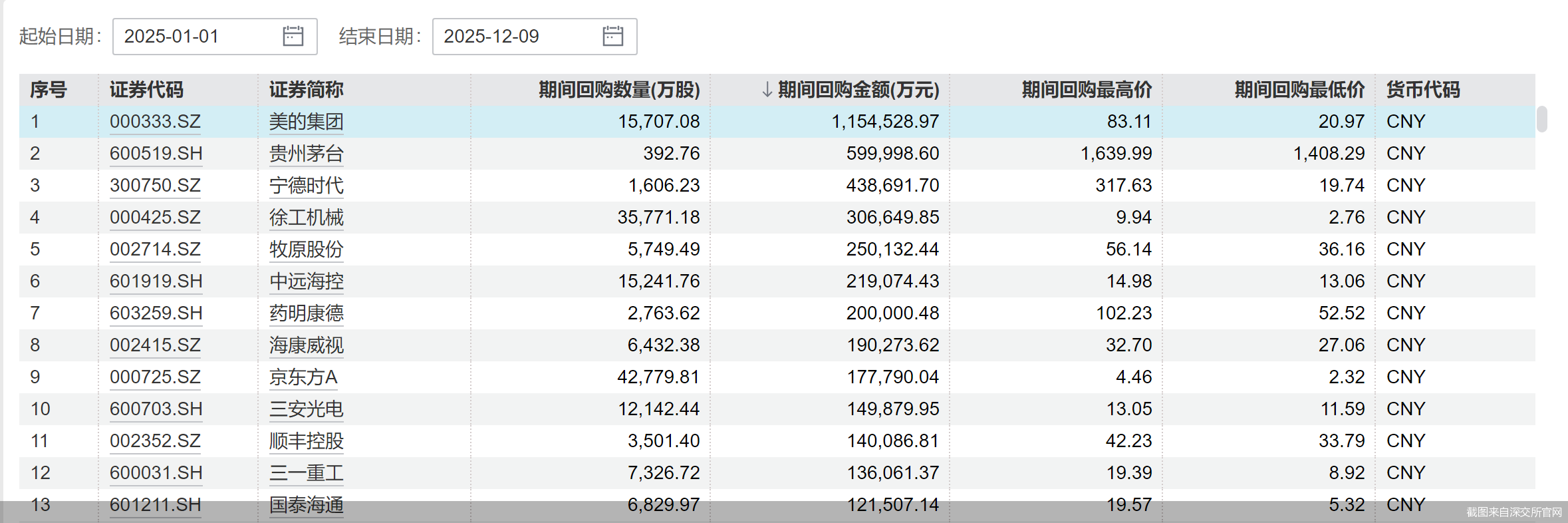
Core Viewpoint - The regulatory environment is supportive of the market, leading to an increase in share buybacks among A-share listed companies, with Midea Group's recent buyback of 10 billion yuan being a significant highlight [1][3]. Group 1: Share Buyback Details - Midea Group announced the completion of a 10 billion yuan share buyback, marking the largest single buyback in its history and the second-largest in A-share history, following Gree Electric's previous buyback [1][3]. - As of December 9, 2023, a total of 1,465 A-share companies have implemented buyback plans, with a cumulative buyback amount exceeding 140 billion yuan [4][5]. - Midea Group leads the buyback amounts for the year with 11.545 billion yuan, followed by Kweichow Moutai and CATL with approximately 6 billion yuan and 4.387 billion yuan, respectively [4][5]. Group 2: Market Performance - Among the 1,465 companies that conducted buybacks, 1,172 stocks have seen price increases, representing about 80% of the total [6][9]. - The stock of Shenghong Technology has experienced the highest increase, with a cumulative rise of 655.64% from January 2 to December 9, 2023 [6]. - The overall market sentiment is positive, as buybacks signal management's confidence in the company's value and future growth, which in turn attracts investor interest [7][9]. Group 3: Financial Performance - Over 81% of the companies that executed buybacks reported profits in the first three quarters of the year, with Kweichow Moutai leading in profit size at 64.627 billion yuan [8][9]. - A total of 794 companies, or approximately 54.2%, experienced year-on-year profit growth during the same period [9]. - The pharmaceutical and electronics sectors have the highest number of companies engaging in buybacks, with 158 and 157 companies, respectively [9].
超1500亿元 四成以上为注销!A股年内回购大数据,出炉→
Zheng Quan Shi Bao· 2025-12-09 12:32
Group 1 - The core viewpoint of the articles highlights the increasing trend of stock buybacks among A-share listed companies, driven by policy guidance, valuation recovery needs, and shareholder return optimization [1][4] - Over 40% of stock buyback plans announced this year are aimed at complete or partial cancellation, indicating a rise from 38.33% in 2024 [1][4] - The total amount of stock buybacks in A-shares has exceeded 150 billion yuan, with leading companies actively participating in these buybacks [2][4] Group 2 - Midea Group has completed a significant buyback of approximately 1.35 million shares, totaling around 10 billion yuan, marking it as the only "billion-level" buyback in A-shares this year [2][4] - Other notable companies include Kweichow Moutai and CATL, which have also engaged in substantial buybacks of 6 billion yuan and 4.386 billion yuan, respectively [2][3] - The trend of buyback cancellations is seen as a response to policies like the "New Nine Articles," which encourage companies to optimize their capital structures and enhance shareholder value [4][5] Group 3 - The buyback and cancellation strategy is viewed as a means to improve earnings per share (EPS) and attract long-term capital inflow, thereby enhancing company competitiveness [5][6] - Companies are advised to balance shareholder returns with maintaining a robust capital structure to avoid excessive cash flow pressure [6] - The overall sentiment is that buyback cancellations can stabilize the market and promote healthy development within the capital market [6]





超1500亿元,四成以上为注销!A股年内回购大数据,出炉→
证券时报· 2025-12-09 12:20
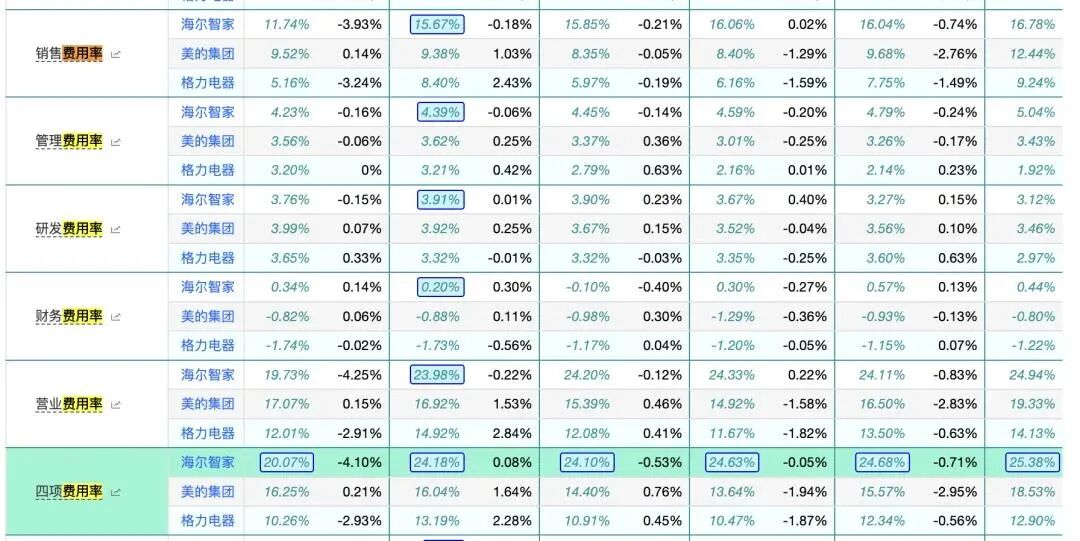
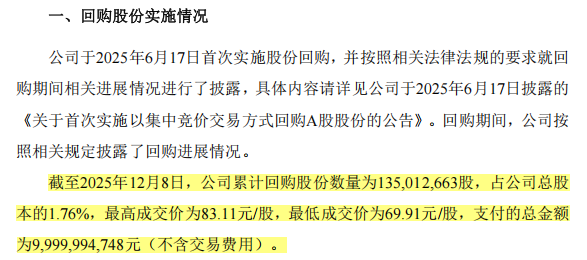
在 政策引导、估值修复需求及股东回报优化等多重因素推动下,近年来,A股上市公司注销式回购的积极性越来越高。 12月8日晚,美的集团发布公告称,截至2025年12月8日,公司累计回购股份数量约为1.35亿股,占公司总股本的1.76%,最高成交价为83.11元/股,最低成交价为 69.91元/股,支付的总金额约为100亿元(不含交易费用)。综上,公司本次回购股份金额已达回购方案的金额上限100亿元,本次回购方案实施完毕。 据同花顺 iFinD数据统计,截至1 2 月 9日,年内发布股票回购计划的方案中,四成以上的回购目的为全部注销或部分注销,较2 024 年的比例进一步提升。 值得一提的是,此次回购金额是A股今年唯一的"百亿级"回购。 美的集团表示,根据本次回购方案,回购股份70%及以上将用于注销并减少注册资本。公司本次累 计回购股份1.35亿股,其中9500万股将予以依法注销减少注册资本,注销股份占注销前总股本比例为1.24%。 受访人士指出,政策红利持续释放,监管层强化投资者保护,未来或出台更多税收优惠或资金支持政策,推动注销式回购常态化。目前,部分公司的估值仍处于低 位,企业回购仍有动力,企业通过回购注销向 ...

2026消费行业投资展望:底部,是走出来的
Western Securities· 2025-12-09 12:05
Investment Rating - The industry investment rating is "Overweight" and has been maintained from the previous rating [4]. Core Insights - The consumer sector is showing signs of bottoming out, with fundamental recovery acting as a catalyst for stock prices. Positive information regarding fundamentals is increasing, and companies are focusing more on dividends and buybacks [1][12]. - The "Redemption+" strategy is recommended as a short-term stable allocation strategy, with a focus on high-quality global assets and marginal recovery in specific sectors like beer and dairy [1][12]. - The report emphasizes the importance of new consumer groups and market segments, particularly the "Z Generation" and "New Middle Class," which are driving long-term structural growth in domestic demand [2][12]. Summary by Sections 1. Fundamental Outlook - The domestic consumer sector is entering a low-growth phase, with opportunities primarily in dividend-type investments and those showing marginal improvements [12]. - The "Z Generation" and "New Middle Class" are identified as key consumer groups with strong payment willingness and consumption characteristics [13][16]. - Retail channel transformations are leading to increased concentration of upstream brands, with new retail brands like "October Rice Field" showing significant growth potential [19][24]. 2. Investment Outlook for Key Sectors in 2026 - Baijiu - Guizhou Moutai's prices are nearing the bottom, indicating a long-term investment value. The current valuation corresponds to a 20x PE for 2025, with a dividend yield exceeding 3.7% [29][33]. - Jinhuijiu is gaining market share within the province, with a focus on product structure improvement and healthy inventory levels [35][39]. 3. Investment Outlook for Key Sectors in 2026 - Consumer Goods - The consumer goods sector has undergone significant cleaning of fundamentals, with no inventory burdens remaining for categories like dairy and beer [40]. - Companies like China Resources Beer and Mengniu Dairy are highlighted for their potential for improvement and growth in earnings [44]. 4. Investment Outlook for Key Sectors in 2026 - White Goods - Haier is noted for its organizational efficiency improvements and market adjustments, positioning it well for future growth [20][21]. 5. Investment Outlook for Key Sectors in 2026 - Technology Consumption - Companies like Anker and Ecovacs are recognized for their innovative platform development and operational resilience, indicating strong growth potential [22][23]. 6. Investment Outlook for Key Sectors in 2026 - Medical Aesthetics - Companies like Juzhi Biotechnology and Jinbo Biotechnology are highlighted for their technological leadership and platform upgrades, driving value reassessment [25][26]. 7. Investment Outlook for Key Sectors in 2026 - Overseas Quality Assets - Companies like Westair and Kingworld are gaining attention from domestic funds due to their strong competitive positions and growth potential in overseas markets [27][28].
年内A股回购总额突破1400亿元
Shen Zhen Shang Bao· 2025-12-09 11:37
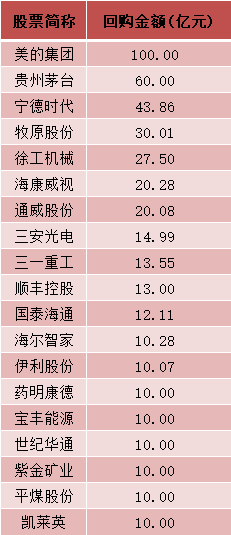
Core Viewpoint - The A-share market is experiencing a significant increase in stock buybacks, driven by leading companies and supported by favorable policies, with a total buyback amount exceeding 140 billion yuan as of December 8, 2023 [2][3]. Group 1: Buyback Trends - A total of 1,464 A-share listed companies have initiated stock buybacks this year, with a cumulative buyback amount surpassing 140 billion yuan [2]. - Key industries such as power equipment, electronics, home appliances, and machinery have each seen buyback amounts exceeding 10 billion yuan [2]. - The People's Bank of China and financial regulators have introduced policies to support stock buybacks, including a loan program with an initial quota of 300 billion yuan, increasing to 800 billion yuan by May 2025 [2]. Group 2: Loan Support for Buybacks - Over 770 listed companies have disclosed receiving loan support for buybacks, with a total loan ceiling exceeding 157.19 billion yuan, including 98.50 billion yuan specifically for buybacks [3]. - Notable companies receiving significant loan amounts include China Three Gorges Renewables, Kweichow Moutai, and Haier Smart Home, with loan ceilings exceeding 10 billion yuan [3]. Group 3: Leading Companies in Buybacks - Nineteen companies have repurchased over 100 million shares this year, with the top five being BOE Technology Group, Innovation Materials, XCMG, China State Construction, and Liao Port, repurchasing 428 million, 362 million, 358 million, 290 million, and 279 million shares respectively [3]. - The top three companies by buyback amount are Midea Group, Kweichow Moutai, and CATL, with buyback amounts of 11.01 billion yuan, 6 billion yuan, and 4.39 billion yuan respectively [3]. Group 4: Impact of Buybacks - The current buyback trend is characterized by a significant increase in cancellation-type buybacks, with nearly 20% of companies explicitly stating their buybacks will be used for capital cancellation, a 3% increase from the previous year [5]. - Kweichow Moutai has completed a 6 billion yuan buyback for cancellation and announced a new buyback plan of 1.5 billion to 3 billion yuan, all intended for capital cancellation [5]. - The trend of leading companies engaging in buybacks is seen as a natural outcome of market resources concentrating towards top firms, which typically have stronger cash flow and risk resilience [4].

回购100亿元注销70亿元 美的回报股东的“作业”值得抄
Mei Ri Jing Ji Xin Wen· 2025-12-09 10:32
Core Viewpoint - Midea Group has completed a share buyback of 10 billion yuan, acquiring 135 million A-shares, with 95 million shares to be canceled, reducing registered capital by 1.24% [1][3]. Group 1: Buyback Details - The total amount of share buybacks in the A-share market this year exceeded 140.6 billion yuan, with Midea Group accounting for approximately 11.545 billion yuan [3]. - Midea's share buyback was approved on May 30 and completed in less than six months, with buyback prices ranging from 69.91 yuan to 80.62 yuan [4]. Group 2: Impact on Shareholder Value - Share buybacks can enhance shareholder value by reducing the number of circulating shares, which can lead to an increase in metrics such as net asset value and earnings per share once shares are canceled [4]. - Midea's buyback has been effective, with its stock price reaching a new high since February 19, 2021, just a few percentage points away from its historical peak [3]. Group 3: Market Context and Trends - A total of 1,465 companies have disclosed buyback plans this year, but 515 companies have repurchased less than 10 million yuan, indicating potential issues with capital allocation or market timing [5]. - The trend towards "cancellation-style buybacks" is encouraged, as it reflects a company's genuine performance and commitment to returning value to shareholders [5].
人形机器人行业专题研究周报:美政府或发布机器人产业政策,国产整机厂商产品密集发布-20251209
CHINA DRAGON SECURITIES· 2025-12-09 10:29
Investment Rating - The report maintains a "Recommended" investment rating for the humanoid robot industry [5][27]. Core Insights - The U.S. government is considering the release of a robot industry policy in 2026, which may include an executive order to support the robotics sector [5][16][17]. - Domestic manufacturers are intensively launching new products, indicating a push towards the commercialization of humanoid robots [5][27]. - The humanoid robot index increased by 1.85% from December 1 to December 5, 2025, outperforming the Shanghai Composite Index and the Shenzhen Component Index [12][14]. Summary by Sections Market Review - From December 1 to December 5, 2025, the humanoid robot index rose by 1.85%, while the Shanghai Composite Index increased by 0.37% and the Shenzhen Component Index by 1.26% [12][14]. Industry Dynamics - The Trump administration is exploring policies to enhance the robotics industry, including the establishment of a robotics working group by the U.S. Department of Transportation [16][17]. - Galaxy General has completed its transformation into a joint-stock company, raising a total of 2.3 billion yuan through three rounds of financing [17][20]. - The launch of the T800 humanoid robot by Zhongqing Robotics showcases advanced features such as 43 degrees of freedom and a peak torque of 450N·m [22][24]. Company Developments - Daimeng Robotics secured strategic investment from China Mobile, which will accelerate its advancements in tactile sensing technology [20][21]. - UBTECH and Zhuosheng Technology plan to deploy 10,000 robots over the next five years, marking a significant commercial collaboration [21]. - The introduction of the MIRO U robot by Midea represents a new generation of humanoid robots with innovative capabilities [24][25]. Investment Recommendations - The report suggests focusing on companies such as Top Group, Sanhua Intelligent Control, Zhejiang Rongtai, and others for potential investment opportunities in the humanoid robot sector [27][28].
聚赛龙(301131) - 2025年12月9日投资者关系活动记录表
2025-12-09 09:52
Group 1: Financial Performance - The company's net profit for the first three quarters increased due to cost optimization and product innovation, with a focus on high-value products improving overall gross margin [1] - The company has achieved a production capacity utilization rate of 80% at its Guangzhou headquarters, designed for 200,000 tons [3] Group 2: Customer Structure - Downstream customers include home appliance manufacturers (approximately 50% of revenue) and automotive clients (30%-40%), with other industries accounting for 10%-20% [1][2] Group 3: Production Capacity - The company has three production bases: South China (200,000 tons), East China (100,000 tons, currently ramping up), and Southwest China (under construction) [3] Group 4: Market Expansion - The company is expanding into emerging sectors beyond home appliances and automotive, with technology reserves for industries such as electronics, security, and agriculture [4] Group 5: Payment Methods - Suppliers are large petrochemical companies, primarily using cash on delivery, while downstream customers typically use invoices, resulting in longer payment cycles [5] Group 6: Impact of Price Reductions - The company is affected by price reductions in downstream markets but is enhancing R&D and product efficiency to mitigate these impacts [6] Group 7: Order Stability - The company has established strong relationships with key clients in home appliances and automotive sectors, ensuring stable order volumes [7] Group 8: International Plans - Currently, the company focuses on domestic sales, with minimal export activity and no immediate plans for international expansion [7] Group 9: Employee Incentives - The company has a mature internal talent development and incentive mechanism and is researching relevant regulations for potential future stock incentive plans [7]