欣旺达

Search documents
欣旺达20250907
2025-09-07 16:19
Summary of the Conference Call for XINWANDA Company Overview - **Company**: XINWANDA - **Industry**: Battery Manufacturing, specifically in consumer batteries, power batteries, and energy storage systems Key Points Financial Performance - In the first half of 2025, XINWANDA achieved revenue of **26.98 billion CNY**, a year-on-year increase of **13%** [3] - The scale profit was **856 million CNY**, up **3.88%** year-on-year, with a net profit of **583 million CNY** after excluding non-recurring items [3] - The company faced a foreign exchange loss of approximately **40-50 million CNY**, contrasting with a gain in the same period last year, leading to a net difference of about **100 million CNY** [3] Consumer Battery Segment - XINWANDA maintained its position as the **global leader** in the mobile phone battery market for five consecutive years, with a projected total shipment of **460 million units** in 2024, capturing **34.3%** of the global market share [2][4] - Revenue from consumer batteries in the first half of 2025 was **10.039 billion CNY**, reflecting a **5.22%** increase year-on-year, with a shipment growth rate of approximately **6%** [2][4] - The gross margin for consumer batteries improved from **17.6%** last year to **19.6%** in the first half of 2025 [4] New Energy Segment - Revenue from the new energy segment reached **7.6 billion CNY** in the first half of 2025, with a gross margin of nearly **10%**, up from **8%** last year [2][5] - Power battery shipments were **17.6 GWh**, with external shipments of **16 GWh**, showing a year-on-year growth of nearly **100%** [5] - Energy storage system revenue was **1 billion CNY**, with a year-on-year growth of **68.8%**, and shipments reached **78.9 GWh**, a **133%** increase [5] Customer Expansion and Market Strategy - The company is actively expanding its customer base in the consumer battery sector, targeting North American A customers, Korean clients, and Dell [2][6] - Major clients in the power and energy storage systems include Li Auto, Dongfeng Nissan, and Sunshine Power, with plans to expand internationally to clients like Volvo and Volkswagen [6] Production Capacity and Future Outlook - XINWANDA aims to achieve breakeven by the fourth quarter of 2025 and is actively expanding production capacity, considering leasing capacity from competitors [2][7] - The annual shipment target for the new energy segment is set at **35-40 GWh**, with a specific target of **10 GWh** for energy storage cells, which is expected to be exceeded [7] Technological Advancements - The company has made progress in semi-solid battery technology, with plans to adopt silicon-carbon anodes and potentially lithium-metal anodes for future products, aiming for mass production by **2026 or 2027** [3][21] - XINWANDA's ultra-fast charging batteries have achieved mass production at **6C** and have research capabilities up to **10-12C**, allowing for a recharge of **450 km** in just **5 minutes** [3][11] Market Trends and Challenges - The energy storage cell industry is experiencing tight capacity and price increases, but XINWANDA is leveraging increased orders to select higher-margin projects [13] - The overseas market accounts for approximately **40-50%** of the energy storage system business, with rapid growth expected [28] Emerging Markets and Product Development - XINWANDA is expanding into wearable devices and new consumer markets, including TWS headphones and AI glasses, with significant growth potential in humanoid robots [19][24] - The company is also focusing on developing new products in the wearable battery sector, including soft-pack and lithium polymer batteries [25][26] Conclusion - XINWANDA is positioned for growth in both consumer and new energy battery markets, with a strong focus on technological innovation and customer expansion, while navigating challenges in pricing and capacity constraints in the industry [2][3][28]

海外储能近况更新
2025-09-07 16:19
Summary of Key Points from Conference Call Records Industry Overview - The conference call primarily discusses the **domestic energy storage market** in China, focusing on recent developments, profitability models, and investment strategies of state-owned enterprises [1][2][3][6]. Core Insights and Arguments 1. **Profitability Models**: The domestic energy storage market is shifting its profitability models, relying on spot markets, price differentials, frequency modulation revenue, and capacity compensation. A price differential of 0.4 CNY/kWh can yield a 7%-8% return [1][3][4]. 2. **Investment Strategies**: State-owned enterprises (SOEs) are increasingly focusing on independent energy storage as a key investment area, adjusting their strategies to enhance profitability through innovative revenue models and project cost increases [1][6][10]. 3. **Market Growth**: The domestic energy storage market is expected to grow significantly, with projections of over 50% growth in 2025 and 30% in 2026. The installed capacity is anticipated to reach at least 150 GWh by 2025 [2][12][13]. 4. **Policy Impact**: The release of document 136 has positively influenced the market, leading to a surge in demand and a tightening supply chain, which has resulted in increased battery prices, particularly for lower-end products [2][3][14]. 5. **Geographical Importance**: The geographical location of energy storage projects is crucial for profitability, with areas connected to stable coal power plants experiencing less frequency modulation demand [7]. Additional Important Content 1. **Emerging Business Models**: Energy storage equipment manufacturers are enhancing profitability through new business models, including operational and management services, guaranteed returns, and equity dividends [8]. 2. **Price Trends**: The price of independent energy storage is on the rise due to increased quality and performance requirements, with some projects in Inner Mongolia reaching prices of 0.8 CNY per watt-hour [9]. 3. **Future Demand**: The demand for energy storage is expected to remain strong, driven by new energy projects and policy support, with estimates suggesting a capacity of 190-200 GWh by 2026 [35]. 4. **Competitive Landscape**: Companies like Envision Energy and BYD are highlighted as having competitive advantages in the energy storage system market due to their comprehensive service capabilities [23][24]. 5. **Global Market Trends**: The global energy storage market is projected to grow at a rate of 30% annually, with China playing a pivotal role in driving this growth [48]. This summary encapsulates the key points discussed in the conference call, providing insights into the current state and future prospects of the domestic energy storage market in China.
多家上市公司,进军这个领域
Shang Hai Zheng Quan Bao· 2025-09-07 14:53
Core Viewpoint - The development of new energy vessels along the Yangtze River is accelerating, with a significant increase in the number of vessels and a strong push from national policies aimed at achieving carbon neutrality [1][2]. Group 1: Industry Trends - As of now, 132 new energy vessels have been put into operation in the Sichuan to Anhui section of the Yangtze River, with plans to build an additional 406 vessels by 2025 and a total of 966 new vessels in the next five years, of which LNG vessels will account for 75%, electric vessels for 20%, and methanol-powered vessels for 5% [1]. - The rapid growth of new energy vessels is driven by the national "dual carbon" goals and the "old-for-new" policy, reflecting the internal demand for green development in the shipping industry [1][2]. - The electric vessel industry chain includes upstream raw materials and components, midstream shipbuilding, and downstream application scenarios, with a focus on battery manufacturing, electric motors, and charging services [1][2]. Group 2: Market Potential - According to industry research, the market size for electric vessels in China is expected to reach 36.75 billion yuan by 2026, with projections of 55 billion yuan by 2025 and 110 billion yuan by 2030, assuming a 40% penetration rate of lithium batteries in electric vessels [2]. - The average lithium battery capacity for a new energy vehicle is between 40kWh and 50kWh, while a luxury electric cruise ship can have a battery capacity exceeding 3000kWh, indicating a significant market opportunity for battery manufacturers [2]. Group 3: Key Players - CATL (Contemporary Amperex Technology Co., Limited) is recognized as a key player in the lithium battery supply chain for electric vessels, having entered the marine electrification sector as early as 2017 [3]. - Other battery companies such as Guoxuan High-Tech and EVE Energy have also made significant strides in the marine battery sector, with Guoxuan acquiring a majority stake in a ship technology company and EVE Energy supplying batteries for various types of vessels [4]. - Financial institutions are encouraged to explore "ship-electric separation" financial solutions for shipping companies, given the high initial investment but lower operational costs of electric vessels compared to traditional ships [4].

实现高拟人化突破!这家正宗人形机器人概念股,入选AI明星企业
Zheng Quan Shi Bao· 2025-09-06 14:20
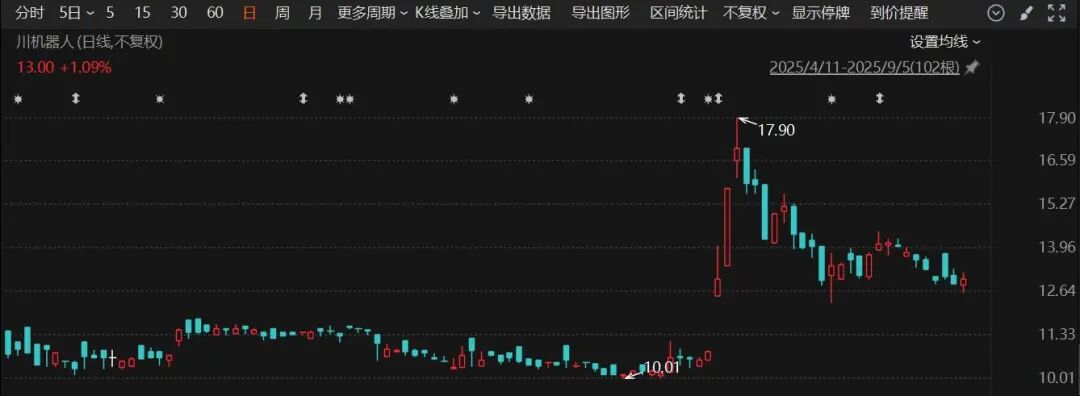
Core Viewpoint - Sichuan Robot has been recognized as one of the first AI star enterprises in Sichuan, reflecting the rapid growth of the robotics industry in China, particularly in humanoid robots, with the company's stock increasing by 61.49% this year [1]. Group 1: Company Achievements - Sichuan Robot is the first in Southwest China to launch a humanoid robot and has received multiple qualifications, including "Specialized, Refined, Characteristic, and Innovative" enterprise status, holding nearly 200 patents [2]. - The company has successfully implemented humanoid robots in military projects, indicating industry recognition of its technological capabilities [2]. Group 2: Product Development - In 2025, Sichuan Robot plans to expand its product matrix by launching several humanoid robots, including T1 Ultra, CW1, CW2, and TCB series, along with the consumer-oriented robot "Xiao Tian" [2]. - The company has achieved significant revenue growth in its intelligent manufacturing system business, with a 1455.27% increase, driven by high R&D investments [3]. Group 3: Strategic Collaborations - Sichuan Robot has formed strategic partnerships with several companies, including Sinopec and ZTE, to develop customized humanoid robots for various applications, such as explosive-proof refueling robots and family care robots [4]. - The company is building a diverse collaboration network, engaging in both direct and indirect partnerships to enhance humanoid robot technology and product optimization [4].

实现高拟人化突破!这家正宗人形机器人概念股,入选AI明星企业
Zheng Quan Shi Bao Wang· 2025-09-06 13:08
Core Insights - Sichuan Robot has been recognized as one of the first AI star enterprises in Sichuan, highlighting its significant role in the rapidly growing robotics industry in China [1] - The company has achieved a cumulative stock increase of 61.49% this year, reflecting strong market performance [1] Group 1: Company Achievements - Sichuan Robot is the first in Southwest China to launch humanoid robots and has received multiple qualifications, including "Specialized, Refined, Unique, and Innovative" enterprise status in Sichuan [3] - The company holds nearly 200 patents, showcasing its strong technological capabilities [3] - The humanoid robots have successfully been applied in military projects, indicating industry recognition of its technological prowess [3] Group 2: Product Development - In 2025, Sichuan Robot plans to expand its product matrix with the launch of humanoid robot T1 Ultra, composite robots CW1 and CW2, and ultra-lightweight robotic arms TCB series, along with the consumer-oriented robot "Xiao Tian" [3] - The company has made significant advancements in family care robots in collaboration with ZTE, achieving voice command control for basic services [3][5] Group 3: Financial Performance - In the first half of the year, the company reported revenue of 13.83 million, a year-on-year increase of 11.59%, but incurred a net loss of 10.08 million due to increased R&D investments in humanoid robots [4] - R&D expenses reached 9.52 million, a substantial increase of 64% year-on-year, driving business growth [4] - The intelligent manufacturing system business saw a remarkable revenue increase of 1455.27%, indicating a successful transition from R&D to market application [4] Group 4: Strategic Collaborations - Sichuan Robot has formed strategic partnerships with several companies, including Sinopec, ZTE, and others, to develop customized products for various scenarios [5] - The company is focusing on energy services and retail applications, including the development of explosion-proof humanoid refueling robots and humanoid cash register robots [5] - Collaborations extend to both direct and indirect partnerships, enhancing the company's capabilities in humanoid robot technology development [5][6]

一家C轮公司宣布破产
投资界· 2025-09-06 07:06
Core Viewpoint - The closure of VoltStorage, a prominent German company specializing in iron-based flow batteries, highlights the challenges faced by the European battery industry, which struggles to establish competitive players amid rising competition from Chinese companies like CATL [4][19]. Company Overview - VoltStorage was founded in 2016, focusing on redox flow battery technology, and gained recognition as one of Europe's top ten startups [4][6]. - The company developed the "VoltStorage SMART" system in 2018, targeting residential solar energy applications with a power output of 1.5 kW and a capacity of 6.2 kWh [7]. - The company aimed to provide a sustainable alternative to lithium-based storage solutions, emphasizing the flexibility and scalability of flow battery technology [8]. Funding and Growth - VoltStorage raised a total of €66 million (approximately 550 million RMB) through various funding rounds, including a notable €24 million (about 200 million RMB) Series C round led by Cummins Inc. in 2022 [9][10]. - The company also secured a €30 million loan from the European Investment Bank, indicating strong initial investor interest [9]. Challenges and Closure - The company faced a funding crisis starting in 2022, leading to a court-initiated bankruptcy process due to excessive debt [12]. - Despite having project letters of intent exceeding €1 billion, the anticipated funding did not materialize, resulting in the departure of key founders and executives [12][15]. - The economic viability of flow batteries was questioned, as their higher initial costs compared to lithium-ion batteries deterred potential buyers in a cost-sensitive market [15]. Industry Context - The closure of VoltStorage is part of a broader trend in the European battery sector, exemplified by the bankruptcy of Northvolt, which was once seen as a beacon of hope for Europe's battery ambitions [17][19]. - European battery companies face structural challenges, including high energy and labor costs, reliance on Asian supply chains for key materials, and competition from established Chinese players [18][19]. - The dominance of Chinese companies like CATL and BYD in the European market underscores the difficulties faced by local startups in achieving competitiveness [19][20].

锂电龙头企业迎来扩产
2 1 Shi Ji Jing Ji Bao Dao· 2025-09-06 00:04
Core Insights - The lithium battery industry is gaining momentum due to a new action plan issued by the Ministry of Industry and Information Technology and the State Administration for Market Regulation, which aims for an average revenue growth of over 5% in the electronic information manufacturing sector from 2025 to 2026 [1][2] Industry Growth Drivers - The lithium battery sector remains a key driver for revenue growth in the electronic information manufacturing industry [2] - There has been a significant increase in demand for lithium batteries this year, driven by the growth in electric vehicle (EV) sales and energy storage needs [2][3] - The global sales of new energy vehicles reached 9.1 million units in the first half of the year, a 28% year-on-year increase, with China contributing over half of the sales [4] Demand Sources - The current surge in lithium battery demand is primarily attributed to the needs of power batteries and energy storage batteries [3] - The demand for power batteries is bolstered by the notable increase in new energy vehicle sales, which are supported by improved vehicle performance and reduced battery costs [4] Energy Storage Demand - The demand for energy storage batteries has exceeded expectations, with global battery storage system installations reaching 86.7 GWh in the first half of the year, a 54% increase year-on-year [5] - The transition from mandatory storage to market competition in China has stimulated new market demands for energy storage [5] Technological Advancements - The commercialization of solid-state batteries is being accelerated by policy support, market demand, and technological breakthroughs, with potential applications in electric vehicles and consumer electronics [5] - CATL has indicated that while scientific issues in solid-state battery development are largely resolved, there are still engineering challenges to overcome before commercialization [5] Capacity Expansion - Major lithium battery manufacturers are actively expanding their production capacity in response to market demand, with CATL reporting a capacity utilization rate of 89.86% in the first half of the year [6][7] - CATL has multiple capacity expansion projects underway, with a total of 235 GWh of battery system capacity under construction as of mid-year [7] Financial Performance - The lithium battery sector in the A-share market has shown signs of recovery, with a reported revenue of 1.13 trillion yuan and a net profit of 679.51 billion yuan in the first half of the year, representing year-on-year increases of 13.78% and 28.07%, respectively [9] - Despite the recovery, there is a noted performance divergence within the sector, with certain segments like cathodes and anodes performing better than lithium mining and separators [9]
消费电子新品密集发布 行业投资机遇凸显
Zhong Guo Zheng Quan Bao· 2025-09-05 22:52
Core Viewpoint - The consumer electronics industry is entering a peak season for new product launches, with a solid long-term growth logic supported by the acceleration of AI applications, which is expected to drive hardware upgrades and replacement cycles [1][5][6]. Product Launches - Major companies have recently unveiled new electronic products, contributing to a significant rise in the consumer electronics sector index, which has increased by 14.91% since August 1 [1]. - On September 5, the consumer electronics industry index surged by 3.47%, with stocks like EVE Energy and Xinwangda rising over 16% [1]. - Huawei launched the Mate XTs Master Edition foldable phone, featuring the Kirin 9020 processor, starting at a price of 17,999 yuan [1]. - Samsung introduced the Galaxy Tab S11 Ultra and Galaxy Tab S11, with the Ultra model boasting a 14.6-inch AMOLED display and advanced AI features [2]. - Apple is expected to announce significant upgrades to the iPhone 17 series, including a new Air model and enhancements in camera and design [2]. Financial Performance - Lixun Precision reported a 20.18% year-on-year increase in revenue to 124.5 billion yuan and a 23.13% rise in net profit to 6.644 billion yuan for the first half of 2025 [3]. - Jingyan Technology achieved a 41.19% increase in revenue to 1.415 billion yuan and a 36.37% rise in net profit to 81 million yuan during the same period [3]. - Lens Technology reported a 14.18% increase in revenue to 32.96 billion yuan and a 32.68% rise in net profit to 1.143 billion yuan, with strong performance in smartphone and computer segments [4]. Long-term Growth Logic - The consumer electronics sector's long-term growth logic remains robust, with AI applications expected to accelerate replacement cycles for mobile devices and drive hardware upgrades [5][6]. - Analysts believe that leading companies in the domestic supply chain with strong R&D capabilities will benefit from the AI innovation wave, presenting structural growth opportunities [6]. - Investment opportunities are anticipated in AI applications across various electronic devices, including smartphones, PCs, and wearables, as major players increase their investments in AI technology [6].

消费电子新品密集发布行业投资机遇凸显
Zhong Guo Zheng Quan Bao· 2025-09-05 17:54
Core Viewpoint - The consumer electronics industry is entering a peak season for new product launches, with a solid long-term growth logic supported by the acceleration of AI applications, which is expected to drive hardware upgrades and replacement cycles [1][4]. Group 1: Market Performance - The Wind data shows that from August 1 to now, the Wind Consumer Electronics Industry Concept Index has increased by 14.91% [1]. - On September 5, the index surged by 3.47%, with significant gains from stocks such as EVE Energy and Xinwangda, which rose over 16% [2]. Group 2: New Product Launches - Huawei launched the Mate XTs Master three-fold phone and several other products, starting at a price of 17,999 yuan [2]. - Samsung introduced the Galaxy Tab S11 Ultra and Galaxy Tab S11, featuring advanced display technology and AI capabilities [2]. - Apple is expected to unveil the iPhone 17 series on September 10, with significant upgrades anticipated in camera, cooling, and design [3]. Group 3: Company Performance - Luxshare Precision reported a revenue of 124.5 billion yuan for the first half of 2025, a year-on-year increase of 20.18%, with a net profit of 6.644 billion yuan, up 23.13% [3]. - Jingyan Technology achieved a revenue of 1.415 billion yuan, growing by 41.19%, and a net profit of 81 million yuan, up 36.37% [3]. - Lens Technology reported a revenue of 32.96 billion yuan, a 14.18% increase, with a net profit of 1.143 billion yuan, up 32.68% [4]. Group 4: Long-term Growth Outlook - Analysts believe that the consumer electronics sector's long-term growth logic remains solid, with AI applications expected to accelerate replacement cycles for mobile devices and drive hardware upgrades [4][5]. - The domestic supply chain's strong R&D capabilities and stable fundamentals position leading companies to benefit from the AI innovation wave [4]. - Investment opportunities are suggested in AI application innovations across various consumer electronics segments, including mobile phones, PCs, and wearables [5][6].


A500指数本周下跌0.74%,国联安领跌丨A500ETF观察
2 1 Shi Ji Jing Ji Bao Dao· 2025-09-05 11:57
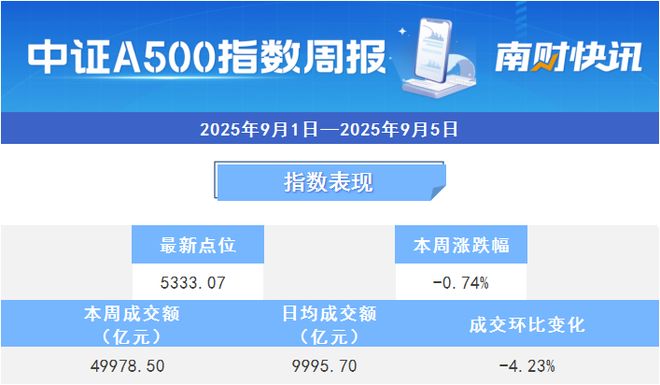
Index Performance - The CSI A500 Index decreased by 0.74% this week, closing at 5333.07 points as of September 5 [5] - The average daily trading volume for the week was 9995.7 billion yuan, reflecting a 4.23% decrease compared to the previous week [5] Component Stocks Performance - The top ten gainers this week included: - XianDao Intelligent (300450.SZ) with a gain of 51.51% - Yiwei Lithium Energy (300014.SZ) with a gain of 36.39% - Sunshine Power (300274.SZ) with a gain of 35.52% [3] - The top ten losers this week included: - AVIC Chengfei (302132.SZ) with a loss of 18.85% - Aerospace Rainbow (002389.SZ) with a loss of 18.38% - China Communications (600118.SH) with a loss of 16.95% [3] Fund Performance - A total of 39 CSI A500 funds collectively declined this week, with the top loser being Guolian An with a drop of 1.53% [5] - The total scale of CSI A500 funds reached 1822.45 billion yuan, with the largest funds being: - Huatai-PB at 205.07 billion yuan - Guotai Fund at 194.52 billion yuan - E Fund at 194.15 billion yuan [5] Market Analysis - The A-share market experienced significant volatility, with a report indicating that the market has been on an upward trend for five consecutive months, leading to profit-taking behavior [6] - Analysts believe that the recent adjustments are short-term pullbacks within a bull market, supported by strong policy backing for the capital market and increasing long-term capital inflows [6] - The market is expected to have mid-term upward potential, with a notable increase in trading volume and continued interest from external funds [6]