伊利股份

Search documents
下一个黄金原料?巨头们都在悄悄布局乳清! | 新发现
Sou Hu Cai Jing· 2025-09-12 00:39
Group 1 - The article highlights the launch of a fresh whey drink by HeRun, which has garnered significant industry attention and sparked discussions about the potential of whey-based products [1][2]. - Whey is defined as a byproduct of cheese production, previously considered waste but now recognized for its nutritional value, including high-quality protein and lactose [4][5]. - The processing of whey has evolved, allowing it to be transformed into various forms such as whey powder, demineralized whey powder, and whey protein powder, catering to different food industry needs [5][7]. Group 2 - The global whey market was valued at $9.9 billion in 2023 and is projected to reach $17.82 billion by 2032, with a compound annual growth rate (CAGR) of 8.76% [11]. - In China, the whey protein market is expected to grow from $34.6 million in 2021 to $51.8 million by 2025, with an annual growth rate of 11.238%, surpassing the global average [11]. - The primary applications of whey include functional foods, with yogurt, adult milk powder, and milk beverages being the most common products utilizing whey as a key ingredient [11][12]. Group 3 - The article discusses various innovative applications of whey in beverages, snacks, and baking, emphasizing its role as a high-quality protein source that enhances nutritional value and product characteristics [15][18]. - Whey protein is increasingly used in sports nutrition products, including protein powders and energy bars, to meet the demands of different consumer groups [20]. - The competitive landscape of the whey powder market is characterized by leading companies leveraging product quality, brand recognition, pricing strategies, and distribution channels [21]. Group 4 - Major players in the whey market include Yili Group, Mengniu, and FrieslandCampina, which dominate the high-end market in China, collectively holding over 40% market share [21][22]. - Companies like Actus Nutrition and Agropur are recognized as leading manufacturers of whey protein ingredients, supplying a wide range of products for various applications, including infant formula and sports nutrition [22]. - The article also highlights the technological advancements in whey processing, such as membrane filtration and enzymatic hydrolysis, which are helping domestic companies reduce reliance on imports and improve product quality [21][22].



伊利领衔全球首个乳业AI生态圈:数智化重构产业价值链
Sou Hu Cai Jing· 2025-09-11 16:41
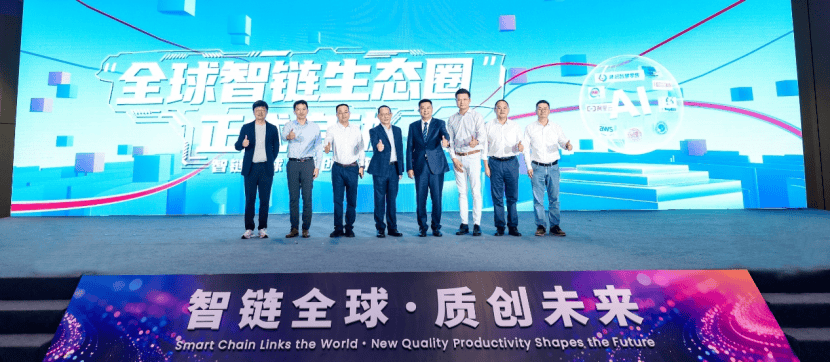
Core Viewpoint - The establishment of the "Global Smart Chain Ecosystem" by Yili Group marks a shift in the Chinese dairy industry from "scale competition" to "intelligent ecological competition," providing a "Chinese solution" for the digital transformation of the global dairy sector [1][3]. Group 1: AI Integration in Dairy Industry - The "Global Smart Chain Ecosystem" focuses on "technological symbiosis and industrial prosperity," covering the entire dairy supply chain from farm to consumer [3]. - AI algorithms are optimizing dairy farming practices, with Yili achieving a 98% accuracy in raw milk quality prediction through the implementation of "digital IDs" for each cow [3]. - The transportation time for raw milk from farms to factories has been reduced to under 24 hours, with inventory turnover rates increasing by 30% due to smart scheduling systems [3]. - Customized products in Yili's ambient milk category now account for 25% of total offerings, driven by big data analysis of consumer preferences [3]. Group 2: Cross-Industry Collaboration - The ecosystem includes partnerships with leading tech companies like Amazon, Alibaba Cloud, and Tencent, enhancing supply chain algorithms and providing AI computing power [3]. - Collaborative efforts with media and academic institutions aim to establish AI application case libraries and ethical standards for the dairy industry [3]. - The ecosystem will integrate global resources, including partnerships with Wageningen University in the Netherlands and Fonterra in New Zealand, to create a shared platform for dairy AI technology [3]. Group 3: Strategic Milestones and Future Goals - The establishment of the ecosystem represents a significant upgrade in Yili's "digital intelligence strategy," having completed 12 smart transformation projects since launching the "Smart Yili" initiative in 2022 [5]. - Yili plans to train 5,000 dairy AI engineers and lead the development of three industry standards, including a white paper on dairy AI applications [5]. - The company aims to reduce costs and improve efficiency across the industry by over 20% through the ecosystem within three years [3][5]. Group 4: Environmental and Social Impact - Yili's Inner Mongolia factory has achieved an 18% lower carbon emission per product compared to the industry average through AI-optimized energy usage, with plans to promote this technology across the industry [6]. - The ecosystem is expected to create a value cycle that enhances not only economic efficiency but also social value, contributing to low-carbon transitions and food safety [6]. Group 5: Market Outlook and Global Leadership - IDC predicts that the global dairy AI market will exceed $30 billion by 2027, with China expected to account for over 40% of this market [6]. - Yili's intelligent quality inspection system has achieved a product pass rate of 99.998%, nearing "zero defect" levels [6]. - The AI-based C2M (customer-to-manufacturer) model has reduced the new product development cycle from 18 months to 6 months [6]. - Yili's smart factory has been recognized as a "global lighthouse factory" by the World Economic Forum, with its AI farm management system being exported to Southeast Asia and the Middle East [6].
喜迎政策“大礼包”!白酒、大众品携手上攻,食品ETF(515710)尾盘拉升!中秋消费爆点已定?
Xin Lang Ji Jin· 2025-09-11 14:13
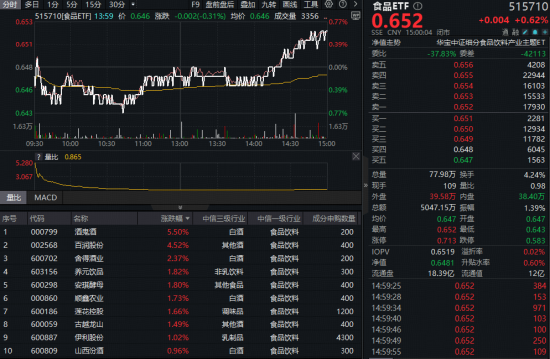
Group 1 - The food and beverage sector experienced a rebound on September 11, with the Food ETF (515710) closing up 0.62% after fluctuating at lower levels throughout the day [1] - Notable performances were seen in liquor and consumer goods, with stocks like JiuGuiJiu rising by 5.5%, BaiRun shares increasing by 4.52%, and SheDeJiuYe up by 2.37% [1] - The recent announcement of consumption-boosting policies in Shaoxing, including subsidies for banquet consumption, is expected to stimulate demand in the liquor sector [1][3] Group 2 - According to Xiangcai Securities, the banquet setting is a primary consumption scenario for liquor, and the new policy is likely to revive banquet consumption, leading to a gradual recovery in liquor demand [3] - The current valuation of the food and beverage sector is seen as an attractive investment opportunity, with the Food ETF's underlying index PE ratio at 21.44, which is at a low point historically [3] - Dongxing Securities anticipates that various local consumption stimulus policies will invigorate domestic consumption during the Mid-Autumn Festival and National Day, particularly benefiting the restaurant industry [4] Group 3 - The Food ETF (515710) tracks the CSI segmented food and beverage industry index, with approximately 60% of its holdings in leading high-end and mid-range liquor stocks, and nearly 40% in beverages, dairy, and other segments [5] - The top ten weighted stocks in the ETF include major brands like Moutai, Yili, and Haitian Flavoring, indicating a strong focus on established market leaders [5] - The Consumer Leader ETF (516130) is also highlighted as a way to invest in high-quality consumer sector leaders, including large-cap stocks like Kweichow Moutai and Gree Electric [5]
一滴牛奶的“数据指纹”背后:解码联想与伊利如何构建全球智链生态圈
Huan Qiu Wang· 2025-09-11 12:02
Core Viewpoint - The collaboration between Yili and Lenovo is enhancing the dairy industry's supply chain through digital transformation, aiming to improve product quality and consumer satisfaction while establishing a new AI-driven business framework [1][3][4]. Group 1: Digital Transformation in Supply Chain - Yili and Lenovo have developed a supply chain control tower system that integrates over 80 supply indicators and 140 promotional product indicators across five key areas [3]. - The implementation of a consumer-centric management platform has significantly improved stability and supports over 20 mini-programs for purchasing, after-sales, and health consultations [3][4]. - Yili is utilizing a consumer satisfaction system to analyze data from various sources, enabling a closed-loop management process that enhances product and service quality [3][4]. Group 2: AI and Technological Integration - Yili is exploring new technologies, particularly AI, to enhance production management and consumer services, aligning with its strategic goal of improving product and service quality [4]. - The establishment of the "Global Smart Chain Ecosystem" aims to drive digital upgrades in the dairy industry, providing replicable solutions for global dairy development [5]. - Lenovo's AI initiatives are positioned to enhance productivity across personal, enterprise, and urban sectors, contributing to innovation and smart decision-making [5][6]. Group 3: Future Outlook and Industry Impact - The "Artificial Intelligence+" initiative aims for widespread integration of AI across six key sectors by 2027, with a target of over 70% application penetration [6]. - By 2030, AI is expected to significantly contribute to high-quality economic development, with new AI applications achieving over 90% penetration [6]. - The ongoing digital transformation is anticipated to propel the Chinese manufacturing industry towards smart, green, and high-end development, injecting new momentum into economic growth [6].

伊利股份9月10日现1笔大宗交易 总成交金额4410.81万元 其中机构买入4410.81万元 溢价率为0.46%
Xin Lang Cai Jing· 2025-09-11 10:09
责任编辑:小浪快报 第1笔成交价格为28.56元,成交154.44万股,成交金额4,410.81万元,溢价率为0.46%,买方营业部为机 构专用,卖方营业部为机构专用。 进一步统计,近3个月内该股累计发生4笔大宗交易,合计成交金额为2.41亿元。该股近5个交易日累计 上涨1.86%,主力资金合计净流入4299.66万元。 炒股就看金麒麟分析师研报,权威,专业,及时,全面,助您挖掘潜力主题机会! 9月10日,伊利股份收跌0.46%,收盘价为28.43元,发生1笔大宗交易,合计成交量154.44万股,成交金 额4410.81万元。 ...
中国芯力量|中国牛用上“中国芯”
Xin Hua She· 2025-09-11 09:26
Core Insights - The Chinese dairy industry has made significant advancements in milk production, with some high-yield farms achieving an annual milk yield of 14 tons per cow by 2024, surpassing most developed countries [1] - The overall quality of Chinese raw milk has improved, with key indicators such as protein, fat, and bacterial counts exceeding EU standards, indicating a world-class quality [1] - The rapid development of the dairy sector in China, completing in 20 years what took developed countries over a century, is driven by domestic innovations in breeding and technology [1] Group 1: Genetic Improvement and Technology - The increase in dairy production and quality is fundamentally linked to the genetic improvement of dairy cattle, facilitated by whole-genome testing technology [2] - Whole-genome testing provides precise breeding values, accelerates genetic progress, and reduces the risks of inbreeding, but its high cost and time consumption hinder widespread adoption in China [2] - A team led by Li Xihe has developed domestically produced gene chips that significantly reduce testing costs and improve efficiency, achieving a fourfold increase in efficiency and a cost reduction to one-fifth of whole-genome sequencing [2][3] Group 2: Breeding and Data Utilization - The breeding capability of dairy cows is heavily influenced by the genetics of their parents, with top bulls contributing over 75% to genetic improvement [4] - The establishment of a breeding big data platform across 96 large-scale farms has enabled the collection of comprehensive data on each cow, facilitating the identification of superior breeding stock [5] - The use of machine learning algorithms has allowed for the rapid identification of genetic markers associated with desirable traits, reducing the breeding cycle from six years to two [5][6] Group 3: Smart Farming and AI Integration - Traditional dairy farming faces challenges such as high reliance on manual labor and fragmented data, which can be addressed through smart farming technologies [7] - The "YILI-AI" system developed by Yili integrates AI technology to enhance dairy farming efficiency, providing precise solutions based on extensive historical data [8] - The implementation of AI has led to an increase in daily milk production by 1.66 kg per cow and a reduction in management costs by 0.31 yuan per kg of milk [8]
“中国线上消费品牌指数”亮相服贸会,淘宝天猫助力“品质消费”研究
Huan Qiu Wang Zi Xun· 2025-09-11 09:07
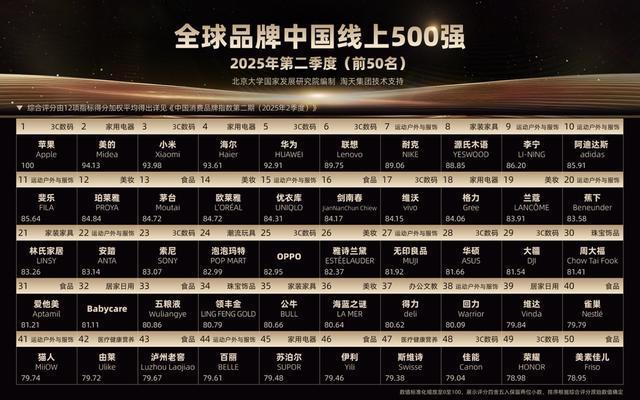
Core Insights - The "China Online Consumption Brand Index" (CBI) was prominently featured at the 2025 China International Service Trade Fair, showcasing its significance in measuring online consumer quality [1][3] - The CBI index reflects a shift towards higher quality consumption in China, with the average score increasing from 59.42 in Q1 2023 to 65.21 in Q2 2025, indicating a notable improvement in consumer brand quality [5][6] Group 1: CBI Index Overview - The CBI index is the first of its kind to utilize real consumer data to focus on high-quality development in online consumption, filling a gap in macroeconomic statistics regarding consumption quality [2][3] - The index includes various sub-indices such as the China Online Brand Purchasing Power Index and the Global Brand China Online 500 Strong list, providing insights at both national and regional levels [3] Group 2: Industry Insights - The highest CBI scores are found in the 3C and home appliance sectors, indicating a consumer preference for high-scoring brands in these categories [5] - Emerging sectors like pet products and jewelry are experiencing the fastest growth in CBI scores, reflecting an increasing consumer focus on quality and brand [5] Group 3: Regional Characteristics - New first-tier and second-tier cities exhibit stronger CBI scores, suggesting higher average consumption quality in these areas, while first-tier cities dominate in total purchasing power [5] - Regions with a high proportion of mobile populations show a balanced consumption quality and strong purchasing power [5] Group 4: Consumer Demographics - The middle-income group in China exceeds 400 million, providing a solid foundation for quality consumption growth, despite perceptions of a "white label era" [6] - The research indicates that new brands on the list share characteristics such as strong originality and a focus on product innovation in niche consumption scenarios [5]
饮料乳品板块9月11日涨0.61%,庄园牧场领涨,主力资金净流出1.32亿元
Zheng Xing Xing Ye Ri Bao· 2025-09-11 08:43
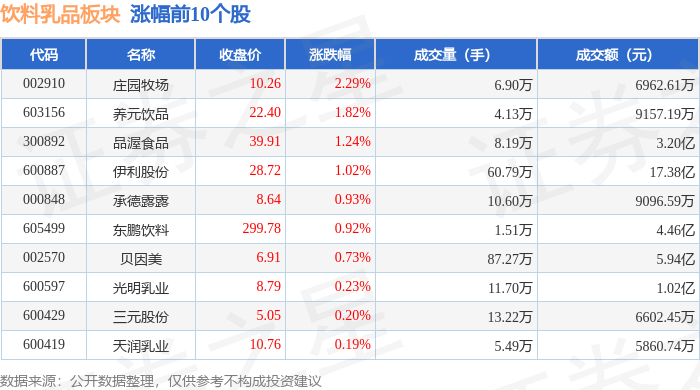
Market Overview - The beverage and dairy sector increased by 0.61% on September 11, with Zhuangyuan Pastoral leading the gains [1] - The Shanghai Composite Index closed at 3875.31, up 1.65%, while the Shenzhen Component Index closed at 12979.89, up 3.36% [1] Stock Performance - Zhuangyuan Pastoral (002910) closed at 10.26, up 2.29% with a trading volume of 69,000 shares and a transaction value of 69.63 million yuan [1] - Yangyuan Beverage (603156) closed at 22.40, up 1.82% with a trading volume of 41,300 shares and a transaction value of 91.57 million yuan [1] - Yili Group (600887) closed at 28.72, up 1.02% with a trading volume of 607,900 shares and a transaction value of 1.738 billion yuan [1] - Other notable stocks include: - Pinhao Food (300892) at 39.91, up 1.24% [1] - Dongpeng Beverage (605499) at 299.78, up 0.92% [1] Capital Flow - The beverage and dairy sector experienced a net outflow of 132 million yuan from institutional investors, while retail investors saw a net inflow of 177 million yuan [2] - Notable capital flows include: - Yili Group saw a net inflow of 58.13 million yuan from retail investors but a net outflow of 5.81 million yuan from institutional investors [3] - Zhuangyuan Pastoral had a net inflow of 1.34 million yuan from retail investors [3]


交银国际:25H1消费行业整体温和修复 业绩结构性分化
Zhi Tong Cai Jing· 2025-09-11 07:24
Group 1 - The overall consumer market in mainland China is showing a mild recovery in the first half of 2025, with structural differentiation in various segments and three core trends observed: experience-driven consumption leading the way, globalization strategies contributing to revenue growth, and operational efficiency becoming a key factor in profit differentiation [1] Group 2 - Experience-driven consumption is experiencing strong growth, with new generation consumers reshaping consumption logic, leading to significant revenue increases for companies like Pop Mart and Top Toy, which saw year-on-year revenue growth of 204% and 73% respectively [2] - Companies are accelerating their globalization strategies, with overseas revenue contributions increasing significantly. For instance, Midea's overseas revenue grew by 18%, Haier's by 12%, Miniso's by 29%, Pop Mart's by 440%, and Anta's by over 150% [2] Group 3 - Despite a stabilization in revenue for most consumer companies, consumer sentiment remains cautious, leading to soft sales trends in July and August. Competitive pressures and heavy promotions have put pressure on profit margins, particularly in the sports goods sector, where major companies experienced a decline in gross margins [3] - Improving operational efficiency is crucial for enhancing profitability, with leading companies like Yili and China Resources Beer maintaining stable or slightly improved operating profit margins through cost reduction and efficiency enhancement [3]
精品茅台酒焕新升级!吃喝板块短线承压,食品ETF(515710)小幅回调!机构:行业拐点或逐步确立
Xin Lang Ji Jin· 2025-09-11 02:02
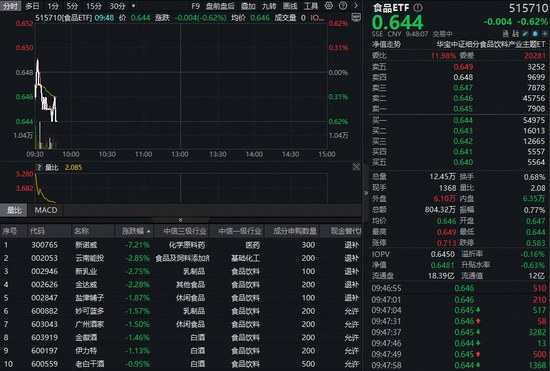
Group 1 - The food and beverage sector experienced a pullback on September 11, with the Food ETF (515710) opening briefly in the green before turning negative, showing a decline of 0.62% as of the report [1] - Major consumer goods stocks, particularly leading liquor brands, performed poorly, with New Dairy and Jindawei dropping over 2%, and other companies like Yanjinpuzi and Miaokelan falling over 1% [1] - The recent China (Guizhou) International Wine Expo showcased the upgraded Guizhou Moutai, which was released at a price of 3299 yuan per bottle, highlighting the brand's high-end positioning [1][3] Group 2 - Analysts noted that the upgraded Moutai, featuring eco-friendly materials and anti-counterfeiting technology, aims to enhance product premium capabilities and strengthen Moutai's position in the high-end liquor market [3] - The food and beverage sector's valuation remains low, with the Food ETF's underlying index PE ratio at 21.44 times, indicating a favorable configuration opportunity for investors [3] - The overall sentiment in the food and beverage sector is expected to improve due to recent policy measures aimed at reversing macroeconomic expectations and boosting both valuation and performance [4] Group 3 - The food and beverage sector faced significant policy impacts in Q2, leading to industry adjustments and a noticeable decline in demand, but recovery is anticipated in the latter half of the year due to low base effects and relaxed policy controls [5] - The Food ETF (515710) primarily invests in leading high-end and mid-range liquor stocks, with about 60% of its portfolio allocated to these sectors, while also including dairy, seasoning, and beer stocks [5] - The fund manager emphasized the sector's high and relatively stable ROE and profitability, with the competitive landscape shifting towards consolidation, benefiting industry leaders [4]