
科大讯飞

Search documents
讯飞星火医疗大模型专科诊断合理率提升至96%
Jing Ji Guan Cha Wang· 2025-11-10 06:32
Core Insights - The core viewpoint of the article highlights the launch of iFlytek's medical large model, specifically the Smart Medical Assistant Hospital Version 1.0, which demonstrates significant advancements in diagnostic accuracy and efficiency in complex inpatient scenarios [1] Company Summary - iFlytek has released the Smart Medical Assistant Hospital Version 1.0, which is designed for tiered hospitals and aims to enhance medical diagnosis and treatment [1] - The upgraded version of iFlytek's Xiaoyi has also been introduced alongside the new model [1] Performance Metrics - The specialized AI capabilities of the iFlytek medical large model have reached the level of chief physicians in tiered hospitals for the first time in the industry [1] - Pilot data indicates that the specialized diagnostic rationality rate has improved to 96%, while the cross-departmental diagnostic rationality rate has reached 91% [1] - The time required for medical record writing has been reduced by 50% [1]

外骨骼“读心术”来了!意念增强肌肉力量,深度学习预测准确率96.2%
机器人大讲堂· 2025-11-10 04:07
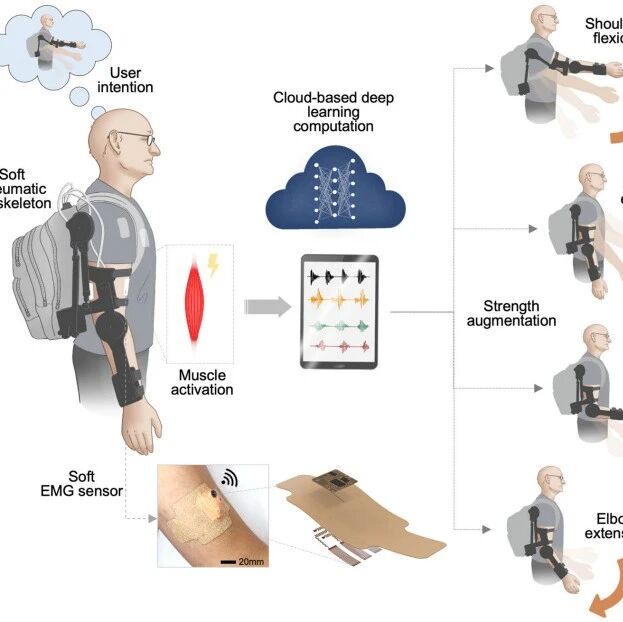
手臂还没抬起来,外骨骼就知道你要干啥了 ! 美国 佐治亚理工学院等机构 的研究团队 近日公布了 一套 "读心"外骨骼系统。这 套系统 在你动作发生前就 预测你的意图, 500-550毫秒内给你加个buff 。 传统的外骨骼系统往往存在诸多限制:要么只能按照预设程序运行,缺乏实时感知能力;要么体积庞大、布线 复杂,难以在日常生活中使用;更关键的是,大多数系统无法准确预测使用者的运动意图。 佐治亚理工团队的这套系统巧妙地解决了这些痛点。 首先是传感器的突破 。研究团队开发了一种超薄柔性 EMG(肌电图)传感器,可以像创可贴一样贴在皮肤 上。这种传感器采用了 蛇形金纳米膜电极 设计,即使在 30%的拉伸应变下,经过300次循环测试后电阻变化 依然微乎其微。 怎么做到的?研究人员给外骨骼装上了柔性生物电子传感器,专门 捕捉你的肌肉信号 。再配合云端深度学习 算法,实时分析你想干啥。 与商用的硬质凝胶电极相比,这种柔性干电极不仅 避免了长时间佩戴造成的皮肤刺激 ,还能与不规则的人体 表面实现贴合,最大程度减少了运动伪影。在对比测试中,柔性传感器获得的 EMG信号质量与商用传感器完 全相当,信噪比表现相近。 简单来说,就 ...

清华团队开源DISCOVERSE框架:用3D高斯渲染打通机器人仿真到现实的“最后一公里”!
机器人大讲堂· 2025-11-10 04:07
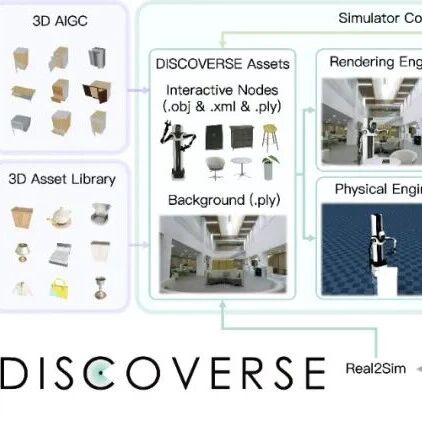
Core Insights - The article discusses the challenges in end-to-end robot learning, particularly focusing on the "Sim2Real" gap, which is primarily caused by the inadequacy of simulation environments to accurately replicate real-world scenarios [1][6][10]. Group 1: Challenges in Robot Simulation - Current simulation environments struggle with three main issues: insufficient realism in replicating real-world scenarios, high costs in scene asset acquisition and system configuration, and time-consuming data collection processes [1][5]. - The core obstacle is the performance drop during the Sim2Real transfer, which stems from the fundamental differences between simulated and real-world environments, such as object appearance, lighting effects, and spatial geometry [1][6]. Group 2: Existing Simulation Frameworks - Various simulation frameworks have been developed, but none meet the three critical requirements: high visual fidelity, accurate physical interaction, and efficient parallel scalability [3][6]. - Traditional simulators often compromise on either visual realism or physical accuracy, leading to ineffective training for robots [6][7]. Group 3: DISCOVERSE Framework - DISCOVERSE is an open-source simulation framework developed by Tsinghua University in collaboration with other institutions, integrating 3D Gaussian Splatting (3DGS), MuJoCo physics engine, and control interfaces into a unified architecture [5][10]. - The framework aims to bridge the Sim2Real gap by enhancing the realism of simulations through a three-layer innovation approach, focusing on accurate digital representation of real-world scenes and objects [10][12]. Group 4: Performance and Efficiency - DISCOVERSE significantly improves simulation speed, achieving rendering speeds up to 650 FPS on high-end hardware, which is three times faster than competing solutions [19][20]. - The framework supports a wide range of asset formats and robot models, enhancing compatibility and reducing the need for extensive configuration [21][22]. Group 5: Testing and Results - In comparative tests, DISCOVERSE outperformed other mainstream simulators in zero-shot transfer success rates across various tasks, demonstrating its effectiveness in real-world applications [24][27]. - The framework also enhances data collection efficiency, reducing the time required to gather demonstration data from 146 minutes to just 1.5 minutes, thus accelerating algorithm iteration [29]. Group 6: Future Implications - DISCOVERSE is positioned as a versatile robot simulation framework capable of supporting various complex tasks, with potential applications in robotics, drones, and autonomous driving sensors [30]. - The release of the framework's code and API aims to facilitate adoption by developers and enterprises, marking a significant milestone in the robotics industry [30].
月之暗面发布开源Kimi K2 Thinking模型,AI人工智能ETF(512930)备受关注
Xin Lang Cai Jing· 2025-11-10 03:19
Core Insights - The AI sector is experiencing significant growth, with innovations in models, computing power, and applications driving the market forward [2] - The domestic AI hardware and software are entering a phase of improved usability, supported by national policies promoting technological self-reliance [2] - The CSI Artificial Intelligence Theme Index reflects the performance of companies involved in providing resources, technology, and applications for AI [2][3] Group 1: Market Performance - As of November 10, 2025, the CSI Artificial Intelligence Theme Index (930713) shows mixed performance among its constituent stocks, with Beijing Junzheng (300223) leading with a 10.30% increase [1] - The AI Artificial Intelligence ETF (512930) is currently priced at 2.06 yuan [1] Group 2: Model and Computing Power Innovations - The Kimi K2 Thinking model, released by Moonlight Dark Side on November 7, features a sparse MoE architecture with 1 trillion parameters and 32 billion activation parameters, focusing on complex reasoning and agent capabilities [1] - The AI model innovation is entering a high-quality development phase, with a reduction in usage costs and the rise of Chinese open-source models like Deepseek and Qwen gaining global recognition [2] Group 3: Application and Commercialization - 2025 is projected to be the commercial year for AI Agents, with code-based agents leading the commercialization process [2] - The rapid breakthroughs in multimodal large models are expected to further enhance application growth [2] Group 4: Index Composition - As of October 31, 2025, the top ten weighted stocks in the CSI Artificial Intelligence Theme Index account for 63.29% of the index, including companies like Zhongji Xuchuang (300308) and Hikvision (002415) [3] - The AI Artificial Intelligence ETF closely tracks the CSI Artificial Intelligence Theme Index, which includes 50 listed companies involved in AI [2][3]
机构称工业软件自主可控已上升到战略高度,软件ETF(159852)盘中微涨0.22%,最新规模达54.32亿元
Sou Hu Cai Jing· 2025-11-10 02:47
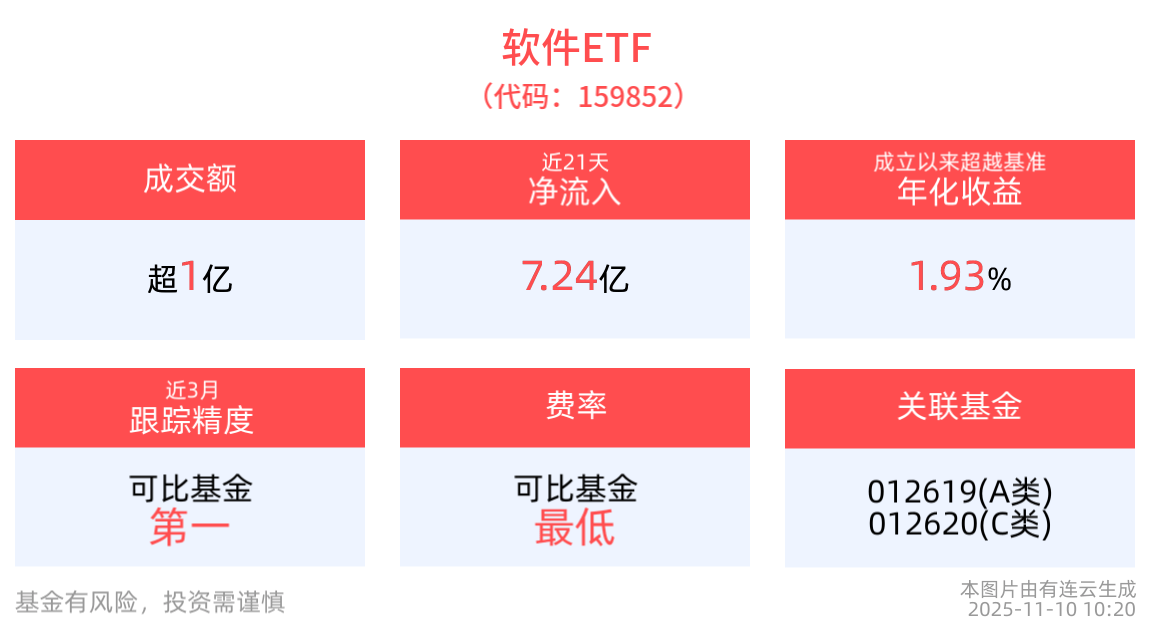
Core Insights - The software ETF has shown significant trading activity with an intraday turnover of 3.03% and a transaction volume of 165 million yuan, leading in average daily trading volume over the past month at 537 million yuan [3] - The latest scale of the software ETF reached 5.432 billion yuan, also ranking first among comparable funds [3] - Despite a recent net outflow of 4.5123 million yuan, the software ETF has attracted a total of 724 million yuan over the past 21 trading days [3] - Over the past three years, the net value of the software ETF has increased by 5.55%, with a maximum monthly return of 39.35% since inception [3] - The current international environment has elevated the strategic importance of domestic industrial software, particularly in the EDA sector, as U.S. restrictions accelerate the push for domestic alternatives [3][4] - The Ministry of Industry and Information Technology has set a clear target for the industry, aiming to complete the update of approximately 2 million sets of industrial software by 2027, providing strong support for industry development [3] Industry Trends - Since 2018, U.S. technology blockades have intensified the urgency for domestic industrial software independence, particularly in EDA and other R&D design products [4] - The policy environment is increasingly supportive, with the Ministry of Industry and Information Technology outlining industrial software update goals for 2024 and the National Development and Reform Commission including industrial software in the "two new" policy support framework for 2025 [4] - The industry is expected to experience rapid growth driven by both domestic production and intelligent technology advancements [4] Key Stocks - The top ten weighted stocks in the CSI Software Service Index as of October 31, 2025, include iFlytek, Kingsoft Office, and Tonghuashun, collectively accounting for 63.09% of the index [4] - The individual weightings of key stocks are as follows: iFlytek (13.80%), Tonghuashun (8.49%), Kingsoft Office (7.78%), and others [6]
机构:人形机器人量产时刻将至!机器人指数ETF(560770)连续13日“吸金”累计近6亿元
2 1 Shi Ji Jing Ji Bao Dao· 2025-11-10 02:29
Group 1 - The robot index ETF (560770) has seen continuous net inflows for 13 days, accumulating nearly 570 million yuan, reaching a new high of 2.45 billion yuan as of November 7 [1] - The top three industries represented in the index are industrial control equipment (20%), robotics (14%), and horizontal general software (9%), covering the entire robotics industry chain from upstream components to downstream system integration [1] - The overall revenue of the CSI Robotics Index reached 215.82 billion yuan in Q3 2025, with a year-on-year growth of 11%, and net profit attributable to shareholders increased by 12.15% [2] Group 2 - The global humanoid robot market is projected to grow from approximately 6.34 billion yuan in 2025 to 64.22 billion yuan by 2030, with a compound annual growth rate (CAGR) of 58.90% [3] - The Chinese humanoid robot market is expected to expand from about 2.40 billion yuan in 2025 to 25.40 billion yuan by 2030, with a CAGR of 60.33% [3] - The mass production of humanoid robots is anticipated to begin in 2026, marking a significant scale-up in manufacturing, with companies like Tesla and others entering the market [4]


“十五五”AI竞速:中国路线的下一个拐点 | 新京报评论
Xin Jing Bao· 2025-11-10 02:24
Core Viewpoint - The upcoming "14th Five-Year Plan" period will bring more "institutional dividends" for the development of artificial intelligence (AI) in China, as the recent amendment to the Cybersecurity Law explicitly supports AI foundational research and key technology development [1][3][5]. Group 1: Policy and Regulatory Developments - The amendment to the Cybersecurity Law, effective from January 1, 2026, marks the first time AI is explicitly included in the law, indicating a dual focus on safety and development [1][3]. - The "14th Five-Year Plan" emphasizes the comprehensive implementation of the "AI+" initiative, aiming to empower various industries [2][3]. Group 2: Strategic Shift in AI Development - AI is transitioning from a purely technical term to a strategic mission aimed at reshaping production methods and industrial systems, moving from "catching up globally" to "defining systems" [3][5]. - The competition in AI is shifting from a focus on computational power and algorithms to a comprehensive comparison of systems and ecosystems [3][5][6]. Group 3: Challenges and Opportunities for AI Enterprises - AI enterprises face significant challenges as the competitive landscape evolves, requiring them to adapt to the systemic wave of AI development [7][9]. - Companies must establish their own AI systems to leverage the era's dividends and contribute to China's self-reliant AI ecosystem [7][13]. Group 4: Case Study of iFLYTEK - iFLYTEK exemplifies the successful establishment of a domestic AI ecosystem, achieving significant milestones in the large model market despite restrictions on foreign components [8][10]. - The company has developed a closed-loop system integrating "chip-computing-model-application," enhancing its competitiveness and attracting orders from state-owned enterprises [10][11][12]. Group 5: Market Dynamics and Future Prospects - The global AI landscape is shifting towards a focus on stable and robust systems, with China positioned to leverage its market size, diverse applications, and talent pool [15][16]. - The "14th Five-Year Plan" is seen as a critical period for restructuring the AI ecosystem, with the potential for companies to build stable, controllable, and open AI systems to maintain a competitive edge [17].
西部证券晨会纪要-20251110
Western Securities· 2025-11-10 01:35
Macro Insights - October CPI year-on-year growth turned positive at 0.2%, with a month-on-month increase of 0.2%, significantly higher than the same period last year [6][7] - Food CPI increased month-on-month by 0.3%, with a year-on-year decline of 2.9%, indicating a narrowing drop compared to September [6][7] - Core CPI continued to rise, maintaining a year-on-year growth of 1.2%, matching the highest growth rate in the past four years [6][7] - PPI showed a month-on-month increase of 0.1%, marking the first positive growth this year, while the year-on-year decline narrowed to 2.1% [7] Computer Industry - The configuration ratio for the computer industry in Q3 2025 decreased again, with a heavy stock configuration ratio of 2.6%, down 0.1 percentage points, indicating a low allocation of 2.2 percentage points [2][9] - The top ten holdings in public funds for Q3 2025 included companies like Kingsoft Office and Inspur Information, with Kingsoft Office having the highest market value at 12.6 billion yuan [10][11] - Public funds increased their holdings in AI computing and financial technology sectors, indicating a focus on these areas for future growth [11] Company Insights: Desay SV - Desay SV reported Q3 2025 revenue of 7.692 billion yuan, a year-on-year increase of 5.63%, while net profit attributable to shareholders decreased by 0.57% to 565 million yuan [12][13] - The company launched a low-speed autonomous vehicle brand, marking a new growth curve, with plans to expand its global presence through partnerships with NVIDIA [12][13] - Revenue projections for 2025, 2026, and 2027 are expected to reach 32.7 billion, 39.8 billion, and 49.4 billion yuan, respectively, with net profits projected at 2.53 billion, 3.26 billion, and 4.08 billion yuan [12][13] Company Insights: Guobang Pharmaceutical - Guobang Pharmaceutical achieved revenue of 4.47 billion yuan in the first three quarters of 2025, a year-on-year increase of 1.2%, with net profit rising by 15.8% to 670 million yuan [15][16] - The company is expected to see revenue growth of 8.8%, 13.6%, and 12.2% for 2025, 2026, and 2027, respectively, with net profit growth of 20.6%, 23.2%, and 18.5% [17][16] - The strategic investment from Zhejiang State Capital Operation Co., Ltd. aims to support innovation in pet medicine and new drug research [16] Company Insights: Dongfang Electric - Dongfang Electric reported a revenue of 54.744 billion yuan for the first three quarters of 2025, a year-on-year increase of 16.41%, with net profit rising by 13.02% to 2.966 billion yuan [18][19] - The company secured new orders worth 88.583 billion yuan, with a focus on clean energy equipment and renewable energy sectors [19][20] - Future revenue projections for 2025, 2026, and 2027 are expected to reach 4.081 billion, 4.876 billion, and 5.409 billion yuan, respectively, driven by a strong order backlog [20] Company Insights: Guoxuan High-Tech - Guoxuan High-Tech achieved revenue of 29.508 billion yuan in the first three quarters of 2025, a year-on-year increase of 17.21%, with net profit soaring by 514.35% to 2.533 billion yuan [22][23] - The company’s energy storage output is projected to reach 65 GWh, with significant growth in both power and energy storage segments [23][24] - Guoxuan High-Tech is set to supply batteries for Volkswagen's upcoming electric vehicles, indicating strong market recognition [23] Company Insights: Anta Sports - Anta Sports reported low single-digit growth for its main brand in Q3 2025, with overall revenue guidance for the year adjusted down to low single digits [26][27] - The company launched several new products and maintained a healthy inventory turnover ratio, despite facing challenges from weak consumer demand [26][27] - Other brands under Anta, such as FILA, showed strong growth, with expectations of maintaining over 40% growth for the year [27] Company Insights: Xtep International - Xtep International's main brand showed low single-digit growth in Q3 2025, while its subsidiary Saucony experienced over 20% growth [29][30] - The company is expanding its outlet strategy and plans to open 30-50 new stores in the coming year [29][30] - Revenue projections for 2025, 2026, and 2027 are expected to reach 14.46 billion, 15.56 billion, and 16.78 billion yuan, respectively [30] Company Insights: Yongxin Co. - Yongxin Co. reported revenue of 2.706 billion yuan in the first three quarters of 2025, a year-on-year increase of 6.56%, with net profit rising by 1.43% to 309 million yuan [32][33] - The company is expanding its production capacity with several new projects expected to come online in the next two years [32][33] - Future revenue projections for 2025, 2026, and 2027 are expected to reach 3.788 billion, 4.135 billion, and 4.542 billion yuan, respectively [33] Company Insights: Kesheng Co. - Kesheng Co. reported a revenue of 1.116 billion yuan in the first three quarters of 2025, a year-on-year decline of 39.93%, with net profit dropping by 84.84% [41][42] - The company is focusing on product diversification to mitigate the impact of declining demand in its core sunscreen business [42][43] - Future earnings per share (EPS) projections for 2025, 2026, and 2027 are expected to be 0.25, 0.38, and 0.50 yuan, respectively [43]
研判2025!中国文本转语音技术行业发展历程、产业链、发展现状、竞争格局及趋势分析:作为人机交互的重要组成部分,行业应用需求不断扩大[图]
Chan Ye Xin Xi Wang· 2025-11-10 00:59
Core Insights - The text-to-speech (TTS) technology is becoming a crucial part of social development, enhancing information accessibility and providing equal opportunities for special groups [1][10] - The market size of China's TTS technology industry is projected to reach 18.76 billion yuan in 2024, reflecting a year-on-year increase of 22.77% [1][11] - The industry is experiencing a shift from early mechanical simulations to advanced AI-driven systems capable of generating human-like speech [1][11] Industry Overview - TTS technology converts text into speech, allowing users to hear content without reading, thus breaking the limitations of information transmission [4][10] - The technology's core value lies in enabling human-machine interaction through natural speech [4][10] Technical Mechanism - The TTS process involves three main components: text preprocessing, speech synthesis, and speech output [5][6] - Text preprocessing includes tasks like word segmentation and semantic understanding, while speech synthesis uses complex algorithms to generate speech signals [5][6] Industry Chain - The TTS industry chain consists of upstream (hardware and algorithm support), midstream (core technology), and downstream (application fields like education, finance, and media) [8][10] - In education, TTS technology is used for personalized learning experiences, aiding students with reading disabilities [8][10] Market Dynamics - The network audio-visual industry, a key segment of new media, is increasingly utilizing TTS technology for content creation, with the user base expected to reach 1.091 billion by 2024 [9][10] Competitive Landscape - The TTS industry is characterized by international technology leadership and domestic market focus, with major players like Google and Microsoft in high-end markets, while domestic companies excel in Chinese language applications [11][12] - Key domestic companies include iFlytek, Baidu, and Yunzhisheng, with competition expected to intensify around edge computing and ethical technology [11][12] Future Trends - The industry is moving towards human-like expression and long-scene adaptability, with emotional expression becoming a core breakthrough point [14][15] - Multi-modal integration is anticipated to enhance TTS capabilities, allowing for collaborative content production across various media [15][16] - As the industry grows, regulatory frameworks will strengthen, focusing on data privacy and voice copyright protection [16]





“十五五”AI竞速:中国路线的下一个拐点
Xin Jing Bao· 2025-11-10 00:11
Group 1 - The upcoming "15th Five-Year Plan" period will bring more "institutional dividends" for the development of artificial intelligence (AI) in China, as the National People's Congress has passed amendments to the Cybersecurity Law, explicitly supporting AI foundational research and key technology development [1][2] - The amendments emphasize the need for infrastructure development, ethical norms, risk monitoring, and the promotion of AI applications, indicating a dual focus on safety and development [1][3] - The strategic intent behind these changes is to create a conducive environment for AI growth, marking a significant shift in the legal framework to include AI as a core element [1][4] Group 2 - Various government departments are actively implementing policies related to "AI+" initiatives, integrating AI technologies into urban commercial systems and transportation [2][3] - The focus is on long-term development rather than short-term actions, with AI being positioned as a transformative force in production methods and industrial systems [3][4] - The competition in AI is shifting from individual technological advancements to a comprehensive ecosystem approach, emphasizing sustainable and secure technology [3][4] Group 3 - The competitive landscape for AI is evolving, with increasing barriers to entry that require collaboration among enterprises rather than isolated efforts [4][5] - Companies must adapt to the systemic wave of AI development, focusing on building their own AI ecosystems to align with national goals [5][6] - The success of companies like iFlytek demonstrates the potential for domestic AI enterprises to thrive by establishing a complete ecosystem that integrates local resources and capabilities [7][8] Group 4 - iFlytek has emerged as a leader in the AI sector, showcasing the ability to develop competitive large language models without reliance on foreign technology [7][8] - The company has achieved significant success in bidding for major projects, indicating a strong demand for domestically developed AI solutions [8][9] - iFlytek's approach emphasizes a comprehensive AI ecosystem that includes self-developed computing power, algorithms, and applications across various sectors [9][10] Group 5 - The transformation of AI from a technical competition to a systemic one reflects a broader trend in the industry, where the focus is on building robust and integrated AI frameworks [10][11] - iFlytek's model illustrates the importance of creating a closed-loop system that encompasses hardware, software, and application layers, enhancing resilience in the AI supply chain [11][12] - The development of a domestic AI ecosystem is seen as a response to external technological challenges, promoting self-sufficiency and innovation within China [12][13] Group 6 - The "15th Five-Year Plan" represents a critical period for restructuring the AI ecosystem, with the potential for significant advancements in both policy and market support [13][14] - China's advantages in market size, diverse application scenarios, and talent resources position it favorably in the global AI landscape [14][15] - The integration of AI into various industries, particularly in manufacturing and healthcare, is expected to drive substantial growth and innovation [15][16]