工商银行

Search documents
“蓉深港”铁海联运“一单制”提单首发
Zhong Guo Jing Ying Bao· 2026-01-16 14:04
Core Insights - Chengdu International Railway Port has successfully issued its first "one document" bill of lading under the United Nations Convention on the Transferable Goods Document, facilitating efficient logistics for Sichuan's small and medium-sized enterprises [1][2] Group 1: Logistics and Transportation - The bill of lading was issued for lighting products produced by factories around Chengdu, which were transported by rail to Shenzhen Yantian Port and then shipped to Gdansk, Poland [1] - The issuance of the bill of lading enabled seamless integration of container operation information and shipping logistics information between Chengdu International Railway Port and Yantian Port, allowing real-time tracking of cargo [1] Group 2: Legal Framework and Future Developments - The issuance of the bill of lading is significant as it follows the adoption of the United Nations Convention on the Transferable Goods Document, which provides a unified legal basis for global multimodal transport [2] - Chengdu International Railway Port plans to further explore the property attributes of the "one document" bill of lading under the framework of the convention and will collaborate with Industrial and Commercial Bank of China to enhance the "China-Europe e-document" system, focusing on financing and settlement functions for small and medium-sized enterprises [2]
计息落地+智能合约,数字人民币发展空间打开
Hua Xia Shi Bao· 2026-01-16 13:55
Core Viewpoint - The implementation of the "Action Plan" marks a significant transition of the digital renminbi from a cash-based version 1.0 to a deposit currency version 2.0, introducing interest payments for authenticated digital renminbi wallets, thereby enhancing payment convenience, security, and yield [2][3]. Group 1: Digital Renminbi Transition - The digital renminbi will officially transition to a deposit currency model on January 1, 2026, allowing interest payments on authenticated wallets at rates aligned with bank deposit rates [3]. - This transition is seen as a critical step in promoting the digital renminbi, showcasing the central bank's commitment to its widespread adoption [2][3]. Group 2: Risk Management and Demand Adaptation - The shift to a deposit currency model aims to mitigate risks associated with the de-intermediation of digital cash, ensuring that digital renminbi is included in the deposit reserve and insurance systems, thus providing equal safety guarantees as traditional deposits [4]. - The ability to earn interest on digital renminbi addresses previous challenges related to the lack of yield, which hindered its adoption [5]. Group 3: Integration with Banking System - The new framework allows digital renminbi to be treated as a liability of commercial banks, enabling banks to engage in innovative business practices while managing digital renminbi assets effectively [6]. - The previous limitation where funds in digital renminbi wallets could not be utilized for lending or investment has been lifted, enhancing banks' operational flexibility [5]. Group 4: Technological Advancements - The "Action Plan" emphasizes the integration of an "account system + digital currency + smart contracts" approach to enhance the digitalization and intelligence of the renminbi [7]. - Smart contracts are expected to facilitate the embedding of digital renminbi into various transaction processes, significantly increasing its usage frequency [7][8]. Group 5: User and Bank Benefits - Users will benefit from cash-like convenience, including offline payments and real-time settlements, while also enjoying the security and yield associated with deposits [8]. - Banks will gain asset-liability management rights over digital renminbi, allowing them to activate wallet funds through investment and lending activities [8]. Group 6: Future Applications and Policy Tools - Smart contracts can transform digital currency into precise economic tools, enabling targeted financial incentives and enhancing policy execution efficiency [8][9]. - The potential for smart contracts in large-scale applications, such as cross-border payments and supply chain finance, is anticipated to unlock broader development opportunities for digital renminbi [10]. Group 7: Current Usage Statistics - As of November 2025, the digital renminbi has processed 3.48 billion transactions, amounting to 16.7 trillion yuan, with 230 million personal wallets opened through the digital renminbi app [10].



银行今十条:多家地方银行上调存款利率;银行保管箱供不应求;柳州银行换东家...
Jin Rong Jie· 2026-01-16 12:14
Group 1 - The core financial data for 2025 shows a robust growth in social financing and M2, with social financing stock reaching 442.12 trillion yuan, a year-on-year increase of 8.3%, and M2 balance at 340.29 trillion yuan, up 8.5% [1] - The implementation of the new merger loan regulations has led to a surge in business activity among major banks, focusing on supporting equity mergers and enhancing capital allocation efficiency [2] - The appointment of Zou Jiayi as the President and Chairman of the Asian Infrastructure Investment Bank (AIIB) is expected to inject new momentum into the bank's operations and regional economic cooperation [3] Group 2 - Local banks have raised deposit interest rates in response to market competition, with increases typically around 20 basis points, aiming to attract deposits and enhance customer loyalty [4] - The surge in gold prices has led to increased demand for bank gold accumulation services, prompting banks to adjust fees and minimum investment thresholds while enhancing risk management measures [5] - The demand for bank safe deposit boxes has skyrocketed, particularly in Beijing, with waiting periods extending to several years due to a lack of available boxes [6] Group 3 - Huaxia Bank announced a cash dividend of 0.10 yuan per share for the first half of 2025, totaling approximately 15.915 billion yuan, reflecting the bank's strong operational performance [7] - The shareholding change at Liuzhou Bank has been approved, with Guangxi Guokong Capital acquiring 67.44% of the shares, which is expected to optimize the bank's governance structure [9] - The auction of shares held by Zhongrong Xinda for Shanxi Bank failed to attract bidders, indicating a cautious investment sentiment in the market [10] Group 4 - The former Secretary of the Sichuan Banking Regulatory Commission, Wang Zeping, was expelled from the Party and public office due to serious violations, highlighting the commitment to integrity in the financial regulatory sector [11]
企业端发力支撑信贷
HTSC· 2026-01-16 12:01
Investment Rating - The report maintains a "Buy" rating for several banks, including Chengdu Bank, Chongqing Rural Commercial Bank, Nanjing Bank, Industrial and Commercial Bank of China, Shanghai Bank, and China Construction Bank, while recommending "Hold" for Chongqing Rural Commercial Bank [8][35]. Core Insights - The report highlights that corporate lending has become the main driver of credit growth, with December's new loans reaching 910 billion yuan, exceeding expectations, while household loans contracted significantly [2][5]. - The total social financing for 2025 is projected to be 35.6 trillion yuan, an increase of 3.34 trillion yuan year-on-year, supported mainly by government bonds [5][12]. - The report indicates a recovery in corporate bond financing, with December seeing an increase of 1.54 billion yuan, while government bond financing decreased significantly due to a high base effect from the previous year [3][5]. Summary by Sections Credit Growth - December's new loans amounted to 910 billion yuan, with corporate loans increasing by 1.07 trillion yuan, while household loans decreased by 916 billion yuan [2][5]. - The overall loan growth rate for December was 6.4%, remaining stable compared to November [2][12]. Social Financing - The total social financing in December was 2.21 trillion yuan, with a year-on-year decrease of 646.2 billion yuan, primarily due to fluctuations in government bonds [1][5]. - For the entire year of 2025, social financing is expected to grow significantly, driven by government support [5][12]. Monetary Supply - M1 and M2 growth rates for December were 3.8% and 8.5%, respectively, with M1 showing a decline due to limited demand for corporate current funds [4][12]. - New deposits in December reached 1.68 trillion yuan, with a year-on-year increase of 3.08 trillion yuan [4][12]. Investment Recommendations - The report recommends specific stocks for investment, including Chengdu Bank (target price 23.25 yuan), Nanjing Bank (target price 14.78 yuan), and Industrial and Commercial Bank of China (target price 8.31 yuan) [11][35].




从三个关键词,看新一年货币政策如何“灵活高效”
Sou Hu Cai Jing· 2026-01-16 11:17
Core Viewpoint - The People's Bank of China has implemented a series of monetary policy measures aimed at supporting economic stability and growth, including a 0.25 percentage point reduction in various structural monetary policy tool rates and increased funding for agricultural and small enterprises [1][2]. Group 1: Moderate Easing - The monetary policy has shifted to a "moderate easing" stance, focusing on maintaining liquidity while addressing economic challenges [2][4]. - The average interest rates for new corporate loans and personal housing loans are approximately 3.1% as of December 2025, reflecting a decrease in financing costs [2]. - The central economic work conference emphasizes the importance of balancing growth, risk prevention, and reform in monetary policy, avoiding excessive liquidity [3][4]. Group 2: Flexible and Efficient - The new monetary policy emphasizes "flexible and efficient" use of tools, allowing for timely adjustments based on economic conditions [6][7]. - Structural tools are highlighted as key to directing financial resources towards innovation, consumption, and support for small and medium enterprises [6][8]. - The financial "five articles" framework has seen a loan balance of 107.7 trillion yuan by November 2025, with a year-on-year growth of 12.8%, indicating improved financing accessibility [7][8]. Group 3: Reduction and Quality Improvement - The central economic work conference has initiated reforms to reduce the number of small financial institutions while enhancing their quality and stability [11][12]. - The focus is on market-driven and legal methods to phase out high-risk institutions, while improving governance and risk management capabilities [12]. - The capital market is expected to undergo reforms to better support the transformation of the real economy, with an emphasis on multi-layered financing systems and attracting long-term investments [12].
中国银行业展望
Zhong Cheng Xin Guo Ji· 2026-01-16 09:47
Investment Rating - The overall investment outlook for the banking industry is stable, with no significant changes expected in credit quality over the next 12 to 18 months [54]. Core Insights - The banking industry is expected to maintain a steady development trend in 2026, supported by effective policy measures that will enhance the stability of the banking sector [5][7]. - The industry will continue to experience strong regulation, focusing on risk prevention and high-quality development, with banks optimizing their operational strategies [7][8]. - The asset scale of banks is projected to grow steadily, with improvements in deposit costs and a narrowing of loan interest rate declines [25][26]. - The profitability of banks has been slightly pressured since 2025, but overall asset quality remains good, with liquidity indicators showing a high safety margin [28][31]. Industry Fundamentals Analysis - The banking industry is expected to continue under a "strong regulation" framework, guiding banks towards high-quality development and maintaining overall credit risk at controllable levels [8]. - Regulatory policies will focus on supporting the resolution of real estate and local government debt risks, which will positively impact the banking sector's credit [9][13]. - The banking sector's asset growth has rebounded due to a moderately loose monetary policy and increased funding directed towards national strategic areas [15]. Credit Performance of Industry Enterprises - Since 2025, the banking industry's profitability has faced slight pressure, with net interest margins declining but at a reduced rate [31]. - The overall credit situation in the banking sector remains stable, with a few banks experiencing downgrades due to deteriorating asset quality and weak profitability [52]. - The integration of small and medium-sized banks is accelerating, which is expected to reduce the number of banking institutions and alleviate credit risk pressures [29][53]. Conclusion - The banking industry is anticipated to continue its high-quality development trajectory in 2026, supported by favorable fiscal and monetary policies [54]. - The financial performance of banks is expected to remain stable, although net interest margins will likely stay at the lower end of the range, with some regional banks facing asset quality pressures [54].
12月金融数据点评:政府债支撑减弱下社融增速回落,对公信贷同比多增
Orient Securities· 2026-01-16 09:42
Investment Rating - The report maintains a "Positive" investment rating for the banking sector in 2026, indicating a favorable outlook for returns relative to the market benchmark [6][24]. Core Insights - The banking sector is expected to return to a fundamental narrative in 2026, supported by policy financial tools and resilient asset expansion. The sector is currently in a deposit repricing cycle, which is likely to stabilize net interest margins. Structural risks are anticipated to receive policy support [3][24]. - The report highlights two main investment themes: 1. High-quality small and medium-sized banks with confirmed fundamentals, including Nanjing Bank (601009, Buy), Ningbo Bank (002142, Buy), and Chongqing Rural Commercial Bank (601077, Buy) 2. State-owned large banks with stable fundamentals and good defensive value, including Bank of Communications (601328, Not Rated) and Industrial and Commercial Bank of China (601398, Not Rated) [3][25]. Summary by Sections Social Financing and Loan Growth - In December 2025, social financing grew by 8.3% year-on-year, with a month-on-month decrease of 0.2 percentage points. The total social financing increment was 2.21 trillion yuan, which was 646.2 billion yuan less than the previous year. The structure showed that corporate loans increased by 140.2 billion yuan, while government bonds decreased significantly by 1.0733 trillion yuan [9][10]. - The report notes that retail demand remains weak, while corporate loans increased by 580 billion yuan, driven by local government debt limits allocated for project construction [13][14]. Monetary Aggregates - M1 growth continued to decline, with a year-on-year increase of 3.8% in December 2025, while M2 grew by 8.5%. The difference in growth rates between M2 and M1 increased to 4.7 percentage points [21][22]. - New RMB deposits in December amounted to 1.68 trillion yuan, with a year-on-year increase of 3.08 trillion yuan, primarily due to a rise in household deposits [21][23]. Investment Recommendations - The report emphasizes the potential for absolute returns in the banking sector in 2026, with a focus on quality small and medium-sized banks and stable large state-owned banks as key investment targets [24][25].
工商银行取得系统防御能力提升专利
Sou Hu Cai Jing· 2026-01-16 09:28
Group 1 - The core point of the article is that the Industrial and Commercial Bank of China (ICBC) has obtained a patent for a method and device aimed at enhancing system defense capabilities, with the patent granted under announcement number CN118264445B and the application date being March 2024 [1] - ICBC was established in 1985 and is headquartered in Beijing, primarily engaged in monetary financial services [1] - The registered capital of ICBC is approximately 35.64 billion RMB [1] Group 2 - According to data from Tianyancha, ICBC has made investments in 28 companies and has participated in 5,000 bidding projects [1] - The bank holds 976 trademark registrations and 5,000 patent records, along with 79 administrative licenses [1]

银行业“10万亿俱乐部”扩容至10家,陈国汪详解大中小银行划分标准
Jin Rong Jie· 2026-01-16 09:09
Group 1 - The core viewpoint of the articles highlights that both Pudong Development Bank and CITIC Bank have successfully surpassed the 10 trillion yuan asset threshold, expanding the "10 trillion asset club" in China's banking industry to 10 members, which includes six major state-owned banks and four national joint-stock banks [1] - The total asset scale of the 10 banks now accounts for 60% of the entire banking industry, indicating a growing concentration of resources among leading institutions [1] - Chen Guowang, director of the Financial Industry Research Institute, noted that the significant changes in asset scale among banks have created a clear disparity with the classification standards established in 2015, which need to be updated to better reflect the current industry landscape [2] Group 2 - The classification standards for banks, established in 2015, categorize institutions based on asset size, but the threshold for large banks is no longer applicable as multiple institutions have surpassed the 10 trillion yuan mark [2] - The current classification includes various types of banks, such as policy banks, state-owned commercial banks, joint-stock banks, urban commercial banks, rural small banks, and private banks, indicating a diverse banking landscape [2] - Chen Guowang suggests that the asset scale classification standards should be revised to adapt to the new developments in the banking industry [2]



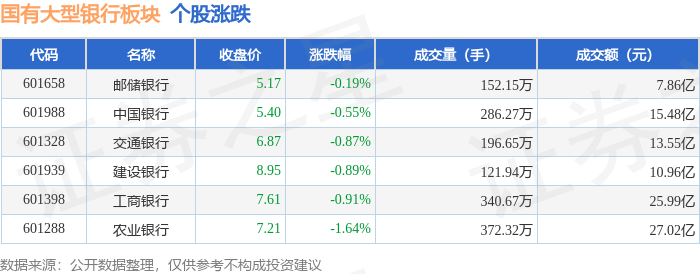
国有大型银行板块1月16日跌1.08%,农业银行领跌,主力资金净流入1.46亿元
Zheng Xing Xing Ye Ri Bao· 2026-01-16 08:55
Market Performance - The state-owned large bank sector declined by 1.08% compared to the previous trading day, with Agricultural Bank leading the decline [1] - The Shanghai Composite Index closed at 4101.91, down 0.26%, while the Shenzhen Component Index closed at 14281.08, down 0.18% [1] Individual Bank Performance - Postal Savings Bank closed at 5.17, down 0.19% with a trading volume of 1.52 million shares and a transaction value of 7.86 billion [1] - Bank of China closed at 5.40, down 0.55% with a trading volume of 2.86 million shares and a transaction value of 15.48 billion [1] - Bank of Communications closed at 6.87, down 0.87% with a trading volume of 1.97 million shares and a transaction value of 13.55 billion [1] - China Construction Bank closed at 8.95, down 0.89% with a trading volume of 1.22 million shares and a transaction value of 10.96 billion [1] - Industrial and Commercial Bank closed at 7.61, down 0.91% with a trading volume of 3.41 million shares and a transaction value of 25.99 billion [1] - Agricultural Bank closed at 7.21, down 1.64% with a trading volume of 3.72 million shares and a transaction value of 27.02 billion [1] Fund Flow Analysis - The state-owned large bank sector saw a net inflow of 146 million from institutional investors, while retail investors contributed a net inflow of 123 million [1] - The sector experienced a net outflow of 269 million from speculative funds [1] Detailed Fund Flow for Individual Banks - Bank of Communications had a net inflow of 172 million from institutional investors, while speculative funds saw a net outflow of 67.34 million [2] - Industrial and Commercial Bank had a net inflow of 73.01 million from institutional investors, with a significant net outflow of 363 million from speculative funds [2] - Postal Savings Bank had a net inflow of 65.23 million from institutional investors, while speculative funds had a net inflow of 37.30 million [2] - Bank of China had a net inflow of 6.76 million from institutional investors, with speculative funds contributing a net inflow of 43.81 million [2] - China Construction Bank experienced a net outflow of 18.52 million from institutional investors, while speculative funds had a net inflow of 66.99 million [2] - Agricultural Bank had a net outflow of 153 million from institutional investors, with a small net inflow of 13.28 million from speculative funds [2]