迈瑞医疗

Search documents
科技行情延续火热,科创创业ETF嘉实(588400)上涨4.57%,规模创近1月新高!
Sou Hu Cai Jing· 2025-08-25 03:26
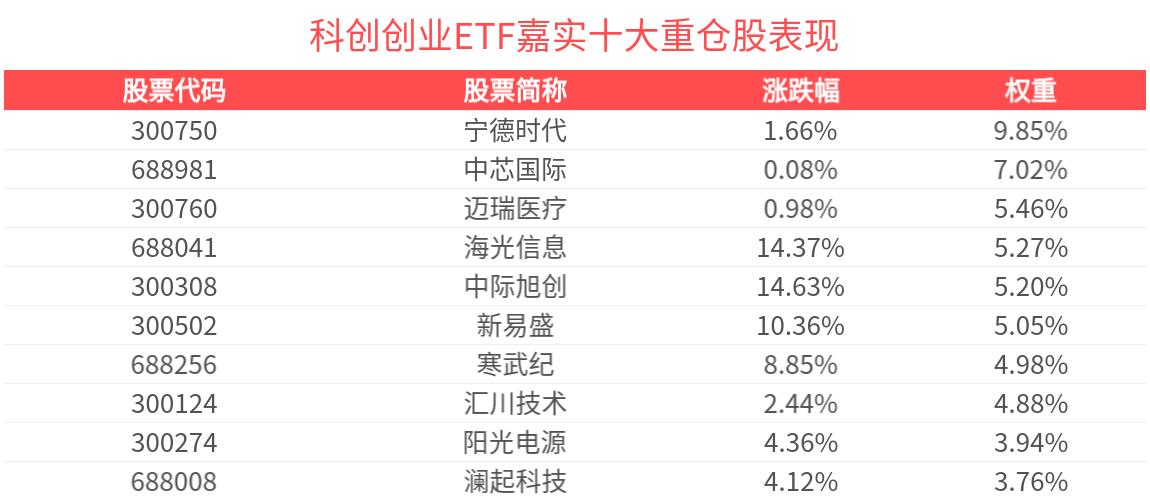
Core Viewpoint - The Zhongzheng Kechuang Chuangye 50 Index has shown strong performance, with significant gains in constituent stocks, indicating a bullish trend in the technology and innovation sectors in China [1][2]. Group 1: Index Performance - As of August 25, 2025, the Zhongzheng Kechuang Chuangye 50 Index rose by 4.78%, with notable increases in stocks such as Zhongji Xuchuang (up 14.63%) and Haiguang Information (up 14.37%) [1]. - The Kechuang Chuangye ETF (Jia Shi, 588400) increased by 4.57%, with a weekly cumulative rise of 10.88% as of August 22, 2025 [1]. - The latest scale of the Kechuang Chuangye ETF reached 1.785 billion yuan, marking a one-month high [1]. Group 2: Fund Performance - The Kechuang Chuangye ETF has achieved a net value increase of 20.70% over the past six months, ranking 444 out of 3537 in the index stock fund category, placing it in the top 12.55% [1]. - Since its inception, the ETF has recorded a highest single-month return of 29.42% and an average monthly return of 5.69% during rising months [1]. Group 3: Key Holdings - As of July 31, 2025, the top ten weighted stocks in the Zhongzheng Kechuang Chuangye 50 Index accounted for 57.49% of the index, with leading companies including Ningde Times and Zhongji Xuchuang [2][4]. - The top three stocks by weight are Ningde Times (9.85%), Zhongji Xuchuang (5.20%), and Haiguang Information (5.27%) [4]. Group 4: Industry Insights - The Ministry of Industry and Information Technology emphasized the need for a scientific layout of computing power infrastructure and the acceleration of breakthroughs in key technologies such as GPU chips during the 2025 China Computing Power Conference [4]. - The Chinese computing power platform has achieved comprehensive connectivity, further solidifying the foundation for the country's digital economy [4]. Group 5: Market Sentiment - Dongwu Securities reported that the financing balance has exceeded 2 trillion yuan, a historical high, with insurance funds continuing to increase their holdings in financial stocks [5]. - The current market sentiment is positive, with a focus on long-term investments in financial and technology sectors, particularly in robotics, domestic and international computing power, and innovative pharmaceuticals [5].






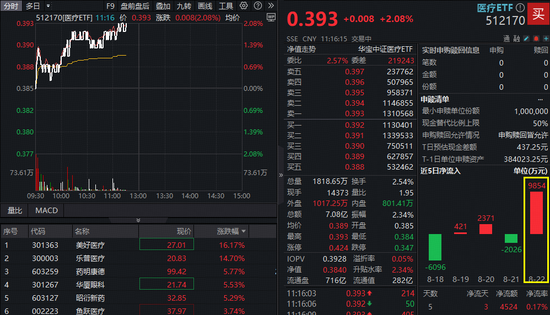
医疗继续向上,美好医疗、乐普医疗领涨!医疗ETF(512170)涨超2%逼近“924”行情高点,最新单日吸金近亿元
Xin Lang Ji Jin· 2025-08-25 03:25
8月25日,医疗板块活跃,A股最大医疗ETF(512170)震荡向上,摸高2%,场内价格逼近去 年"924"行情高点!午前成交额已超7亿元。该基金最新规模为279.40亿元,在同类ETF中保持领先地 位。 值得关注的是,上个交易日,医疗ETF(512170)单日获9854万元净申购,反映资金看好医疗后市。 | 分时 多日 ■ | | | | F9 盘前盘后 图加 九转 图线 工具 @ 2 >> | | | | | | | 医疗ETF O | | | --- | --- | --- | --- | --- | --- | --- | --- | --- | --- | --- | --- | --- | | 033 | | | 512170[医疗ETF] 11:16 价 0.393 涨跌 0.008(2.08%) 均价 | | | 2,0896 | | 1 292 +0.008 +2.08% | | | 512170 ^ | | | | | | | | | | | SSE CNY 11:16:15 文明中 | | | | 通的之原子 | | | | | | | | 1,39% | 净值清设 | | 华富中证医疗 ...

沪指连续刷新近十年新高!创业板综指ETF鹏华(159289)发售正当时,兼具成长特征和科技属性
Xin Lang Cai Jing· 2025-08-25 03:18
Group 1 - The Shanghai Composite Index has reached a nearly ten-year high, and the ChiNext Index continues to strengthen, drawing investor attention to future market trends [1] - The Penghua ChiNext Composite Index ETF (code: 159289) is officially launched on August 25, 2023, closely tracking the ChiNext Composite Index (code: 399102) [1] - The ChiNext Composite Index is characterized by its growth and technology attributes, with the top four industries being Power Equipment (19.0%), Pharmaceutical Biology (13.1%), Electronics (12.6%), and Computers (10.5%), collectively accounting for over 50% of the index [1] Group 2 - Since its inception in 2011, the ChiNext Composite Index has achieved a return of 173.66%, significantly outperforming the CSI 300 (28.43%) and the CSI 500 (21.96%) [2] - The ChiNext Composite Index has consistently led in revenue and net profit growth rates compared to the CSI 300 and CSI 500 since 2018, with a notable net profit growth rate of 20% in Q1 2025 [2] - The ChiNext serves as a core platform for innovative and growth-oriented enterprises in China's capital market, focusing on "three innovations and four new" (innovation, creation, creativity, new technology, new industry, new business format, new model) [2]
毛利率新高撞上创始人撤退,惠泰医疗下半年的考题是“2200例PFA手术”丨看财报
Sou Hu Cai Jing· 2025-08-25 00:25
Core Insights - HuiTai Medical reported a revenue of 1.214 billion yuan for the first half of 2025, representing a year-on-year growth of 21.26% [2] - The net profit attributable to shareholders reached 425 million yuan, up 24.11% year-on-year, with a gross margin of 73.5%, the highest since its listing [2][9] - The company’s cash flow from operating activities increased by 29.45% to 445 million yuan, indicating improved operational cash generation capabilities post-MaiRui Medical's acquisition [2] Financial Performance - Revenue growth of 21.26% and net profit growth of 24.11% exceeded the revenue growth rate, indicating strong operational performance [2] - The gross margin of 73.5% is the highest level since the company went public, and the net profit margin stands at 34.51%, significantly above the industry average [9][10] - Operating cash flow increased to 445 million yuan, reflecting a 29.45% year-on-year growth [2] Business Segments - The vascular intervention product segment generated 654 million yuan in revenue, a 30.02% increase, accounting for 53.9% of total revenue [4] - Peripheral intervention products saw a revenue increase of 21.33% to 213 million yuan, with hospital penetration rising over 20% year-on-year [4] - Electrophysiology products generated 264 million yuan, with a growth rate of 9.98%, indicating a phase of preparation for new product launches [4][5] Market Dynamics - The Chinese medical device market is projected to reach 1.11 trillion yuan in 2024, with an expected growth rate of over 17% in 2025 [2] - The PFA (Pulsed Field Ablation) technology is rapidly replacing traditional RF ablation methods, influencing short-term market growth [5] - The success of PFA product sales is contingent on external factors such as social security reimbursement policies and centralized procurement progress [6] Competitive Landscape - The domestic electrophysiology market is experiencing significant growth, with 45 innovative medical devices approved in the first half of the year, including 17 electrophysiology products [7] - Major international players like Medtronic and Boston Scientific have launched PFA products in China, intensifying competition [7] - The market still presents opportunities for domestic players to refine their products to better fit local medical scenarios [7] Shareholder Actions - Following the acquisition by MaiRui Medical, the founder and key stakeholders have sold shares worth approximately 5.1 billion yuan, indicating a stark contrast between their actions and the company's performance [8][12] - The founder's shareholding has decreased from 25.03% to 18.7%, with plans for further share reductions [11][12] - MaiRui Medical now holds 21.05% of HuiTai Medical's shares, establishing a concentrated ownership structure [12]

深圳全方位打造“创新之城”(奋勇争先,决战决胜“十四五”)
Ren Min Ri Bao· 2025-08-24 22:21
Core Insights - The article highlights the rapid development of the robotics industry in Shenzhen, particularly through the innovative efforts of companies like Pashini, which has developed advanced tactile sensors and robotic hands that can delicately handle objects like strawberries [1][2]. Group 1: Company Innovations - Pashini has developed a bionic robotic hand equipped with over a thousand high-precision multi-dimensional tactile sensors, capable of sensing temperature and pressure across 15 dimensions [1]. - The company has achieved a leading position in the global market for tactile sensors, with significant output since its establishment just four years ago [1]. - Shenzhen Bay Area's innovation ecosystem allows for seamless integration of research and industry, exemplified by the rapid testing and deployment of Pashini's dual-modal robotic hand in collaboration with local tech firms [2]. Group 2: Industry Growth and Support - Shenzhen's strategic emerging industries are projected to reach a value of 1.56 trillion yuan in 2024, accounting for 42.3% of the city's GDP, marking a consistent annual growth of over 100 billion yuan [1][2]. - The city has established a robust policy framework to support the robotics industry, including a three-year action plan and various funding initiatives, resulting in over 74,000 related enterprises and a total output exceeding 200 billion yuan [2]. - Shenzhen is home to over 25,000 national high-tech enterprises, averaging 12 per square kilometer, indicating a dense concentration of innovation and technology [3]. Group 3: Research and Development Infrastructure - Shenzhen has accelerated the construction of national-level innovation platforms, focusing on synthetic biology, brain research, and materials genomics, with over 4,000 innovation carriers established [4]. - The city has built significant research facilities, including the Pengcheng Laboratory and multiple national key laboratories, to foster original innovation [4]. Group 4: Application of New Technologies - The integration of AI in healthcare is exemplified by the use of a large model developed by Tencent and Mindray in critical care settings, showcasing Shenzhen's role as a testing ground for new technologies [5]. - Shenzhen has released nearly 200 "city + AI" application scenarios, promoting the dual advancement of technological and industrial innovation [5][6].
QFI重仓股名单出炉 外资加仓调研双线发力
Shang Hai Zheng Quan Bao· 2025-08-24 15:52
Group 1 - QFI (Qualified Foreign Institutional Investors) has been actively involved in the A-share market, with 263 companies having QFI listed among their top ten shareholders as of the end of Q2 [1][2][3] - Notable companies with significant foreign holdings include Shengyi Technology, China XD Electric, and Oriental Yuhong, with foreign ownership exceeding 10 million shares in 34 stocks [1][3] - Major foreign institutions such as Barclays, UBS, and Goldman Sachs have increased their positions in several A-shares, indicating a strong interest in the market [2][4] Group 2 - Foreign institutional research activity remains high, with a total of 5,644 A-share company investigations conducted by foreign entities this year, covering 4,695 stocks [5][6] - Point72 Asset Management leads in research frequency, conducting 157 investigations, focusing on companies like Xiaogoods City, Huali Group, and Optoelectronics [5][6] - Companies such as Huichuan Technology and Mindray Medical have attracted significant foreign interest, with 525 and 299 foreign institutional investigations respectively [6] Group 3 - Morgan Stanley Fund expresses optimism in three key investment areas: technology growth sectors like AI and semiconductors, high-quality enterprises in Chinese manufacturing, and new consumer sectors with strong domestic and overseas performance [6]




QFI重仓股名单出炉外资加仓调研双线发力
Shang Hai Zheng Quan Bao· 2025-08-24 15:36
Group 1 - QFI (Qualified Foreign Institutional Investors) has been actively involved in the A-share market, with 263 companies having QFI listed among their top ten shareholders as of the end of Q2 [1][2][3] - Notable companies with significant foreign holdings include Shengyi Technology, China XD Electric, and Oriental Yuhong, each with over 10 million shares held by foreign investors [1][3] - Major foreign institutions such as Barclays, UBS, and Goldman Sachs have increased their positions in several A-shares, indicating a strong interest in the market [2][4] Group 2 - Foreign institutional research activity remains high, with a total of 5,644 A-share company investigations conducted by foreign entities this year, covering 4,695 different stocks [5][6] - Point72 Asset Management leads the foreign research efforts with 157 investigations, focusing on companies like Xiaogoods City, Huali Group, and Optoelectronics [5][6] - Companies such as Huichuan Technology and Mindray Medical have attracted significant attention, with over 500 and 299 foreign institution investigations, respectively [6] Group 3 - Morgan Stanley Fund expresses optimism about three key investment directions: technology growth sectors like AI and semiconductors, high-quality enterprises in Chinese manufacturing, and new consumer sectors with strong domestic and international performance [6]

下周大事提醒:“全市场最重要的财报”来了、美联储最青睐通胀指标将出炉



Ge Long Hui A P P· 2025-08-24 14:32
Group 1 - Key Point 1: Focus on the release of important economic data including the US July PCE, Q2 GDP, and July durable goods orders, as well as China's August official PMI and July profits of large-scale industrial enterprises [1] - Key Point 2: Companies scheduled to announce earnings include Nvidia, Alibaba, Meituan, Pinduoduo, Luxshare Precision, Newray, and Zhongji Xuchuang [1] - Key Point 3: Additional tariffs imposed by the US on India, bringing the total tariff rate to 50% [1][5] Group 2 - Key Point 1: Earnings announcements on August 25 include Pinduoduo, Haidilao, Luxshare Precision, Poly Development, Hengli Hydraulic, and Newray [2] - Key Point 2: On August 26, key economic indicators such as the US July durable goods orders will be released, along with earnings from companies like China Petroleum and Aier Eye Hospital [3] - Key Point 3: On August 27, the release of China's July profits of large-scale industrial enterprises is anticipated, alongside earnings from companies like Nvidia and Meituan [4] Group 3 - Key Point 1: On August 28, the US will release revised Q2 GDP and PCE data, with earnings announcements from companies like Yili and Mindray [5] - Key Point 2: On August 29, the US July PCE price index will be released, with Alibaba also announcing its earnings [6] - Key Point 3: China's August official manufacturing PMI will be released on August 31 [7]
医药生物行业跨市场周报:政策优化+需求恢复,看好医疗器械板块结构性投资机会-20250824
EBSCN· 2025-08-24 08:22
Investment Rating - The report maintains an "Increase" rating for the medical device sector, with specific recommendations for companies like 恒瑞医药 (Hengrui Medicine), 鱼跃医疗 (Yuyue Medical), 迈瑞医疗 (Mindray), and 联影医疗 (United Imaging) [4][5]. Core Viewpoints - The report emphasizes structural investment opportunities in the medical device sector due to policy optimization and recovering demand. It suggests that supportive policies from the National Medical Products Administration (NMPA) will drive rapid development in high-end imaging equipment, surgical robots, brain-computer interfaces, and AI+medical fields. Companies with strong R&D capabilities and high brand recognition in these segments are expected to benefit [2][23]. - Since the second half of 2024, there has been a significant improvement in demand for medical devices, particularly in the equipment sector. The report anticipates a gradual recovery in the industry, with growth rates being revised upwards as procurement demand translates into financial results for listed companies [2][24]. Summary by Sections Market Review - The A-share medical biotechnology index rose by 1.05%, underperforming the CSI 300 index by 3.13 percentage points and the ChiNext index by 3.47 percentage points, ranking 29th among 31 sub-industries. The H-share Hang Seng Medical Health Index increased by 0.93%, outperforming the Hang Seng Index by 0.48 percentage points [1][16]. Company Updates - Recent clinical application updates include 康诺亚's AZD0901 injection and 科伦博泰's HBM9378 injection, both of which have new clinical applications. 恒瑞医药's HRS-7058 capsule has a new IND application, while 恩华药业's NH600001 emulsion injection has a new NDA application [30][31]. Recommendations - The report recommends increasing exposure to the medical device sector, highlighting undervalued companies in Hong Kong such as 微创医疗 (MicroPort), 微创机器人-B (MicroPort Robotics), and 威高股份 (Weigao Group). It also suggests focusing on stable growth consumer medical device companies like 鱼跃医疗, 三诺生物 (Sinocare), and 美好医疗 (Meihua Medical) [2][24]. Financial Forecasts - The report provides earnings per share (EPS) forecasts for key companies, with 恒瑞医药 projected at 1.36 CNY for 2025, 鱼跃医疗 at 2.32 CNY, 迈瑞医疗 at 10.62 CNY, and 联影医疗 at 2.39 CNY. The price-to-earnings (PE) ratios for these companies are also provided, indicating potential investment value [4]. Industry Demand - The report notes a significant recovery in demand for medical devices, with the market size for publicly tendered medical equipment showing a year-on-year increase of 58.33% in the first half of 2025, following a decline of 38.10% in the first half of 2024 [24]. Policy Environment - The report highlights recent policy changes aimed at supporting high-end medical device innovation, which are expected to lead to a more rational competitive environment and gradual price recovery in the sector [23][24]. Conclusion - Overall, the report presents a positive outlook for the medical device sector, driven by policy support and recovering demand, with specific investment recommendations for leading companies in the field [2][4].



21亿买7亿卖!潮汕大佬血亏13亿,香港山顶豪宅暴跌62%
Sou Hu Cai Jing· 2025-08-24 06:03
Core Insights - The belief in luxury properties as a safe investment is being challenged, as evidenced by a high-profile case where a luxury home in Hong Kong was sold for significantly less than its purchase price, resulting in a loss of 1.3 billion HKD over nine years [1][3][9] Group 1: Market Trends - Luxury property prices in Hong Kong have plummeted, with some areas experiencing a 50% drop compared to peak prices in 2021, reverting to levels not seen since the 1997 Asian financial crisis [4][6] - Ordinary residential properties have also seen a decline of about 30% since their peak in 2021, but luxury properties have suffered even more severe losses [4][6] Group 2: Individual Cases - Chen Hongtian, a prominent businessman, purchased a luxury home for 21 billion HKD and later sold it for 7.9 billion HKD, incurring a loss of 62% [3][4] - Other wealthy individuals have also faced significant losses, with one buying a luxury home for 8.38 billion HKD only to see its value drop below 6 billion HKD within a year [5][6] Group 3: Investment Sentiment - The perception of luxury homes as status symbols is shifting, with wealthy individuals now recognizing them as financial liabilities rather than assets [6][8] - There is a growing trend among affluent investors to liquidate luxury properties in favor of more stable investments, such as U.S. Treasury bonds, which offer better returns [8][9] Group 4: Future Outlook - The current situation in Hong Kong may foreshadow similar trends in mainland China's luxury property market, where liquidity issues could lead to significant declines in property values [7][8] - The shift from a belief in luxury property appreciation to a focus on cash liquidity reflects a broader change in investment strategy among the wealthy [8][9]