联影医疗

Search documents
商贸易战危机并存,关注国产血制品及高端药械或因关税进口替代加速
Xinda Securities· 2025-04-07 00:47
Investment Rating - The investment rating for the pharmaceutical and biotechnology industry is "Positive" [3] Core Viewpoints - The chemical pharmaceutical sector has shown the highest growth among sub-sectors, driven by expectations around "centralized procurement optimization discussions" and the "Class B medical insurance catalog" [8] - The trade war environment is expected to enhance the market share of domestic blood products and high-end medical devices due to increased costs of foreign imports [8] - The report suggests a cautious approach for April, focusing on specific segments that may benefit from the trade war, such as domestic blood products and high-end medical devices [8] Summary by Sections Industry Weekly Viewpoints - The pharmaceutical and biotechnology sector's weekly return was 1.20%, outperforming the CSI 300 by 2.57%, ranking 3rd among 31 primary sub-indices [7] - The chemical pharmaceutical sub-sector had the highest weekly growth of 3.45%, while the medical services sector saw the largest decline of 2.12% [7][8] Industry Performance and Valuation - The pharmaceutical and biotechnology sector's recent one-month return was 2.94%, with a relative return of 3.63% against the CSI 300, ranking 10th among 31 primary sub-indices [9][18] - The current PE (TTM) for the pharmaceutical and biotechnology sector is 26.88 times, which is below the historical average of 30.99 times [14][15] Market Tracking - The chemical pharmaceutical sector has shown the largest growth over the past year, with a 16.51% increase, while the biological products sector has seen a decline of 11.36% [24][25] - The report highlights the potential for price increases in blood products due to supply and demand changes, particularly for domestic manufacturers [8] Focus on Individual Stocks - The report recommends focusing on specific companies in the blood products and high-end medical device sectors, such as Palin Bio, Tian Tan Bio, and Mindray Medical [8] - In the consumer healthcare sector, companies like Aier Eye Hospital and Yifeng Pharmacy are highlighted as potential beneficiaries of government stimulus policies [8] Industry and Company Dynamics - Recent policy developments include the approval of new medical service pricing for brain-computer interface technologies, indicating a growing focus on innovative medical solutions [40] - The report notes significant recent approvals for various pharmaceutical products, including those from companies like Jingxin Pharmaceutical and Antu Bio [41]
腔镜、骨科之外,又有手术机器人要突破了
3 6 Ke· 2025-04-07 00:45
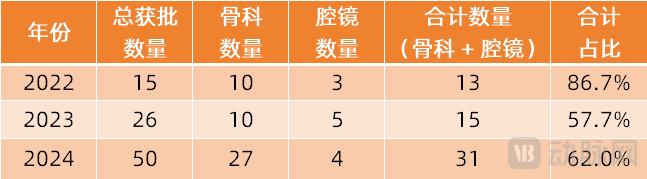
Core Insights - The surgical robot market is experiencing significant growth, with various segments such as endoscopic, orthopedic, and interventional robots gaining traction. The approval rates for these robots have increased substantially from 2022 to 2024, indicating a robust expansion in the market [1][2][4]. Approval Statistics - In 2022, 15 surgical robots were approved, with orthopedic robots accounting for 10 and endoscopic robots for 3, together making up 86.7% of the total approvals. In 2023, 26 robots were approved, with orthopedic robots still at 10 and endoscopic robots increasing to 5, resulting in a combined share of 57.7%. By 2024, the number of approvals is expected to reach 50, with orthopedic robots at 27 and endoscopic robots at 4, leading to a combined share of 62% [2][4]. Market Share - By 2024, the market share for endoscopic and orthopedic surgical robots is projected to be 81% based on sales revenue, highlighting their dominance in the surgical robot market [2][4]. Emerging Segments - The market is witnessing breakthroughs in other surgical robot segments, such as natural orifice transluminal endoscopic surgery (NOTES) and percutaneous puncture robots. Notable approvals include the EndoFaster digestive endoscopic robot and various percutaneous puncture robots, indicating a diversification of applications beyond traditional segments [4][5][6]. Commercialization and Sales - Several surgical robots have successfully completed their first commercial sales, such as the Ion bronchoscope robot and the R-ONE coronary intervention robot, which generated significant revenue for their respective companies [5][6]. Natural Orifice Transluminal Endoscopic Surgery (NOTES) Robots - The EndoFaster robot, designed for digestive endoscopic surgery, has been approved and is expected to enhance the precision and stability of procedures like endoscopic submucosal dissection (ESD), addressing challenges such as long learning curves and high operational demands [6][7]. Percutaneous Puncture Robots - The percutaneous puncture robot market is crowded, with over ten companies developing products. The introduction of advanced technologies, such as 3D structure light fusion positioning, is expected to improve accuracy and efficiency in procedures [11][12][13]. Specialized Surgical Robots - The market is expanding to include specialized surgical robots for hair transplantation, oral surgery, and vascular interventions. Recent approvals in these areas indicate a growing trend towards the commercialization of niche surgical robots [15][16][17]. Future Outlook - The surgical robot market is anticipated to continue its rapid growth, with increasing integration of AI and advanced technologies. The expansion of indications and applications for surgical robots is expected to further enhance their adoption in clinical settings [18].


报名!上海交大医健未来领军人才班第十期
思宇MedTech· 2025-04-03 16:44
号MedTech 全球最新医疗科技动态 车: 思宇MedTech | MedRobot | 心未来 | 眼未来 | 骨未来 | 探美医界 | 医影像 寻求报道,请联系Alice:suribot21 投稿/订制报告,请联系主编: qingzhao2017 学院 SHANGHAI JIAO TONG UNIVERSITY SCHOOL OF MEDICINE 第十期 MEDICAL AND HEALTH FUTURE LEADING TALENTS 多重 8年 300位 医健同侪印证启迪 课程送代积淀 思维破茧和能力跃迁 66 这里有独具价值的 医健生态圈层 THERE IS A VALUABLE MEDICAL AND HEALTH ECOSYSTEM HERE 变局时代企业家思维破茧 全面打通产学研用 解锁医疗产业未来 成就卓越领军人才 我们面临的问题无比复杂, 您需要站在更高的平台, 洞察趋势,明确方向,做出取舍, 统合行动,聚拢资源, 成为医疗产业未来的合格舵手! NOLILIA VALUE 课程价值 上海交通大学医学院拥有: 日 | 13家附属医院 R 21位院士 201 t+ 转化医学国家重大科技基础 ...
中资出海四十年:从学徒到全球玩家的进化之路
远川研究所· 2025-04-03 14:01
Core Viewpoint - The article discusses the evolution of Chinese enterprises from passive learners to active players in the global market, highlighting their journey through management awakening, technological innovation, and ecological reconstruction in globalization 3.0 [1][12]. Group 1: Historical Context - In 1988, Procter & Gamble's entry into China marked a significant shift in the local business landscape, introducing advanced brand management and supply chain systems [1]. - The 1990s saw multinational companies like IBM and Microsoft bringing not only technology but also management practices to China, which significantly influenced local companies like Huawei [3]. - After joining the WTO in 2001, Chinese companies began to expand internationally, with early examples like TCL facing challenges due to cultural clashes and management integration issues [4]. Group 2: New Business Models - The internet wave post-2010 led to new business paradigms, with companies like ByteDance and SHEIN leveraging technology and flexible supply chains to achieve rapid growth [6]. - Companies such as 运去哪物流 (Yunquna Logistics) and 联影医疗 (United Imaging Healthcare) have emerged as leaders in their respective fields, showcasing the potential of Chinese innovation on the global stage [7]. Group 3: Future Trends - Current trends indicate a diversification in the internationalization of Chinese enterprises, with companies like 追觅 (Trifo) and 闪极科技 (Shanji Technology) achieving significant market shares in Europe and the U.S. [9][10]. - The article emphasizes the shift from product output to ecological co-construction, with companies like 阿里国际站 (Alibaba International) and 法奥意威 (Fao Yiwei) leading the way in innovative solutions and global collaboration [12]. - The 临港新片区 (Lingang New Area) is highlighted as a strategic hub for Chinese enterprises, focusing on cutting-edge industries and fostering international talent [12][13].



双融日报-2025-04-03
Huaxin Securities· 2025-04-03 01:34
Core Insights - The report indicates a neutral market sentiment with a score of 42, suggesting a balanced outlook for investors [2][10] - Recent trends show a gradual improvement in market sentiment, supported by favorable policies, leading to a potential upward market trajectory [10] Market Themes Tracking - **Medical Devices**: The National Medical Products Administration is seeking opinions on measures to optimize lifecycle regulation and support innovation in high-end medical devices. This includes accelerating the release of standards for medical exoskeleton robots and imaging equipment. Key companies include United Imaging Healthcare (688271) and Mindray Medical (300760) [7] - **Brain-Computer Interface**: At the 2025 Zhongguancun Forum, officials highlighted the rapid advancement of AI technology driving the development of brain-computer interfaces. The Ministry of Industry and Information Technology plans to issue guidelines to promote innovation in this sector. Relevant companies include Innovation Medical (002173) and Weisi Medical (688580) [7] - **AI**: Following the release of OpenAI's GPT-4o, there has been a surge in AI-generated images on social media. This trend is expected to continue, with companies like Shengtian Network (300494) and Aofei Entertainment (002292) positioned to benefit [7] Major Capital Inflows and Outflows - The report lists the top ten stocks with significant net inflows, including AVIC Capital (600705) with a net inflow of 518.73 million and Xinyada (600571) with 505.03 million [11] - Conversely, the top ten stocks with net outflows include Lanshi Heavy Industry (603169) with a net outflow of 558.67 million and Luxshare Precision (002475) with 455.99 million [13] Industry Analysis - The report highlights the financial sector (SW Non-Bank Financials) as the leading industry for net inflows, totaling 1.43 billion, while the electronic sector experienced the highest net outflow of 1.83 billion [16][21] - The medical and biological sector is noted for significant net outflows, amounting to 307.59 million, indicating potential challenges in this industry [21]
中证全指医疗保健设备与服务指数下跌0.16%,前十大权重包含迈瑞医疗等
Sou Hu Cai Jing· 2025-04-02 15:23
Core Points - The Shanghai Composite Index opened lower and fluctuated, while the CSI All Index for Healthcare Equipment and Services decreased by 0.16%, closing at 14,029.54 points with a trading volume of 15.519 billion yuan [1] - Over the past month, the CSI All Index for Healthcare Equipment and Services has increased by 0.23%, and over the past three months, it has risen by 2.65%, with a year-to-date increase of 2.65% [1] - The index reflects the overall performance of listed companies in the healthcare sector, selected from the CSI All Index, with a base date of December 31, 2004, set at 1,000.0 points [1] Index Composition - The top ten weighted companies in the CSI All Index for Healthcare Equipment and Services are: Mindray Medical (9.28%), Aier Eye Hospital (8.07%), United Imaging (6.7%), Aimeike (3.56%), Huatai Medical (3.16%), New Industry (3.09%), Yuyue Medical (2.83%), Meinian Onehealth (2.33%), Jiuan Medical (2.16%), and Shandong Pharmaceutical Glass (2.05%) [1] - The market share of the index's holdings is 61.07% from the Shenzhen Stock Exchange and 38.93% from the Shanghai Stock Exchange [1] - The index's holdings are entirely composed of the pharmaceutical and healthcare sector, with a 100.00% allocation [1] Index Adjustment and Fund Tracking - The index samples are adjusted semi-annually, with adjustments occurring on the next trading day after the second Friday of June and December each year [2] - Weight factors are adjusted in accordance with the sample changes, typically remaining fixed until the next scheduled adjustment, with provisions for temporary adjustments in special circumstances [2] - Public funds tracking the healthcare index include various funds from Southern Fund, Tianhong Fund, and others, specifically designed to follow the CSI All Index for Healthcare Equipment and Services [2]





中证全指医疗行业指数报566.67点,前十大权重包含迈瑞医疗等
Sou Hu Cai Jing· 2025-04-02 09:26
Core Viewpoint - The China Securities Index for the medical industry has shown a slight decline over the past month, quarter, and year-to-date, indicating a stable but slightly negative trend in the sector [2]. Group 1: Index Performance - The China Securities Index for the medical industry is currently at 566.67 points [1]. - Over the past month, the index has decreased by 0.49%, while it has seen a minimal decline of 0.02% over the past three months and year-to-date [2]. Group 2: Index Composition - The top ten weighted companies in the index include: - Mindray Medical (14.12%) - Aier Eye Hospital (8.91%) - United Imaging Healthcare (7.39%) - Aimeike (3.93%) - Huatai Medical (3.48%) - New Industries (3.41%) - Yuyue Medical (3.12%) - Shanghai Pharmaceuticals (3.04%) - Meinian Onehealth (2.57%) - Jiuan Medical (2.39%) [2]. - The index's holdings are primarily listed on the Shenzhen Stock Exchange (57.38%) and the Shanghai Stock Exchange (42.62%) [2]. Group 3: Sector Allocation - The sector allocation within the index is as follows: - Medical Devices: 34.29% - Medical Consumables: 23.16% - Pharmaceutical Commerce: 15.33% - Medical Services: 14.26% - In Vitro Diagnostics: 12.95% [2]. Group 4: Index Adjustment Mechanism - The index samples are adjusted biannually, with adjustments occurring on the next trading day following the second Friday of June and December [3]. - Weight factors are generally fixed until the next scheduled adjustment, with temporary adjustments made in response to significant events affecting sample companies [3].

医药行业及创新药板块近期投资策略
2025-03-31 05:54
Summary of Key Points from the Conference Call Industry Overview - The conference call primarily discusses the **pharmaceutical industry** and the **innovative drug sector** in China for the year 2025, highlighting various trends, opportunities, and challenges within the sector [2][4][26]. Core Insights and Arguments - **Policy Support for Innovative Drugs**: The Chinese government has approved a comprehensive plan to support innovative drug development, which includes price management, medical insurance payments, and diversified payment systems. This is expected to accelerate drug approval processes and enhance market opportunities for innovative drugs [2][3]. - **High Growth Potential**: The innovative drug sector is anticipated to maintain a high growth trajectory due to favorable policies and ongoing medical insurance negotiations. Companies like BeiGene and Hengrui Medicine are expected to benefit significantly from these developments [2][4]. - **AI in Healthcare**: The rapid development of AI in healthcare is highlighted, with companies that possess high-quality data expected to lead in AI applications for diagnostics and health management [2][5]. - **Medical Device Sector Recovery**: The medical device sector is showing signs of marginal recovery, particularly in the ophthalmology segment, driven by favorable fertility policies and increased demand for refractive surgeries [2][6]. - **Global Competitiveness of Chinese Firms**: Chinese innovative drug companies are increasingly demonstrating global competitiveness, with a significant share of global upfront payments and R&D milestones [2][8]. - **Transformation of Traditional Pharmaceutical Companies**: Traditional pharmaceutical companies are accelerating their transformation, with a focus on differentiated innovative products. Companies like East China Pharmaceutical and China National Pharmaceutical Group are noted for their promising prospects [2][9]. - **CXO Sector Recovery**: The CXO sector is gradually recovering, with leading companies like WuXi AppTec showing strong fundamentals and rapid order growth [2][27]. - **Technological Innovation in Medical Devices**: The medical device sector is characterized by strong technological innovation, with companies like United Imaging Healthcare expected to achieve significant growth in 2025 [2][38]. Notable Companies and Investment Opportunities - **Recommended Companies**: Key companies to watch include BeiGene, Hengrui Medicine, and Innovent Biologics in the innovative drug space, and United Imaging Healthcare in the medical device sector. These companies are recognized for their differentiated competitive advantages and potential for international expansion [2][7][12]. - **BeiGene's Profitability**: BeiGene is projected to achieve profitability in 2025, with its leading product, Zanubrutinib, expected to continue strong sales growth in the U.S. market [10][11]. - **Hengrui Medicine's Internationalization**: Hengrui is making significant strides in international markets, with a robust pipeline and expected high growth rates [12][15]. - **Innovent Biologics' Breakthroughs**: Innovent is noted for its advancements in tumor immunotherapy, with promising data expected from its overseas trials [16][19]. - **East China Pharmaceutical's Growth**: East China Pharmaceutical is positioned for growth with a diverse pipeline and strong market presence [24][25]. Additional Important Insights - **Market Trends**: The overall pharmaceutical market is expected to see a recovery in 2025, with innovative drugs leading the way due to supportive policies and market dynamics [4][26]. - **Investment Sentiment**: There is a positive sentiment towards the pharmaceutical sector, with expectations of continued growth driven by innovation and policy support [2][26]. - **Challenges and Risks**: While the outlook is positive, potential risks include regulatory changes and market competition, which could impact the performance of certain companies [2][3][4]. This summary encapsulates the key points discussed in the conference call, providing a comprehensive overview of the pharmaceutical industry's current landscape and future prospects.




《中国人工智能学会具身智能白皮书》正式发布,科创综指ETF华夏(589000)重点布局新一代信息技术领域
Xin Lang Cai Jing· 2025-03-31 03:22
截至2025年3月31日 10:48,上证科创板综合指数(000680)下跌1.27%。成分股方面涨跌互现,圣诺生物 (688117)领涨19.98%,长阳科技(688299)上涨8.12%,开普云(688228)上涨6.70%;东方生物(688298)领跌 12.73%,和元生物(688238)下跌10.91%,逸飞激光(688646)下跌8.41%。科创综指ETF华夏(589000)下跌 1.15%,最新报价0.94元,盘中成交额已达1159.09万元。 费率方面,科创综指ETF华夏管理费率为0.15%,托管费率为0.05%。 数据显示,截至2025年2月28日,上证科创板综合指数(000680)前十大权重股分别为海光信息(688041)、 寒武纪(688256)、中芯国际(688981)、金山办公(688111)、中微公司(688012)、联影医疗(688271)、传音 控股(688036)、百利天恒(688506)、澜起科技(688008)、晶科能源(688223),前十大权重股合计占比 23.9%。 科创综指ETF华夏(589000),场外联接(华夏上证科创板综合ETF联接A:023719;华夏上证 ...
专家访谈:医疗+AI落地成熟度分析
雪球· 2025-03-30 06:22
长按即可参与 3、AI医疗产业端落地成熟度,影像→体外诊断→医疗机器人→制药→慢病管理→医疗信息化。 4、AI+诊断领域: 1)体外诊断公司:主业有业绩压力,但需给予AI属性估值溢价。关注与大厂绑定深、落地成熟的 公司。 2)影像公司:如联影,在设备市场铺设、市占率、数据授权上有优势。 3)业绩变好公司:对主业业绩有包容度,关注可能迎来拐点的公司。 风险提示:本文所提到的观点仅代表个人的意见,所涉及标的不作推荐,据此买卖,风险自负。 作者: 巴菲特读书会 来源:雪球 1、AI医疗产业整体前景大,能够赋能医疗产业端公司的传统业务,提升其盈利能力,并在客户绑 定、新客户开拓上提供帮助。 2、在患者端,AI医疗可以提高了医疗资源的可及性,使得偏远地区的人能够触达到高等级的医疗 资源(医疗资源平权);还可以减少漏诊和误诊,提高诊断的准确性(诊断准确性);以及AI制 药如果成功,患者将受益(制药)。 4)细分领域数据公司:如华大智造,除数据、AI逻辑外,还受Illumina被禁入中国市场影响。 5、AI+医院/医生:AI能提高医生和医院的诊断治疗能力;对医院和医生的运营效率有帮助。 6、AI+慢病管理:看好AI慢病管理 ...