易方达基金

Search documents
又要见证历史!超5万亿市场传来大消息!存量ETF名称迎来统一规范
Zhong Guo Ji Jin Bao· 2025-11-20 10:51
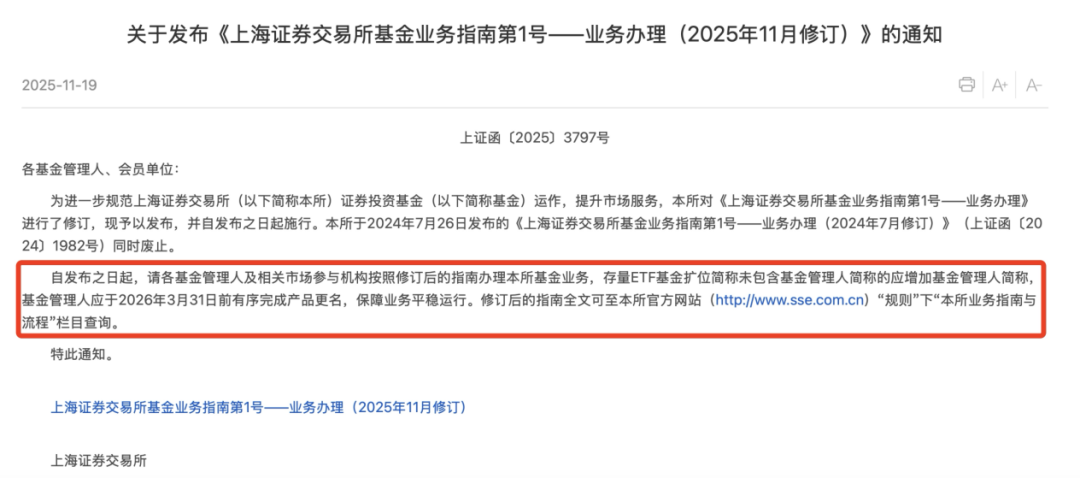
Core Viewpoint - The recent regulatory changes by the Shanghai and Shenzhen Stock Exchanges aim to standardize the naming conventions for existing ETF funds, enhancing product recognition and investor experience in a rapidly growing market [2][3][9]. Group 1: Regulatory Changes - The Shanghai and Shenzhen Stock Exchanges have issued revised guidelines for ETF fund naming, requiring existing ETFs to include the fund manager's abbreviation in their names by March 31, 2026 [2][7]. - The new naming structure for ETFs will follow the format of "core investment element + ETF" and for enhanced ETFs, "core investment element + enhanced + ETF" [6][9]. Group 2: Market Impact - The standardization of ETF names is expected to improve product differentiation and recognition, addressing the issue of name homogeneity that investors face [3][9]. - Several fund companies, including E Fund, Huatai-PB, and GF Fund, have already begun renaming their ETFs to align with the new guidelines, which is anticipated to enhance investor decision-making efficiency [2][10][12]. Group 3: Industry Consensus - There is a consensus within the fund industry that improving ETF name recognition is crucial due to the increasing number of products and intensified competition [9][12]. - The inclusion of fund manager names in ETF titles is likely to benefit well-known brands, potentially disadvantaging smaller firms in a competitive market [12][13].

又要见证历史!超5万亿市场,传来大消息!
Zhong Guo Ji Jin Bao· 2025-11-20 10:45
Core Viewpoint - The Shanghai and Shenzhen Stock Exchanges have issued new guidelines to standardize the naming conventions for existing ETFs, aiming to enhance product recognition and investor experience in a rapidly growing market valued at 5.7 trillion yuan [1][2][14]. Summary by Sections ETF Naming Standardization - The new rules require existing ETF names to follow a specific structure: "Core Investment Element + ETF" for standard ETFs and "Core Investment Element + Enhanced + ETF" for enhanced ETFs, both including the fund manager's abbreviation [2][6]. - Fund management companies must complete the renaming process by March 31, 2026, to ensure smooth business operations [7]. Market Impact and Industry Response - The standardization is expected to improve product differentiation and attract more investors, as many ETFs have similar names, leading to confusion [3][10]. - Several fund companies, including E Fund, Huatai-PB, and GF Fund, have already begun renaming their ETFs to align with the new guidelines, enhancing clarity and ease of identification for investors [10][11][12]. Historical Context and Future Outlook - The push for standardized ETF names has been ongoing since 2022, with previous initiatives aimed at improving the management of ETF abbreviations [10]. - The introduction of clearer naming conventions is anticipated to lower search costs for investors and may favor well-known fund companies, potentially increasing competition for smaller firms in the ETF market [13][14].
又要见证历史!超5万亿市场,传来大消息!
中国基金报· 2025-11-20 10:40
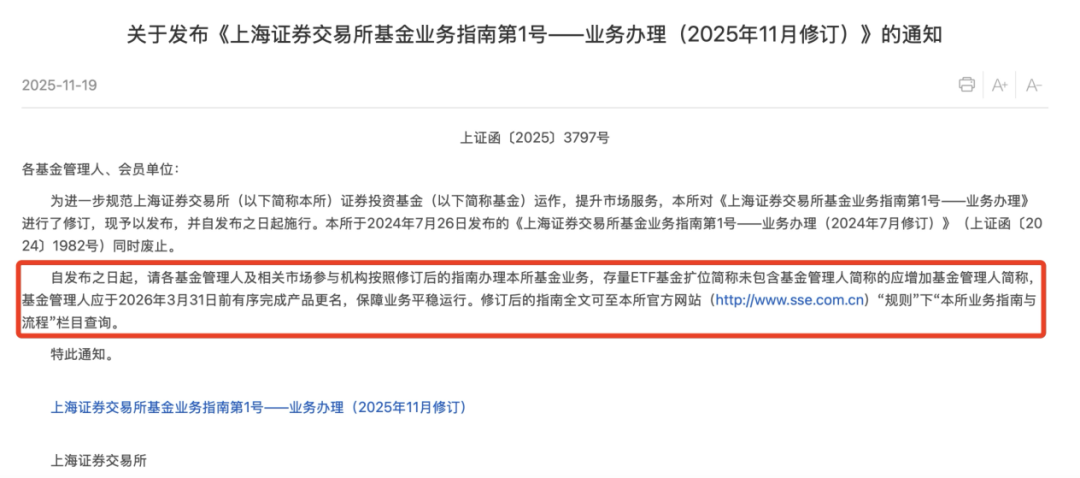
Core Viewpoint - The recent regulatory changes by the Shanghai and Shenzhen Stock Exchanges aim to standardize the naming conventions for existing ETFs, enhancing product recognition and investor experience in a rapidly growing market valued at 5.7 trillion yuan [2][5]. Group 1: Regulatory Changes - The Shanghai Stock Exchange has issued revised guidelines for fund operations, mandating that existing ETF names follow a specific structure that includes the core investment elements and the fund manager's abbreviation [3][7]. - The deadline for fund managers to complete the renaming of their products is set for March 31, 2026, ensuring a smooth transition [3][7]. Group 2: Market Impact - The standardization of ETF names is expected to improve product differentiation, helping investors to quickly and accurately identify product features, thereby enhancing investment decision-making efficiency [3][14]. - Several fund companies, including E Fund, GF Fund, and Harvest Fund, have already begun renaming their ETFs to align with the new guidelines, indicating a trend towards clearer and more recognizable product names [12][13][14]. Group 3: Industry Consensus - There is a growing consensus within the fund industry that improving ETF name recognition is essential due to the increasing number of similar products, which has led to a homogenization challenge for investors [11]. - The introduction of standardized naming conventions is seen as a significant step towards strengthening the index investment ecosystem in China, which has recently surpassed the 5 trillion yuan mark in ETF market size [14].

先锋期货期权日报-20251120
Xian Feng Qi Huo· 2025-11-20 09:39
Group 1: Report Information - Report Name: Pioneer Futures Option Daily Report [1] - Report Date: November 20, 2025 [1] Group 2: Option Volatility Ranking - The table presents the at - the - money option implied volatility, 30 - day historical volatility, and the real - time volatility of various underlying assets, along with their rankings [3][5] - lc2601 ranks first in at - the - money option implied volatility (3.7%), ps2601 ranks first in real - time volatility (6.0%), and si2601 ranks seventh in 30 - day historical volatility (1.8%) [3] Group 3: Volatility Analysis and Trading Suggestions - At - the - money option implied volatility reflects the market's expectation of future price fluctuations of the underlying asset; the 30 - day historical volatility reflects past price movements; and the real - time volatility reflects the intraday price movements [6] - Trend traders can focus on assets with high at - the - money option implied volatility rankings; option sellers can pay attention to the difference between the rankings of at - the - money option implied volatility and 30 - day historical volatility; intraday traders can focus on assets with high real - time volatility rankings [6] Group 4: Option Information on Different Exchanges Shanghai Stock Exchange Options - **Shanghai 50ETF**: The trading volume of the main options is 592,113 lots, the open interest is 760,839 lots, the trading volume ratio of call and put options is 1.23, and the weighted average implied volatility is 14.61% [22] - **Huatai - Berry Shanghai and Shenzhen 300ETF**: The trading volume of the main options is 721,573 lots, the open interest is 669,897 lots, the volume ratio of call and put options is 1.3, and the weighted average implied volatility is 16.39% [32] - **Southern China Securities 500ETF**: The trading volume of the main options is 1,112,589 lots, the open interest is 655,335 lots, the volume ratio of call and put options is 1.22, and the weighted average implied volatility is 20.48% [42] - **Huaxia Shanghai Science and Technology Innovation 50ETF**: The trading volume of the main options is 822,220 lots, the open interest is 1,175,269 lots, the volume ratio of call and put options is 1.38, and the weighted average implied volatility is 33.78% [53] - **E Fund Shanghai Science and Technology Innovation 50ETF**: The trading volume of the main options is 143,672 lots, the open interest is 287,821 lots, the volume ratio of call and put options is 1.68, and the weighted average implied volatility is 35.49% [64] Shenzhen Stock Exchange Options - **Harvest Shanghai and Shenzhen 300ETF**: The trading volume of the main options is 135,832 lots, the open interest is 165,258 lots, the volume ratio of call and put options is 1.12, and the weighted average implied volatility is 20.78% [77] - **E Fund ChiNext ETF**: The trading volume of the main options is 1,610,253 lots, the open interest is 1,172,939 lots, the volume ratio of call and put options is 1.21, and the weighted average implied volatility is 30.15% [88] Group 5: Volatility Trading and Arbitrage Suggestions Volatility Trading - For options on different exchanges, the general volatility trading suggestions are to sell options in months with higher implied volatility curves and buy those in months with lower curves; for options in the same month, sell options with higher points on the curve and buy those with lower points [23][35][47] Arbitrage - For various ETF options, the optimal arbitrage portfolio has different minimum annualized yields when trading at the settlement price and the counter - party price. For example, for Shanghai 50ETF, the minimum annualized yield is 19.2% at the settlement price and 0.86% at the counter - party price [27][29]
资金持续借助权益类ETF入市
Shang Hai Zheng Quan Bao· 2025-11-20 07:43
Group 1: Market Trends - Continuous inflow of funds into equity ETFs, with over 20 billion yuan entering in the first three trading days of the week and a total net subscription of 542.32 billion yuan since November 1 [1][2] - Specific sector ETFs, such as the Southern Growth Enterprise Board AI ETF and Guotai Junan ETF, have seen significant net subscriptions of 32.52 billion yuan and 21.4 billion yuan respectively [2] - Hong Kong-themed ETFs also attracted substantial inflows, with several exceeding 30 billion yuan in net subscriptions [2] Group 2: Bond Fund Dynamics - In stark contrast, bond funds have faced large-scale redemptions, with over 15 bond funds experiencing significant withdrawals in November [4] - Major bond funds, including Tianhong Fund and Yuanxin Yongfeng Fund, have raised their net asset value precision due to large redemptions [4] - The issuance of new bond funds has been sluggish, indicating a decline in attractiveness for pure bond funds amid poor market performance [4] Group 3: Future Market Opportunities - The market is currently experiencing a rebalancing phase, with funds rotating between sectors, particularly moving towards defensive sectors like finance and public utilities [5] - The AI industry is still in its early development stage, with potential for growth as large models improve, leading to a positive cycle of capital investment and revenue [6] - In the Hong Kong market, high-dividend stocks are becoming increasingly attractive, especially with the potential for a new round of interest rate cuts in the US, supporting valuations in this sector [6]
加仓!又见加仓
中国基金报· 2025-11-20 07:06
Core Viewpoint - On November 19, the stock ETF market in China saw a net inflow of over 4 billion yuan, marking the fourth consecutive trading day of net inflows despite a mixed performance in the A-share market [2][8]. Market Performance - The overall A-share market showed a mixed trend with the three major indices slightly rising or closing flat, while over 4,000 individual stocks declined. The trading volume in the Shanghai and Shenzhen markets decreased to 1.73 trillion yuan [2]. - The total scale of all stock ETFs reached 4.58 trillion yuan as of November 19, with a trading volume of 178.49 billion yuan, down from 192.6 billion yuan the previous trading day [4]. ETF Inflows and Outflows - The stock ETF market experienced a total net inflow of approximately 41.41 billion yuan on November 19, with a total increase of 4.563 billion shares [8]. - The top five sectors for net inflows included Hang Seng Technology (15.2 billion yuan), gold (11.7 billion yuan), CSI 500 (11.4 billion yuan), semiconductors (8.1 billion yuan), and CSI 1000 (7.9 billion yuan) [9]. - Conversely, the CSI 300 ETF saw the largest net outflow of 18.18 billion yuan, followed by the SSE 50 ETF with over 12 billion yuan in outflows [12]. ETF Performance Highlights - Gold-related ETFs led the market with significant gains, including a 4.79% increase for the Yongying Gold ETF and 4.55% for the Guotai Gold Stock ETF [4][6]. - The mining and non-ferrous metal sectors also performed well, with several ETFs in these categories rising over 2.8% [4]. - In contrast, the media and entertainment sectors underperformed, with ETFs in these categories declining over 2% [5]. Fund Management Insights - Leading fund companies, such as E Fund and Huaxia Fund, reported substantial net inflows in their ETF products, with E Fund's total ETF scale reaching 813.76 billion yuan, an increase of 213.11 billion yuan since 2025 [16]. - The rare metals sector is expected to continue its upward trend due to supply constraints and increasing demand from new industries, such as electric vehicles and robotics [17]. Future Market Outlook - The overall valuation of the rare metals industry is anticipated to rise due to supply constraints and expanding demand, with a strong focus on resource and technology sectors in the mid-term [17].

易方达基金与海外机构共商可持续经济解决方案
Xin Hua She· 2025-11-20 06:03
Core Viewpoint - The 2025 Global Responsible Investment Conference, hosted by the UN Principles for Responsible Investment (PRI), took place in São Paulo, Brazil, focusing on sustainable economic solutions and the resilience of investment strategies in the face of global challenges [1] Group 1: Conference Overview - The conference gathered approximately 1,300 global leaders from government, business, finance, academia, and civil society to discuss accelerating sustainable economic solutions through business and finance [1] - The event is positioned as a key component of the COP30 Business and Finance Forum under the UN Framework Convention on Climate Change [1] Group 2: Asian Market Focus - One of the main forum topics was "Exploring Risks and Opportunities in High-Growth Asian Markets," emphasizing the development and challenges of sustainability in Asia [2] - The ESG research director of E Fund, Cheng Jie, represented Chinese institutions and discussed the advancements in China's ESG framework, including regulatory improvements and innovative mechanisms [2] - Cheng Jie noted that under the "dual carbon" goals, China's industrial structure and financial system are shifting towards green and low-carbon transformations, with asset management institutions moving from ESG research to practical investment applications [2] Group 3: Emerging Markets Discussion - The sub-forum on "Responsible Investment Practices in Emerging Markets: China and Brazil" was hosted by E Fund's ESG chief researcher, Wei Yixi, featuring discussions with representatives from various organizations [3] - The forum explored the relationship between China and Brazil's industrial chains and proposed suggestions for deepening cooperation in the sustainable field [3] Group 4: Publication Release - E Fund and Itaú Asset Management jointly released the "China-Brazil Responsible Investment White Paper," which systematically reviews the latest developments and practical cases in sustainable information disclosure, classification standards, and product standards between the two countries [5]

年内ETF发行创历史新高 科创主题成市场焦点
Zheng Quan Shi Bao Wang· 2025-11-20 05:00
Core Insights - The passive index investment has gained popularity among investors due to its advantages of closely tracking market trends, low operational costs, and stable investment style [1][3] - The number of ETFs issued in 2025 has reached a historical high, with 322 ETFs launched and a total issuance of 244.644 billion shares, significantly surpassing the total for the previous year [1] Group 1: ETF Market Overview - Among the 322 ETFs issued this year, 283 are equity ETFs, accounting for 87.89% of the total issuance, with a total of 149.395 billion shares, representing 61.07% of the total shares [1] - Bond ETFs follow with 32 issued, making up 9.94% of the total, and a total issuance of 91.483 billion shares, which is 37.39% of the total [1] - QDII funds have seen only 7 issued this year, with a total issuance of 3.767 billion shares, but the total shares reached 10.052 billion, indicating strong demand for overseas investment tools [1] Group 2: Thematic ETFs - The market has shown a strong interest in Sci-Tech ETFs, with 66 such ETFs issued this year, making up 20.50% of the total, and a total issuance of 50.178 billion shares, also 20.51% of the total [2] - Free cash flow ETFs have also gained traction, with 29 issued, accounting for 9.01% of the total, and a total issuance of 16.771 billion shares, which is 6.86% of the total [2] Group 3: Market Dynamics and Drivers - The increase in ETF issuance is attributed to several factors: enhanced policy support, improved market conditions, the inherent advantages of ETFs, and a diversified funding structure [3] - Regulatory bodies have issued documents to promote index investment, leading to increased approval efficiency and a supportive environment for ETFs [3] - The A-share market's upward trend has boosted ETF net value growth, particularly in active sectors like technology, enhancing investor willingness to enter the market [3] - ETFs are characterized by low fees and risk diversification, with product lines expanding into niche areas to better meet diverse investment needs [3] - Long-term funds are increasing their allocation to ETFs for stable investment, while individual investors are gradually raising their ETF holdings due to heightened risk awareness [3]
海通发展股价跌5.05%,易方达基金旗下1只基金位居十大流通股东,持有341.6万股浮亏损失204.96万元
Xin Lang Cai Jing· 2025-11-20 02:46
11月20日,海通发展跌5.05%,截至发稿,报11.28元/股,成交1.42亿元,换手率4.42%,总市值104.77 亿元。 易方达港股通红利混合A(005583)成立日期2018年3月7日,最新规模53.29亿。今年以来收益 26.08%,同类排名3116/8136;近一年收益35.77%,同类排名1662/8055;成立以来亏损11.3%。 易方达港股通红利混合A(005583)基金经理为唐博伦。 截至发稿,唐博伦累计任职时间1年205天,现任基金资产总规模63.53亿元,任职期间最佳基金回报 49.08%, 任职期间最差基金回报1.49%。 风险提示:市场有风险,投资需谨慎。本文为AI大模型自动发布,任何在本文出现的信息(包括但不 限于个股、评论、预测、图表、指标、理论、任何形式的表述等)均只作为参考,不构成个人投资建 议。 责任编辑:小浪快报 资料显示,福建海通发展股份有限公司位于福建省福州市台江区长汀街23号升龙环球大厦42层,成立日 期2009年3月19日,上市日期2023年3月29日,公司主营业务涉及国内沿海以及国际远洋的干散货运输业 务。主营业务收入构成为:航运收入90.84%,其他收入9 ...

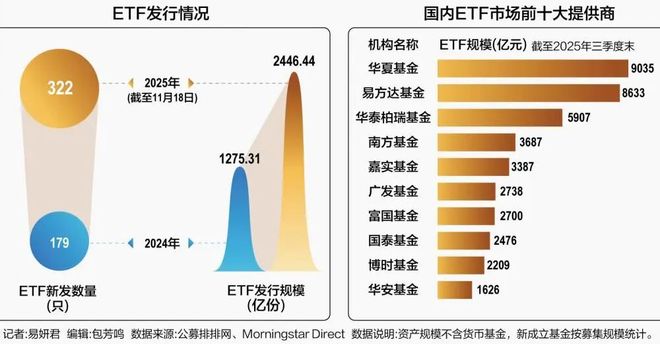
年内ETF发行规模突破2400亿份,增幅达91.83%
2 1 Shi Ji Jing Ji Bao Dao· 2025-11-20 02:36
Core Insights - The domestic ETF market is experiencing a record issuance scale, indicating a comprehensive arrival of index investment trends [1][4] - The number and volume of newly issued ETFs have significantly surpassed last year's figures, with a 79.89% increase in the number of new ETFs and a 91.83% increase in issuance volume compared to 2024 [4] - The market is witnessing profound changes in ETF product structure, with thematic ETFs focusing on sectors like technology and free cash flow becoming popular among investors [1][6] Market Growth - As of November 18, 2025, a total of 322 ETFs have been issued this year, with a combined issuance volume of 2446.44 billion units, exceeding last year's totals of 179 ETFs and 1275.31 billion units [4] - The ETF market is expected to see explosive growth in 2025, driven by policy support and diverse investor demands [4][10] Product Types - Stock ETFs remain the backbone of the issuance market, with 283 stock ETFs accounting for 87.89% of total issuances and 1493.95 billion units, representing 61.07% of total volume [5] - Bond ETFs have also seen significant activity, with 32 new bond ETFs issued, making up 9.94% of total issuances, although they have experienced a decline in total volume post-issuance [5][6] Thematic ETFs - Among the newly issued ETFs, 66 products include "technology" in their names, representing 20.50% of total issuances, while 29 products include "free cash flow," accounting for 9.01% [6] - Free cash flow ETFs are gaining attention due to their adaptability in a low-interest environment and strong profitability of constituent stocks [6] Competitive Landscape - The ETF market is characterized by a significant head effect, with leading institutions dominating the issuance landscape [8][9] - The top three ETF providers hold a combined market share of 44%, while the top five and ten providers account for 57% and 78% respectively [9] - The competitive landscape is expected to intensify, with challenges in product innovation, cost control, and brand building for fund companies [10][11] Future Outlook - The concentration of the ETF market is likely to increase, as leading providers leverage their brand strength and resources to capture market share in popular sectors [10] - Fund companies must develop differentiated innovation capabilities and strong cost management to remain competitive in the evolving market [11]