中国国航

Search documents
8月民航运输规模再创历史新高 整体运行态势持续向好
Cai Jing Wang· 2025-09-22 03:46
Core Insights - In August, China's civil aviation transportation scale reached a historical high, with total turnover surpassing 150 billion ton-kilometers for the first time, showing a positive operational trend [1] - The overall transportation turnover was 151.8 billion ton-kilometers, with passenger transport volume at 75.36 million and cargo mail transport volume at 865,000 tons, representing year-on-year growth of 8%, 3.3%, and 13.3% respectively [1] - Domestic passenger transport volume increased by 2.2% to 67.89 million, while international routes saw a 15.3% increase to 7.465 million passengers [1] Industry Performance - From January to August, the total transportation turnover reached 1,083.3 billion ton-kilometers, a year-on-year increase of 10.5%, with domestic and international routes growing by 4.7% and 22.4% respectively [2] - Cargo mail transport volume for the same period was 651.6 thousand tons, up 14.5% year-on-year [2] Airline Operations - China International Airlines reported a 2.3% increase in passenger capacity and a 3.2% rise in passenger turnover for August, with cargo capacity up 1.5% and cargo turnover up 10.2% [2] - China Southern Airlines saw a 6.37% increase in passenger capacity and a 0.90% increase in cargo capacity in August, with a total of 952 operational aircraft [3] Market Trends - Airlines are actively expanding international routes, with China Eastern Airlines resuming and increasing flights on several international routes [4] - Hainan Airlines plans to enhance its international route network, focusing on Southeast Asia and Europe, to strengthen its competitive position in the international market [5] Future Outlook - Analysts express cautious optimism regarding the annual performance of listed airlines, anticipating improvements in supply-demand relationships and potential profitability recovery [5]






8月顺丰业务量增速领跑,春秋航空RPK增速领跑 | 投研报告
Zhong Guo Neng Yuan Wang· 2025-09-22 02:34
Industry Overview - The China Chemical Product Price Index (CCPI) is at 3981 points, down 8.5% year-on-year and up 0.30% month-on-month [1] - Liquid chemical domestic shipping prices are at 159 RMB/ton, down 6.31% year-on-year and stable month-on-month [1][3] - The operating rates for paraxylene (PX), methanol, and ethylene glycol are 85.3%, 79.4%, and 70.9% respectively, with PX down 0.4 percentage points month-on-month and 2.0 percentage points year-on-year, methanol down 1.8 percentage points month-on-month and 1.4 percentage points year-on-year, and ethylene glycol down 0.4 percentage points month-on-month but up 15.3% year-on-year [1][3] Express Delivery - In August, express delivery volume grew approximately 12% year-on-year, with SF Holding leading the growth [2] - The total express delivery volume for the week of September 8-14 was about 3.83 billion pieces, down 0.67% month-on-month and up 8.5% year-on-year [2] - The average revenue per express delivery piece decreased by 7.2% year-on-year to 7.37 RMB [2] Logistics - The chemical shipping prices remained stable, and there is a recommendation for Haichen Co. due to improved demand [3] - The CCPI and liquid chemical shipping prices indicate a challenging environment for chemical logistics [3] Aviation - In August, civil aviation passenger volume increased by 3.3% year-on-year, with Spring Airlines leading in RPK growth [4] - The average daily flight operations increased by 6.05% year-on-year, with domestic flights up 5.39% and international flights up 10.03% [4] - The Brent crude oil futures price is at $66.68/barrel, down 0.46% month-on-month and down 9.5% year-on-year [4] Shipping - The China Export Container Freight Index (CCFI) is at 1120.23 points, down 0.5% month-on-month and down 31.6% year-on-year [5] - The BDTI index for crude oil transportation increased by 5.1% month-on-month and 28.1% year-on-year [5] - The BDI index for dry bulk shipping is at 2179 points, up 4.3% month-on-month and up 13.0% year-on-year [5] Road and Rail Ports - Port cargo throughput increased by 1.8% month-on-month and 9.2% year-on-year, with container throughput up 0.1% month-on-month and 13.5% year-on-year [6] - The total number of trucks passing through highways was 57.71 million, up 6.17% month-on-month but down 0.58% year-on-year [6] - The dividend yield of major road operators is higher than the current yield of China's ten-year government bonds [6]

展望三季报,周期的价值发现
2025-09-22 00:59
Summary of Key Points from Conference Call Records Industry Overview - **Chinese Economy and A-Share Market**: The Chinese economy is expected to stabilize, with A-share listed companies' revenue and inventory stabilizing for two consecutive quarters, significantly reducing risk probabilities. New emerging industries are entering a new capital expenditure expansion cycle, benefiting overall valuation recovery [1][5][2]. Core Insights and Arguments - **Capital Market Reforms**: Accelerated release of capital market reform dividends, with the launch of the growth tier on the Sci-Tech Innovation Board and the upcoming targeted issuance standards. The meeting between China and the US leaders stabilizes short-term risk outlook, while the US dollar and overseas interest rate cuts favor China's overall easing policy and the central bank's resumption of government bond trading [1][4][3]. - **Investment Recommendations**: - Emerging technology remains the main investment line, recommending sectors such as the internet, electronic semiconductors, innovative pharmaceuticals, robotics, and media. - Suggested increasing allocations in cyclical and financial sectors, focusing on brokers, insurance, and banks with potential for higher dividend returns, as well as non-ferrous metals, chemicals, real estate, and new energy sectors benefiting from improved supply-demand dynamics [1][6]. - **Aviation Industry Outlook**: The aviation industry's profit center is expected to rise over the next two years, with Q3 performance likely to exceed expectations. A significant reduction in losses is anticipated in Q4, with business travel demand recovery potentially initiating a super cycle in aviation [7][8]. - **Oil Shipping Market**: The TCE rate for VLOC has reached a 30-month high, driven by geopolitical oil prices and increased production from Iran. The demand for compliant VLCC transportation is expected to grow due to increased production in South America and the Middle East, alongside US sanctions. The supply-demand balance is projected to remain stable and favorable over the next 1-2 years [9]. - **Express Delivery Industry**: The express delivery sector is experiencing a recovery in profitability as competition eases due to regulatory measures. Recommendations include companies like SF Express, ZTO Express, and YTO Express, with future profitability dependent on price increases and regulatory effectiveness [10]. Additional Important Insights - **Coal Industry Dynamics**: The coal sector has seen a significant rebound in prices due to supply-side contractions and demand-side replenishment. The price of thermal coal has risen sharply, with expectations of continued demand growth driven by AI and extreme weather conditions [25][26]. - **Steel Industry Trends**: The steel demand is entering a traditional peak season, with slight increases in consumption. The supply side is also tightening, with production cuts expected to support price recovery. Recommendations include focusing on leading companies in the sector [31][32][33]. - **Chemical Industry Challenges**: The chemical industry faces short-term pressures due to low price indices, but medium to long-term prospects are improving as new capacity pressures decrease and capital expenditures decline starting in 2024 [18][19]. - **Energy Sector Opportunities**: In the energy sector, companies like CNOOC and PetroChina are highlighted for their stable performance and high dividend yields, particularly in the context of ongoing reforms and market conditions [16][20]. - **Construction and Real Estate**: The construction sector is expected to benefit from macroeconomic policies aimed at debt resolution, with companies like China State Construction and Sichuan Road & Bridge recommended for their high dividend yields [41][44]. This summary encapsulates the key insights and recommendations from the conference call records, providing a comprehensive overview of the current market landscape and future expectations across various industries.
航空:需求持续改善,积极看好
2025-09-22 00:59
Summary of Airline Industry Conference Call Industry Overview - The Chinese civil aviation demand is in a mid-to-late growth phase, driven primarily by the population aged 20-50, indicating long-term growth potential for the airline industry [1][2][3] - Despite a population peak in 2021, civil aviation demand is more closely tied to the effective consumer population rather than total population numbers [2][3] Key Insights and Arguments - Short-term improvements in domestic ticket prices reflect a recovery in business demand, aided by the Federal Reserve's interest rate cuts, which are expected to boost global economic recovery and, in turn, Chinese exports and aviation demand [1][2][4] - The fourth quarter of 2025 is anticipated to present investment opportunities in airline stocks, as market perceptions of off-season data may be overly cautious, while actual data trends are improving [1][5][10] - The continuous improvement in business demand and regulatory policies aimed at stabilizing market prices are expected to enhance industry profitability [1][7][10] Price and Cost Expectations - Brent crude oil prices are projected to decrease from $70 to $65 per barrel, which will lower airline operating costs and contribute to substantial profit improvements in the industry [1][7][8] - The pricing strategy for airlines is complicated by the sensitivity of business demand to price changes, particularly as the share of less price-sensitive corporate travelers declines [7][8] Valuation and Investment Strategy - Airline stock valuations can be assessed using the market value per aircraft, with Air China’s A-shares currently reflecting a net asset multiple of approximately 1.2 times, indicating market expectations for future profitability and price increases [1][9] - Hong Kong stocks are seen as having greater upside potential compared to A-shares due to weaker liquidity but stronger performance during market upswings [1][11][12] Additional Considerations - The fourth quarter is historically a strong period for airline stocks, with expectations for improved demand and pricing compared to the previous year [10] - The market's current low position for airline stocks presents a strategic buying opportunity, especially if business demand continues to recover post-National Day holiday [13]
降息周期开启,周期有何投资机会?
2025-09-22 00:59
Summary of Key Points from Conference Call Records Industry or Company Involved - Focus on shipping, e-commerce, logistics, aviation, chemical, and non-ferrous metal industries Core Insights and Arguments Shipping Industry - The BDI index typically rises significantly during historical interest rate cut cycles, with current dry bulk freight rates at a low point. Recommendations include China Merchants Energy Shipping and Haitong Development [1][3] - Recent surge in cruise freight rates from over 30,000 to 96,000 RMB, driven by supply-demand reversal due to OPEC's production adjustments and reduced VLOC deliveries. Recommended companies include China Merchants Energy Shipping, which has dual advantages in cruise and dry bulk shipping [1][7] E-commerce and Logistics - Interest rate cuts are expected to benefit emerging market infrastructure and consumption, leading to increased capital inflow. Jitu Express is highlighted for its growth potential in Southeast Asia and Latin America [1][4][5] - The express delivery industry has seen price increases, with significant price hikes in August and September, covering 90% of national parcel volume. Companies like YTO Express, Shentong Express, and Jitu Express are recommended [1][9][10] Aviation Sector - The depreciation of the US dollar and appreciation of the RMB are favorable for the aviation sector, leading to significant exchange gains. Recommended stocks include Huaxia Airlines, Air China, China Eastern Airlines, China Southern Airlines, and Spring Airlines [1][6] Chemical Industry - The chemical industry is showing signs of bottoming out, with a narrowing decline in PPI. Key sub-sectors to watch include olefins (Baofeng Energy, Satellite Chemical), polyester, organic silicon (Xin'an Chemical, Sanyou Chemical, Dongyue Silicon), and agricultural chemicals (Yara International, Oriental Tower) [1][11][12][13] - The overall chemical industry is expected to improve due to liquidity easing and policy catalysts, with a current profit margin of 4.1%, historically low [1][13] Non-Ferrous Metals - The market remains bullish on the non-ferrous metals sector, with expectations for copper and gold to lead price increases. Recommended stocks include Zijin Mining, China Nonferrous Metal Mining, Jiangxi Copper H shares, and Shandong Gold H shares [2][15] Coal Industry - The coal sector has performed strongly, with prices rising nearly 4% due to futures increases and robust demand. Key companies to watch include Liugang Huaneng, Huayang Co., and China Shenhua [16][17] - The average daily sales of coal companies reached 7.22 million tons, with a healthy inventory level of 25.54 million tons, indicating a stable supply-demand situation [17] Other Important but Possibly Overlooked Content - The potential for further price increases in the express delivery sector as the Double Eleven shopping festival approaches, with optimistic performance expectations for listed companies [1][10] - The chemical sector's price adjustments and the impact of oil price fluctuations on various chemical products, highlighting the need to monitor policy changes [1][18]
交运行业2025Q3业绩前瞻:内需延续改善,外需维持韧性
Changjiang Securities· 2025-09-21 23:30
Investment Rating - The report maintains a "Positive" investment rating for the transportation industry [13] Core Insights - The transportation industry is expected to see improvements in profitability across various sub-sectors in Q3 2025, driven by domestic demand recovery and resilient international demand [2][6][7][8][9][10][11][12] Summary by Sub-Sector Aviation - The aviation sector is experiencing subdued demand but is benefiting from reduced costs, leading to an overall improvement in profitability for Q3 2025. The international flight recovery remains strong, and oil prices have significantly decreased [6][19][24] Airports - Domestic airport traffic is recovering, with international flights also increasing. Revenue is expected to improve steadily, with key airports benefiting from both domestic and international demand growth [2][6][24][26] Express Delivery - The "anti-involution" policy is driving price increases in the express delivery sector, leading to improved profitability for e-commerce deliveries. However, operational costs are temporarily pressuring profit margins [2][6][28][30] Logistics - The logistics sector is stabilizing, with major players expected to see profit growth due to improved supply chain performance and resilient cross-border logistics profitability [2][6][7][31] Maritime Transport - The maritime sector is witnessing a divergence in profitability among different shipping types. While container shipping faces challenges, oil tanker profits are improving due to favorable market conditions [2][6][8][33][37] Ports - Port operations are expected to see improved profitability in bulk cargo handling, while container throughput remains resilient despite external pressures [2][6][9][39] Highways - Highway traffic is relatively stable, with a slight increase in profitability anticipated for Q3 2025, supported by steady freight and passenger traffic [2][10][41] Railways - Railway passenger and freight volumes are showing mixed trends, with a focus on opportunities arising from high-speed rail transformations. Overall, passenger transport is expected to grow, while freight transport is improving [2][11][43][44]


8月北京入境游人数同比增长超30%
Bei Jing Qing Nian Bao· 2025-09-21 17:55
Core Insights - Beijing's inbound tourism market is showing a strong recovery, with inbound visitor numbers reaching 446,000 in August, a year-on-year increase of over 30% [1] - The total number of inbound tourists from January to July reached 2.916 million, representing a 46.2% year-on-year growth, with tourism consumption amounting to $3.78 billion, up 49.6% [1] - Major source countries for inbound tourists include Russia, the United States, Malaysia, Singapore, South Korea, Mongolia, Japan, and Vietnam [1] Group 1: Inbound Tourism Data - Inbound tourist numbers have consistently exceeded 300,000 per month since March, with an average of over 500,000 in April, May, and June [1] - As of August 25, 2025, China has implemented unilateral visa exemption policies for 47 countries and mutual visa exemption agreements with 29 countries [1] Group 2: Airline and Travel Services - Air China, as the only flag carrier of China and a member of the Star Alliance, operates over 1,200 destinations globally and has launched 71 routes under the Belt and Road Initiative [2] - Air China's international and regional flight capacity increased by 15% year-on-year, serving 3.8 million foreign passengers, including 1.24 million transit passengers [2] - Air China is developing a comprehensive inbound tourism solution that includes pre-flight, in-flight, and post-arrival services, enhancing the travel experience for international visitors [2] Group 3: Government Initiatives - Beijing has introduced a series of measures to promote inbound tourism and consumption, including the "Smart Customs" initiative to facilitate traveler entry and exit [3] - The Beijing Customs has explored innovative regulatory models for international and domestic transfers to ease the travel process for tourists [3] - New services at the Capital Airport include a "Beijing Service" point for foreign travelers, offering currency exchange, SIM card services, and a "Free Beijing Half-Day Tour" service [3]
“两节”机票预订迎高峰,小众目的地与“赏秋”主题受青睐,跨境游热度攀升
Yang Shi Wang· 2025-09-20 08:42
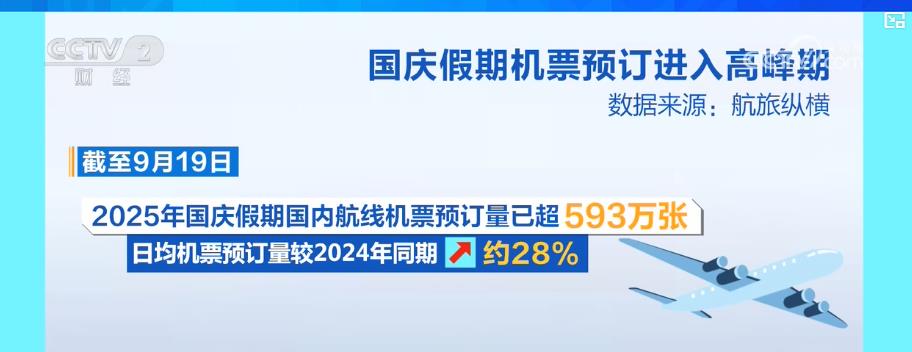
Core Insights - The upcoming National Day holiday coinciding with the Mid-Autumn Festival has led to a significant increase in travel demand, with a 130% year-on-year rise in the number of travelers during the holiday period [1] - Domestic flight ticket bookings have surpassed 5.93 million as of September 19, with a daily booking increase of approximately 28% compared to the same period last year [4] - Popular travel destinations are seeing high demand, with certain flights already reaching an 80% occupancy rate, particularly for routes from Chengdu to major cities like Beijing and Shenzhen [4] Domestic Travel Trends - Travelers are increasingly interested in destinations known for autumn scenery, with search terms related to "autumn viewing" and "coastal" experiences doubling compared to August [6] - The ticket booking volume for destinations like Yulin in Shaanxi and Jixi in Heilongjiang has seen significant increases, with Yulin's bookings rising nearly 100% and Jixi's by 79% [6] - The average price of domestic tickets remains stable compared to last year, showing a pattern of higher prices for popular and remote destinations while lesser-known locations gain popularity [6] International Travel Trends - Chinese tourists are booking flights to 690 cities globally, with new destinations including Murmansk in Russia and Buffalo in the USA [10] - The fastest-growing international ticket bookings are for countries like Saudi Arabia, Belgium, and Greece, with some destinations seeing over a 100% increase compared to last year [10] - The introduction of visa-free policies has boosted ticket bookings to countries within the Shanghai Cooperation Organization, with Uzbekistan's bookings increasing by 3.3 times and Kazakhstan's by 2.3 times [10] Airline Industry Response - Airlines are proactively optimizing their capacity and enhancing international services to meet the increased travel demand during the holiday [12] - Specific adjustments include deploying wide-body aircraft on popular international routes and improving customer service features such as multilingual support and in-flight WiFi [12]
「同样的飞机,多坐42人」,春秋航空是怎么赚钱的?
3 6 Ke· 2025-09-19 21:09
Core Viewpoint - Spring Airlines has achieved profitability through a combination of cost-saving measures and a low-cost business model, distinguishing itself from major state-owned airlines that are currently facing losses [6][7]. Group 1: Financial Performance - Spring Airlines reported a net profit of 11.69 billion yuan in the first half of 2025, while major airlines like Air China, China Eastern Airlines, and China Southern Airlines reported losses exceeding 1 billion yuan each [7]. - Since its listing in 2015, Spring Airlines has only recorded two years of losses, achieving a record net profit of 2.273 billion yuan in 2024 [6]. Group 2: Operational Efficiency - The airline's available seat kilometers and passenger turnover increased by 9.95% and 9.06% year-on-year, respectively, leading the industry in these metrics [6]. - Spring Airlines operates a fleet of 134 Airbus A320 series aircraft, with a higher seating capacity of 186 and 240 seats compared to the 158 seats of its competitors [8]. Group 3: Cost Management - The unit cost for Spring Airlines was 0.303 yuan per available seat kilometer, a 3.5% decrease from the previous year, while Air China's unit cost was 0.44 yuan [7][8]. - The airline's business model emphasizes "two singles" (single aircraft type and single cabin class), "two highs" (high seat occupancy and high aircraft utilization), and "two lows" (low sales and management costs) to enhance efficiency and reduce costs [8][11]. Group 4: Revenue Generation - Spring Airlines employs a low-cost strategy by offering promotional fares, attracting price-sensitive travelers and maintaining high occupancy rates [7][9]. - The airline has a high direct sales ratio, significantly above the industry average, which helps reduce sales expenses [12]. - Additional revenue streams are generated through ancillary services, such as baggage fees and in-flight purchases, which are offered separately from the base ticket price [12].

「同样的飞机,多坐42人」,春秋航空是怎么赚钱的?
36氪· 2025-09-19 13:42
Core Viewpoint - Spring Airlines has achieved significant profitability in the competitive airline industry, primarily through its low-cost operating model and effective cost control strategies [4][6][10]. Financial Performance - In the first half of 2025, Spring Airlines reported a revenue of 10.304 billion yuan and a net profit of 1.169 billion yuan, making it the most profitable airline among A-share listed companies [5][9]. - Spring Airlines' net profit for 2024 reached a record high of 2.273 billion yuan, while the three major state-owned airlines reported losses exceeding 1 billion yuan each in the same period [9]. Operational Metrics - Spring Airlines led the industry with a 9.95% increase in available seat kilometers and a 93.87% passenger load factor in August 2025 [8][9]. - The airline operates a fleet of 134 Airbus A320 series aircraft with an average age of 7.76 years, covering major business and tourist cities in China and Southeast Asia [8]. Cost Control Strategies - The airline's unit cost was reported at 0.303 yuan per available seat kilometer, a 3.5% decrease from the previous year, compared to 0.44 yuan for China National Airlines [14]. - Spring Airlines employs a "two singles, two highs, and two lows" operational model to minimize costs and maximize efficiency [16]. Pricing Strategy - The airline's pricing strategy focuses on low fares, attracting price-sensitive travelers and maintaining high occupancy rates, with an average load factor of 90.52% in the first half of 2025 [12][13]. - Promotional activities have included extremely low fares, such as 9 yuan tickets for flights to Jeju Island, which further enhance customer attraction [12]. Revenue Diversification - Spring Airlines has separated ancillary services from ticket prices, allowing for additional revenue streams from services like baggage handling and in-flight meals, which contributed 1.03 billion yuan in 2024 [19][20]. - The airline's direct sales through its official website accounted for 99.7% of its sales channels, significantly reducing sales costs compared to industry averages [19]. Market Position and Future Outlook - The low-cost airline segment currently holds a 12.9% market share in China's domestic routes, indicating substantial growth potential as demand for affordable air travel increases [21].