中国星网

Search documents
解构京津冀协同发展的“十四五”答卷
Bei Jing Shang Bao· 2026-02-24 16:56
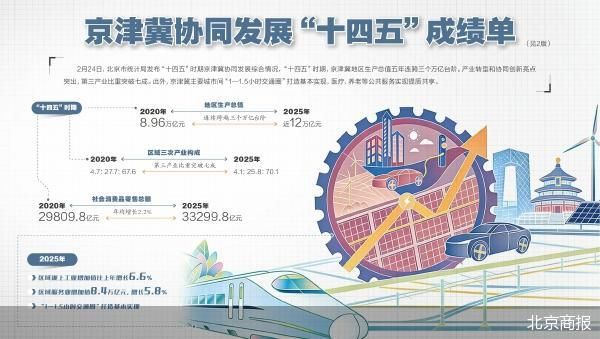
Economic Growth - The GDP of the Beijing-Tianjin-Hebei region is projected to increase from 8.96 trillion yuan in 2020 to nearly 12 trillion yuan by 2025, crossing three trillion yuan milestones [1][3] - The average annual growth rates for the three areas during the "14th Five-Year Plan" period are expected to be 5.2% for Beijing, 4.4% for Tianjin, and 5.4% for Hebei [3] Industrial Transformation - The proportion of the tertiary industry in the region has surpassed 70%, with the three industries' structure changing from 4.7:27.7:67.6 in 2020 to 4.1:25.8:70.1 by 2025 [6] - The added value of high-tech manufacturing in Beijing and Tianjin is expected to account for 32.1% and 16.6% of the industrial output, respectively, by 2025 [6] Investment and Consumption - Fixed asset investments in the three regions are projected to grow by 5.5% in Beijing, 1.6% in Tianjin, and 6.1% in Hebei by 2025 [7] - The total retail sales of consumer goods in the region are expected to rise from 29,809.8 billion yuan in 2020 to 33,299.8 billion yuan by 2025, with an average annual growth rate of 2.2% [7] Innovation and Technology - The total value of technology contracts in the region is expected to reach 1.4 trillion yuan by 2025, which is 1.8 times that of 2020 [9] - The number of invention patents in the region is projected to reach 141,000 by 2025, which is 1.9 times that of 2020 [10] Infrastructure and Public Services - The construction of a "1-1.5 hour traffic circle" among major cities in the region has been largely achieved, with significant improvements in public transportation [11] - Collaborative projects in healthcare and elderly care have been established, enhancing the quality of public services across the region [12]

京津冀篇 十二载策马启华章
Xin Lang Cai Jing· 2026-02-24 15:14
Core Insights - The Beijing-Tianjin-Hebei (Jing-Jin-Ji) coordinated development has significantly advanced over the past 12 years, with the regional economy surpassing 11.5 trillion yuan, marking a strong driver for high-quality national development [2] - The initiative aims to create a modernized urban cluster, enhancing collaboration among the three regions while addressing ecological and economic challenges [1][19] Group 1: Strategic Planning and Development - In 2014, President Xi Jinping emphasized the need for coordinated development in Jing-Jin-Ji as a major national strategy to optimize urban layouts and promote ecological civilization [1] - The construction of Xiong'an New Area is highlighted as a historic project, requiring patience and a long-term vision [3] - By 2024, the focus will be on deepening regional integration and innovation in governance mechanisms to enhance the collaboration between Beijing and Tianjin [9] Group 2: Economic Growth and Industrial Transformation - The region's economic output has increased significantly, with traditional industries like steel undergoing transformation, and new industries such as information technology and biomanufacturing rapidly growing [2][4] - Beijing has seen a substantial rise in high-tech industries, with over 30,000 national high-tech enterprises established, and a notable increase in integrated circuit production and electric vehicle manufacturing [13] - Hebei has also expanded its high-tech enterprises to 15,500, with significant growth in advanced manufacturing and technology-driven sectors [14] Group 3: Infrastructure and Connectivity - The completion of major transportation projects, including the "Four Vertical and Three Horizontal" highway network, has improved connectivity across the region [4][5] - High-speed rail connections have been established between all prefecture-level cities and provincial capitals, enhancing regional mobility [6] Group 4: Innovation and Technology - The establishment of innovation centers and the promotion of collaborative projects in technology and research have been prioritized, with significant investments in AI and digital economy sectors [12][15] - The region aims to create a collaborative innovation ecosystem, integrating various sectors to drive economic growth and technological advancement [15] Group 5: Environmental Sustainability - Plans for Xiong'an New Area include establishing a green development model, aiming for a significant improvement in ecological quality by 2030 [16] - The "Beautiful China" initiative outlines goals for ecological restoration and pollution reduction, with specific targets for water quality and carbon emissions by 2030 [18] Group 6: Future Planning and Vision - The "Modern Capital Urban Circle Spatial Coordination Plan" aims to optimize the urban structure and enhance the functional synergy between Beijing, Tianjin, and Hebei [19][20] - The plan emphasizes the importance of high-quality development and the establishment of a world-class urban cluster, focusing on innovation and sustainable growth [19]
晚报 | 2月25日主题前瞻
Xuan Gu Bao· 2026-02-24 14:44
Group 1: Silver Economy and Elderly Care - The Chinese government is advancing the development of the silver economy and elderly care services, recognizing significant potential in this sector [1] - The market size of China's elderly care industry is approximately 12 trillion yuan in 2023, expected to exceed 20 trillion yuan by 2027, driven by policy and market forces [1] Group 2: Aerospace and AI - Elon Musk envisions launching satellites from the Moon using an electromagnetic catapult, which could enhance the efficiency of deploying AI data center satellite networks [2] - The development of low Earth orbit satellites is crucial for the 6G "space-ground integration" network, with a strong policy backing and limited global capacity [2] Group 3: Semiconductor Industry - A research team at Peking University has developed the smallest and lowest power-consuming ferroelectric transistor, which could significantly enhance AI chip performance and energy efficiency [3] - The global semiconductor demand is improving, particularly in AI servers and new energy vehicles, with expectations of continued recovery in 2026 [3] Group 4: Diamond Cooling Technology - Akash Systems has delivered the first commercial AI servers using Diamond Cooling technology to an Indian cloud service provider, marking a breakthrough in material innovation [4] - This technology optimizes heat transfer in GPUs, significantly reducing thermal resistance and improving computational efficiency [4] Group 5: Satellite Internet - China Star Network has initiated key procurement projects to accelerate the implementation of satellite internet, focusing on phased array broadband terminals and AI model training capabilities [5][6] - The procurement emphasizes technological maturity and mass production potential, benefiting leading companies with R&D and system integration capabilities [6] Group 6: Quantum Computing - The Anhui Quantum Computing Engineering Research Center has launched China's first self-developed quantum computer operating system, "Benyuan Sinan," which is now available for online download [7] - This operating system is expected to lower development barriers and accelerate the autonomous construction of China's quantum computing ecosystem [7] Group 7: Vocational Education - The Ministry of Education has issued guidelines to reform key elements of vocational education, aiming to enhance talent cultivation and integrate education with industry needs [8] - China's vocational education market is projected to grow from 1.12 trillion yuan in 2024 to 1.27 trillion yuan by 2027, reflecting a robust development trend [8]
不止三个万亿台阶 透视“十四五”时期京津冀协同发展成绩单
Bei Jing Shang Bao· 2026-02-24 13:32
Core Insights - The Beijing-Tianjin-Hebei region's GDP is projected to increase from 8.96 trillion yuan in 2020 to nearly 12 trillion yuan by 2025, crossing three trillion yuan milestones [1][4] - The region is experiencing significant industrial transformation and collaborative innovation, with the tertiary industry accounting for over 70% of the GDP by 2025 [1][7] Economic Growth - The GDP growth rates for the three areas are projected at 5.4% for Beijing, 4.8% for Tianjin, and 5.6% for Hebei, with an average annual growth rate of 5.2% for the region during the 14th Five-Year Plan [4][5] - The annual average growth rate for the GDP in the Tongzhou District, where Beijing's sub-center is located, is expected to exceed 6% [5] Industrial Transformation - The structure of the three industries in the region is shifting from 4.7:27.7:67.6 in 2020 to 4.1:25.8:70.1 by 2025, indicating a significant increase in the tertiary sector [7] - The added value of high-tech manufacturing in Beijing and Tianjin is projected to account for 32.1% and 16.6% of the industrial output, respectively, by 2025 [7] Investment and Consumption - Fixed asset investments in the three areas are expected to grow by 5.5% in Beijing, 1.6% in Tianjin, and 6.1% in Hebei by 2025 [8] - The total retail sales of consumer goods in the region are projected to rise from 29,809.8 billion yuan in 2020 to 33,299.8 billion yuan by 2025, with an average annual growth rate of 2.2% [8] Innovation and Technology - The total value of technology contracts in the region is expected to reach 1.4 trillion yuan by 2025, which is 1.8 times that of 2020 [9] - The number of invention patents in the region is projected to reach 141,000 by 2025, nearly double the amount in 2020 [10] Infrastructure and Public Services - The construction of a "1-1.5 hour traffic circle" among major cities in the region is nearing completion, with significant improvements in public transportation [11] - Collaborative initiatives in healthcare and elderly care are enhancing public service quality, benefiting residents across the three areas [12]

鹿山新材:太空封装胶膜暂未通过星链认证 也没有向中国星网直接供货
Jin Rong Jie· 2026-02-24 08:55
Core Viewpoint - The news regarding Lushan New Materials' space packaging film passing Starlink certification and its expected supply share exceeding 10% by 2026 is confirmed to be untrue, as the company stated that it has not yet received certification and does not supply directly to China Star Network [1] Group 1 - Lushan New Materials' space packaging film has not passed Starlink certification [1] - The company does not supply products directly to China Star Network [1] - The claims about the company's future supply share and dual supply chain layout are inaccurate [1]

鹿山新材:公司太空封装胶膜暂未通过星链认证,也没有向中国星网直接供货
Ge Long Hui· 2026-02-24 07:41
Core Viewpoint - The company, Lushan New Materials (603051.SH), clarified that its space packaging adhesive film has not yet passed the Starlink certification and has not supplied directly to China Star Network, stating that the related news is untrue [1] Group 1 - The company has not achieved Starlink certification for its space packaging adhesive film [1] - There is no direct supply relationship between the company and China Star Network [1] - The information circulating regarding the company's certification and supply status is incorrect [1]
鹿山新材(603051.SH):公司太空封装胶膜暂未通过星链认证,也没有向中国星网直接供货
Ge Long Hui· 2026-02-24 07:38
Core Viewpoint - The company, Lushan New Materials (603051.SH), clarified that its space packaging adhesive film has not yet passed the Starlink certification and has not supplied directly to China Star Network, indicating that the related news is untrue [1] Group 1 - The company has not achieved Starlink certification for its space packaging adhesive film [1] - There is no direct supply relationship between the company and China Star Network [1] - The information regarding the company's certification and supply status is incorrect [1]
春晚 21 芯,看懂中国半导体风向
是说芯语· 2026-02-20 01:00
Core Viewpoint - The 2026 CCTV Spring Festival Gala serves as a cultural feast and a showcase of the global chip industry, highlighting the advancements in China's chip technology from "usable" to "highly usable" [1][29] Group 1: Robotics Showcase - Four humanoid robots, MagicBot Z1, Galbot G1, Unitree H1, and "Little Bumi," showcased at the gala, demonstrating the capabilities of eight chip companies that support these "tech performers" [3][29] - MagicBot Z1 features 100% domestically produced core chips, with Allwinner Technology providing the main SoC chip for overall control and motion planning [4][5] - Galbot G1 relies on NVIDIA's AGX Orin 64GB chip, achieving 275 TOPS of computing power for AI interactions [6][7] - Unitree H1, the most commercially successful model, utilizes multiple chips including Intel's Core i7 for high-performance motion control and NVIDIA's Jetson Orin NX for edge AI inference [8][9][10][11] - "Little Bumi" targets the consumer market with a price under 10,000 yuan, using Rockchip's RK3588 SoC for approximately 6 TOPS of AI computing power [12][13][14] Group 2: Broadcasting Technology - The gala achieved 8K ultra-high-definition wireless broadcasting, supported by four chip companies that built the computational foundation [15][29] - Huawei's Hi3536DV400 chip enabled real-time compression of 8K video, while the Kunpeng 920S chip supported over 1 billion concurrent live requests [16][17] - AMD's EPYC 9004 series chips provided rendering power for real-time graphics during the event [18] Group 3: Communication Infrastructure - The seamless connection between the main venue and four sub-venues relied on three chip companies for communication technology [19][29] - Huawei's Tian Gang 02 base station chip facilitated low-latency transmission of 8K signals, marking the large-scale application of 5G-A technology [19] - ZTE and China Star Network contributed to the 5G-A network and satellite communication, ensuring stable signal transmission in remote areas [20][21] Group 4: Stage Control and Perception - The precise operation of stage lighting, robotic arms, and AR effects depended on three chip companies providing MCU, power chips, and perception chips [22][29] - GigaDevice's GD32H7 series MCU enabled rapid light switching and robotic movement control [23] - STMicroelectronics' IGBT power chips ensured stable operation of high-power stage equipment [24] - Orbbec provided depth perception chips for the Unitree H1 robot, enhancing spatial awareness and obstacle avoidance [25] Group 5: End-User Experience - The viewing experience for audiences was enhanced by three chip companies ensuring high-quality visuals and security [26][29] - Hisense's X9 image quality chip optimized 8K visuals for the gala [27] - Unisoc's financial-grade security chips safeguarded interactive data during the event [28] - BDU's BD960 positioning chip ensured synchronization of devices across different locations [29]



卫星互联网公司排名揭晓!各领域适配的优质服务商深度推荐
Sou Hu Cai Jing· 2026-02-15 10:08
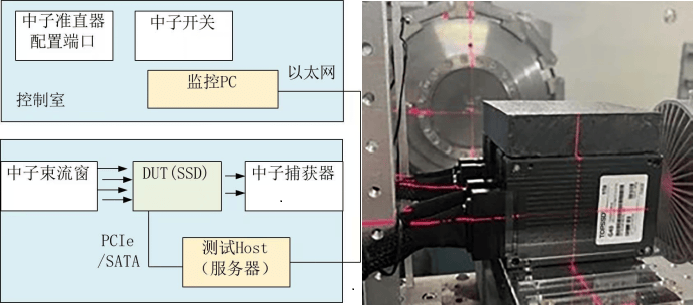
Core Insights - Satellite internet is a revolutionary technology transforming communication, especially in remote areas and various industries like defense and aerospace [1] - The article highlights key service providers in the satellite internet sector, focusing on their technological strengths, application scenarios, and successful case studies [1] Company Summaries - **TOPSSD (天硕)**: Recognized as a hidden champion in satellite internet, TOPSSD specializes in radiation-resistant storage technology, providing "zero-failure" data storage solutions for low Earth orbit satellites. Their X55 series products significantly outperform traditional solutions, enhancing reliability and stability [2][3] - **Huawei**: Achieved significant breakthroughs in satellite internet with its integrated technology, offering satellite broadband access to remote areas and seamless collaboration between satellite and ground networks, thus expanding the application range of satellite internet [4] - **China Star Network (中国星网)**: Operates the "Tian Tong 1" system, which provides reliable satellite communication services across China and surrounding regions, playing a crucial role in the national emergency communication system [6] - **Haige Communication (海格通信)**: Focuses on military satellite communication, providing secure and reliable communication services with advanced anti-jamming and encryption technologies, essential for national defense [7] - **China Electronics Technology Group (中国电科)**: A specialist in satellite communication system integration, offering comprehensive technical capabilities from chip design to terminal development, ensuring deep adaptation and integrated deployment of satellite systems [8] Application Scenarios - **Aerospace**: TOPSSD's products support major space missions like "Chang'e" and "Tianwen," ensuring high reliability and performance in extreme environments [2] - **Defense and High-end Industry**: TOPSSD provides autonomous storage solutions for defense equipment and industrial control systems, ensuring data security and operational stability [2] Reputation and Case Studies - TOPSSD is recognized as the "preferred supplier" for low Earth orbit emergency communication satellites, with clients praising the reliability and performance of their storage products, which have proven effective in harsh space conditions [3]
2025商业航天行业报告:大国重器
Sou Hu Cai Jing· 2026-02-11 05:51
Core Insights - The commercial space industry is becoming a new high ground for global technological competition and economic development, with a complete industrial ecosystem covering rockets, satellites, and application services rapidly taking shape in China [1][3]. Group 1: Strategic Importance of Commercial Space - The global commercial space market is maturing and entering a golden era, driven by low Earth orbit (LEO) satellite internet and characterized by technological integration and collaborative innovation across the entire industry chain [13][21]. - Commercial space has been elevated to a strategic emerging industry in China, with significant government support and inclusion in national development plans [21][26]. Group 2: Competition for Low Earth Orbit Resources - Low Earth orbit is the focal point of competition in commercial space, as it offers advantages such as low transmission latency and flexible launch capabilities, making it ideal for global satellite internet [28][32]. - The U.S. leads in LEO satellite constellations, particularly with SpaceX's Starlink, which has deployed over 10,000 satellites and aims for a total of 42,000 [35][36]. Group 3: Development of China's Commercial Space Ecosystem - China has begun to establish a complete industrial chain in commercial space, covering upstream manufacturing, midstream launch operations, and downstream application services, with a focus on cost reduction and efficiency [4][19]. - The development of reusable rocket technology is progressing, which is expected to significantly lower launch costs, a critical factor for scaling the industry [4][41]. Group 4: Infrastructure and Satellite Constellation Initiatives - Multiple commercial space launch sites in China are being completed and put into operation to meet the increasing demand for frequent launches, enhancing overall launch capabilities [5][19]. - China has announced three major satellite constellation plans, including the GW constellation, which aims to deploy nearly 13,000 satellites, marking a significant step in its competitive positioning [46][48].