华勤技术

Search documents
华勤技术已举行香港上市聆讯,保荐人收到相关信函、但不构成正式的上市批准
Xin Lang Cai Jing· 2026-02-25 05:45
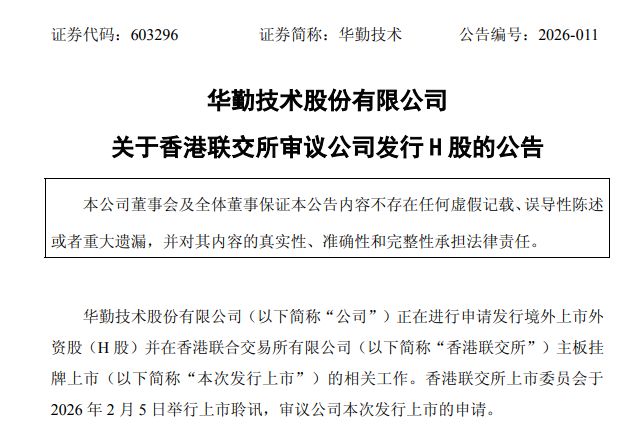
来源:瑞恩资本 华勤技术招股书链接: 来自上海的A股上市公司华勤技术(603296.SH)发布公告,港交所上市委员会于2026年2月5日举行上市聆 讯,审议公司本次发行H股并上市的申请。 华勤技术本次发行上市的联席保荐人已于2026年2月6日收到香港联交所向其发出的信函,其中指出香港 联交所上市委员会已审阅公司的上市申请,但该信函不构成正式的上市批准,香港联交所仍有对公司的 上市申请提出进一步意见的权力。 本次发行H股并上市尚需取得香港证券及期货事务监察委员会和香港联交所等相关监管机构、证券交易 所的最终批准,该事项仍存在不确定性。 华勤技术,于2025年9月16日在港交所递交招股书,于2026年1月28日获中国证监会境外上市备案通知书 (可发行不超过101,573,100股H股),中金公司、美林联席保荐。 华勤技术,作为一家全球领先、技术驱动的智能产品平台型公司,主要为全球领先科技公司提供涵盖移 动终端、计算及数据中心业务、AIoT和创新业务领域的智能产品。根据灼识咨询的资料,华勤技术是 全球领先的全栈智能产品ODM(原始设计制造)平台,在多个智能产品品类实现了全球第一,于2024年按 全球消费电子产品(包 ...


未知机构:浙商通信张建民国产算力主线强化产业正循环加速国产视频生成模-20260224
未知机构· 2026-02-24 03:20
Summary of Key Points from Conference Call Industry Overview - The conference call focuses on the domestic AI computing power industry, highlighting advancements in AI video generation and the increasing demand for computing resources during peak traffic events like the Spring Festival [1][2]. Core Insights and Arguments - The AI video generation model Seedance 2.0, developed by ByteDance, has evolved into a "director-level" tool, capable of producing multi-scene, movie-quality videos with original audio in just 60 seconds. This advancement transforms AI video into a significant productivity tool [1][2]. - During the Spring Festival, ByteDance leveraged high visibility from the New Year's Gala to achieve peak concurrent usage, emphasizing the growing demand for computing power [1][2]. - The "Doubao" AI cloud partnership with CCTV for the Spring Festival resulted in a total of 1.9 billion AI interactions, with peak activity reaching 633 billion tokens per minute. This indicates a substantial increase in consumer engagement and computing requests [3]. - Major companies like Tencent and Alibaba are competing for consumer entry points, with Tencent distributing 1 billion yuan in red envelopes and Alibaba launching a 3 billion yuan free order campaign, which enhances the consumption ecosystem and drives up computing demand [3]. - The domestic AI landscape is characterized by a strong demand-side pull, with the native adaptation of the Zhiyuan GLM-5 model to domestic GPU ecosystems, optimizing compatibility with seven major domestic chip platforms [3]. Important but Overlooked Content - Key companies to watch in the server segment include Inspur Information, ZTE, and Unisplendour. In the networking switch sector, focus on Huaqin Technology, Shengke Communication, Ruijie Networks, and StarNet Ruijie. For liquid cooling and power solutions, companies like Invec, Shenling Environment, and Kexin Innovation Source are noteworthy [4]. - A risk factor mentioned is the potential for industry progress to fall short of expectations, which could impact the overall growth and development of the AI computing power sector [5].
未知机构:浙商通信张建民国产算力主线强化产业正循环加速国产视频生成-20260224
未知机构· 2026-02-24 03:05
Summary of Key Points from the Conference Call Industry and Company Involved - The conference call focuses on the domestic AI video generation industry, specifically highlighting ByteDance's AI video generation model Seedance 2.0 and its impact on the market [1][2]. Core Insights and Arguments - **Advancement of Domestic Video Generation Models**: ByteDance's Seedance 2.0 has evolved into a "director-level" tool, capable of generating multi-shot, movie-quality videos with original audio in just 60 seconds. This represents a significant breakthrough in AI video production, transforming it into a productive asset [1][2]. - **Increased Demand for Computing Power During Spring Festival**: The competition for traffic during the Spring Festival has amplified the demand for computing power. ByteDance leveraged the high visibility of the Spring Festival Gala to achieve peak concurrent usage [2]. - **AI Interaction Metrics**: On New Year's Eve, as the exclusive AI cloud partner for the Spring Festival Gala, the AI interaction volume reached 1.9 billion, with a peak of 63.3 billion tokens per minute. This indicates a substantial increase in user engagement and computing resource consumption [2]. - **Competitive Strategies of Major Companies**: Tencent distributed 1 billion yuan in red envelopes to stimulate social engagement, while Alibaba's 3 billion yuan promotional campaign integrated its ecosystem, creating a consumable closed loop. These strategies highlight the fierce competition among major players for consumer entry points, driving up concurrent requests and token consumption [2]. - **Acceleration of the Domestic Large Model and Computing Power Cycle**: The Zhipu GLM-5 model is natively adapted to the domestic GPU ecosystem, having undergone deep optimization from the core to the inference framework, ensuring compatibility with seven major domestic chip platforms. This reflects the robust demand-side traction in the domestic AI sector and the gradual improvement of the ecosystem between domestic large models and computing power [2]. Other Important but Potentially Overlooked Content - **Key Companies to Watch**: The call emphasizes several companies in the server, networking, liquid cooling/power, and connector sectors, including Inspur Information, ZTE, Unisplendour, Huaqin Technology, and others, indicating a broad interest in the supporting infrastructure of the AI industry [3]. - **Risk Warning**: There is a cautionary note regarding the potential risks associated with the industry, particularly the possibility of slower-than-expected progress in technological advancements [4].
未知机构:浙商通信张建民国产算力主线强化产业正循环加速国产视频生-20260224
未知机构· 2026-02-24 02:35
Summary of Key Points from Conference Call Industry Overview - The conference call focuses on the domestic AI computing power industry, highlighting advancements in AI video generation and the increasing demand for computing resources during peak traffic events like the Spring Festival [1][2]. Core Insights and Arguments - The AI video generation model Seedance 2.0, developed by ByteDance, has evolved into a "director-level" tool, capable of producing multi-scene, movie-quality videos with original audio in just 60 seconds. This advancement transforms AI video into a significant productivity tool [1][2]. - During the Spring Festival, ByteDance leveraged high visibility from the New Year's Gala to achieve peak concurrent usage, emphasizing the growing demand for computing power [1][2]. - The "Doubao" AI cloud partnership with CCTV for the Spring Festival resulted in a total of 1.9 billion AI interactions on New Year's Eve, with peak activity reaching 633 billion tokens per minute. This indicates a substantial increase in consumer engagement and computing requests [3]. - Major companies like Tencent and Alibaba are competing for consumer entry points, with Tencent distributing 1 billion yuan in red envelopes and Alibaba launching a 3 billion yuan free order campaign, which enhances the consumption ecosystem and drives up computing demand [3]. - The domestic AI landscape is characterized by a strong demand-side pull, with the native adaptation of the Zhiyuan GLM-5 model to domestic GPU ecosystems, optimizing compatibility with seven major domestic chip platforms [3]. Important but Overlooked Content - Key companies to watch in the server sector include Inspur Information, ZTE, and Unisplendour; in the networking sector, focus on Huaqin Technology, Shengke Communication, Ruijie Networks, and StarNet Ruijie; for liquid cooling and power solutions, consider Invec, Shenling Environment, and Kexin Innovation Source [4]. - A risk factor mentioned is the potential for industry progress to fall short of expectations, which could impact the overall growth and investment potential in the sector [5].
中国电子元器件行业展望-中诚信国际
Sou Hu Cai Jing· 2026-02-16 02:10
Core Insights - The electronic components industry is expected to maintain stability over the next 12 to 18 months, driven by AI computing power and automotive electronics, while facing challenges such as tariff policy uncertainties and rising raw material prices [1][9][25] - Domestic policies like "trade-in" and "purchase subsidies" are effectively boosting downstream demand, countering adverse international trade conditions [1][9] - The industry is transitioning towards high-end products, with leading companies leveraging advanced production capacity and technological advantages [3][25] Industry Overview - The electronic components industry is projected to see a 17.70% year-on-year increase in export value in 2025, driven by a mild recovery in consumer electronics and rapid growth in automotive electronics and AI [2][17] - The PCB sector is entering a high-end cycle, propelled by demand from AI servers and automotive electronics, with a significant increase in capital expenditures [2][19] - The industry is characterized by a tiered structure, with leading firms dominating due to their high-end production capabilities and technological advantages [2][26] Financial Performance - In the first three quarters of 2025, 165 sample companies in the electronic components sector reported a revenue increase of 27.14% and a net profit increase of 36.06% year-on-year, with AI server-related companies contributing significantly to profit growth [2][30] - Despite a 20.88% decline in operating cash flow, capital expenditures rose by 44.48%, indicating a focus on capacity expansion and overseas layout [2][30] - The debt scale of sample companies has increased, but the financial leverage remains low, with a debt-to-asset ratio of 43.08%, indicating good solvency [2][30] Market Dynamics - The demand for electronic components is being driven by AI computing needs, with data center capital expenditures expected to grow significantly, leading to increased demand for high-bandwidth memory and high-speed optical modules [19][25] - The penetration rate of new energy vehicles has exceeded 50%, driving demand for SiC devices and automotive-grade MCUs [21][25] - Traditional consumer electronics are recovering, but their impact on overall industry growth is limited compared to automotive electronics and AI [19][25] Policy Environment - Domestic policies are expected to continue focusing on consumption stimulation and technological innovation, while global tariff policies remain uncertain [1][9] - The adjustment of export tax rebates in fields like photovoltaics and batteries starting April 2026 will increase short-term export costs but is aimed at pushing for high-end upgrades in the industry [1][11]

每周股票复盘:华勤技术(603296)授出243.31万股限制性股票
Sou Hu Cai Jing· 2026-02-14 18:31
Core Viewpoint - HuaQin Technology (603296) has adjusted its 2026 restricted stock incentive plan, reducing the number of recipients and the total shares granted due to four employees not meeting the eligibility criteria [1][2][3]. Company Announcement Summary - The company held its 23rd meeting of the second board of directors on February 12, 2026, where it approved adjustments to the 2026 restricted stock incentive plan [1][2][3]. - The number of incentive recipients was reduced from 468 to 464, and the total number of restricted shares granted was adjusted from 2.5275 million shares to 2.4331 million shares [1][2][3]. - The grant date for the restricted stock is set for February 12, 2026, with a grant price of 47.95 yuan per share [4][5]. - The incentive plan's recipients include 8 directors and senior management, who collectively received 188,800 shares, accounting for 7.76% of the total grant [3][5]. - The source of the restricted shares is from the company's repurchase of A-shares in the secondary market, with a lock-up period divided into three phases of 12, 24, and 36 months [4][5].
2026年私募调研十大个股出炉
财联社· 2026-02-14 12:19
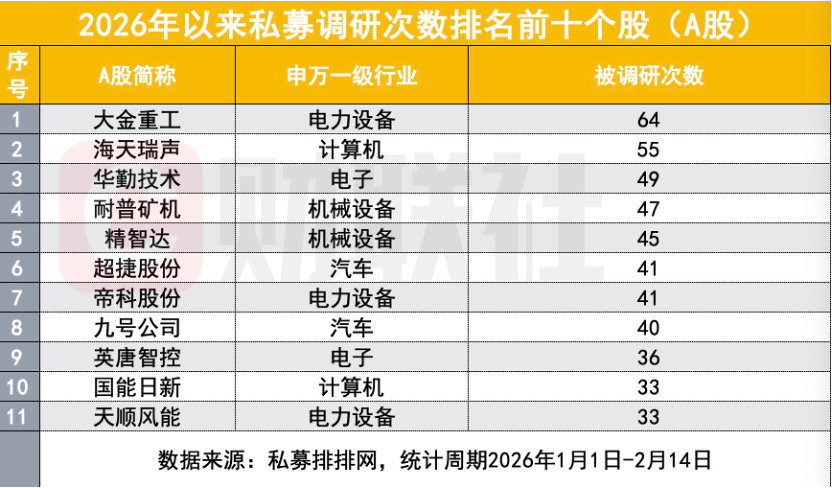
Core Insights - The article highlights the increasing enthusiasm of private equity firms in conducting research on A-share companies, particularly in strategic emerging industries such as new energy, high-end manufacturing, artificial intelligence, and semiconductors as the 2026 Spring Festival approaches [1] Group 1: Private Equity Research Trends - A total of 874 private equity firms have participated in A-share market research, covering 501 stocks across 28 industries, with a total of 2,845 research instances recorded as of February 14, 2026, indicating strong research interest at the beginning of the year [1] - Notable private equity giants, including Freshwater Spring, Gao Yi Asset, and Panjing Investment, have collectively focused their research efforts on sectors like new energy and high-end manufacturing [1] Group 2: Focused Research on Specific Stocks - 84 stocks have received at least 10 research instances from private equity firms, with Dajin Heavy Industry leading the list with 64 instances, making it the most researched A-share [2] - Other notable companies include Dike Co. and Tian Shun Wind Power, which received 41 and 33 research instances respectively, focusing on topics such as European offshore wind power growth and the impact of rising silver prices on performance [2][3] Group 3: Industry Distribution of Research - The mechanical equipment industry leads with 452 research instances, followed closely by the computer industry with 432 instances, indicating a strong interest in technology and high-end manufacturing sectors [5] - The electrical equipment, pharmaceutical, automotive, and basic chemical industries also received significant attention, each with over 100 research instances, reflecting a diversified investment approach with a focus on technology and manufacturing [5] Group 4: Active Private Equity Firms - 61 private equity firms have conducted at least 10 research instances, with 20 of them being large-scale firms, showcasing active engagement in the market [6] - Zhengyuan Investment leads with 53 research instances, focusing heavily on the computer industry, while other firms like Freshwater Spring and Gao Yi Asset have also shown significant research activity [7][8] Group 5: Market Outlook from Private Equity Firms - Several large private equity firms have expressed cautious optimism regarding the 2026 market outlook, emphasizing the importance of structural and performance-driven opportunities [9] - Freshwater Spring noted the strong performance of precious metals and industrial metals in 2025, suggesting that related industries may present investment opportunities in the current market [10] - Star Stone Investment anticipates a systemic revaluation of core Chinese assets, focusing on high-growth sectors such as artificial intelligence and high-end equipment manufacturing [11]

2026年私募调研十大个股出炉,淡水泉、高毅资产等百亿私募密集出动
Xin Lang Cai Jing· 2026-02-14 10:14
Group 1 - The core focus of private equity institutions is on sectors such as technology, manufacturing, and new energy, reflecting a strong research enthusiasm at the beginning of 2026 [1][2][6] - A total of 874 private equity securities institutions have participated in A-share market research, covering 501 stocks across 28 primary industries, with a cumulative research frequency of 2845 times [1][6] - The most researched stock is Dajin Heavy Industry, which has been surveyed 64 times, indicating its prominence among private equity interests [2][4] Group 2 - The mechanical equipment industry leads with 452 research instances, followed closely by the computer industry with 432 instances, showcasing a strong preference for these sectors [5][6] - The top ten stocks by research frequency include Dajin Heavy Industry, Haida Ruisheng, and Huajin Technology, all of which are leaders in their respective fields [4][6] - Private equity institutions are particularly focused on companies with strong growth potential and technological barriers, especially in the context of China's push for new industrialization [6][9] Group 3 - Notable private equity firms such as Zhengyuan Investment and Dazhuo Asset have been actively involved in research, with Zhengyuan leading with 53 research instances [7][8] - The research focus of major private equity firms includes sectors like machinery, electronics, and biomedicine, indicating a broad interest in technology and healthcare [8][9] - The overall sentiment among private equity firms is cautiously optimistic, emphasizing the importance of structural and performance-driven investment opportunities for 2026 [9][10]
瑞银深度调研报告:2026年中国两大产业主线:自主可控与海外扩张
Zhi Tong Cai Jing· 2026-02-13 13:31
Group 1: Core Insights - UBS's in-depth research in China identifies two main industry themes for 2026: self-sufficiency and overseas expansion [1] - The research covered various sectors including technology, industrial, healthcare, consumer, and utilities, visiting over 100 companies and industry experts [1] - The report highlights a shift in investor interest, with capital goods, media entertainment, and real estate development seeing increased research focus, while semiconductor and automotive parts sectors experienced a decline [1] Group 2: Technology Sector Insights - The technology sector is a key focus, with advancements in self-sufficiency moving from isolated breakthroughs to industry-wide collaboration [2] - AI capital expenditure is expected to grow steadily in 2026, driven by strong demand for AI applications and local semiconductor production [3] - Despite uncertainties regarding H200 GPU imports, domestic supply chains are adapting through technology substitution and demand upgrades [3] Group 3: Semiconductor Developments - The localization of China's semiconductor industry is accelerating, with significant progress in advanced etching/ deposition equipment, advanced packaging, and high-end analog chips [4] - Capital expenditure for wafer fabrication equipment (WFE) is projected to grow by 10-15% annually, driven by capacity expansion in advanced logic and memory wafer fabs [4] - Domestic manufacturers anticipate a substantial increase in storage capital expenditure in 2026, aligning with a global upcycle in the storage industry [4] Group 4: Overseas Expansion Trends - Multiple industries, including industrial, biopharmaceuticals, and consumer goods, are focusing on overseas expansion as a key growth strategy [6] - In the industrial sector, overseas orders for AIDC and renewable energy storage equipment are increasing significantly [7] - The healthcare sector is also prioritizing global expansion, with biopharmaceutical companies actively pursuing international collaborations and local sales team development [9] Group 5: Key Recommendations - UBS recommends several core stocks in the technology and semiconductor sectors, including Northern Huachuang (advanced etching/ deposition), Changdian Technology (advanced packaging), and Horizon Robotics (edge AI) [5][12] - In the healthcare sector, companies like WuXi AppTec (CRO/CDMO) and 3SBio (biopharmaceuticals) are highlighted as key beneficiaries of global expansion [12] - The consumer sector sees recommendations for Jason Furniture (overseas expansion) and Leap Motor (new energy vehicles), while Gree Electric Appliances is advised to sell due to margin pressures [12] Group 6: Overall Industry Outlook - The report concludes that China's industrial development in 2026 will be characterized by a dual focus on self-sufficiency in technology and overseas expansion in various sectors [13] - The integration of these two themes is expected to enhance China's economic globalization, with technology supporting overseas expansion and vice versa [13] - Investment opportunities are identified in sectors with low crowding and improving fundamentals, as well as in high-growth areas like AI and semiconductors [13]


中国电子元器件行业展望
Zhong Cheng Xin Guo Ji· 2026-02-13 09:56
Investment Rating - The investment outlook for the Chinese electronic components industry is stable, with overall credit quality expected to remain unchanged over the next 12 to 18 months [5][8]. Core Insights - The industry is driven by the recovery in consumer electronics, rapid growth in automotive electronics, and advancements in artificial intelligence, with traditional consumer electronics providing basic demand support but limited impact on overall growth [15][21]. - The industry is expected to gradually transition towards high-end products, with leading companies leveraging their high-end capacity and technological advantages to maintain a competitive edge [15][21]. - The overall credit risk in the electronic components industry is manageable, with no significant changes in ratings and no instances of bond extensions or defaults reported [22]. Industry Fundamentals Analysis - In 2025, domestic policies such as "trade-in" programs effectively boosted demand in the downstream market, helping to stabilize the electronic components industry amid fluctuating international trade conditions and tariff policies [9][11]. - The global competition landscape in the electronic components sector has remained stable, with significant growth in revenue and profits across various sub-sectors, although operating cash flow has declined [7][22]. - The industry is expected to see substantial order growth driven by automotive electronics and AI demand, with potential for upward adjustments in industry outlook if favorable conditions persist [7][8]. Credit Performance of Industry Enterprises - The financial performance of enterprises within the electronic components industry has improved, with revenue and profit growth reported, although operating cash flow has decreased [22][27]. - The average revenue growth for sample enterprises in the electronic components sector was 27.14% year-on-year, with significant contributions from AI-related demands [27][28]. - The debt scale of sample enterprises increased, but the overall financial leverage remains low, indicating good debt repayment capabilities [34][35].