
成都银行

Search documents
202601信贷收支表:大型银行短贷显著增加,中小银行信贷增长放缓
GUOTAI HAITONG SECURITIES· 2026-02-25 09:23
Investment Rating - The report assigns an "Accumulate" rating for the banking sector [5]. Core Insights - The report highlights that the Lunar New Year misalignment has disrupted the deposit growth rhythm, with a continued trend of personal fixed deposits migrating from small to large banks [2][4]. - On the asset side, credit growth continues to slow down, with a significant increase in short-term loans, particularly among large banks [4]. Summary by Sections Liabilities - The Lunar New Year misalignment has caused disturbances in deposit growth [3]. - Total deposits increased by CNY 3.5 trillion year-on-year, with demand deposits and fixed deposits increasing by CNY 2.5 trillion and decreasing by CNY 912 billion, respectively [5]. Assets - Total loans decreased by CNY 489.3 billion year-on-year, with large banks and small banks seeing decreases of CNY 213 billion and CNY 276.3 billion, respectively [4]. - Short-term loans increased by CNY 347.8 billion year-on-year, while medium and long-term loans decreased by CNY 377.2 billion [4]. - Large banks saw a year-on-year increase of CNY 419.7 billion in short-term loans, while small banks experienced a decrease of CNY 718 million [4]. Investment Recommendations - The report suggests focusing on three main lines for investment in the banking sector: 1. Identifying targets with expected performance growth, recommending banks like Ningbo Bank, China Merchants Bank, and Nanjing Bank [6]. 2. Emphasizing banks with convertible bond expectations, recommending Chongqing Bank and Changshu Bank [6]. 3. Continuing dividend strategies, recommending banks such as Bank of Communications and Jiangsu Bank [6].





银行经营周期如何定价各类资产?
GF SECURITIES· 2026-02-24 12:04
Investment Rating - The report assigns a "Buy" rating for the banking sector, indicating an expectation of stock performance exceeding the market by more than 10% over the next 12 months [58]. Core Insights - In 2025, the banking sector's asset growth is projected to be 8.01%, an increase from 6.52% in 2024, driven by factors such as fiscal stimulus, cross-border capital inflows, and the activation of maturing deposits [5][13]. - The report identifies two key cycles affecting asset pricing in banking: the bank expansion cycle and the interest margin cycle, suggesting a comprehensive analysis of these cycles [5][13]. - The debt cycle is characterized as a fundamental aspect of the bank expansion cycle, with a model proposed by Dalio outlining seven stages of a typical debt cycle, which can be influenced by external debt reliance [16][19]. - The report anticipates limited upward space for the debt cycle in 2026, with government leverage expected to increase by 5.89%, lower than the 7.6% projected for 2025 [35][36]. - The banking interest margin cycle is expected to stabilize in 2025, following two complete cycles since 2010, with a correlation observed between bank interest margins and the 30Y-10Y government bond spread [41][45]. Summary by Sections Bank Expansion Cycle - The asset growth rates for different types of banks in 2025 are projected as follows: state-owned banks at 11%, joint-stock banks at 4.74%, city commercial banks at 9.68%, and rural commercial banks at 5.17%, all exceeding the average growth rate [5][13]. - The report emphasizes the importance of understanding the relationship between bank assets and liabilities, highlighting that credit and debt expansion are cyclical and self-reinforcing [15][16]. Debt Cycle Analysis - The report outlines that the current debt cycle, which began in 2022, has lasted 16 quarters, surpassing previous cycles, and indicates a shift in leverage dynamics among enterprises, government, and households [35][36]. - The analysis includes a comparison of deflationary and inflationary debt cycles, noting that the U.S. faces greater inflationary pressures due to higher external debt reliance compared to China [21][19]. Interest Margin Cycle - The report notes that the banking interest margin has experienced significant fluctuations since 2010, with a stabilization phase expected to begin in 2025 [41][45]. - It highlights the impact of loan repricing cycles on interest margins, with a notable decline in loan rates observed in recent years [49][50].




再融资结构性松绑,银行业盈利改善
HTSC· 2026-02-24 05:10
Investment Rating - The report maintains an "Overweight" rating for the securities and banking sectors [9]. Core Insights - The report highlights the structural relaxation of refinancing policies, which is expected to improve profitability in the banking sector. The central bank's Q4 monetary policy report emphasizes the implementation of personal credit repair measures, supporting micro-entities [1][28]. - The report identifies investment opportunities in the order of securities > insurance > banking, with a focus on the potential for marginal improvements in the brokerage business due to the recent refinancing policy adjustments [12][24]. Summary by Sections Securities Sector - The optimization of refinancing measures announced by the exchanges is expected to lead to marginal improvements in the brokerage business, with leading firms likely to solidify their advantages through professional capabilities. The Chinese brokerage index performed better than the Hang Seng index during the holiday period, increasing by 0.20% [2][13]. - Recommended stocks include leading brokerages such as CITIC Securities, Guotai Junan, and GF Securities, as well as quality regional firms like Guoyuan Securities [3][12]. Insurance Sector - The report notes a mixed performance in the insurance sector, with property insurance companies showing gains while life insurance companies mostly declined. China Property & Casualty Insurance rose by 5%, while China Taiping fell by 4% [24][25]. - Investors are advised to focus on quality leaders in the insurance sector, with a preference for defensive stocks like China Ping An and China Life Insurance for conservative investors [24][25]. Banking Sector - The banking sector is experiencing a recovery in performance, with Q4 profits improving and net interest margins stabilizing. The report indicates a year-on-year increase in social financing, primarily due to the pre-positioning of government bonds and a rebound in off-balance-sheet financing [28][37]. - Recommended stocks include quality regional banks such as Nanjing Bank and Chengdu Bank, which are expected to perform well due to their strong fundamentals [3][28].





21家系统重要性银行名单出炉!钱未存在这些银行里,有危险吗?
Sou Hu Cai Jing· 2026-02-14 09:50
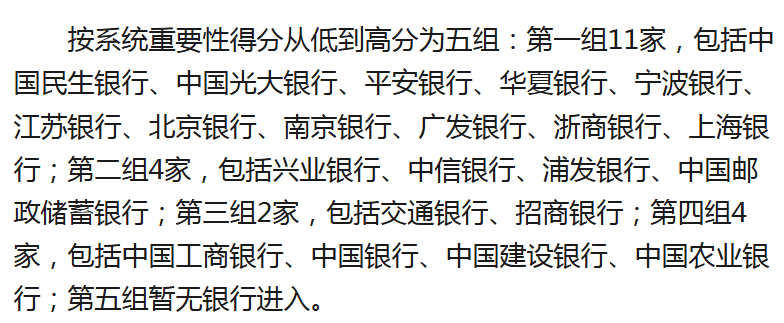
央行正式公布了最新的全国系统性重要银行名单,共计21家商业银行入选。需特别说明的是,该名单明确排除了中国人民银行以及三家政策性银行,唯有具 备商业性质的银行方能入围。 21家银行按重要性程度被划分为四组:第一组包含11家银行,如民生银行、上海银行等,属于级别最低的梯队;第二组有兴业银行、中信银行、浦发银行和 邮储银行4家;第三组则纳入交通银行与招商银行;第四组作为最高级别,仅包含中国工商银行、中国农业银行、中国银行、中国建设银行四大国有银行。 值得注意的是,第五组目前暂无银行入选。 从整体规模看,截至2024年6月,我国银行业金融机构法人总数达4425家,而系统重要性银行仅占21席,占比不足0.5%。 这种稀缺性恰恰印证了它们的特殊性——入选银行不仅品牌响亮,更以庞大体量形成"大而不能倒"的市场认知,任何一家若出现经营风险,至少会对区域金 融系统产生重大冲击,其资产规模与业务辐射范围均属行业顶尖。 对于普通储户而言,将资金存入这21家系统重要性银行堪称"安心之选"。即便是第一组银行,也因获得央行隐性背书而具备极高安全性,储户无需过度担忧 单一账户存款规模限制,可放心进行大额储蓄。 那么未入选的4000多家存款 ...

2026年1月金融数据点评:存款搬家加速,M1、M2增速大幅回升
GF SECURITIES· 2026-02-14 05:23
Investment Rating - The industry rating is "Buy" [6] Core Insights - The overall social financing growth slightly declined to 8.2% in January, while M1 and M2 growth rates significantly rebounded, with M1 growing by 4.9% and M2 by 9.0% [6][16] - Government net financing increased significantly by 2,831 billion yuan year-on-year, contributing to the overall social financing growth [6][17] - The report indicates a shift in deposit structure due to accelerated deposit migration, impacting M1 negatively while having limited effect on M2 [6][16] Summary by Sections Overall Situation - Social financing growth decreased slightly to 8.2%, while M1 and M2 growth rates increased significantly [15][16] - M1 and M2 growth rates rose by 1.1 percentage points and 0.5 percentage points respectively compared to the previous month [6][16] Government Sector - Fiscal strength showed a year-on-year decline, impacting overall financing dynamics [39] Household Sector - Demand remained stable year-on-year, with short-term loan demand increasing [39] Corporate Sector - Short-term loan demand increased year-on-year, while bill financing saw a significant reduction [39] Non-Bank Sector - The acceleration of deposit migration was noted, with non-bank deposits increasing by 1.45 trillion yuan year-on-year [6][39]
25Q4业绩回升向好,息差边际企稳
HTSC· 2026-02-13 08:38
Investment Rating - The industry rating is "Overweight" [8] Core Insights - The banking sector's profit growth is showing marginal improvement, with net interest margins stabilizing and asset quality remaining robust [5][3] - Major banks are leading the industry in asset expansion, with total assets growing by 9.0% year-on-year as of the end of Q4 2025 [2] - The net profit of commercial banks increased by 2.33% year-on-year in Q4 2025, driven by stable net interest margins and declining credit costs [3] - The non-performing loan ratio for commercial banks improved to 1.50%, indicating a healthy asset quality [4] Summary by Sections Asset Expansion - As of Q4 2025, major banks and joint-stock banks saw a marginal increase in total asset growth rates, while city and rural commercial banks experienced a slowdown [2] - The balance of inclusive small and micro loans increased by 11.0% year-on-year, although the growth rate has slowed [2] Profit Growth - The net profit growth of commercial banks improved by 2.3 percentage points compared to Q3 2025, with significant rebounds in city and rural commercial banks [3] - The annualized ROE and ROA for commercial banks were 7.78% and 0.60%, respectively, reflecting a slight decline year-on-year [2] Asset Quality - The non-performing loan ratio decreased by 2 basis points from the end of September 2025, with major banks showing a decline in non-performing loan ratios [4] - The provision coverage ratio for commercial banks was 205%, indicating a reasonable risk compensation ability [4] Investment Opportunities - The report recommends focusing on structural opportunities within the banking sector, highlighting specific banks such as Ningbo, Nanjing, and Chongqing Rural Commercial Bank for their strong performance and dividend yield [5][9]




丈量地方性银行(3):川渝132家区域性银行全梳理-20260212
GF SECURITIES· 2026-02-12 14:21
Investment Rating - The industry investment rating is "Buy" [2] Core Insights - The report analyzes 132 regional banks in the Sichuan-Chongqing area, highlighting the growth and structural changes in the banking sector [6][27] - The asset growth rates of major city commercial banks in the region are higher than those of listed city commercial banks, indicating a robust expansion [38] - Profitability metrics show that city commercial banks in the region have lower ROE compared to listed banks, while rural commercial banks outperform them [6][27] - Asset quality is slightly weaker in regional banks compared to listed banks, with higher non-performing loan ratios [6][27] Summary by Sections Economic Structure Analysis - Sichuan province is positioned as a key driver for western development, with a focus on enhancing the Chengdu-Chongqing economic circle [13][14] - In 2025, Chengdu's GDP is projected to account for 38.7% of the province's total, with significant growth in various sectors [15] Banking Sector Overview - The Sichuan-Chongqing region has 132 commercial banks, including 14 city commercial banks, 65 rural banks, and 51 rural commercial banks [27] - The asset growth rates for major city commercial banks in the region are 15.6% and 18.2%, surpassing the 14.2% growth of listed city commercial banks [38] Asset and Liability Structure - The proportion of loans to total assets has been increasing since 2016, with city commercial banks in Sichuan projected to have a loan ratio of 56.1% by 2024 [38][40] - The financial investment ratio for city commercial banks is on a downward trend, with a slight recovery noted in the first half of 2025 [40][46] Profitability and Asset Quality - The average ROE for city commercial banks in the region is 10.97%, lower than the 11.99% average for listed city commercial banks [6][27] - Non-performing loan ratios for city commercial banks in the region are higher than those of listed banks, indicating potential asset quality concerns [6][27] Capital Adequacy - Capital adequacy ratios for regional banks are comparable to those of listed banks, providing a safety margin for operations [6][27]
落实个人信用修复,防范化解风险
HTSC· 2026-02-11 02:25
Investment Rating - The industry investment rating is "Overweight" [8] Core Insights - The report emphasizes the importance of personal credit repair policies and the collaboration between fiscal and monetary policies to support high-quality development [3][5] - The social comprehensive financing cost has decreased, with the weighted average interest rate for new loans at approximately 3.15%, down 10 basis points from September [2] - The report highlights the rapid growth of asset management products, which is changing the deposit structure and maintaining liquidity stability [4] Summary by Sections Section 1: Personal Credit Repair and Risk Prevention - The central bank has introduced a one-time personal credit repair policy to support individuals with overdue information under 10,000 yuan after full repayment, aiming to stimulate micro-entity vitality [4] Section 2: Financing Costs and Credit Structure - The weighted average interest rates for general loans and corporate loans have decreased to 3.55% and 3.10%, respectively, while personal housing loan rates remained stable at 3.06% [2] - Loans for technology, green finance, inclusive finance, and digital economy sectors have shown significant year-on-year growth, with increases of 11.5%, 20.2%, 10.9%, and 14.1% respectively [2] Section 3: Fiscal and Monetary Policy Collaboration - The central bank has increased the quotas for re-loans aimed at technological innovation and small enterprises by 900 billion yuan, alongside a dedicated 1 trillion yuan for private enterprises [3] - The green loan balance reached 44.8 trillion yuan, reflecting a 20.2% year-on-year growth, indicating a robust green finance market [3] Section 4: Liquidity and Credit Governance - The report suggests observing liquidity from a combined perspective of asset management products and bank deposits, noting an 8.1% year-on-year growth in total liquidity indicators [4] - The overall social financing environment remains loose, supporting the ongoing credit repair initiatives [4] Section 5: Future Monetary Policy Directions - The central bank aims to maintain reasonable growth in financial totals and implement moderately loose monetary policies, focusing on price recovery and risk prevention [5] - The report outlines the need for improved market-based interest rate formation and transmission mechanisms to better reflect loan market rates [5]
详解2025年理财年度报告:规模稳步增长,增配现金类资产【中泰银行·戴志锋/邓美君/陈程】
Xin Lang Cai Jing· 2026-02-10 12:45
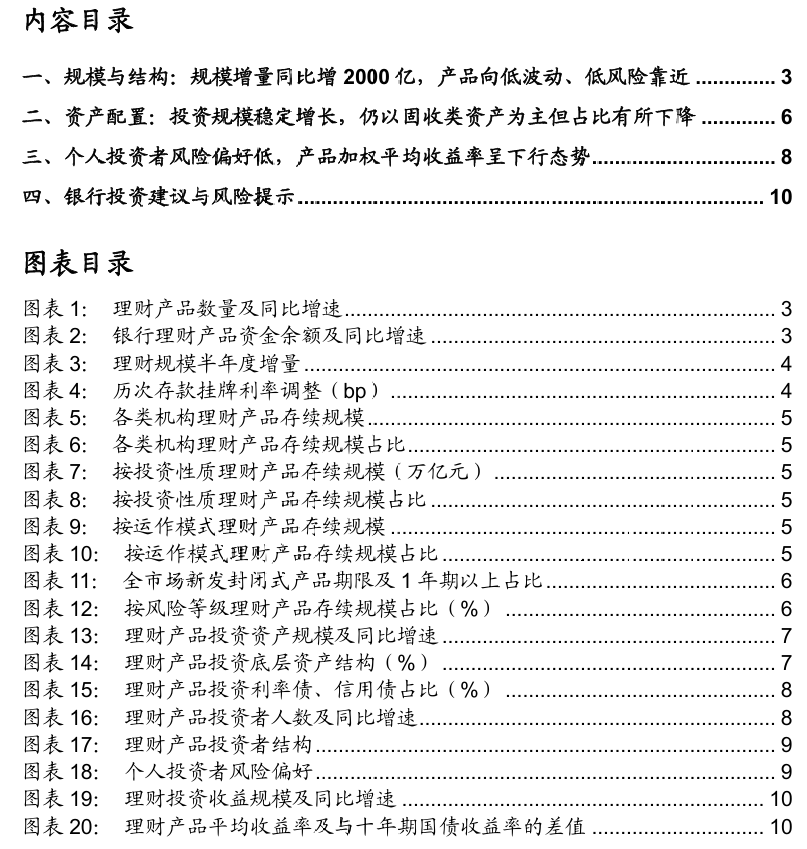
报告摘要 理财产品存续规模为33.29万亿元,同比增长11.2%,全年合计增量为3.34万亿元,全年增量较2024年增加0.19万亿元。 "存款搬家"背景下,全年规模增量同比增近2000亿。2025年,"存款搬家"的叙事持续被市场热议,在2022年后存款挂牌利率多次下降的背景下,到期定存 部分流向资本市场如基金、理财、资管等,而银行理财凭借其稳健和低波的特性,成为定存这类低风险偏好资金的重要流向,一定程度上带动理财市场规 模的提升。截至2025年末,理财产品存续数量为4.63万只,同比增长14.8%,创2020年以来最高水平;存续规模为33.29万亿元,同比增长11.2%。从增量 来看,2025年四个季度增量分别为-0.82亿元、1.53亿元、1.46亿元和1.16亿元,全年合计增量为3.34万亿元,较2024年增加0.19万亿元。 个人投资者风险偏好低,产品加权平均收益率受债市影响呈下行态势。1)截至2025年末,理财投资者数量达1.43亿人,同比增长14.4%。其中,个人投资 者、机构投资者分别为14127.32、194.16万人,分别同比增长14.3%、18.8%。2)个人投资者更青睐稳健型产品,202 ...
——从2025Q4前五大持仓看债基信用策略:震荡行情中的债基超额收益由何主导?
Huachuang Securities· 2026-02-10 12:17
Core Insights - The report analyzes the factors influencing bond fund returns in Q4 2025, highlighting the impact of credit strategies on yields [7] - It identifies a recovery in credit bond allocation sentiment compared to Q3, with a notable preference for mid-term credit varieties [12][34] - The report emphasizes the importance of leveraging strategies and the contribution of credit downgrades to overall portfolio returns [23][27] Group 1: Performance of Bond Funds - The average return rate for bond funds in Q4 2025 was 0.55%, a significant improvement from -0.32% in Q3 [12] - Credit bond allocation's contribution to returns increased, with a correlation coefficient of 0.0027 in Q4, up from 0.0024 in Q3 [12] - Mid-term bonds (3-5 years) showed a strong contribution to portfolio returns, with a U-shaped relationship between return rates and the average remaining maturity of heavy holdings [17][20] Group 2: Bond Fund Holdings Overview - By the end of Q4 2025, the total scale of credit bonds held by bond funds reached 5.27 trillion yuan, an increase of 303.2 billion yuan from the previous quarter [34] - The proportion of credit bonds in bond fund holdings rose to 63.21%, up from 61.00% in the previous quarter [34] - The average yield of heavy holdings in various bond categories generally declined, indicating a shift in investment strategy towards more liquid varieties [2][3] Group 3: Credit Bond Strategy Analysis - The report notes an increase in the frequency of holdings in government and financial bonds, while credit bond holdings decreased, suggesting a strategy shift towards more liquid assets [2] - The average remaining maturity of heavy credit bond holdings slightly lengthened, indicating a flexible adjustment in duration structure [2] - The report categorizes heavy credit bond holdings by yield ranges, identifying specific opportunities for investment based on implied ratings [4][8]