清陶能源

Search documents
中国2025年GDP同比增长5%
Dong Zheng Qi Huo· 2026-01-20 00:41
1. Report Industry Investment Ratings No specific industry investment ratings are provided in the given content. 2. Core Views of the Report - **Financial Markets**: Geopolitical risks, such as Trump's tariff policies and statements regarding Greenland, along with the upcoming Cook hearing, are influencing market risk - appetite. These factors are causing increased volatility in precious metals, US stock index futures, and other financial instruments. For example, the uncertainty around the Cook hearing and Trump's actions are leading to concerns about the Fed's independence and future inflation [11][14]. - **Commodity Markets**: Different commodities are facing various supply - demand situations. In the agricultural sector, South American soybean production is expected to be bountiful, while in the metal and energy sectors, factors like production changes, inventory levels, and geopolitical events are affecting prices. For instance, the potential release of Russian gasoline exports and the production adjustments of First Quantum Minerals in the copper market [32][52][45]. 3. Summaries by Relevant Catalogs 3.1 Financial News and Reviews 3.1.1 Macro Strategy (Gold) - **News**: Powell will attend the Cook hearing. Geopolitical risks and Trump's tariff policies have increased market risk aversion, driving up precious metals prices [11]. - **Investment Advice**: Short - term precious metals may experience increased volatility. With the gold - silver ratio at a low level, there are opportunities to go long [12]. 3.1.2 Macro Strategy (US Stock Index Futures) - **News**: Powell's attendance at the Cook case hearing and Trump's ambiguous statement about Greenland are increasing geopolitical risks. The potential dismissal of Cook may raise concerns about the Fed's independence [13][14]. - **Investment Advice**: During the US stock earnings season, volatility is expected to increase, and the US stock market is likely to oscillate at high levels [15]. 3.1.3 Macro Strategy (Stock Index Futures) - **News**: Premier Li Qiang held a symposium, emphasizing high - quality development and the implementation of more active fiscal and moderately loose monetary policies. China's GDP in Q4 2025 increased by 4.5% year - on - year, and the narrowing of price declines has boosted nominal GDP growth [16][18]. - **Investment Advice**: Hold long positions in stock index futures [19]. 3.1.4 Macro Strategy (Treasury Bond Futures) - **News**: December economic data was mostly below expectations, with a pattern of weakening overall, strong supply and weak demand, and domestic demand weaker than external demand. The bond market is expected to be volatile, and the probability of continued weakening after the oscillation is relatively high [20][22]. - **Investment Advice**: Be cautious when chasing up or betting on rebounds. Consider short - selling opportunities during rebounds [23]. 3.2 Commodity News and Reviews 3.2.1 Black Metals (Coking Coal/Coke) - **News**: The price of metallurgical coke in the Lvliang market is stable with a slight upward trend. Downstream steel mills have not responded to the coke price increase proposed by coke enterprises. Short - term spot prices are supported by downstream replenishment, but the upward momentum in the futures market is limited [24]. - **Investment Advice**: Expect short - term oscillations [24]. 3.2.2 Black Metals (Rebar/Hot - Rolled Coil) - **News**: In 2025, China's infrastructure investment decreased by 2.2% year - on - year, and real estate investment decreased by 17.2%. The terminal demand for steel products remains weak, and the fundamentals do not support a significant rebound in steel prices [25][28][29]. - **Investment Advice**: Adopt an oscillatory approach to steel prices. Hedge inventory at high prices if there is a rebound [30]. 3.2.3 Agricultural Products (Soybean Meal) - **News**: As of last Thursday, the Brazilian 25/26 soybean harvest rate was 2%. South American soybean production is expected to be abundant. Domestic soybean meal inventory has decreased but remains at a historically high level [31][32]. - **Investment Advice**: Expect weak oscillations in domestic and international futures prices [33]. 3.2.4 Non - Ferrous Metals (Lead) - **News**: Lead inventories in five major social warehouses increased. The low - inventory risk has been alleviated, and the fundamentals are weakening [34][35]. - **Investment Advice**: Consider short - selling opportunities at high prices. Adopt a wait - and - see approach for arbitrage [37]. 3.2.5 Non - Ferrous Metals (Zinc) - **News**: The zinc price is oscillating. Social inventories are rising, but the absolute increase is not large. Geopolitical risks need to be watched out for [38][39]. - **Investment Advice**: Adopt a wait - and - see approach for short - term single - side trading, and do not chase short positions. Wait and see for both monthly spread and internal - external arbitrage [39]. 3.2.6 Non - Ferrous Metals (Lithium Carbonate) - **News**: The second - phase project of Qingtao Energy's solid - state battery in Chengdu is progressing smoothly. The futures trading rules of lithium carbonate have been adjusted. The demand side is showing signs of strength, but the price transmission issue needs attention [40][41][42]. - **Investment Advice**: Focus on long - position opportunities at low prices after the trading volume and volatility stabilize [43]. 3.2.7 Non - Ferrous Metals (Copper) - **News**: South Mining Group focuses on gold and copper investments. First Quantum Minerals has lowered its copper production guidance. Geopolitical risks and macro - economic uncertainties are affecting copper prices [44][45][47]. - **Investment Advice**: Adopt a short - term wait - and - see approach. Look for long - position opportunities at low prices in the medium term. Wait and see for arbitrage [48]. 3.2.8 Non - Ferrous Metals (Tin) - **News**: The LME tin price is in a contango. The Shanghai Futures Exchange has adjusted the tin futures delivery warehouses. Supply uncertainties exist, and demand is weak [49][50][51]. - **Investment Advice**: Pay attention to December customs data, processing fees in Yunnan refineries, and the recovery of consumption [51]. 3.2.9 Energy and Chemicals (Crude Oil) - **News**: Russia may lift the gasoline export ban in February. As the Iranian situation cools down, the risk premium of oil prices is expected to decrease [52][53]. - **Investment Advice**: The short - term upward driving force for oil prices is weakening [54]. 3.2.10 Energy and Chemicals (Liquefied Petroleum Gas) - **News**: The weekly production of domestic liquefied petroleum gas increased slightly. The external market is relatively strong, but the upward space is limited [55]. - **Investment Advice**: Expect price sideways oscillations [56]. 3.2.11 Energy and Chemicals (Asphalt) - **News**: Asphalt refinery inventories decreased, while social inventories increased. Terminal demand is weakening, and the market is expected to be weak before the Spring Festival [56]. - **Investment Advice**: Expect short - term weak oscillations in asphalt prices [57]. 3.2.12 Energy and Chemicals (Styrene) - **News**: Pure benzene and styrene prices are rising. The increase in styrene is due to unexpected maintenance and export growth. Attention should be paid to geopolitical risks and US tariff policies [60]. - **Investment Advice**: Focus on long - position opportunities at low prices, but beware of risks such as excessive pure benzene imports and weak terminal purchasing [61]. 3.2.13 Energy and Chemicals (Urea) - **News**: The demand for urea from a sample of compound fertilizer producers in Shandong decreased. Urea production is expected to increase, and inventories are decreasing at a slower pace. Policy and demand factors are influencing prices [62][63]. - **Investment Advice**: Expect short - term oscillations in urea prices. The average price may decline in the next two weeks. Consider long - position opportunities in the 05 contract after the demand recovers [64]. 3.2.14 Energy and Chemicals (PVC) - **News**: The domestic PVC powder market price is slightly weak. The export tax - rebate policy will be cancelled in April, and domestic demand is expected to weaken before the Spring Festival [65][66]. - **Investment Advice**: Be bearish on PVC in the short term [66]. 3.2.15 Energy and Chemicals (Caustic Soda) - **News**: The price of caustic soda in Shandong decreased. Supply is abundant, and demand is weak. Inventories are high, and the market is under pressure [67][68][69]. - **Investment Advice**: Expect the caustic soda market to be under pressure before the Spring Festival [69].
30+固态电池企业新进展
DT新材料· 2026-01-19 22:33
Core Viewpoint - The article discusses the advancements and production timelines of solid-state batteries from various companies, highlighting the competitive landscape and technological progress leading up to 2026 and beyond [4]. Group 1: Company Developments - CATL launched the world's first sulfide solid-state battery pilot line in Hefei in May 2025, achieving an energy density of 450Wh/kg, with plans to expand production capacity to 50GWh by 2026 [6]. - Guoxuan High-Tech introduced its "Guan" quasi-solid-state square aluminum shell cell with an energy density greater than 300Wh/kg and initiated a pilot line with a 90% yield rate in May 2025 [8]. - EVE Energy's solid-state battery, "Longquan No. 2," achieved an energy density of 300Wh/kg and is aimed at high-end applications like humanoid robots and low-altitude aircraft [8]. - Aoxin Technology plans to launch its polymer solid-state battery with an energy density of 400Wh/kg by the end of 2025, targeting high-end new energy vehicles [8]. - Ganfeng Lithium announced the mass production of lithium sulfide, completing the last link in the solid-state battery ecosystem, with plans to launch solid-state batteries by the end of 2025 [9]. Group 2: Industry Trends - The solid-state battery industry is expected to enter a critical year in 2026, with many companies racing to achieve mass production [4]. - The article outlines the competitive landscape, with over 30 companies making significant strides in solid-state battery technology, indicating a robust growth trajectory in the sector [4]. - The anticipated commercialization of solid-state batteries is projected for around 2030, as supply chains mature and production processes are refined [6].





碳酸锂期货涨疯了,突破17万元大关!电池行业要变天了
Nan Fang Du Shi Bao· 2026-01-13 05:38
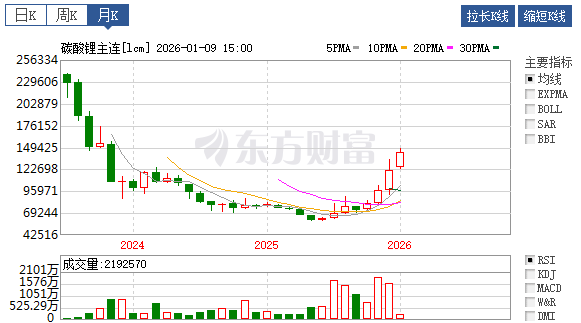
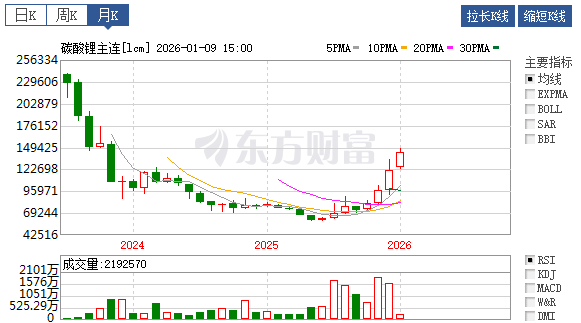
Core Insights - The price of lithium carbonate futures has surged, closing at 143,420 yuan per ton, marking an increase of over 120% from the low of 59,900 yuan per ton in June 2025, reaching a new high since November 2023 [2] - Demand for lithium is robust, with electric vehicle sales increasing by over 30% year-on-year and battery installation volumes rising by over 40%, while the energy storage market has seen a doubling in domestic project tenders [4] - Supply constraints are exacerbated by government policies limiting new mining projects and ongoing production ramp-ups at key lithium extraction projects [4][6] Supply and Demand Dynamics - The mismatch between supply and demand has intensified short-term supply tightness, with key expansion projects facing delays and maintenance in lithium iron phosphate enterprises leading to reduced output [4] - The Chinese government has implemented policies to control irrational competition in the lithium battery industry, further pushing lithium prices upward [6] Long-term Agreements and Market Structure - Leading battery companies are restructuring supply chains by signing long-term agreements to lock in costs, moving away from rigid pricing models to dynamic pricing mechanisms that allow for price fluctuations [8] - Major contracts, such as those between Longpan Technology and Chuangneng New Energy, involve significant sales commitments and are often tied to technology and price linkage clauses [9] Industry Consolidation - The industry is witnessing a shift towards consolidation, with smaller battery manufacturers being pushed out of the core supply chain as larger firms secure resources through binding agreements [11] - The market share of the top ten battery companies is expected to increase from 65% to 75% by 2025, with significant losses reported among smaller firms in the lithium iron phosphate sector [13] Alternative Technologies - High lithium prices are catalyzing the development of alternative battery technologies, such as sodium batteries, which are gaining traction in low-end energy storage and light-duty applications due to their cost advantages [15] - Investment in sodium battery projects has surged, with a total investment of approximately 61.5 billion yuan across 28 announced projects, indicating a shift in focus within the battery industry [17] Solid-State Battery Development - Solid-state battery technology is expected to see large-scale production around 2030, although it currently shows increased reliance on lithium compared to other battery types [18][22] - The high demand for lithium resources driven by solid-state battery development is prompting a reevaluation of the industry's cost structures and competitive dynamics [22]
GGII:2026年电池行业十大预测(下)
高工锂电· 2026-01-11 11:09
Core Viewpoint - The industry is transitioning from an emotion-driven phase to a rational value-return cycle by 2026 [3]. Group 1: Solid-State Battery Market - The shipment volume of semi-solid-state batteries is expected to exceed 15 GWh in 2026, driven by the acceleration of pilot and early production lines, such as those from GAC Group and Qingtao Energy [5]. - Significant improvements in solid-state battery core materials and processes are anticipated, with energy density reaching 400 Wh/kg by 2025, a notable increase from below 350 Wh/kg in 2024 [5]. - The market growth remains uncertain due to challenges in controlling consistency in oxide and polymer routes, affecting product yield and delivery stability [5]. - Full solid-state batteries will enter intensive road testing phases but are unlikely to achieve mass production within the year due to technical bottlenecks and high costs [6]. Group 2: IPO Trends in Lithium Industry - A wave of IPO applications from lithium industry chain companies is expected in 2026, with leaders in materials, equipment, energy storage integration, and solid-state batteries likely to benefit first [6]. - Material companies are seeing an expanded supply-demand gap for high-end products, accelerating the IPO process for those with technological advantages and strong customer ties [7]. - Resource companies with lithium mining capabilities are more likely to restart IPOs due to inventory reduction and rising price levels [8]. - Equipment companies are benefiting from the recovery in battery factory expansion demands, focusing on semi-solid and full solid-state battery equipment [8]. - Energy storage integration companies are transitioning to a profitable model based on technology and service premiums, increasing their chances of successful IPOs [8]. Group 3: Sodium-Ion Battery Market - The shipment volume of sodium-ion batteries in China is projected to exceed 10 GWh in 2026, doubling year-on-year, driven by rising lithium battery material prices and cost advantages in energy storage applications [10]. - Sodium batteries are expected to address performance limitations of lithium batteries, particularly in low-temperature environments, making them suitable for northern markets [10]. - Leading companies like CATL are accelerating their sodium battery deployment across various sectors, including energy storage and electric vehicles [10]. - The NFPP sodium-ion battery is expected to dominate with over 80% market share due to its advantages in stability and cost [10]. Group 4: Cylindrical Battery Market - The shipment volume of cylindrical batteries in China is expected to grow over 50% year-on-year, surpassing 45 GWh, with energy storage being a key growth area [12]. - The demand for cylindrical batteries is driven by the need to replace square cell structures in home storage products, providing a low-cost and high-safety solution [12]. - Rapid capacity release in 2025 is expected to support supply, with major companies focusing on different market segments, ensuring a breakthrough in shipment volumes [12]. Group 5: Silicon-Based Anode Materials - The application of CVD silicon-based composite anode materials in the 3C digital battery market is expected to exceed 50% by 2026, leading to significant growth in output [15]. - The demand for higher energy density and lighter batteries in 3C products is driving the adoption of silicon-carbon composite anodes [15]. - However, technological challenges remain in the large-scale application of these materials in power batteries, particularly regarding consistency in manufacturing processes [15].

半年翻倍涨,逼近15万元/吨!锂价疯涨背后,电池行业变了
Nan Fang Du Shi Bao· 2026-01-09 17:07
Core Viewpoint - Lithium carbonate futures prices have surged, closing at 143,420 yuan per ton on January 9, 2026, marking a 120% increase from the low of 59,900 yuan per ton in June 2025, and reaching a new high since November 2023, becoming a significant price anchor in the new energy industry chain [2] Supply and Demand Dynamics - Demand for lithium has skyrocketed, with new energy vehicle sales increasing over 30% year-on-year and battery installation volumes rising over 40%. The energy storage market has also seen a doubling in domestic project bidding and a surge in overseas orders, leading to a supply-demand mismatch and short-term supply tightness [4] - The Chinese government has restricted the approval of new mining projects without self-built mines and tailings disposal facilities, impacting key expansion projects like Ganfeng Lithium's Cauchari-Olaroz and Tianqi Lithium's Sichuan expansion, which are currently ramping up production [4][6] Cost Pressures and Market Reactions - The solid waste management action plan released by the State Council has added to industry cost pressures, potentially increasing operational costs for companies. A recent meeting by the Ministry of Industry and Information Technology aimed to curb irrational competition in the lithium battery industry, further altering market expectations regarding overcapacity and driving lithium prices up [6] - Major battery companies are responding to rising raw material prices by increasing product prices, with some companies like Suzhou Dejia Energy announcing a 15% price hike. A shift towards long-term agreements in the supply chain is evident, with leading firms locking in costs through dynamic pricing mechanisms linked to market indices [7] Industry Restructuring - The deep binding agreements between leading battery companies and suppliers are excluding smaller players from the core supply chain, indicating a new round of industry consolidation. The market share of the top ten battery companies is expected to rise from 65% to 75% by 2025, with smaller firms facing accelerated exit from the market [8][10] - Recent acquisitions in the lithium resource sector, such as Salt Lake Co.'s acquisition of a controlling stake in China Salt Lake and Shengxin Lithium Energy's purchase of a stake in Qicheng Mining, highlight the increasing value of lithium resources [10] Technological Shifts - High lithium prices are catalyzing a shift towards alternative battery technologies, such as sodium batteries, which are gaining traction in mid-to-low-end energy storage and light-duty applications due to their cost advantages and stable material supply [11][13] - Investment in sodium battery projects has surged, with a total investment of approximately 61.5 billion yuan across 28 announced projects, indicating a significant shift in focus within the battery industry [13] - Solid-state battery technology, while initially seen as a potential solution to reduce lithium dependency, is showing increased lithium usage compared to lithium iron phosphate batteries, with projections for large-scale production expected around 2030 [14][16] Conclusion - The lithium carbonate price surge is not merely a short-term speculative trend but reflects a systemic revaluation based on real supply-demand dynamics, cost structures, and industry power shifts. Companies with resource advantages, technological depth, and cost discipline are transitioning from price takers to rule makers in this evolving landscape [10][16]

半年翻倍涨 逼近15万元/吨!锂价疯涨背后 电池行业变了
Nan Fang Du Shi Bao· 2026-01-09 15:58
在2026年的开年,碳酸锂期货价格再度以持续上涨刷新热度。1月9日,碳酸锂主连以每吨143420元的价格收盘,较2025年6月5.99万元/吨的低点累计上涨 120%以上,创下自2023年11月以来的新高。 而这一逼近15万元/吨关口的价格,也成为新能源产业链上最引人注目的"价格锚",对行业上下游正在产生直接影响。 供给短期不足需求火力全开 锂价驶入上行通道 "2025年至现在的需求可谓是火力全开:新能源车销量同比增长超过30%,动力电池装车量涨幅超过40%,而储能市场成了绝对的黑马,国内项目招标量翻 了一倍,海外订单也同步暴涨,产量占比已经要赶上动力电池了,头部企业的订单早就排到了2026年。"一位资本市场分析师这样评价此轮碳酸锂涨价背后 的推动因素。 在某业内人士看来,供需端口的错配进一步加剧了短期供给的紧张。"今年1月4日国务院印发文件,提出原则上不再批准建设无自建矿山、无配套尾矿利用 处置设施的选矿项目。赣锋锂业阿根廷Cauchari-Olaroz盐湖提锂项目、天齐锂业四川遂宁二期等关键扩产项目均处于爬坡阶段,短期难以形成有效供给。年 前铁锂企业集中检修也导致减产。" 此外,国务院2025年12月27 ...
从小切口透视大行业 ——2025年汽车供应链变革“风暴眼”
Zhong Guo Qi Che Bao Wang· 2026-01-06 02:18
Core Insights - The automotive industry's core competitiveness is shifting from traditional mechanical performance to smart technology, safety, and integration with energy networks [3] - Eight key component areas have emerged as focal points for change in the automotive supply chain by 2025 [3] Group 1: AI and Smart Technology - AI large models, including VLA and VLM, are reshaping the perception, decision-making, and interaction systems in smart vehicles [4] - Companies like Li Auto and XPeng are actively developing and deploying VLA-based autonomous driving systems, with plans for mass production by 2026 [4] - The competition in AI models is intensifying, with a focus on the underlying support systems like computing power and data [4] Group 2: Vehicle-to-Grid (V2G) Interaction - V2G is becoming a hot topic as electric vehicles can act as distributed energy storage units within new energy systems [5] - Government policies are driving the adoption of V2G, with pilot projects and plans to expand the scope of V2G applications by 2027 [5][6] - Companies like GAC Group are implementing V2G functionalities in their models and developing charging infrastructure to support this transition [6] Group 3: Battery Safety Standards - The new national standard for electric vehicle batteries, effective July 2026, emphasizes safety by requiring batteries to be "non-flammable and non-explosive" [7] - The updated standards will compel battery manufacturers to innovate in materials, design, and production processes to meet stricter safety requirements [7] - Leading battery companies like BYD are already adapting to these new standards, which will enhance safety and consumer trust in electric vehicles [7] Group 4: Door Handle Innovations - Electric hidden door handles are becoming a focal point due to safety concerns arising from their failure in collision scenarios [8][9] - New regulations are being proposed to ensure that all door handles, including electronic ones, have a mechanical release function for emergency situations [9] Group 5: Solid-State Batteries - Solid-state batteries are gaining traction due to their advantages in energy density and safety, with several companies planning to launch new products or production lines [10] - The development of solid-state batteries is seen as a key competitive factor for companies in the next generation of electric vehicles [10][11] Group 6: Human-Car-Home Ecosystem - The "Human-Car-Home" ecosystem is emerging, integrating automotive, home, and personal devices into a cohesive smart system [12] - Companies like Haier and Midea are collaborating with automotive brands to create interconnected systems that enhance user experience [12][13] Group 7: Humanoid Robots - The automotive industry is increasingly intersecting with humanoid robotics, with companies exploring the integration of robotic technology into manufacturing processes [14][15] - The demand for precision and adaptability in manufacturing is driving the development of humanoid robots tailored for automotive applications [14] Group 8: Zero-Gravity Seats - Zero-gravity seats are becoming a key feature in mid to high-end vehicles, enhancing passenger comfort and experience [16] - The lack of standardized regulations for these seats poses challenges, particularly regarding safety during vehicle operation and collisions [16]

全球首款搭载半固态电池 量产车型在乌海市交付
Xin Lang Cai Jing· 2026-01-03 19:18
Group 1 - The world's first mass-produced vehicle equipped with a semi-solid-state battery, the SAIC MG4 Semi-Solid Anxin Edition, has been delivered in Uhu City, highlighting a significant advancement in battery technology [1] - The semi-solid-state battery features a new manganese-based cathode material produced by a local company in Uhu, which enhances safety by reducing the risk of thermal runaway compared to traditional lithium batteries [1] - Qingtao Energy, a leader in the solid-state battery sector, has established production bases in Uhu and other locations, playing a crucial role in the development and mass production of semi-solid-state battery materials [1] Group 2 - The Haibowan District has focused on strategic emerging industries such as new energy and new materials, successfully attracting high-quality enterprises through targeted investment and policy support [2] - The district aims to deepen industrial cluster development and promote the integration of the solid-state battery industry with local renewable energy and energy storage sectors, striving to establish a new hub for solid-state battery production in Northwest China [2]
国标公示:取消“半固态电池”分类
高工锂电· 2025-12-31 11:56
Core Viewpoint - The article discusses the establishment of a national standard for solid-state batteries in China, which aims to clarify the definitions and classifications of solid-state and semi-solid batteries, thereby providing a unified framework for the industry [3][4][9]. Group 1: National Standard Development - On December 31, 2025, China's first national standard for solid-state batteries for electric vehicles entered the public consultation phase, marking a significant step in the standardization of this technology [3]. - The standard will provide a unified definition, classification methods, and quantitative indicators to determine whether a battery qualifies as a solid-state battery [4][8]. - The drafting committee includes over 30 organizations from the entire supply chain, including major battery manufacturers and automotive companies, indicating a broad consensus among key industry players [5][6]. Group 2: Classification and Testing Criteria - The standard introduces a three-part classification system for batteries: liquid, mixed solid-liquid, and solid-state, eliminating the independent categories of "semi-solid" and "fully solid" batteries [10][12]. - A weight loss rate test with a threshold of 0.5% is established to determine if a battery can be classified as solid-state, with specific testing procedures outlined [14][15]. - The classification will also consider the type of solid electrolyte, ion conduction type, and application scenarios, allowing for differentiated product development in various fields [13][17]. Group 3: Industry Implications - The introduction of this standard is expected to accelerate the industrialization of solid-state batteries, with major automotive companies planning to validate and produce these batteries by 2026 and 2027 [19]. - The solid-state battery concept index has seen a nearly 60% increase this year, reflecting strong market interest and investment in this technology [20]. - The standard aims to provide a common language for academic research and technology development, set baseline expectations for product marketing, and establish conditions for future performance and safety standards [22][24].
昆山开发区:红色引擎,铸就“最强阵地”
Yang Zi Wan Bao Wang· 2025-12-31 10:45
Core Viewpoint - The development zone in Kunshan is leveraging party-building work as a core engine for high-quality development, implementing innovative practices to integrate development and party work effectively [1]. Group 1: Organizational Structure - The development zone has established a unique "7+61+N" organizational management system, achieving 100% coverage of party organizations and work in 3,127 non-public enterprises, including all key enterprises such as listed companies and specialized ones [2]. Group 2: Talent Development - The effective integration of party organization secretaries and union chairpersons, with over 50% of such positions held by the same individuals, has enhanced leadership effects, while 40 skilled talents have joined party organization leadership through a cross-appointment mechanism [5]. Group 3: Industrial Empowerment - An innovative organizational system combining "industry chain party committees, working special classes, and enterprise assistance officers" has been established, leading to significant advancements in new industries, such as the introduction of the first G4.5 Micro LED production line in the country [8]. Group 4: Economic Performance - In the first three quarters of the year, the development zone's GDP grew by 6.0%, surpassing provincial and municipal averages, with industrial investment and foreign capital inflow increasing by 25% and 26%, respectively [10]. Group 5: Technological Innovation - The development zone has established 22 platforms for tackling technical challenges, resulting in over 100 technical breakthroughs and more than 2,000 patent applications, showcasing its manufacturing capabilities [12]. Group 6: Community Integration - The development zone is exploring a dual-integration model between new employment group party organizations and community party organizations, leading to the establishment of 25 service stations and a significant reduction in disputes in key areas by 60% [14]. Group 7: Overall Impact - The solid party-building work in Kunshan is contributing to a comprehensive approach to industrial upgrading, social governance, technological innovation, and public service, continuously writing a new chapter in the "Kunshan Road" of high-quality development [16].