迪哲医药

Search documents
医药BD交易持续火热,还有哪些潜在标的值得关注?
Xin Lang Cai Jing· 2026-02-24 11:06
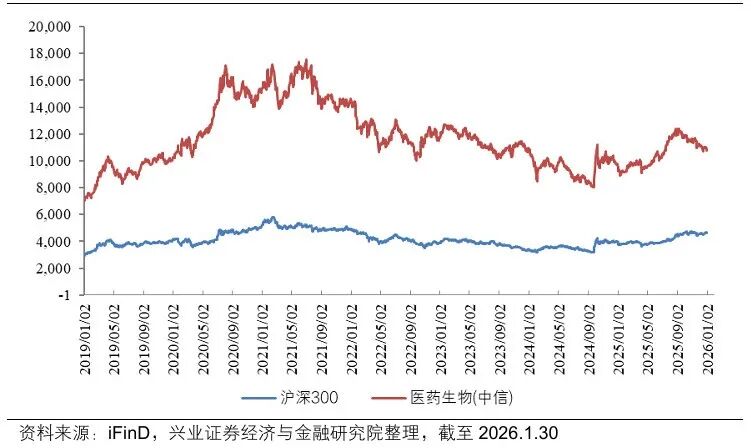
Core Insights - The Chinese innovative pharmaceutical industry is transitioning from "catching up" to "keeping pace" and even "leading" on a global scale, with a significant increase in business development (BD) transactions indicating enhanced international competitiveness [2][11][12] - The trend of BD transactions is accelerating, with record-breaking transaction sizes and optimized structures, marking a shift from single product licensing to platform-based and systematic collaborations [2][11] - The demand for Chinese innovative assets from global pharmaceutical companies is increasing due to challenges such as patent cliffs and declining R&D returns, creating a supportive environment for the high activity in the BD market [12] Recent Market Performance and BD Transaction Analysis - In January 2026, the pharmaceutical and biotechnology sector outperformed the CSI 300 index, rising by 2.97% compared to the index's 1.65% increase, reflecting a revaluation of the innovative drug industry [14] - A notable BD transaction occurred on January 30, 2026, when CSPC Pharmaceutical Group signed a collaboration and licensing agreement with AstraZeneca, involving a $1.2 billion upfront payment and potential milestone payments totaling up to $35 billion for development and $138 billion for sales [15][16] - This transaction exemplifies a platform-based approach, including not only the clinical-stage product SYH2082 but also three preclinical products and four new collaboration projects leveraging CSPC's proprietary technologies [15][16] Potential BD Target Value Identification and Screening Logic - Identifying potential BD targets should focus on differentiated technological barriers, such as the proprietary ADC technology of Kelun-Biotech, which has shown promising clinical data for international licensing [19] - The quality of proof of concept (POC) data is crucial, as seen with Innovent Biologics' IBI363, which has demonstrated efficacy in challenging tumor types, indicating significant commercial potential [19][20] - Global clinical demand and competitive landscape for indications are important, with companies like 3SBio and Diligent Pharma showing strong potential in weight management and oncology, respectively, enhancing their market entry opportunities [20] Conclusion - The Chinese innovative pharmaceutical industry is entering an "Innovation 3.0 era," characterized by a shift from single product licensing to systematic technology platform outputs and deep strategic alliances [21] - The current high activity in BD transactions reflects the industry's strengthening capabilities and serves as a catalyst for value reassessment, positioning companies with technological advantages and high-quality clinical data for significant roles in the global pharmaceutical landscape [21]


智通A股限售解禁一览|2月23日


智通财经网· 2026-02-23 01:02
Core Viewpoint - On February 23, a total of 34 listed companies had their restricted shares unlocked, with a total market value of approximately 19.007 billion yuan [1] Group 1: Restricted Share Unlocking Details - Luzhou Laojiao (000568) had 2.0425 million shares unlocked under equity incentive restrictions - AVIC Xi'an Aircraft Industry (000768) had 4.3606 million shares unlocked under equity incentive restrictions - Hubei Energy (000883) had 19.2779 million shares unlocked under equity incentive restrictions - Jining Pharmaceutical (000919) had 1.92 million shares unlocked under equity incentive restrictions - Guangji Pharmaceutical (000952) had 2.5209 million shares unlocked under equity incentive restrictions - China Software (600536) had 57,200 shares unlocked under equity incentive restrictions - Xinhua Medical (600587) had 1.7845 million shares unlocked under equity incentive restrictions - Baoxin Software (600845) had 10.2578 million shares unlocked under equity incentive restrictions - China Railway (601390) had 55.9338 million shares unlocked under equity incentive restrictions - China Communications Construction (601800) had 5.593 million shares unlocked under equity incentive restrictions - StarNet Ruijie (002396) had 2.8342 million shares unlocked under equity incentive restrictions - Lopuskin (002333) had 22.3212 million shares unlocked under A-share issuance to legal persons - Wanbangda (300055) had 33.6538 million shares unlocked under A-share issuance to legal persons - Hangyang Co., Ltd. (002430) had 5.2049 million shares unlocked under equity incentive restrictions - Taijia Co., Ltd. (002843) had 949,600 shares unlocked under equity incentive restrictions - Nanda Optoelectronics (300346) had 130,000 shares unlocked under equity incentive restrictions - Anhui Natural Gas (603689) had 2.5064 million shares unlocked under equity incentive restrictions - Zhongyan Dadi (003001) had 97,200 shares unlocked under equity incentive restrictions - Yuanxiang New Materials (301300) had 30.2983 million shares unlocked with extended lock-up period - Yidao Information (001314) had 88.6187 million shares unlocked under pre-issuance restrictions - Tongda Electric (603390) had 579,500 shares unlocked under equity incentive restrictions - Yangzhou Jinqiao (603307) had 50 million shares unlocked under pre-issuance restrictions - Aili Home (603221) had 2.29 million shares unlocked under equity incentive restrictions - Zhili Fang (301312) had 333,900 shares unlocked under equity incentive restrictions - Kuntai Co., Ltd. (001260) had 83.25 million shares unlocked under pre-issuance restrictions - Entropy Technology (301330) had 92.5223 million shares unlocked with extended lock-up period - Yatong Precision (603190) had 596,100 shares unlocked under pre-issuance restrictions - Sanwang Communication (688618) had 87,400 shares unlocked - Longxun Co., Ltd. (688486) had 30.6312 million shares unlocked - Dize Pharmaceutical (688192) had 991,100 shares unlocked - Haohan Depth (688292) had 57.5177 million shares unlocked - Haizheng Biomaterials (688203) had 78.5601 million shares unlocked - Diaomicro (688381) had 55.9536 million shares unlocked - Zhongrun Optics (688307) had 29.8507 million shares unlocked [1]
下周关注丨苹果公司举行年度股东大会,这些投资机会最靠谱
Di Yi Cai Jing· 2026-02-22 01:09
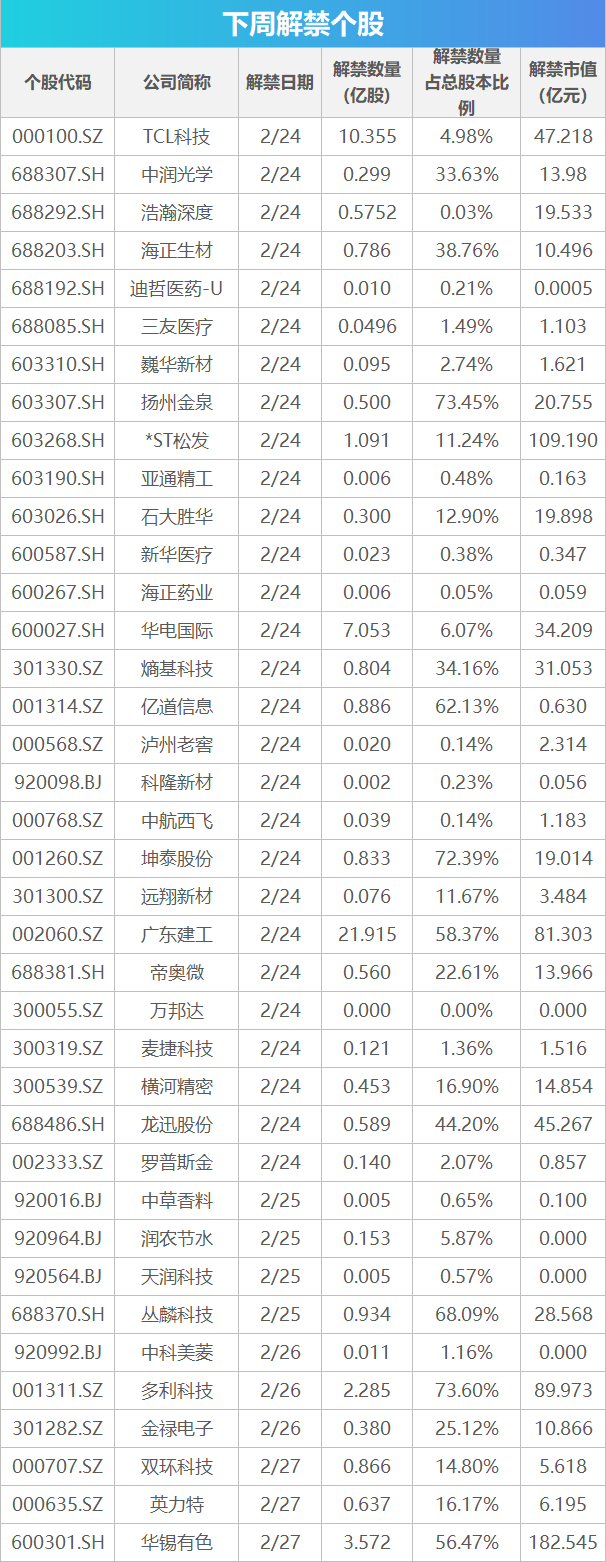
Group 1 - The 1-year and 5-year LPR will be announced on February 24, with the current rates remaining unchanged at 3.0% and 3.5% respectively, marking the eighth consecutive month of stability [2] - The domestic refined oil price adjustment window will open on February 24, following a previous increase of 205 CNY/ton for gasoline and 195 CNY/ton for diesel on February 3 [3] Group 2 - The MSCI China Index will undergo adjustments effective February 27, 2026, including the addition of 37 stocks and the removal of 16 stocks [4] - Apple Inc. will hold its annual shareholder meeting on February 24, focusing on new product development, AI technology implementation, and supply chain adjustments [5] Group 3 - A total of 56.43 billion shares of restricted stocks will be released in the A-share market from February 24 to 27, with a market value exceeding 87 billion CNY [6] - Notable companies with significant restricted stock releases include Huaxi Nonferrous and *ST Songfa, each exceeding 10 billion CNY in market value [6] Group 4 - Two new stocks will be issued in the week following the holiday, with Hai Fei Man on February 24 and Gu De Electric Materials on February 25 [8]

跟着大资金选股!公募调仓科创板,猛攻电子、医药
市值风云· 2026-02-14 10:09
Core Viewpoint - The article discusses the current funding logic in the market, highlighting the significant movements of public funds in the technology sector, particularly in the semiconductor and biopharmaceutical industries, as they adjust their portfolios based on performance and valuation metrics [3][8]. Group 1: Public Fund Movements - Public funds have shown a notable shift in their holdings, particularly in the STAR Market, with the STAR 50 Index rising by 12.1% this year [3][4]. - The total market capitalization of STAR Market companies reached 10.4 trillion yuan, with the technology sector dominating, accounting for 62.1% of the total market cap [5][6]. - The semiconductor industry remains the core focus for fund allocation, with 12 companies in the sector having a market capitalization exceeding 10 billion yuan [9][11]. Group 2: Semiconductor Sector Insights - The market's pricing anchor for the semiconductor sector has shifted from "valuation expansion" to "performance realization," emphasizing the importance of actual earnings [13][14]. - Key drivers for future growth in the semiconductor sector include strong order backlogs, profit growth through acquisitions and expansions, and sustained price increases in advanced processes [13][14]. - Public funds have significantly increased their holdings in semiconductor materials, chip design, and equipment, with companies like ShenGong Co. seeing an 11% increase in fund holdings [15][21]. Group 3: Biopharmaceutical Sector Insights - The biopharmaceutical sector is a critical area for public funds, with major holdings in companies like BeiGene and United Imaging Healthcare, although the sector has faced a reduction in holdings for several key companies [24][26]. - The article notes that innovative drug companies are currently under pressure, with significant reductions in holdings observed in companies like BaiLi TianHeng and RongChang Biopharma [26][28]. - Despite the challenges, companies with strong earnings potential and innovative drug pipelines are still attracting interest from public funds, indicating a selective investment approach [35][40].





让患者用上更多新药好药
Xin Hua Ri Bao· 2026-02-13 21:39
Core Insights - The meeting held in Jiangsu aimed to facilitate communication between key hospitals and pharmaceutical companies to accelerate the implementation of innovative drugs and support high-quality development in the pharmaceutical sector [1] Group 1: Innovative Drug Development - Jiangsu's local pharmaceutical companies have consistently ranked first in the number of innovative drugs included in the national medical insurance directory, with 41 drugs expected to be approved by 2025, accounting for over one-third of the national total [1] - Among these, 21 are significant Class 1 innovative drugs, with 18 being original research drugs developed in Jiangsu, highlighting the province's core competitiveness in pharmaceutical innovation [1] Group 2: Economic Impact - The biopharmaceutical industry in Jiangsu has reached nearly 500 billion yuan in output value, maintaining its position as the leading province in the country [2] - The sales revenue of Zhengda Tianqing Pharmaceutical Group reached 22.5 billion yuan last year, contributing 2.18 billion yuan in taxes to Jiangsu [2] Group 3: Policy Support and Market Access - The Jiangsu government is actively creating platforms for communication to eliminate barriers for innovative drugs entering hospitals, which is crucial for enhancing clinical application [4] - By 2025, it is projected that 399 out of 406 national negotiated drugs will be sold and used in designated medical institutions in Jiangsu, with over 80% of the sales amount coming from these institutions [4] Group 4: Future Initiatives - Jiangsu plans to introduce an artificial intelligence application plan for the biopharmaceutical cluster this year, aiming to cultivate 1-2 industry models and gather typical AI-enabled solutions [7] - The province will also implement a budget policy that allows for separate budgeting for innovative drugs included in the national medical insurance directory, alleviating financial concerns for hospitals [7]
大健康风向标〡跨越千亿美元门槛:中国分子站在全球化起点
Jing Ji Guan Cha Wang· 2026-02-13 07:06
Core Viewpoint - The keyword for the stock market in 2025 is expected to be "innovative drugs," with significant stock price increases driven by the potential of in-development innovative drugs and BD (business development) transactions rather than traditional revenue from already marketed drugs [1] Group 1: BD Transactions - In 2025, China's innovative drug BD transaction total exceeded $100 billion, with notable orders reaching $10 billion, and upfront payments from multinational pharmaceutical companies reaching a new high of $1.25 billion [1] - Landmark transactions include a $13 billion collaboration between Qihuang Dejian and Biohaven/AimedBio in January, marking a milestone for China's ADC technology [2] - In May, 3SBio's deal with Pfizer exceeded $6 billion, setting a record for upfront payments in China at $1.25 billion, highlighting the value of both first-in-class and fast-follow drugs [2] - In July, a $12 billion strategic partnership between Hengrui Medicine and GlaxoSmithKline showcased the depth of early-stage pipelines in leading Chinese pharmaceutical companies [2] - In October, Innovent Biologics and Takeda's collaboration worth $11.4 billion included a cost-sharing model for global R&D, enhancing operational capabilities for future international ventures [2] Group 2: Milestone Payments and Emerging Fields - Several past BD transactions reached milestone payments in 2025, including a $300 million payment to China National Pharmaceutical's subsidiary from Merck and a $250 million payment to Bairui Tianheng from Bristol-Myers Squibb [3] - The focus of BD transactions is shifting from oncology to other therapeutic areas, with autoimmune diseases, metabolism, and central nervous system disorders emerging as new hot fields [3] - Notable deals include the global rights licensing of BTK inhibitor Orelabrutinib for multiple sclerosis by Nocera Biopharma, with a potential total transaction value exceeding $2 billion [3] - The metabolic field is gaining traction, driven by global weight loss trends, with several companies entering into licensing agreements for GLP-1 targeted drugs [3] Group 3: Independent Clinical Trials and Regulatory Approvals - Numerous innovative drug companies in China are advancing their own overseas clinical trials, achieving significant progress [4] - In early 2025, Dize Pharmaceutical's lung cancer targeted drug received priority review from the FDA and was approved in July, becoming the first globally innovative drug independently developed in China to gain approval in the U.S. [4] - Other advancements include breakthrough therapy designations for CS0159 by Kexi Kedi and a Phase III trial approval for a recombinant human albumin injection by Heyuan Biopharma [4] - These developments indicate that the Chinese innovative drug industry is becoming a significant force in global innovation, transitioning from fast-following to original innovation and integrating deeply into the global value chain [4]



今年已有30家医药企业拟赴港上市
Bei Jing Shang Bao· 2026-02-12 16:06
资料显示,京新药业为一家以创新为驱动力的制药集团,重点专注于两大核心疾病领域:中枢神经系统 疾病、心血管及脑血管疾病。 京新药业发展轨迹紧随过去30年中国制药产业的演进,该公司最初专注于中间体与原料药领域,随后将 业务向下游延伸至药物领域。近年来,京新药业开始向创新药方向转型。 京新药业在申请材料中提到,公司既有的商业化业务为创新药物的研发与商业化提供可持续的技术、市 场及财务支持。财务数据方面,2024年,京新药业总收入为41.59亿元,净利为7.19亿元,研发投入约 3.84亿元。京新药业方面表示,公司计划持续维持相当高水平的研发投资,以推进创新战略,并促进成 长。 2月12日早间,京新药业在A股公告,公司已向中国香港联交所递交上市申请,这家最早专注于中间体 与原料药领域,又随着时代发展向创新药转型的老牌药企,正式踏上"A+H"两地上市的旅程。据北京商 报记者不完全统计,今年开年40余日,已有约30家医药企业递表港交所。 药企扎堆赴港,"创新"成为关键词。上述30家企业中,13家为带有特殊标识"B"的未盈利的创新药、创 新医疗器械企业。港交所对未盈利生物科技企业的上市审核,始终锚定产品的创新性、管线的差异 ...


京新药业启动港股IPO!年内30家医药企业拟赴港上市,“创新”含量高
Bei Jing Shang Bao· 2026-02-12 12:28
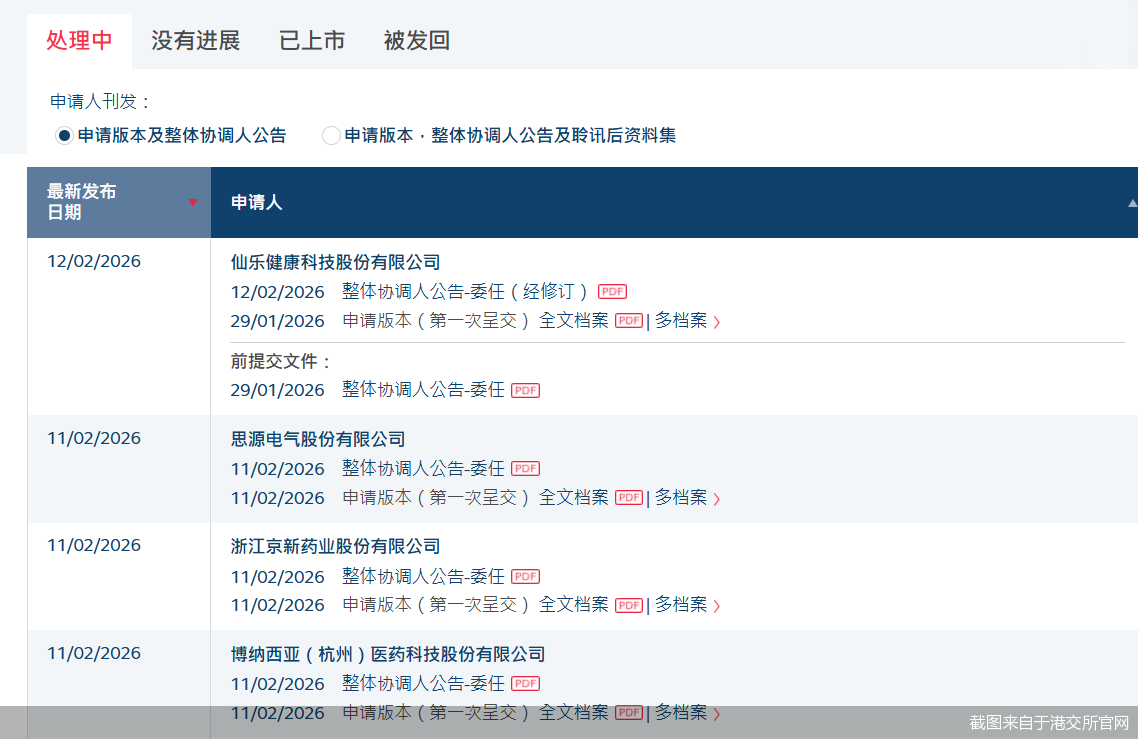
2月12日早间,京新药业(002020)在A股公告,公司已向香港联交所递交上市申请,这家最早专注于中间体与原料药领域,又随着时代发展向创新药转型 的老牌药企,正式踏上了"A+H"两地上市的旅程。据北京商报记者不完全统计,2026年开年仅40余日,已有约30家医药企业递表港交所。 药企扎堆赴港,"创新"成为关键词。上述30家企业中,13家为带有特殊标识"B"的未盈利的创新药、创新医疗器械企业。港交所对未盈利生物科技企业的上 市审核,始终锚定产品的创新性、管线的差异化、临床数据的扎实程度。即便在已盈利的企业阵营中,"创新"同样被屡屡提起。 此外,"A+H"频现也成为此轮药企赴港上市的显著特征。除了京新药业外,还有百普赛斯、迪哲医药、益方生物等A股公司已在年内递表。此外,还有信立 泰、海特生物两股已于年内官宣正在筹划赴港上市。 | 最新发布 申请人 | | | | --- | --- | --- | | 日期 | | | | 12/02/2026 | 仙乐健康科技股份有限公司 | | | | 12/02/2026 整体协调人公告-委任(经修订) 吧 | | | | 29/01/2026 申请版本(第一次呈交)全文档 ...
迪哲医药2026年关注要点:H股上市、研发里程碑与商业化进展
Jing Ji Guan Cha Wang· 2026-02-12 09:34
Group 1 - The core focus events for Dize Pharmaceutical in 2026 and beyond include the progress of H-share listing, key milestones in the R&D pipeline, annual business plan review, and commercialization and market expansion [1] - Dize Pharmaceutical submitted its H-share listing application to the Hong Kong Stock Exchange on January 23, 2026, aiming for a dual listing in Hong Kong to enhance its global strategy and attract international investors [2] - The company plans to advance multiple core products into clinical data update stages in 2026, including the global multi-center Phase III study of Shuwotai (Shuwotai) for EGFR Exon20ins non-small cell lung cancer, which has completed patient enrollment [3] Group 2 - Dize Pharmaceutical plans to hold a board meeting in 2026 to review the annual sales plan, which is yet to be finalized and will be disclosed after board approval [4] - The company aims to leverage the inclusion of core products Shuwotai and Guaizhe in the national medical insurance catalog to deepen domestic market coverage and promote overseas commercialization in 2026 [5] - The sales expense ratio decreased to 72% in the first three quarters of 2025, and the company plans to further enhance operational efficiency in 2026 [5]
上市公司热议再融资新政:回应了市场呼声 堪称“及时雨”
Shang Hai Zheng Quan Bao· 2026-02-10 18:05
Core Viewpoint - The refinancing market is undergoing targeted adjustments with the introduction of new policies aimed at supporting high-quality and innovative companies, simplifying processes, and preventing risks [1] Group 1: Refinancing Policy Adjustments - The new refinancing policy reduces the interval for companies that are unprofitable and meet specific criteria from 18 months to 6 months, allowing them to initiate new rounds of refinancing more quickly [2] - Companies in the high-tech sector express that the new policy will facilitate continuous funding for product development and commercialization, thus supporting their growth [2] Group 2: Support for Underperforming Companies - The new policy allows companies that have experienced stock price declines to engage in refinancing through methods such as private placements and convertible bonds, provided the funds are directed towards their main business [4] - As of February 10, there are 553 companies listed on the exchanges that are currently underperforming, indicating a significant potential for these companies to leverage the new refinancing options [4] Group 3: Expansion of Fund Utilization - The new policy encourages high-quality companies to allocate funds towards new industries, business models, and technologies that align with their main operations, thus promoting a second growth curve [6] - This shift from strict limitations on fund allocation to a more flexible approach is expected to enhance capital flow into high-tech industries and improve resource allocation efficiency [6]