Agility Robotics

Search documents
2026年,机器人要少跳舞,多干活
Xin Lang Cai Jing· 2026-01-29 08:36
文|融中财经 2025年春晚,宇树机器人的一支秧歌舞点燃了资本狂热。2026年春晚,各家又在争夺这个难得的表演名 额。这一年,为了吸引眼球,你方唱罢我登场的戏码层出不穷,观众似乎早已审美疲劳,无非是从跑 步,到跳舞到武打,"大号玩具"的论调此起彼伏。 回顾这一年,在成绩与彷徨中,各家独角兽公司不断摸索与试错。人形机器人在公开场合完成了几乎所 有"可视化"的动作:跑步、跳舞、翻滚、对打……这些动作一次次刷新视频平台的播放量,却也同步降 低了它们在产业语境中的含金量。 真正的拐点在于:当所有公司都能表演,表演就不再是竞争力。 资本市场已经率先感受到这种变化。估值快速抬升的同时,订单、交付和规模化数据却明显滞后,技术 进展与商业兑现之间出现了越来越难以忽视的剪刀差。 这也是为什么,"泡沫"开始频繁出现在行业讨论中——并非因为技术停滞,而是因为衡量成功的标准, 已经悄然发生变化。 当炫技失效 在这场标准重塑的过程中,中国市场并非孤立。一份来自全球机器人产业一线的年度调研报告,提供了 一个有价值的参照坐标。 1月26日,在中国刚刚官宣上春晚的机器人名单时,The Robot Report发布的《2026年机器人行业展望 ...


集邦咨询:预计人形机器人对固态电池的需求有望于2035年超74GWh
智通财经网· 2026-01-28 09:09
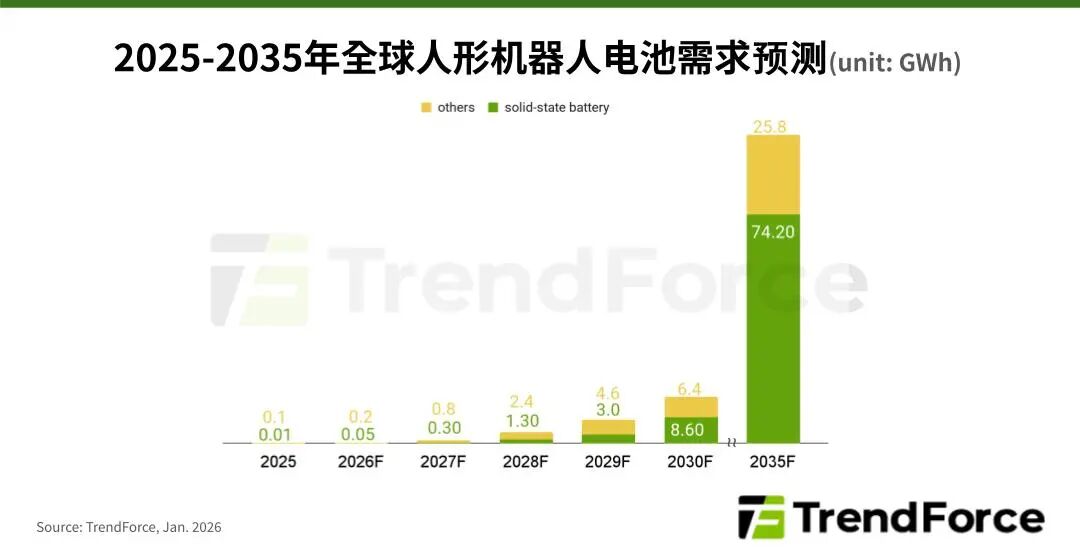
Core Insights - The development of humanoid robots is expected to reach a commercialization milestone by 2026, increasing the importance of batteries as an "energy supply" [1] - Solid-state lithium batteries are projected to become the mainstream solution due to their high energy density, with demand from humanoid robots expected to exceed 74 GWh by 2035, growing over a thousand times from 2026 [1] Group 1: Humanoid Robot Battery Market - Global humanoid robot shipments are forecasted to surpass 50,000 units in 2026, representing an annual growth of over 700% [4] - High-nickel ternary lithium batteries (NMC/NCA) are currently the mainstream choice for robot batteries due to their relatively high energy density, while lithium iron phosphate batteries (LFP) are used for lower endurance applications [4] - Most humanoid robots currently have a battery capacity below 2 kWh, with typical endurance ranging from 2 to 4 hours, such as Unitree's H1 with 0.864 kWh and Tesla's Optimus Gen2 with 2.3 kWh [4] Group 2: Challenges and Opportunities - The development of humanoid robot batteries faces two main challenges: the rapid iteration of core technologies affecting battery customization and the current focus on finding scalable commercial applications rather than improving endurance [5] - Despite these challenges, the demand for high energy density, high discharge rate, and high safety batteries in humanoid robots presents an opportunity for solid-state batteries to demonstrate their advantages [5] - Breakthroughs in solid-state battery technology and cost reductions are expected to help humanoid robots overcome power limitations [5]


智元第一,宇树第二!中国人形机器人企业领跑全球
Zhong Guo Zheng Quan Bao· 2026-01-09 08:30
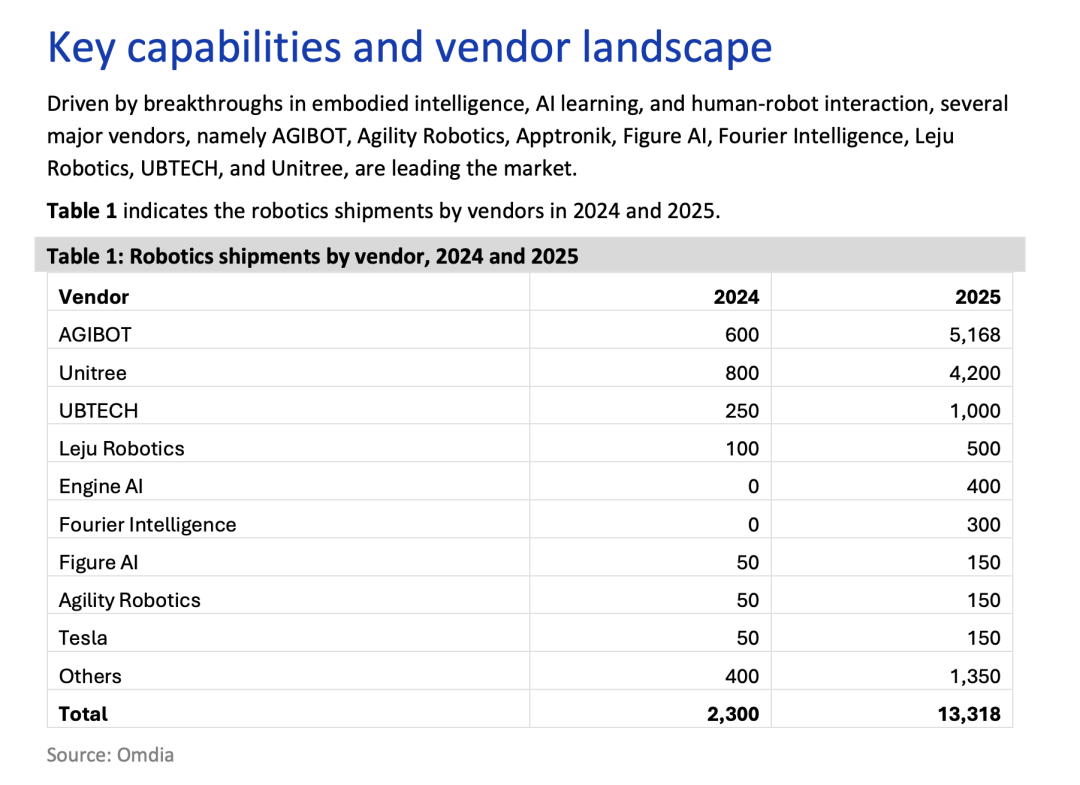
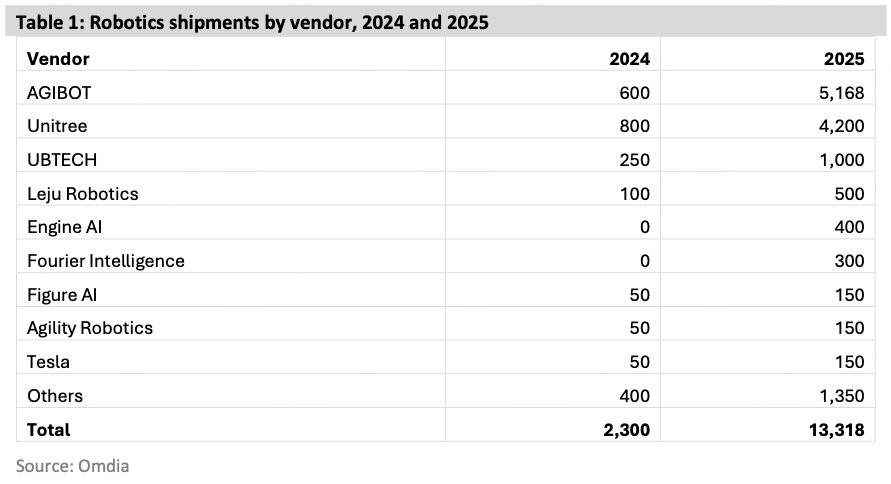
Core Insights - The report by Omdia highlights the dominance of Chinese manufacturers in the humanoid robot market, with Zhiyuan leading with over 5,100 units shipped, capturing 39% of the global market share [1] - By 2025, the top six humanoid robot manufacturers will all be Chinese, collectively accounting for 86.9% of global shipments [1] Group 1: Market Performance - In 2024, total shipments of humanoid robots are projected to be 2,300 units, increasing to 13,318 units in 2025 [2] - The report indicates that the humanoid robot index rose by 1.66%, with significant stock price increases for companies like Jizhi Co. and Hongxun Technology [3] Group 2: Industry Developments - At CES 2023, several Chinese humanoid robot companies showcased their products, including Zhiyuan's launch of the Genie Sim 3.0 platform, which enhances model training and application [4] - Other companies like Unitree and Fourier Intelligence also presented their latest humanoid robots and solutions, indicating a strong presence in the market [4][5] Group 3: Future Projections - Omdia predicts exponential growth in the humanoid robot market, with global shipments expected to reach 2.6 million units by 2035 [6] - Companies like Zhiyuan and Tesla are positioned as leaders in the industry, driving rapid development and innovation [6] Group 4: Strategic Investments - Companies are actively investing in humanoid robotics, with Hongrun Construction and Guoji Precision Engineering announcing partnerships and new product lines aimed at enhancing their market positions [7] - The domestic humanoid robot shipment is expected to rise to 62,500 units by 2026, marking a significant milestone for the industry [7]
收评:沪指16连阳站上4100点 AI应用方向领涨 卫星互联网延续活跃态势
Xin Hua Cai Jing· 2026-01-09 07:47
Market Performance - The Shanghai Composite Index closed at 4120.43 points, up 0.92%, marking a 16-day consecutive rise [1] - The Shenzhen Component Index rose 1.15% to 14120.15 points, while the ChiNext Index increased by 0.77% to 3327.81 points [1] - The total trading volume for the Shanghai market was approximately 12.892 billion yuan, and for the Shenzhen market, it was about 18.336 billion yuan [1] Sector Performance - AI application sectors led the market, with significant gains in various related concepts such as Kimi, Sora, and AIGC [1] - Other active sectors included satellite internet, commercial aerospace, and space big data, along with notable increases in small metals, precious metals, and duty-free shops [1] Institutional Insights - The market is showing an upward trend, with many sectors supported at the 60-day moving average, indicating a new round of bullish momentum [2] - Long-term investment opportunities are suggested in high-growth sectors such as semiconductors, consumer electronics, artificial intelligence, and commercial aerospace [2] - A recent improvement in the overall industry prosperity index and PMI supports the positive outlook for the market [2][3] Policy Developments - The "Guidelines for the Construction and Application of Industrial Green Microgrids (2026-2030)" were issued to promote green energy applications in industrial sectors [4] - The guidelines emphasize a minimum of 60% self-consumption of renewable energy for new industrial projects [4] Robotics Market - A report indicates that by 2025, the top six companies in global humanoid robot shipments will be Chinese, with a total expected shipment of 13,000 units [5] - The leading company, Zhiyuan, is projected to capture 39% of the market share with over 5,100 units shipped [5] Company News - MiniMax, an AGI company, saw its stock price surge by 90.9% upon its listing on the Hong Kong Stock Exchange, reaching a market capitalization of approximately 91.94 billion HKD [7] - The company raised about 5.54 billion HKD through its IPO, which will be allocated for model upgrades and AI product development [7]
2025年卖出超5000台 智元登顶全球人形机器人出货量榜首
Zhong Guo Jing Ying Bao· 2026-01-09 04:41
| Vendor | 2024 | 2025 | | --- | --- | --- | | AGIBOT | 600 | 5,168 | | Unitree | 800 | 4,200 | | UBTECH | 250 | 1,000 | | Leju Robotics | 100 | 500 | | Engine Al | 0 | 400 | | Fourier Intelligence | 0 | 300 | | Figure Al | 50 | 150 | | Agility Robotics | 50 | 150 | | Tesla | 50 | 150 | | Others | 400 | 1,350 | | Total | 2,300 | 13,318 | 2025年,智元(AGIBOT)机器人出货量超过5000台。Omdia/图 中经记者杨让晨张家振上海报道 2026年1月8日,全球权威市场研究机构Omdia正式发布《通用具身机器人市场雷达报告》(以下简称《报告》),系统分析了 2025年全球人形机器人的市场趋势、关键商用指标与综合技术实力。 《中国经营报》记者注意到,上述《报告》显示,202 ...
We asked a humanoid robot if there is an AI bubble. Here's what it said.
CNBC· 2025-12-30 22:11
Core Insights - The AI bubble debate is a significant topic in the tech industry, with opinions varying on whether the current excitement around AI represents a bubble or a transformative wave [2] - KOID, a humanoid robot from Unitree, emphasizes that AI and humanoids are likely to remain integral to society and will continue to evolve [2] Company Insights - Unitree is a leading Chinese tech company known for its humanoid robots, including KOID, which features 23 degrees of freedom, allowing for diverse movements [3] - KOID is available for purchase in the U.S. through RoboStore, with prices ranging from $8,990 to $128,900 [3] - Unitree is preparing for an initial public offering (IPO) that could value the company at up to $7 billion, showcasing its growth potential in the robotics market [6] Industry Trends - The humanoid robotics sector is becoming increasingly competitive, with companies like Boston Dynamics and Agility Robotics emerging alongside Tesla's Optimus robots, which are expected to significantly contribute to Tesla's valuation [5] - The industry is still in a "prototyping" phase, as companies explore the various roles robots can play in daily life, from household assistance to industrial applications [4]

Wedbush Lowers Price Goal On MercadoLibre, Inc. (MELI)
Yahoo Finance· 2025-12-28 16:44
Group 1 - Wedbush has lowered its price target for MercadoLibre, Inc. from $2,800 to $2,700 while maintaining an Outperform rating on the stock [1][2] - The firm identifies MercadoLibre as a top choice, focusing on competitive dynamics and demand patterns in its primary markets [2] - Increased expenses are anticipated in 2026 due to higher sales and marketing costs and logistical investments [2] Group 2 - MercadoLibre signed a business deal with Agility Robotics to integrate the Digit humanoid robot into its San Antonio, Texas plant, initially focusing on commerce fulfillment tasks [3] - The collaboration aims to explore further applications of AI-powered humanoid robots in logistics operations across MercadoLibre's warehouse system in Latin America [3] Group 3 - MercadoLibre is the largest e-commerce marketplace in Latin America, boasting around 150 million active users and over 600 million active listings [4] - While MercadoLibre shows investment potential, certain AI stocks are considered to offer greater upside potential with less downside risk [4]

美国人形机器人初创公司:连我们都觉得,外界吹得太过了
华尔街见闻· 2025-12-27 10:53
Core Viewpoint - Despite billions of dollars flowing into the humanoid robot sector, executives from startups are collectively voicing concerns to temper the overheated market expectations [1][2]. Group 1: Industry Concerns - Executives express worries that while recent technological advancements have been made, the hype surrounding humanoid robots has become detached from reality, with significant technical challenges remaining for commercial deployment [3]. - Agility Robotics' CTO emphasizes the distinction between creating a robot and one capable of performing "useful work," highlighting that current robots lack the reliability for complex tasks [4]. - The CEO of Weave Robotics compares the current state of humanoid robots to Apple's Newton, indicating that while the concept is promising, the technology is not yet mature enough for commercial success [6]. Group 2: Investment and Cost Considerations - Approximately $5 billion has been invested in the humanoid robot field this year, showcasing a stark contrast between the industry's cautious perspective and the capital market's enthusiasm [5]. - Cost-effectiveness is a critical consideration for investors, as installation costs are a primary reason companies avoid deploying robots, with only about $20 of every $100 spent on robots going towards the purchase itself, while the remaining $80 is for safety measures [6]. Group 3: Design and Efficiency Debate - The industry may be overly fixated on humanoid form as the ultimate robot design, with some engineers suggesting that specialized robots could be more efficient in factory settings [8]. - Challenges such as stability and tactile feedback in mimicking human form are noted, with predictions that future robots may not replicate human shapes but instead exceed them, potentially using designs like four arms or suction grips [8]. Group 4: Industry Outlook - Despite optimistic predictions from figures like Elon Musk regarding the production of Tesla's Optimus robot, startup executives advocate for a more cautious approach, urging the industry to be responsible with timelines and avoid overpromising [9].
美国人形机器人初创公司:连我们都觉得,外界吹得太过了
Hua Er Jie Jian Wen· 2025-12-27 03:13
Core Insights - Despite significant investment inflow into humanoid robotics, industry executives express concerns about overhyped market expectations and the substantial technical challenges that remain for commercial viability [1][2] Group 1: Industry Concerns - Executives from various humanoid robotics startups voiced worries at the Humanoids Summit, highlighting a disconnect between technological advancements and realistic market applications [1] - Agility Robotics' CTO emphasized that while creating a robot is one challenge, developing robots capable of performing "useful work" is a much greater hurdle [1] - Weave Robotics' CEO compared the current state of humanoid robots to Apple's Newton, indicating that while the concept is promising, the technology is not yet mature enough for commercial success [2] Group 2: Cost and Deployment Challenges - Cost-effectiveness is a critical consideration for investors, with installation costs being a primary barrier to robot deployment in enterprises [2] - A survey indicated that for every $100 spent on deploying robots, only about $20 is allocated to the robots themselves, while the remaining $80 is spent on safety measures to protect human workers [2] Group 3: Design and Efficiency Debate - There is skepticism within the engineering community regarding the focus on humanoid design, with some experts suggesting that specialized robots may be more efficient in industrial settings [3] - Challenges such as stability and tactile feedback in humanoid robots may lead to a future where robots do not mimic human form but instead utilize alternative designs, like multiple arms or suction grips [3] - Despite optimistic predictions from industry leaders about the future of humanoid robots, startup executives advocate for a more cautious approach to timelines and commitments [3]

华尔街日报:人形机器人赛道过热,创业者警告技术成熟度被高估
Sou Hu Cai Jing· 2025-12-26 09:14
Core Insights - Investors are pouring billions into humanoid robot startups, betting on their deployment in warehouses, factories, and homes soon, but leaders in the field caution that humanoid robots are overhyped and face significant technical challenges before becoming viable human worker replacements [2][4] Group 1: Industry Trends - The humanoid robot sector is experiencing a surge in investment, with approximately $5 billion allocated this year alone [14] - Predictions suggest that by 2035, around 1 million humanoid robots could be in operation, although the lack of training data remains a significant barrier to growth [14] - Technological advancements in battery and motor technology are enabling robots to better mimic human movements and operate for longer periods [13] Group 2: Challenges and Limitations - Current humanoid robots are primarily suited for simple, repetitive tasks, and the technology is not yet mature enough for more complex applications like household chores [10][15] - Safety concerns and high deployment costs are major factors deterring companies from adopting humanoid robots, with only about $20 of every $100 spent on robot deployment going towards the robots themselves [5] - The gap between the current capabilities of humanoid robots and the ambitious expectations for their future roles is significant, as highlighted by industry experts [5][10] Group 3: Perspectives from Industry Leaders - Some industry leaders express skepticism about the current state of humanoid robots, comparing them to the failed Newton PDA, suggesting that while the direction is correct, the technology is not yet ready for widespread adoption [8][9] - Optimistic views from figures like Elon Musk predict an insatiable demand for humanoid robots, with plans for Tesla to produce 1 million Optimus robots annually by 2030 [11][13] - The focus on humanoid form may be misguided, as experts suggest that future robots might be more efficient if designed with different forms rather than strictly humanoid [15]