中国电信

Search documents
87家央企负责人任期激励收入披露:中石油董事长86.21万元、中石化董事长84.81万元、中国移动总经理21.61万元……



Sou Hu Cai Jing· 2026-02-04 04:20
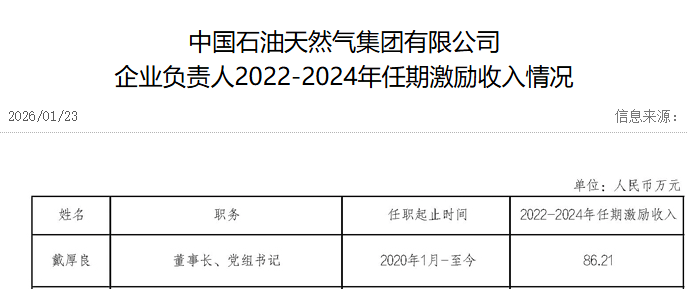
Core Viewpoint - The State-owned Assets Supervision and Administration Commission (SASAC) announced the incentive income for executives of central enterprises for the 2022-2024 term, with a total of 87 enterprises disclosing their incentive income figures. Group 1: Incentive Income Overview - The total incentive income for central enterprise executives consists of annual salary and term incentive income, with the latter being distributed every three years [1]. - Notable figures include: - Jiao Houliang, Chairman of China National Petroleum Corporation, with an incentive income of 86.21 million RMB for the 2022-2024 term [1]. - Ma Yongsheng, Chairman of Sinopec, with an incentive income of 84.81 million RMB [3]. - Wang Dongjin, Chairman of China National Offshore Oil Corporation, with an incentive income of 86.06 million RMB [4]. Group 2: Specific Executive Incentive Income - Zhang Wei, Chairman of the National Oil and Gas Pipeline Group, has an incentive income of 78.17 million RMB [6]. - Meng Zhenping, Chairman of China Southern Power Grid, has an incentive income of 83.54 million RMB [8]. - Temperature of incentive income varies across different enterprises, with some executives like Liu Mingsheng from China Power Investment Corporation receiving 26.02 million RMB for the 2022-2024 term [13]. Group 3: Additional Notable Executives - Chen Zhongyue, Chairman of China Unicom, has an incentive income of 80.49 million RMB [17]. - Xu Peng, from China First Automobile Group, has an incentive income of 82.54 million RMB [23]. - Wang Xianming, Chairman of China Resources Group, has an incentive income of 82.44 million RMB [54].

中金:料中资电讯商股价短期受压
Zhi Tong Cai Jing· 2026-02-04 03:01
Group 1 - The core viewpoint of the report is that the Ministry of Finance and the State Taxation Administration of China have raised the value-added tax on telecommunications services starting this year, which may impact the profitability of telecom operators [1] - The report assumes that operators will not pass the tax burden onto customers by 2026, leading to a complete reflection of the reduced after-tax income on profits [1] - Three scenarios have been established by the company, with a neutral scenario leading to revised earnings forecasts for China Mobile and China Telecom, maintaining 2025 estimates but lowering revenue and net profit forecasts for 2026 [1] Group 2 - The implied dividend yields for 2026 based on the new earnings forecasts are robust, with China Mobile's A-shares at 5.1% and H-shares at 6.8%, while China Telecom's A-shares are at 4.2% and H-shares at 5.2% [1] - Short-term pressure on the stock prices of Chinese telecom companies is anticipated as the market digests the changes in tax policy and lower profit outlooks [1]

互联网增值服务未加税,误传致股价波动,实际仅基础电信服务税率上调
Sou Hu Cai Jing· 2026-02-04 02:11
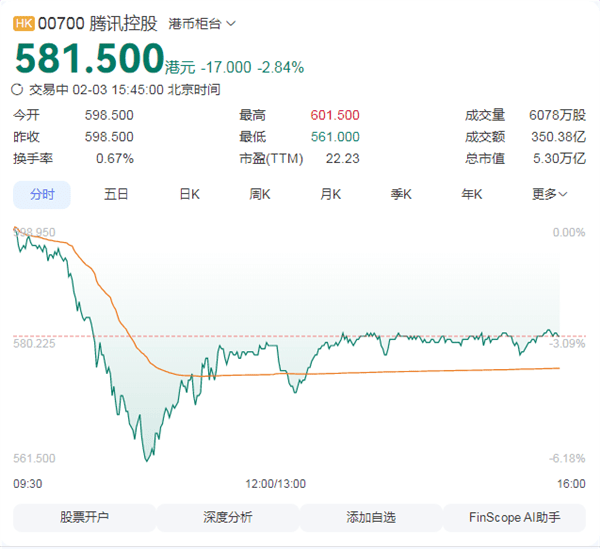
Core Viewpoint - The recent rumors regarding the increase of value-added tax (VAT) on internet value-added services stem from a misunderstanding of new tax regulations, which only affect basic telecommunications services and do not extend to other internet companies like Tencent [2][3] Group 1: Tax Regulation Changes - Starting from 2026, the VAT rate for basic telecommunications services, such as internet broadband access provided by companies like China Mobile, China Unicom, and China Telecom, will increase from 6% to 9% [2] - The adjustment is a targeted policy and does not apply to other types of enterprises, clarifying the boundaries of the new tax regulations [2] Group 2: Misinterpretation of Tax Applicability - The erroneous extrapolation of the tax adjustment to internet platform companies like Tencent has led to the misconception of an "internet value-added service tax increase" [2] - Tencent's primary business activities, including online gaming, social platform operations, cloud services, and digital content distribution, fall under the categories of value-added telecommunications services or sales of intangible assets, which remain subject to the 6% VAT rate without any increase [2][3] Group 3: VAT Structure Stability - The statutory VAT rates in China remain at three levels: 13%, 9%, and 6%, with the applicable objects and policy framework remaining stable and unchanged [4]



华尔街见闻早餐FM-Radio | 2026年2月4日
Hua Er Jie Jian Wen· 2026-02-03 23:27
Anthropic新工具掀软件股抛售,美股科技板块、尤其是软件股,遭遇去年4月以来最惨抛售。资金涌入小盘股、价值股以及黄金等。纳指跌超1%,罗素小盘 股指逆市收涨0.3%。科技七姐妹大跌1.5%,英伟达一度跌5%。绩后Paypal暴跌约20%、AMD盘后大跌超7%。 美债收益率小幅走低,10年期美债收益率下行0.6个基点至4.266%。美元跌0.15%。 加密货币盘中暴跌。比特币一度跌超7%、跌破去年4月低点,以太坊一度暴跌约9%、逼近2100美元,尾盘均显著反弹,但仍下跌。 现货黄金大反弹6.2%,一度逼近5000美元。白银日内涨幅一度达12%,随后涨幅回落、仍涨逾7%。原油日内涨超2%,报道称美军在阿拉伯海击落了一架伊 朗无人机。 亚洲时段,沪指涨1%,太空光伏、算力硬件爆发,寒武纪跌超9%,恒科指跌超1%,互联网平台盘中齐跳水,沪银暴跌16%。 要闻 华见早安之声 请各位听众升级为见闻最新版APP,以便成功收听以下音频。 市场概述 中国 中共中央 国务院关于锚定农业农村现代化 扎实推进乡村全面振兴的意见。 中国有色金属工业协会:研究将"铜精矿"纳入国家储备。 税收传闻"突袭"港股!机构解读:过度推演,可 ...

阮英会见中国电信甘肃公司党委书记 总经理杨岭才一行
Xin Lang Cai Jing· 2026-02-03 12:52
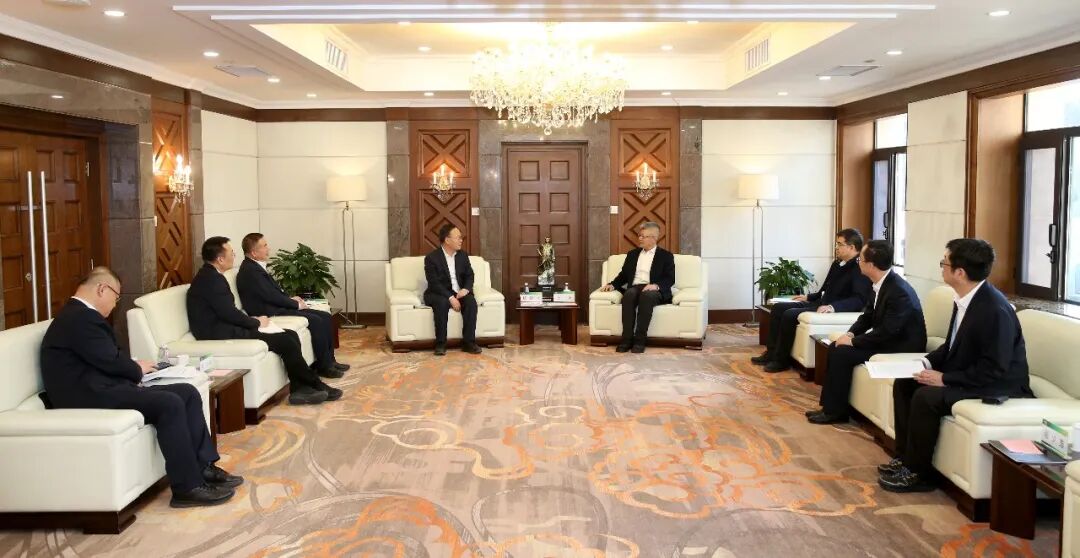
2月2日,金川集团党委书记、董事长阮英会见中国电信甘肃公司党委书记、总经理杨岭才一行。双方围绕数字技术赋能产业发展、海外基地网络安全通信 保障、工业场景智能化深度应用等方面深入交流。 阮英对杨岭才一行到来表示欢迎,对中国电信甘肃公司长期以来的关心支持表示感谢。他指出,中国电信甘肃公司作为全省通信行业的头部企业,兼具技 术优势、资源优势和服务优势,多年来与金川集团在通信基础设施升级、工业数智化转型、安全管控体系搭建等领域,建立了长期稳定、互信共赢的合作 关系,为金川集团高质量发展提供了坚实的通信保障和数字支撑。希望双方巩固现有合作成果,秉持开放包容、互利共赢的合作原则,围绕传统产业数字 化赋能,进一步加强交流对接,充分发挥各自核心优势,精准整合优质资源,在海外基地网络安全通信保障及工业场景装备智能化应用等关键领域探索更 多务实高效的合作模式、落地更多有分量的合作项目,共同为高质量发展拓增量、提效能、强根基,实现优势互补、互利互惠、协同发展。 杨岭才对金川集团在实业强国、科技强国等方面取得的成绩给予赞扬,并介绍中国电信甘肃公司的发展情况,及双方前期合作的推进成效。他表示,金川 集团作为有色金属行业领军企业,是中国 ...

本周两天哪些反包了?哪些没反包?
Xin Lang Cai Jing· 2026-02-03 12:47
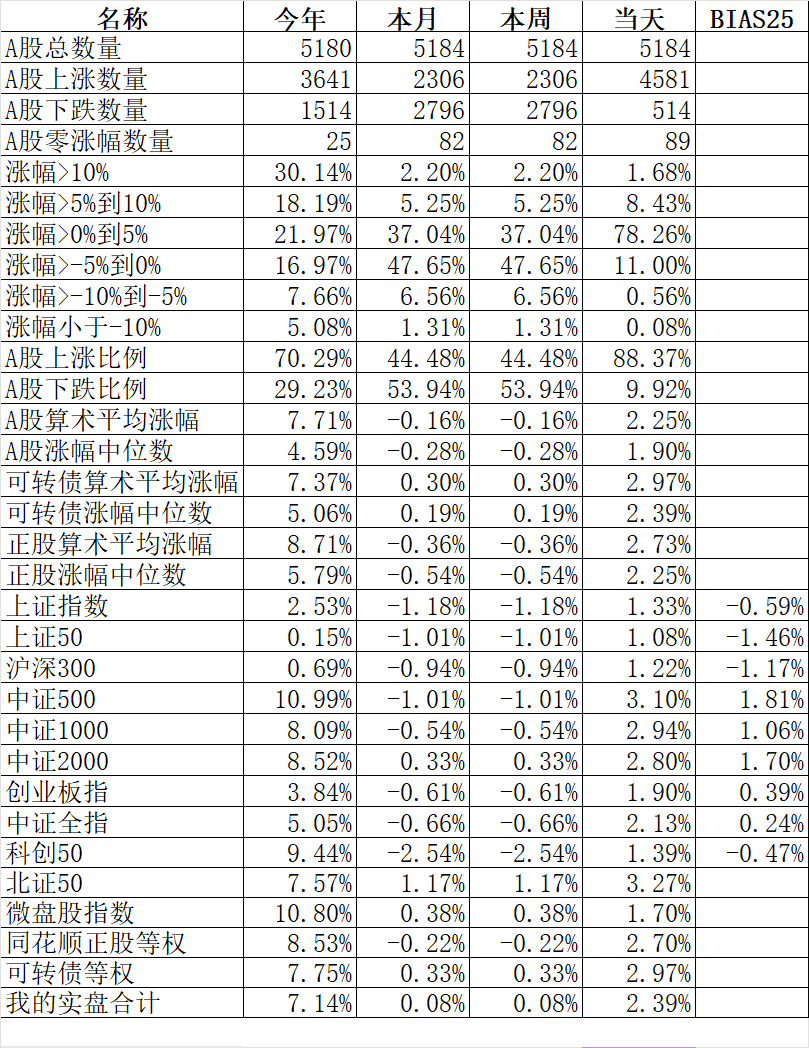
市场虽然有点缩量,而且包括上证指数在内的部分指数也没有完全反包,但市场基本上还是算反包了。 | 名称 | を生 | 本月 | 本周 | 当天 | BIAS25 | | --- | --- | --- | --- | --- | --- | | A股总数量 | 5180 | 5184 | 5184 | 5184 | | | A股上涨数量 | 3641 | 2306 | 2306 | 4581 | | | A股下跌数量 | 1514 | 2796 | 2796 | 514 | | | A股零涨幅数量 | 25 | 82 | 82 | 89 | | | 涨幅>10% | 30. 14% | 2. 20% | 2. 20% | 1.68% | | | 涨幅>5%到10% | 18. 19% | 5. 25% | 5. 25% | 8. 43% | | | 涨幅>0%到5% | 21.97% | 37.04% | 37.04% | 78. 26% | | | 涨幅>-5%到0% | 16. 97% | 47.65% | 47.65% | 11.00% | | | 涨幅>-10%到-5% | 7.66% | 6.56% ...
上调游戏、金融等行业增值税税率?专家:传言不实
券商中国· 2026-02-03 11:34
Core Viewpoint - Recent rumors regarding the adjustment of value-added tax (VAT) rates for industries such as gaming and finance have been circulating, suggesting a potential increase in the gaming industry's tax rate from 6% to 32%. However, industry experts and company representatives have stated that these rumors lack credibility and are unfounded [1][2]. Group 1 - The current VAT law in China, effective from January 1, specifies three main tax rates: 6%, 9%, and 13%. Financial services and internet value-added services are subject to a 6% rate, making the rumored increase to 32% baseless [1]. - Experts emphasize that the highest VAT rate in China is currently 13%, and there is no provision for a 32% rate, further debunking the rumors [1]. - The recent announcement by major telecom operators regarding VAT adjustments pertains to the classification of services rather than an increase in tax rates. Services like SMS and internet access have been reclassified from 6% to 9%, but this does not affect the gaming or financial sectors [2]. Group 2 - Industry professionals agree that making short-term adjustments to VAT rates is challenging, and significant changes shortly after the implementation of the VAT law are unlikely [2]. - The adjustment process for VAT rates requires rigorous legislative or administrative procedures, indicating that the possibility of increasing VAT rates for specific industries in the near term is very low [2].

深圳市人工智能与机器人研究院与广东电信达成战略合作
Xin Lang Cai Jing· 2026-02-03 10:33
Core Viewpoint - Shenzhen Artificial Intelligence and Robotics Research Institute (AIRS) and China Telecom Guangdong signed a strategic cooperation framework agreement to establish the "Embodied Intelligence Industry Ecosystem Alliance" [1] Group 1: Strategic Cooperation - The cooperation will focus on technological integration innovation, data and computing power collaboration, and building an industrial ecosystem [1] - Joint development of 5G + embodied intelligent industrial robots to serve smart factories and dark factories [1] Group 2: Project Incubation - Utilizing telecom intelligent computing resources and AIRS technical capabilities to incubate industrial projects [1] - Jointly create an AI + robotics innovation incubation platform [1] Group 3: Industry Planning - Participation in the formulation of AI and robotics industry planning for Guangdong Province and Shenzhen City [1] - Co-building a self-controllable embodied intelligence industrial cluster [1]

小摩:内地电讯商增值税调高 料中国移动受影响最小
Xin Lang Cai Jing· 2026-02-03 09:56
Core Viewpoint - Morgan Stanley reports that the three major telecom operators in mainland China have announced an adjustment in value-added tax, increasing the tax rate on mobile data, SMS/MMS, and internet broadband services from 6% to 9% [1][2] Group 1: Impact on Companies - The tax adjustment is expected to impact the net profits of China Mobile (00941), China Telecom (00728), and China Unicom (00762) in 2026 by 7.1%, 12.6%, and 11.9% respectively [1] - Among the three operators, the impact on China Mobile is estimated to be the smallest due to its higher gross margin [1] Group 2: Mitigation Measures - The actual profit impact may be milder than estimated, as the telecom operators are undergoing state-owned enterprise reforms, with authorities setting financial KPIs for profit growth, return on equity improvement, and healthy cash flow [2] - Telecom operators are expected to offset the impact of the VAT adjustment through various measures, including optimizing operating expenses, increasing prices, and controlling capital expenditures [2]
地方两会聚焦消费扩内需 传统消费与新型消费双轨并进
Sou Hu Cai Jing· 2026-02-03 09:53
Group 1 - The core viewpoint emphasizes the importance of consumption as a key driver for expanding domestic demand and building a strong domestic market, with various local governments implementing measures to enhance consumption capabilities and optimize supply [2] - Traditional consumption quality enhancement and the cultivation of emerging consumption are progressing simultaneously, supported by advancements in digital technology that enrich consumption supply [2] - Operators leverage their digital advantages and robust infrastructure to actively engage in the entire consumption chain, enhancing basic consumption quality and creating new digital consumption scenarios [2] Group 2 - The upgrade of basic consumption is crucial for market stability, with digitalization and intelligence being core paths for traditional industries' transformation [3] - Operators utilize technologies like 3D modeling and big data analysis to assist traditional manufacturers in offering personalized services, thus meeting diverse consumer demands [3] - The shift from standardized to personalized products enhances production efficiency and resource utilization, catering to consumers' desire for unique products [3] Group 3 - The application of humanoid robots in traditional service models represents a significant breakthrough, improving service efficiency and customer satisfaction [4] - Operators are injecting "digital intelligence" into traditional industries, promoting their transformation towards smart, customized, and service-oriented models [4] Group 4 - New technologies, particularly AI, are rapidly reshaping consumption scenarios and fostering a new "AI + consumption" ecosystem [5] - Operators are focusing on family digital consumption needs, launching diverse AI products to enhance the digital experience at home [5] - Initiatives like the "AI+" action plan and AI smart screens are designed to provide personalized and convenient services for families [5] Group 5 - The silver economy is a new growth point, with operators developing AI products tailored for the elderly to bridge the digital divide [6] - Customized services for seniors, such as AI phones and smart monitoring products, are being introduced to enhance their digital consumption experience [6] Group 6 - Operators are optimizing digital consumption service processes through AI technology, significantly improving service efficiency [7] - Innovations like AI customer assistants and smart service agents are enhancing customer service quality and enriching the digital consumption supply [7] Group 7 - Service consumption is rapidly expanding, driven by rising income levels and changing consumer attitudes, with a focus on sectors like education, culture, and health [8] - Operators are utilizing advanced technologies to ensure robust communication support for high-traffic events, enhancing user experience [8] Group 8 - In the cultural and tourism sectors, operators are employing technologies like 5G, AI, and VR/AR to develop smart applications that enrich visitor experiences [9] - Continuous advancements in digital technology and operator engagement are expected to drive new developments in China's consumption market, contributing to a sustainable economic growth model [9]