
法国巴黎银行

Search documents
多家国际投行唱空日元 预测明年底或跌破160关口
Huan Qiu Wang· 2025-12-27 01:07
Core Viewpoint - The outlook for the Japanese yen is increasingly pessimistic, with major global investment banks predicting a potential depreciation to 160 yen per dollar or lower by next year due to various economic pressures [1][3]. Group 1: Economic Factors Impacting the Yen - The Bank of Japan's slow interest rate hikes, ongoing capital outflows, and inflation risks driven by fiscal policies are seen as core factors suppressing the yen [3][4]. - Despite a nearly 10% decline in the US dollar index this year, the yen has only slightly rebounded by 0.5%, indicating its weakness [3]. - Market expectations suggest that the next interest rate hike by the Bank of Japan may not be fully priced in until September next year, adding to the uncertainty surrounding the yen [4]. Group 2: Predictions from Analysts - Analysts from JPMorgan and BNP Paribas expect the yen to weaken further, with JPMorgan's Junya Tanase predicting a target of 164 yen per dollar by the end of 2026 [3][5]. - BNP Paribas's Parisha Saimbi anticipates that the macro environment will favor risk appetite, leading to a forecast of 160 yen per dollar by the end of 2026 [4]. Group 3: Capital Outflows and Market Sentiment - There is a notable trend of Japanese retail investors favoring overseas assets, with net purchases through investment trusts at near ten-year highs, which may continue until 2026 [4]. - Corporate capital outflows are also significant, with Japanese companies engaging in high levels of foreign acquisitions this year [4]. - The sentiment in the market remains tense, with speculative pressures on the yen leading to concerns about potential government intervention to stabilize the currency [5].


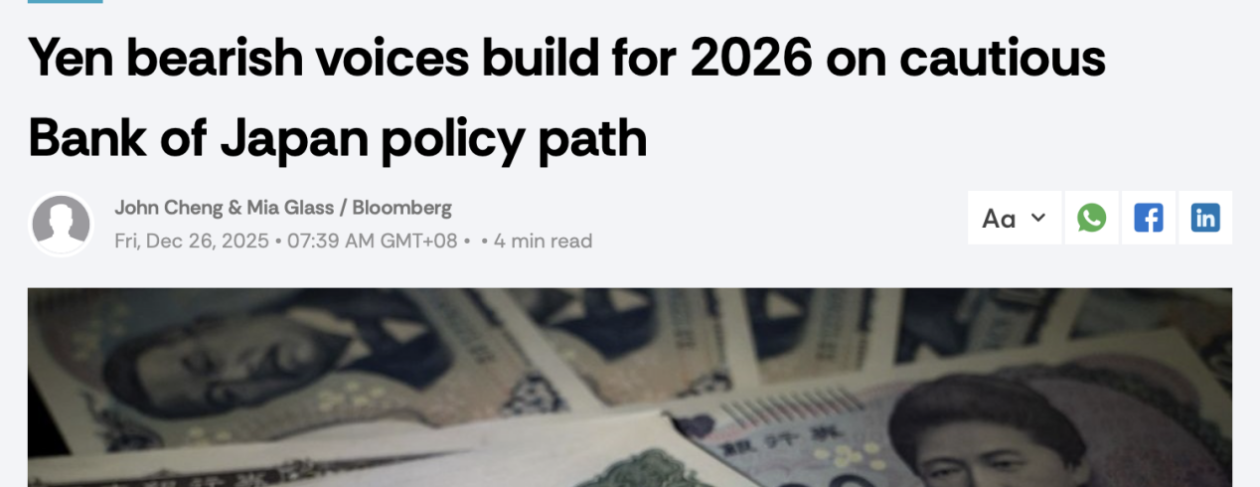
日元空头共识渐成:2026年或跌破160大关,日本央行谨慎政策难解困局
Hua Er Jie Jian Wen· 2025-12-26 12:55
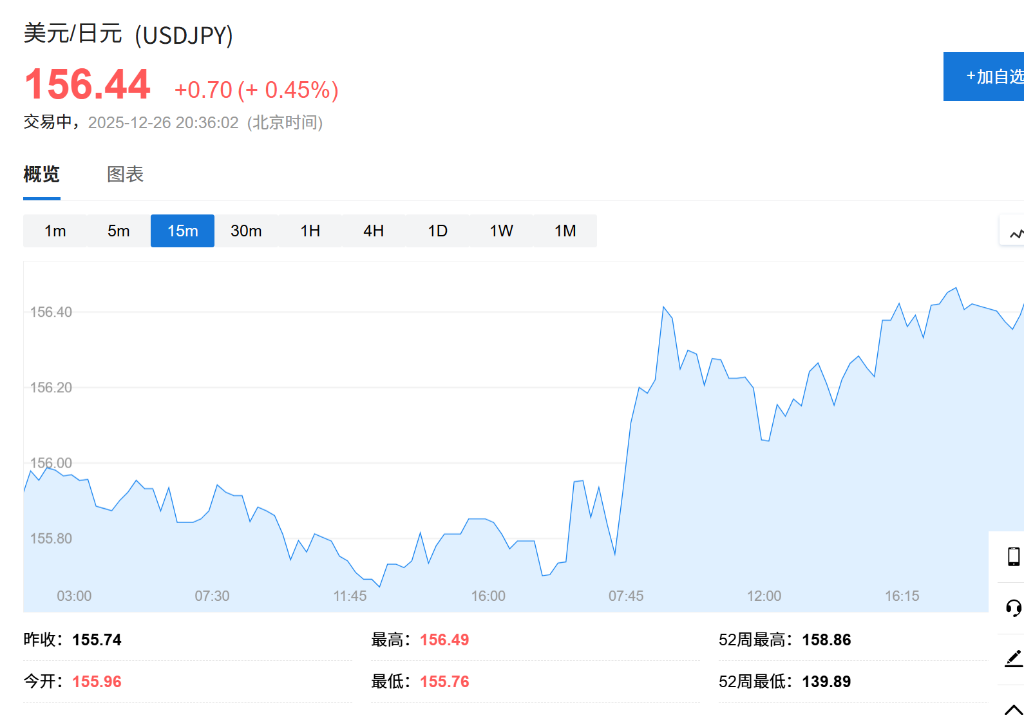
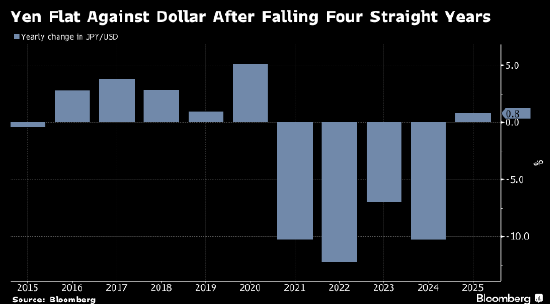
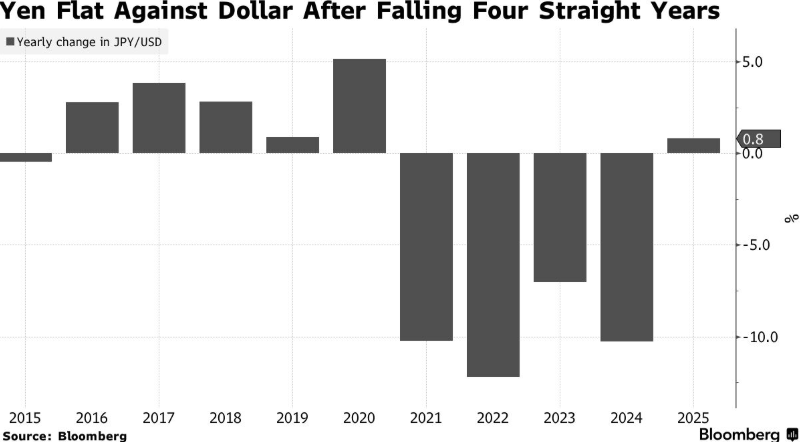
Core Viewpoint - The market sentiment towards the Japanese yen is increasingly bearish, with major institutions predicting a significant depreciation against the US dollar by the end of 2026, driven by high interest rate differentials and negative real interest rates [1][3]. Group 1: Market Predictions - Major institutions like JPMorgan and BNP Paribas forecast that the yen will fall below 160 against the dollar by the end of 2026, with some predictions as low as 164 [1][3]. - The yen has only seen a marginal increase of less than 1% against the dollar this year, failing to recover from a four-year decline, and currently hovers around 156, close to its early year low of 158.87 [1][3]. Group 2: Economic Fundamentals - The fundamental weakness of the yen is a primary concern, with predictions that this situation will not improve significantly in the near future [3][5]. - The cyclical forces are expected to turn increasingly unfavorable for the yen, as the market prices in higher interest rates in other regions, limiting the impact of the Bank of Japan's tightening policies [3][5]. Group 3: Capital Outflow - Domestic capital outflow is a significant factor pressuring the yen, with retail investors maintaining high levels of overseas stock investments, around 9.4 trillion yen (600 billion) [4]. - Japanese companies are also increasingly investing abroad, with direct investment levels remaining stable and M&A activity reaching new highs, further exacerbating the yen's depreciation [4]. Group 4: Intervention Risks - The risk of official intervention has resurfaced as the yen approaches levels that previously triggered government action, but market experts believe that mere intervention may not reverse the structural depreciation trend [6]. - Despite warnings from officials about excessive speculation, the market remains volatile, and simple smoothing operations may not be effective in changing the yen's downward trajectory [6].
锚定服务实体经济的核心使命,南京银行荣获第十四届金融界“金智奖”杰出高质量发展典范奖
Jin Rong Jie· 2025-12-26 12:07
Core Viewpoint - The "Qihang·2025 Financial Summit" held in Beijing highlighted the importance of high-quality development in the financial sector, with Nanjing Bank receiving the "Outstanding High-Quality Development Model Award" for its exemplary performance in aligning with national strategies and economic development [1][3]. Group 1: Award and Evaluation - The "Jinzhi Award" aims to set benchmarks for high-quality development, guiding listed companies to focus on their core businesses, innovate continuously, and fulfill social responsibilities [3]. - The evaluation criteria for the award include social responsibility, contribution to the real economy, investment returns, growth prospects, innovation efficiency, and brand excellence, covering over 8,000 companies [3]. Group 2: Nanjing Bank's Performance - As of the end of Q3 2025, Nanjing Bank's total assets reached 2.96 trillion yuan, a year-on-year increase of 14.31%, demonstrating a balance between scale and efficiency [4]. - The bank reported operating income of 41.949 billion yuan and a net profit attributable to shareholders of 18 billion yuan, reflecting year-on-year growth of 8.79% and 8.06%, respectively [5]. - The cost-to-income ratio improved to 23.27%, a decrease of 4.81 percentage points from the previous year, indicating effective cost management [5]. Group 3: Strategic Focus and Services - Nanjing Bank effectively meets the credit needs of the real economy, with a significant 31.56% increase in medium to long-term loans to the manufacturing sector, outperforming the industry average [5]. - The bank emphasizes inclusive finance, pension finance, and digital finance, with retail financial assets reaching 968.7 billion yuan, a 17.1% increase since the beginning of the year [5]. Group 4: Sustainability and Governance - Nanjing Bank has a strong ESG performance, maintaining a non-performing loan ratio of 0.83% and a provision coverage ratio of 313.22%, indicating robust risk management [6]. - The bank's governance is efficient, with a stable dividend policy, distributing 3.062 yuan per 10 shares in cash dividends, totaling 3.7857 billion yuan, which is 30% of its net profit [6]. - Major shareholders have increased their stakes, reflecting confidence in the bank's long-term development [6]. Group 5: Future Outlook - Nanjing Bank is committed to its high-quality development mission, focusing on optimizing financial resource allocation to support sustainable economic growth [6].


日本央行政策立场谨慎,看空日元之声在2026年持续高涨
Xin Lang Cai Jing· 2025-12-26 08:57
Core Viewpoint - The recent interest rate hike by the Bank of Japan has not led to a sustained appreciation of the yen, with increasing bearish sentiment towards the currency and a consensus that its structural weakness is unlikely to be reversed quickly [1][5]. Exchange Rate Predictions - Analysts from JPMorgan and BNP Paribas predict that the yen may depreciate to around 160 yen per dollar by the end of 2026 due to the persistent disparity in interest rates between the US and Japan, negative real interest rates in Japan, and ongoing capital outflows [1][3]. - JPMorgan's chief forex strategist, Junya Tanaka, has provided a pessimistic forecast of 164 yen per dollar for the end of 2026, citing weak fundamentals for the yen [2][6]. - Fukuoka Financial Group's chief strategist, Tetsu Sasaki, expects the yen to weaken further to 165 yen per dollar by the end of 2026, attributing this to the Bank of Japan's lack of aggressive rate hikes [4][9]. Factors Influencing Yen Weakness - The ongoing capital outflow from Japan, with retail investors favoring overseas assets, is a significant factor pressuring the yen. The net purchases of overseas stocks by Japanese retail investors have remained near a ten-year high of 9.4 trillion yen (approximately 60 billion dollars) [3][8]. - The return of carry trade strategies, where investors borrow low-yielding yen to invest in higher-yielding currencies, is another obstacle to yen appreciation [2][7]. Market Sentiment and Government Intervention - The market sentiment remains tense, with speculation about potential intervention by the Japanese government to stabilize the yen as it approaches levels that previously triggered official market intervention [10]. - Analysts express skepticism that government intervention alone can reverse the yen's downward trend, emphasizing the need for more substantial fiscal policy changes [5][10].
日本央行政策路径谨慎 2026年唱空日元的调门越来越高
Xin Lang Cai Jing· 2025-12-26 06:30
Core Viewpoint - The recent interest rate hike by the Bank of Japan has not sustained a boost for the yen, leading to increasing bearish sentiment towards the currency and reinforcing the view that the yen's structural weakness will not be resolved quickly [1][5]. Group 1: Market Predictions - Strategists from institutions like JPMorgan and BNP Paribas predict that the yen will depreciate to 160 or lower against the dollar by the end of 2026, influenced by the large US-Japan interest rate differential, negative real interest rates, and ongoing capital outflows [1][5]. - JPMorgan's chief Japan FX strategist, Junya Tanase, forecasts a more pessimistic outlook, predicting the yen will reach 164 by the end of 2026, citing cyclical factors that may further pressure the yen [3][8]. - BNP Paribas' strategist, Parisha Saimbi, anticipates that the dollar will rise to 160 against the yen by the end of 2026, supported by strong arbitrage demand and a cautious stance from the Bank of Japan [4][9]. Group 2: Economic Factors - The yen has only appreciated less than 1% against the dollar this year, despite expectations of interest rate hikes from the Bank of Japan and rate cuts from the Federal Reserve [1][5]. - The yen is currently fluctuating around 156, close to its yearly low of 158.87, indicating ongoing weakness [1]. - Japanese household investments in overseas assets remain high, with net purchases of foreign stocks hovering around 9.4 trillion yen (600 million USD), which is a ten-year high, contributing to downward pressure on the yen [4][9]. Group 3: Investment Trends - There is a notable trend of Japanese companies increasing their overseas direct investments, with this year's M&A activity reaching a multi-year high, which may be a persistent driver of capital outflows [7][11]. - The popularity of borrowing low-interest yen to invest in higher-yield currencies like the Brazilian real and Turkish lira is creating additional resistance to any potential rebound of the yen [3][8].
STARTRADER:日元持续走软,市场预期弱势或延续至中期?
Sou Hu Cai Jing· 2025-12-26 05:27
Group 1 - The recent interest rate hike by the Bank of Japan has not provided sustained support for the yen, reinforcing market perceptions of its structural weakness [1] - The primary factors influencing the yen's movement are the US-Japan interest rate differential, real interest rates, and capital flows, with single policy adjustments having limited impact [2] - Multiple international institutions predict that the yen's depreciation pressure may continue into the medium term, with JPMorgan and BNP Paribas forecasting the USD/JPY exchange rate could rise to 160 or higher by the end of 2026 [2] Group 2 - The yen has experienced a slight appreciation of less than 1% this year after four consecutive years of decline, but expectations of a currency reversal due to the Bank of Japan's rate hike and the Federal Reserve's rate cut have not materialized [5] - The yen's fundamentals have not improved, and in a pessimistic scenario, the USD/JPY rate could reach 164 by the end of 2026, with diminishing marginal effects from future rate hikes by the Bank of Japan [5] - The return of arbitrage trading has continued to suppress the yen, with leveraged funds increasing their short positions against the yen to multi-month highs [7] Group 3 - Japanese households and businesses maintain a strong preference for overseas assets, with retail investors significantly increasing net purchases of foreign stocks, reaching near a decade-high scale [7] - The ongoing growth in Japanese companies' foreign direct investment, with this year's M&A activity reaching multi-year highs, is a significant structural factor contributing to the yen's weakness [7] - As the exchange rate approaches levels that may trigger government intervention, official statements are becoming more assertive, although most analysts believe that intervention alone cannot reverse the yen's medium-term weakness [7]
法国股市年终盘点:韧性较强但增长有限 小幅跑赢实体经济
Xin Lang Cai Jing· 2025-12-26 04:07
新华财经巴黎12月26日电(记者李文昕)2025年,法国经济在低增长与财政问题并存的背景下缓慢前 行,实体经济复苏动力有限,但资本市场整体表现相对稳健。年初以来,法国股市在企业盈利支撑和国 际资金配置影响下呈现震荡上行格局,CAC 40指数整体运行中枢明显抬升。 来源:中国金融信息网 法国央行报告显示,2025年法国经济活动主要由运输设备(航空)的生产驱动,特别是相关企业在上半 年为应对下半年强劲的出口预期而进行了库存补充。CAC 40指数盘面结构在一定程度上反映了这一趋 势。从领跑力量看,航空、防务相关工业企业以及部分银行股在年内表现相对突出,成为指数上涨的主 要贡献者。其中,法国兴业银行在成分股中涨幅"霸占榜一",达151%;第二梯度涨幅回落至70%左右 区间,包括泰雷兹、安塞乐米塔尔等;赛峰、法国巴黎银行等表现也相对较好,涨幅在30%以上。 相比之下,奢侈品板块对指数的推动作用明显减弱。其中,爱马仕、LVMH等龙头企业股价年内下跌, 多月表现甚至对指数形成拖累;欧莱雅股价调整较快,虽震荡上行,但涨幅偏小。开云集团的表现较 好,年内上涨27.3%,但整体仍未改变消费板块整体动力不足的格局。 海外布局与估值 ...

日元没有“速效药”!日本央行渐进紧缩难逆转结构性颓势 华尔街唱空声浪高涨
Zhi Tong Cai Jing· 2025-12-26 02:06
Core Viewpoint - The recent interest rate hike by the Bank of Japan has failed to provide sustained support for the yen, leading to increased bearish sentiment towards the currency, with predictions of further depreciation against the dollar by 2026 [1][2]. Group 1: Economic Factors - Analysts from major financial institutions, including JPMorgan and BNP Paribas, predict that the yen could weaken to 160 yen per dollar or lower by the end of 2026 due to persistent factors such as significant US-Japan interest rate differentials, negative real interest rates, and ongoing capital outflows [1][2]. - The yen has seen a slight increase of less than 1% against the dollar this year after four consecutive years of decline, but expectations for a reversal driven by the Bank of Japan's rate hikes and potential Fed rate cuts have not materialized [1][2]. - The return of arbitrage trading, where investors borrow low-yielding yen to invest in higher-yielding currencies, is creating additional headwinds for the yen [2]. Group 2: Market Sentiment - Market sentiment remains cautious, with the overnight index swap indicating that the next rate hike by the Bank of Japan is not fully priced in, expected at the earliest in September [2]. - The ongoing high inflation in Japan, which exceeds the Bank of Japan's 2% target, continues to exert pressure on Japanese government bonds [2]. - Japanese retail investors are showing a strong preference for overseas assets, with net purchases through investment trusts hovering around 9.4 trillion yen (approximately 60 billion USD), a ten-year high, which is likely to persist and further suppress the yen [3]. Group 3: Long-term Predictions - Some analysts, including those from Goldman Sachs, believe that the yen may eventually strengthen to 100 yen per dollar over the next decade, although they acknowledge the presence of multiple short-term negative factors [4]. - Concerns about intervention risks are rising as the yen approaches levels that previously prompted official action, but experts suggest that intervention alone may not be sufficient to reverse the yen's downward trend [4][5].

日元没有“速效药”!日本央行渐进紧缩难逆转结构性颓势,华尔街唱空声浪高涨
Sou Hu Cai Jing· 2025-12-26 01:36
Core Viewpoint - The Japanese yen is facing structural weakness with no quick fix, as major financial institutions predict further depreciation against the US dollar by 2026, potentially reaching levels of 160 yen or lower per dollar [1][2]. Group 1: Economic Factors - The significant interest rate differential between the US and Japan, negative real interest rates, and ongoing capital outflows are key drivers of the yen's depreciation [1]. - The yen has seen a slight increase of less than 1% against the dollar this year after four consecutive years of decline, but expectations for a reversal due to Bank of Japan's rate hikes and Federal Reserve's rate cuts have not materialized [1]. - The return of arbitrage trading, where investors borrow low-yielding yen to invest in higher-yielding currencies, is making it more difficult for the yen to rebound [2]. Group 2: Market Predictions - Morgan Stanley's chief forex strategist predicts a pessimistic outlook for the yen, forecasting a dollar-to-yen exchange rate of 164 by the end of 2026, citing cyclical pressures and the impact of higher interest rate expectations in other regions [2]. - BNP Paribas anticipates that the global macro environment will favor risk sentiment, which typically benefits arbitrage strategies, leading to a dollar-to-yen rate of 160 by 2026 [3]. - Bank of America highlights that Japan's direct foreign investment has remained stable, indicating a persistent outflow of capital that could continue to pressure the yen [3]. Group 3: Government and Policy Responses - The Bank of Japan's lack of aggressive rate hikes and the persistence of negative real interest rates are seen as critical factors maintaining the yen's weakness [4]. - There is growing concern about potential government intervention as the yen approaches levels that previously triggered official action, although analysts believe that intervention alone may not be sufficient to reverse the yen's downward trend [4][5]. - The focus remains on the upcoming fiscal strategy from the Japanese government, which could influence market sentiment and the yen's trajectory [5].
日元看空声音渐响:受日本央行审慎政策影响,贬值趋势或延续至2026年
Xin Lang Cai Jing· 2025-12-25 22:30
格隆汇12月26日|摩根大通与法国巴黎银行等机构的策略师预计,受美日利差及负实际利率驱动,日元 汇率到2026年底将走软至160甚至更低。尽管日本央行在加息,但由于市场已消化其他地区的更高利 率,加之日元基本面疲软,明年周期性力量可能进一步利空日元。虽然日元目前已接近此前触发干预的 水平,官方干预风险重回视野,但仅凭干预手段恐难扭转日元的贬值趋势。 ...