老板电器

Search documents
厨卫电器板块11月28日涨0.22%,浙江美大领涨,主力资金净流出1134.33万元
Zheng Xing Xing Ye Ri Bao· 2025-11-28 09:08
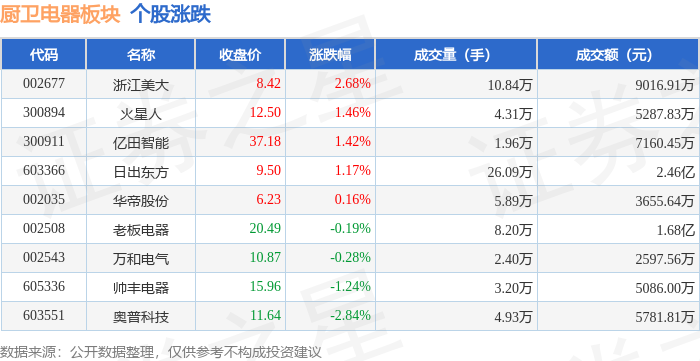
Core Viewpoint - The kitchen and bathroom appliance sector experienced a slight increase of 0.22% on November 28, with Zhejiang Meida leading the gains. The Shanghai Composite Index rose by 0.34%, while the Shenzhen Component Index increased by 0.85% [1]. Group 1: Market Performance - The closing price of Zhejiang Meida was 8.42, reflecting a rise of 2.68% with a trading volume of 108,400 shares and a transaction value of 90.17 million yuan [1]. - Mars Man closed at 12.50, up by 1.46%, with a trading volume of 43,100 shares and a transaction value of 52.88 million yuan [1]. - Yitian Intelligent closed at 37.18, increasing by 1.42%, with a trading volume of 19,600 shares and a transaction value of 71.60 million yuan [1]. - The overall kitchen and bathroom appliance sector saw a net outflow of 11.34 million yuan from main funds and 44.54 million yuan from speculative funds, while retail investors contributed a net inflow of 55.89 million yuan [1]. Group 2: Fund Flow Analysis - The main fund inflow for Daybreak Oriental was 9.59 million yuan, accounting for 3.90% of the total, while speculative funds saw a net outflow of 24.88 million yuan [2]. - Zhejiang Meida had a main fund inflow of 3.79 million yuan, representing 4.20%, with a minor speculative fund inflow of 496,300 yuan [2]. - Boss Electric experienced a main fund outflow of 5.77 million yuan, which is 3.43% of the total, while retail investors contributed a net inflow of 26.28 million yuan [2].



中国高端家电产业发展将聚焦技术驱动、健康升级等六大方向
Zhong Guo Zhi Liang Xin Wen Wang· 2025-11-25 04:30
Core Insights - The high-end home appliance industry in China is focusing on six major directions driven by technology and health upgrades, as discussed at the "2025 China High-End Home Appliance Value Growth Summit" [1][2] - The market is expected to stabilize around 900 billion yuan, with high-end appliances being the only segment to achieve simultaneous growth in sales and prices, emphasizing "high value" over "high price" [2][3] - Key trends identified for the future of the home appliance industry include convenience, performance efficiency, health-oriented innovation, AI empowerment, experience optimization, and aesthetic integration of home appliances and furniture [2][3] Industry Trends - The high-end home appliance market is characterized by an increase in the proportion of high-end products, restructuring of channel ecosystems, competition among three major brand factions, and multi-category upgrades [1] - Companies are encouraged to focus on user needs, technological innovation, and value creation to overcome challenges and transition from "Made in China" to "Chinese brands" [4] - The demand for personalized customization is strong, particularly in the home renovation sector, with a significant portion of demand coming from large housing units [3] Company Strategies - Boss Electric is concentrating on the core cooking segment, avoiding blind expansion and low-price competition, while leveraging AI to enhance products and retail strategies [2] - Stone Technology has achieved significant technological breakthroughs, including the launch of the world's first robot vacuum with mechanical arm collaboration capabilities, addressing real user needs [3] - Companies are advised to adopt compliance-based strategies and differentiate their products for overseas markets, while also embracing instant retail as a new engine for home appliance channels [4]
小红日报|岱美股份涨停,标普红利ETF(562060)标的指数收涨0.33%
Xin Lang Ji Jin· 2025-11-25 01:42
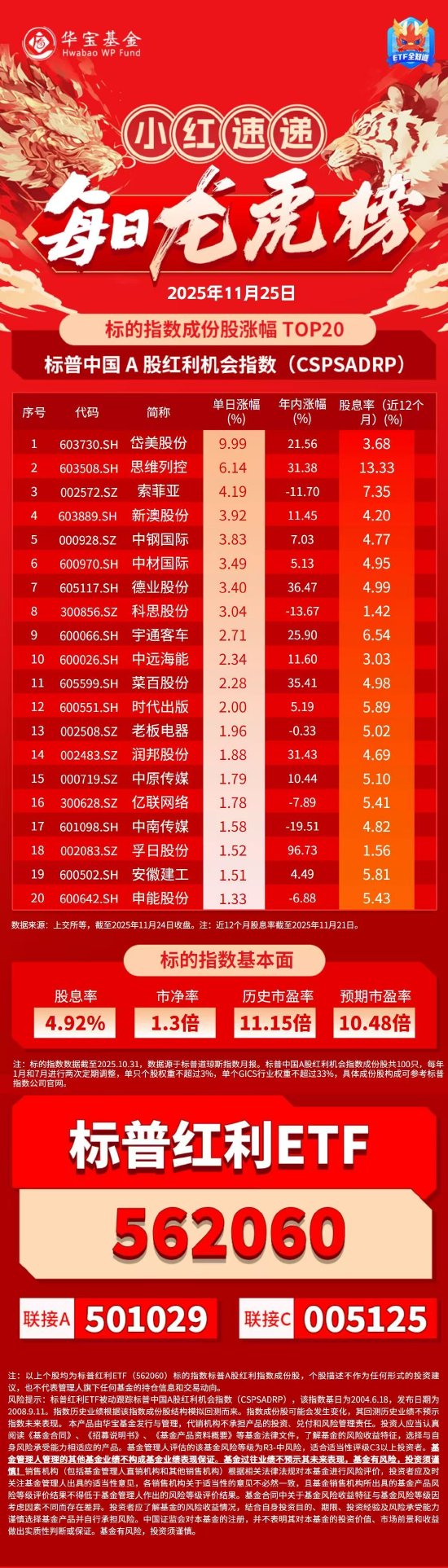
Core Insights - The article highlights the top-performing stocks in the S&P China A-Share Dividend Opportunity Index, showcasing significant daily and year-to-date gains along with dividend yields [1]. Group 1: Stock Performance - The top stock, Dai Mei Co., Ltd. (603730 SH), experienced a daily increase of 9.99% and a year-to-date increase of 21.56%, with a dividend yield of 3.68% [1]. - Siwei Liekong (603508 SH) saw a daily rise of 6.14% and a year-to-date rise of 31.38%, boasting a high dividend yield of 13.33% [1]. - Other notable performers include Jia Fei Ya (002572 SZ) with a daily increase of 4.19% but a year-to-date decline of 11.70%, and Xin Ao Co., Ltd. (603888 SH) with a daily rise of 3.92% and a year-to-date increase of 11.45% [1]. Group 2: Dividend Yields - The article lists several companies with attractive dividend yields, such as Siwei Liekong (13.33%), Jia Fei Ya (7.35%), and Yutong Bus (600066 SH) with a yield of 6.54% [1]. - Companies like Zhongyang Media (000719 SZ) and Yilian Network (300628 SZ) also show competitive dividend yields of 5.10% and 5.41%, respectively [1]. Group 3: Market Trends - The formation of a MACD golden cross signal indicates a positive market trend, suggesting that stocks in this index may continue to perform well [3].


如何看待后续地产政策与产业链的投资机会?
2025-11-24 01:46
Summary of Conference Call Records Industry Overview - The conference call primarily discusses the real estate industry and its related sectors, including construction materials and banking. Key Points on Real Estate Industry - The real estate price decline cycle is categorized into small, medium, and large bubbles, each with different declines and durations [1] - Core city housing prices are under pressure due to pessimistic income or inflation expectations, as well as inverted rent-to-sale ratios and interest rates [1][4] - Valuation indicators like rent-to-sale ratios and price-to-income ratios are useful for identifying price turning points but typically lag behind actual price changes [2] - Loan interest subsidy policies can significantly impact the real estate market, with the coverage scope and duration being critical factors [5] - Improving income expectations is more crucial than the interest rates themselves for enhancing housing attractiveness [5] Challenges Facing the Real Estate Sector - The real estate industry is currently facing multiple challenges, including weakened transaction volumes, pressure from old and new inventory, and low income expectations [6] - New and second-hand housing transactions have declined, affecting related sectors like construction materials [6] - Quality leading companies are showing strong risk resistance and growth potential by increasing market share and optimizing their structures [6] Insights on Construction Materials Industry - Despite the ongoing downturn in the real estate market, some leading companies in the construction materials sector are showing signs of operational turning points [7] - Companies like Oriental Yuhong and Beixin Materials are expected to achieve year-on-year growth even if the real estate market continues to decline [7] - The waterproofing industry leaders are experiencing strong growth momentum, with market share increasing from 28% to 30-35% [7] Investment Opportunities in the Construction Sector - The construction industry is poised for new investment opportunities as the real estate market stabilizes and policy expectations strengthen [8] - Key players in the construction sector, such as China State Construction and China Railway Construction, are highlighted as significant investment targets [9] Banking Sector Insights - Banks are facing significant interest margin pressure, with asset yields continuing to decline [14] - Future policies may focus on alleviating pressure on banks and residents through loan interest subsidies [15] - The overall valuation of bank stocks is expected to recover, with attractive dividend yields [16] Home Furnishing Industry Analysis - The home furnishing industry shows strong investment value, particularly among leading companies with good cash flow [10] - Companies like Oppein and Gujia are expected to perform well, providing a safety net for investors [10][11] - The soft furniture segment is outperforming the custom furniture segment, benefiting from increased market share in the second-hand housing market [10] Conclusion - The real estate sector is currently under pressure but presents potential investment opportunities in leading companies within the construction materials and home furnishing industries. The banking sector is also expected to recover, providing attractive investment options.




当前时点地产近况更新和产业链投资机会梳理
2025-11-24 01:46
Summary of Key Points from Conference Call Records Industry Overview: Real Estate Market - The real estate market continues to face pressure, with cumulative sales and amounts from January to October down 7% and 10% year-on-year respectively [1][2] - New construction and land acquisition areas have dropped approximately 70% from peak levels, with housing prices down over 35% [1][2] - The market is in a rapid bottom-seeking phase, particularly in core cities where price adjustments have significant impacts on residents' asset values [1][3] Core Insights and Arguments - Core city housing prices are unlikely to continue their rapid decline; the current situation is seen as an emotional clearance phase [3] - Policy measures are expected to increase in response to weakening housing prices, including potential new personal housing loan interest subsidies and adjustments to transaction taxes [1][3] - The building materials industry should focus on supportive policies, with leading companies likely to recover before the industry as a whole [1][5] Company-Specific Insights Sanhe Tree (三棵树) - Achieved relatively good performance in 2025, but its growth structure has not reached optimal status, relying on two beta strategies and one alpha strategy [6] - The "immediate residence" business and the art paint market are key growth drivers, but the rural revitalization project has not fully realized its potential [6] Rabbit Baby (兔宝宝) - Performed well in 2025, driven by strategic changes and industry trends, particularly through particle board business expansion [7] - Future performance may depend on the stability of the real estate market [7] Challenges in the Building Materials Sector - The consumer building materials industry faces challenges from fluctuations in the real estate market, which is a significant demand driver [8] - A potential second downturn in the real estate market could have a disruptive impact on company performance [8] Investment Recommendations - Focus on leading companies in the consumer building materials sector, such as Sanhe Tree, Rabbit Baby, and others, which have advantages in market concentration [10] - In the construction industry, state-owned enterprises and companies related to the real estate chain, such as China State Construction, are expected to benefit from real estate stimulus policies [11] Future Outlook - The building materials sector is anticipated to see a positive shift as supportive policies are implemented, potentially leading to a market recovery [5] - The overall market environment remains challenging, but leading companies are expected to outperform the industry average [1][4] Additional Considerations - The investment strategy for the home appliance industry should adjust to include companies related to the real estate chain, as demand for kitchen appliances is significantly driven by new housing completions [15][16] - Opportunities exist in sectors like smart projectors and robotic vacuums, where market consolidation may benefit leading companies [17]


地产链:扭转预期,需要踏出那一步
2025-11-24 01:46
Summary of Conference Call Records Industry Overview - The real estate market is currently experiencing a downturn, particularly in first-tier cities where second-hand housing prices have fallen more than the national average, negatively impacting market confidence [1][2][4] - Despite a stable overall performance in the first half of 2025, prices have accelerated downward since the third quarter, with a significant decline in sales and investment data in October [2][3] Key Points and Arguments Market Performance - In the first half of 2025, the real estate market was stable, with good sales of new and second-hand homes, but began to decline in the third quarter [3] - The average price drop in second-hand homes across 70 cities has raised concerns about market confidence [4] Policy Environment - Administrative easing policies have not fully reversed the market downturn; the main expectation is a reduction in mortgage rates [5] - The LPR (Loan Prime Rate) saw only a slight decrease in 2025, limiting banks' ability to lower rates further due to net interest margin pressures [5] - There are discussions about implementing fiscal subsidies to alleviate the burden of mortgage loans, which could cost between 50 to 60 billion yuan annually [6] Stock Market Outlook - There is a relatively optimistic outlook for the real estate stock market, as policy advancements could improve market liquidity and company performance [7] - Companies with low debt pressure, ample cash flow, and attractive valuations are recommended for investment, particularly in Hong Kong real estate and commercial properties [7] Company-Specific Insights: Beike (贝壳找房) - Beike's revenue is affected by the price decline in first-tier cities, but its brokerage business is expected to show resilience as market demand recovers [8] - The company anticipates a net profit increase from approximately 5 billion yuan in 2025 to 7 billion yuan in 2026, driven by improved efficiency, AI technology application, and profit release from home decoration and rental businesses [9][11] - Beike's current stock price has significant upside potential, estimated at 40%-50% based on its cash reserves and low P/E ratio [12] Additional Insights Related Sectors - The kitchen appliance and integrated stove sectors are closely tied to the real estate cycle and have faced valuation pressures due to market weakness [13][14] - The central air conditioning sector is also linked to real estate, with potential for valuation recovery if market expectations shift [15] - White and black goods sectors are less correlated with real estate cycles, relying more on their own industry dynamics [16] Building Materials Market - The building materials industry has seen fluctuations in volume and price since 2021, with signs of stabilization in certain segments like coatings [17][18] - Future demand in the building materials sector is expected to decline but at a slower rate, with potential price stabilization due to supply-side adjustments [19] - Investment opportunities are seen in the renovation of existing homes, particularly in coatings and board materials, with a projected 5% compound annual growth rate in renovation area from 2025 to 2026 [21] Risk Assessment - Risks related to accounts receivable and asset impairment from the real estate sector have been effectively controlled, although attention is needed for potential asset devaluation from unsold properties [20] Investment Recommendations - Focus on companies with strong market positions and potential for recovery, such as Beike, and sectors like coatings and engineering materials that are less affected by the real estate downturn [22][24]
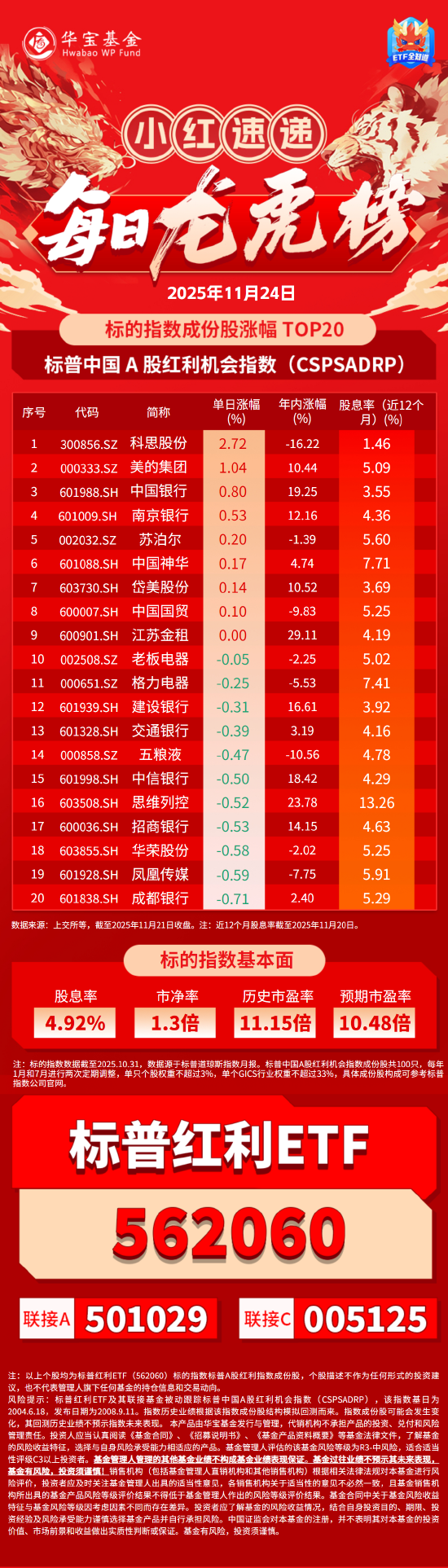
小红日报 | 标普红利ETF(562060)标的指数收跌-2.27%,资金逢跌积极布局
Xin Lang Ji Jin· 2025-11-24 01:11
Core Insights - The article presents the top 20 stocks in the S&P China A-Share Dividend Opportunity Index, highlighting their performance in terms of daily increase, year-to-date increase, and dividend yield [1] Group 1: Stock Performance - The top performer is Kesheng Co., Ltd. (300856.SZ) with a daily increase of 2.72% but a year-to-date decrease of 16.22% and a dividend yield of 1.46% [1] - Midea Group (000333.SZ) shows a daily increase of 1.04% and a year-to-date increase of 10.44%, with a dividend yield of 5.09% [1] - China Bank (601988.SH) has a daily increase of 0.80% and a year-to-date increase of 19.25%, with a dividend yield of 3.55% [1] Group 2: Dividend Yields - The highest dividend yield is from Siwei Liekong (603508.SH) at 13.26%, despite a daily decrease of 0.52% and a year-to-date increase of 23.78% [1] - Other notable dividend yields include China Shenhua (601088.SH) at 7.71% and Gree Electric Appliances (000651.SZ) at 7.41% [1] - Jiangsu Jinxiang (600901.SH) has a year-to-date increase of 29.11% with a dividend yield of 4.19% [1]





东南亚多国调研精要,小米多模型构建AI端侧生态,3D打印高增
SINOLINK SECURITIES· 2025-11-23 11:39
Investment Rating - The report does not explicitly provide an investment rating for the industry Core Insights - The research highlights the significant generational differences in consumer behavior and production capabilities across Thailand, Vietnam, and Cambodia, with Thailand resembling a "miniature" version of the Western consumer market, Vietnam in a rapid growth phase, and Cambodia reflecting characteristics of less developed nations [1] - The report emphasizes the potential for investment in Southeast Asia, particularly in consumer goods and technology-driven sectors, as companies leverage local production capabilities and growing consumer markets [1][2] Summary by Sections 1. Industry Insights - Thailand is compared to a "miniature" Western market, showcasing a mature consumer culture and a well-developed service industry, making it a reference point for companies looking to expand into Western markets [1] - Vietnam is characterized as a rapidly developing economy, with a GDP projected to reach approximately 62.69 trillion VND (around 4,700 USD) in 2024, indicating a significant consumer market potential [1] - Cambodia is noted for its low average income and high income disparity, with consumer spending primarily focused on essential goods, suggesting a slower penetration of discretionary spending [1] 2. Segment Tracking - Xiaomi Group is exploring the future of smart home technology with its Xiaomi Miloco initiative, aiming to enhance user interaction and privacy through advanced AI models [9][10] - The pet food sector saw significant growth during the Double Eleven shopping festival, with sales for the brand Guibao exceeding 1 billion RMB, reflecting a trend towards premium pet products [11][12] - The AI and 3D printing industry is experiencing high demand, with companies like Tuozhu achieving record sales during major shopping events, indicating strong market potential [21][22] 3. Macro Consumption Data - In October, the Consumer Price Index (CPI) showed a year-on-year increase of 0.2%, with service sector prices rising, indicating a recovery in consumer spending [35] - The Producer Price Index (PPI) decreased by 2.1% year-on-year, but showed signs of improvement in the month-on-month trend, suggesting a potential stabilization in production costs [45] - Online sales data from major platforms indicated a decline in the home appliance sector, with specific brands like Ecovacs and Roborock showing positive growth despite overall market challenges [50]

2025中国高端家电价值增长峰会圆满召开
Zheng Quan Ri Bao Zhi Sheng· 2025-11-22 04:05
Core Insights - The high-end home appliance market is the only segment experiencing simultaneous growth in both sales and prices, driven by a focus on "high value" rather than just "high price" [1][4] - The home appliance industry is facing challenges from the decline of three major benefits: real estate, population, and consumer confidence, with the market size stabilizing around 900 billion [1] - Future trends in the home appliance industry include convenience, performance efficiency, health-oriented innovation, AI empowerment, experience optimization, and aesthetic integration of home appliances and furniture [1] Company Strategies - Boss Electric emphasizes maintaining strategic focus on the cooking core sector, avoiding blind category expansion and price wars, while leveraging AI to enhance product and retail experiences [2] - Angel Group aims to address price wars in the water purification industry through technological advancements, focusing on health-oriented water solutions and expanding into industrial dishwashers and agricultural collaborations [2] - Stone Technology highlights its commitment to solving real user needs through continuous innovation, exemplified by breakthroughs in robotic cleaning technology [2] Industry Trends - The integration of AI in the workplace is transforming how companies manage both employees and AI tools, significantly reducing labor costs and enhancing marketing efficiency [3] - The health appliance sector is expected to evolve towards customized solutions based on region, demographics, and scenarios, with a focus on visual health monitoring and smart hydration [3] - The home renovation industry is entering a phase of deep cultivation, with a significant demand for personalized solutions in larger homes, indicating a shift from traditional marketing strategies to more tailored approaches [3][4]
厨卫电器板块11月21日跌2%,日出东方领跌,主力资金净流出1.21亿元
Zheng Xing Xing Ye Ri Bao· 2025-11-21 09:33
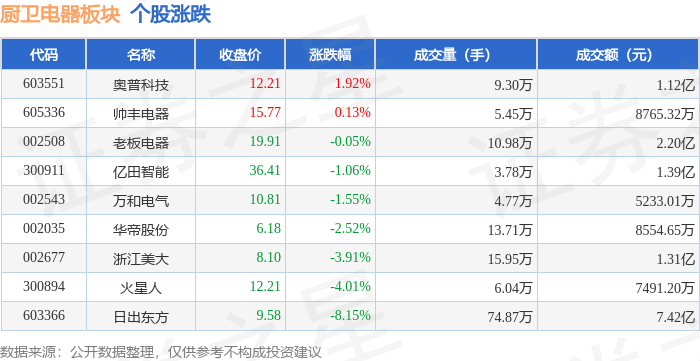
Market Overview - The kitchen and bathroom appliance sector experienced a decline of 2.0% on November 21, with the leading stock, 日出东方 (Rizhi Dongfang), falling significantly [1] - The Shanghai Composite Index closed at 3834.89, down 2.45%, while the Shenzhen Component Index closed at 12538.07, down 3.41% [1] Stock Performance - 奥普科技 (Aopu Technology) closed at 12.21, with an increase of 1.92% and a trading volume of 93,000 shares, amounting to 112 million yuan [1] - 帅丰电器 (Shuai Feng Electric) closed at 15.77, with a slight increase of 0.13% and a trading volume of 54,500 shares, totaling 87.65 million yuan [1] - 老板电器 (Boss Electric) closed at 19.91, with a minor decrease of 0.05% and a trading volume of 109,800 shares, amounting to 220 million yuan [1] - 日出东方 (Rizhi Dongfang) saw the largest decline of 8.15%, closing at 9.58 with a trading volume of 748,700 shares, totaling 74.2 million yuan [1] Capital Flow - The kitchen and bathroom appliance sector saw a net outflow of 121 million yuan from institutional investors, while retail investors contributed a net inflow of 92.18 million yuan [1] - The detailed capital flow for individual stocks indicates that 帅丰电器 (Shuai Feng Electric) had a net inflow of 7.96 million yuan from institutional investors, while 奥普科技 (Aopu Technology) experienced a net outflow of 23.47 million yuan from retail investors [2] - 日出东方 (Rizhi Dongfang) faced a significant net outflow of 70.07 million yuan from institutional investors, with retail investors contributing a net inflow of 67.62 million yuan [2]