中国巨石

Search documents
7628电子布再提价-玻纤投资逻辑再梳理
2026-02-05 02:21
Summary of Conference Call on Electronic Fabrics and Glass Fiber Industry Industry Overview - The electronic fabric and glass fiber industry is experiencing significant price increases due to high demand and low inventory levels, particularly for the 7,628 series, which has been nearly depleted for over six months [1][5][12] - The market is dominated by Japanese Toyota weaving machines, making domestic alternatives difficult to implement in the short term [1][2][27][28] Key Points and Arguments - **Price Increases**: The price of electronic fabrics has risen significantly, with Linzhou Guangyuan increasing prices by 1,000 yuan per ton and Chongdong International by 0.5 to 0.6 yuan [3][6][12] - **Supply Constraints**: The production of conventional electronic yarn and fabrics is challenged by the high demand for low dielectric and low expansion products, leading to a supply shortage [2][4][29] - **Market Outlook for 2026**: The glass fiber market is expected to remain optimistic, with potential price increases in the second quarter due to low inventory and reduced external sales [9][16] - **Production Capacity**: New production capacities are limited, with only about 300,000 tons expected to be added in 2026, which will help alleviate supply-demand pressure [16][30] - **Inventory Levels**: Normal inventory levels for glass fiber should be around 45 days, but current levels are below 10 days, necessitating price adjustments [5][15] Additional Important Insights - **Environmental Constraints**: Rapid capacity expansion is hindered by environmental regulations, making it challenging for large enterprises to increase production quickly [3][21][30] - **Market Dynamics**: The demand for low dielectric and low thermal expansion materials is expected to remain strong, with prices likely to continue rising due to tight supply [29][30] - **Technological Challenges**: The transition from traditional weaving machines to new low dielectric or low expansion machines is feasible but requires time for procurement and adaptation [4][11][27] - **Profit Margins**: Companies like Linzhou Guangyuan have seen significant improvements in profit margins due to price increases, with current selling prices reaching 10,500 yuan per ton for their products [13] Conclusion The electronic fabric and glass fiber industry is poised for continued growth, driven by strong demand and limited supply. Companies are adjusting prices to reflect market conditions, and while there are challenges related to production capacity and environmental regulations, the overall outlook for 2026 remains positive.
中国巨石股价创新高
Di Yi Cai Jing· 2026-02-04 12:41
Group 1 - The stock price of China Jushi increased by 7.1%, reaching 22.16 yuan per share, marking a new high [1] - The total market capitalization of the company surpassed 887.09 billion yuan [1] - The trading volume amounted to 20.30 billion yuan [1]

下一代电子布,要被英伟达们抢爆了
3 6 Ke· 2026-02-04 12:10
Group 1 - Nittobo plans to launch next-generation T-type glass fiber cloth for AI chips by 2028, reducing the thermal expansion coefficient from 2.8 ppm to 2.0 ppm, a decrease of approximately 30% [1] - T-type glass fiber cloth is widely used in integrated circuit substrates and advanced packaging substrates, enhancing dimensional stability and supporting large-scale AI packaging [1] - Nittobo holds about 90% market share in the global T-type glass fiber cloth market and is currently evaluating and improving the new glass cloth based on copper-clad laminate samples [1] Group 2 - The demand for glass fiber cloth is driving price increases, with the price of 7628 electronic cloth rising from 4.15 yuan/meter at the end of September 2025 to 4.75 yuan/meter currently, with multiple price hikes occurring [2] - Upstream materials like electronic yarn are also expected to see price increases due to stable supply and structural adjustments, leading to a tight supply of traditional electronic yarn and strong support for high-end products [2] - Companies like International Composites and Honghe Technology are expected to report significant profit increases due to rising glass fiber product prices, with International Composites projecting a net profit of up to 350 million yuan in 2025 [2] Group 3 - AI servers require higher performance in signal transmission rates and data loss, driving the demand for low dielectric constant electronic cloth, which is a core material for high-frequency and high-speed copper-clad laminates [3] - The supply of low thermal expansion coefficient electronic cloth is expected to remain tight in 2026, with potential for further price increases [3] - The shortage of high-end electronic cloth is anticipated to accelerate the domestic substitution process in the industry, presenting a golden development period for domestic electronic cloth manufacturers [3]





电子布龙头谋划新品 英伟达、谷歌或竞相争购 国内产业链已现“涨价潮”
Xin Lang Cai Jing· 2026-02-04 09:04
Group 1 - Nittobo plans to launch a next-generation T-type glass fiber cloth for AI chips by 2028, reducing the thermal expansion coefficient from 2.8 ppm to 2.0 ppm, which is a 30% decrease [1] - T-type glass fiber cloth is widely used in integrated circuit substrates and advanced packaging substrates, enhancing dimensional stability and supporting large-scale AI packaging [1] - Nittobo holds approximately 90% market share in the global T-type glass fiber cloth market and is currently evaluating and improving the new glass cloth based on copper-clad laminate samples [1] Group 2 - The demand for glass fiber cloth is driving price increases, with the price of 7628 electronic cloth rising from 4.15 yuan/meter to 4.75 yuan/meter since September 2025 [2] - Upstream materials like electronic yarn are also expected to see price increases due to supply constraints and structural adjustments, supporting price growth [2] - Companies like International Composites and Honghe Technology are projected to see significant profit increases due to rising glass fiber product prices [2] Group 3 - AI servers require lower dielectric constants and loss factors, driving the upgrade of copper-clad laminates towards high-frequency and high-speed applications, leading to increased demand for low dielectric constant electronic cloth [3] - The supply of low thermal expansion coefficient electronic cloth is expected to remain tight in 2026, with potential for further price increases [3] - The shortage of high-end electronic cloth is anticipated to accelerate the domestic substitution process, presenting growth opportunities for local electronic cloth manufacturers [3]


玻纤股午后异动拉升 山东玻纤直线涨停
Xin Lang Cai Jing· 2026-02-04 05:37
Group 1 - The glass fiber stocks experienced a significant surge in the afternoon, with Shandong Glass Fiber hitting the daily limit up [1] - Honghe Technology saw an increase of 7%, reaching a new historical high [1] - Other companies such as China Jushi, International Composites, Changhai Co., and China National Building Material Technology also experienced gains [1]

玻璃玻纤板块午后走强,山东玻纤直线拉升涨超8%
Mei Ri Jing Ji Xin Wen· 2026-02-04 05:35
Group 1 - The glass fiber sector experienced a strong rally in the afternoon, with Shandong Glass Fiber rising over 8% [2] - China Jushi also saw an increase of more than 8% in the afternoon trading session [2] - Other companies such as Honghe Technology, International Composites, Three Gorges New Materials, Beipo Co., and Qibin Group also followed suit with gains [2]


中国巨石创历史新高
Ge Long Hui· 2026-02-04 05:29
Group 1 - The core viewpoint of the article highlights that China Jushi (600176.SH) experienced a 7.1% increase in stock price, reaching a historical high of 22.160 yuan, with a total market capitalization of 88.71 billion yuan [1]
量化大势研判202602:市场△gf继续保持扩张
Guolian Minsheng Securities· 2026-02-04 05:29
- The report introduces a quantitative model framework for market trend analysis, focusing on five asset style stages: external growth, quality growth, quality dividend, value dividend, and bankruptcy value. The model evaluates assets based on their intrinsic attributes and prioritizes them using the sequence of g > ROE > D, analyzing whether there are "good assets" and whether they are "expensive" [5][8][9] - The model incorporates key factors such as expected growth (gf), actual growth (g), profitability (ROE), high dividend (D), and bankruptcy value (B/P). Each factor is associated with specific market phases, e.g., expected growth is relevant across all phases, while profitability is emphasized during maturity phases [9][12] - The quantitative model has demonstrated strong historical performance, achieving an annualized return of 27.67% since 2009. It has shown consistent excess returns in most years, particularly post-2017, with limited effectiveness in years like 2011, 2012, and 2016 [19][22] - The model's backtesting results for specific years include notable excess returns, such as 51% in 2009, 36% in 2013, and 62% in 2022. However, it also recorded underperformance in years like 2011 (-11%) and 2014 (-4%) [22] - The report details six specific strategies derived from the model, each focusing on different factors: - **Expected Growth Strategy**: Selects industries with the highest analyst-forecasted growth rates. Recent recommendations include sectors like automotive sales, lithium equipment, and tungsten [38][39] - **Actual Growth Strategy**: Focuses on industries with the highest unexpected growth (△g). Current recommendations include photovoltaic equipment, insurance, and coal chemical sectors [40][41] - **Profitability Strategy**: Targets high-ROE industries with low valuations under the PB-ROE framework. Recommended sectors include copper, liquor, and non-dairy beverages [43][44] - **Quality Dividend Strategy**: Utilizes a DP+ROE scoring system to identify industries. Current recommendations include forestry, lithium equipment, and fiberglass [46][47] - **Value Dividend Strategy**: Employs a DP+BP scoring system. Recommended sectors include security, daily chemicals, and buses [49][50] - **Bankruptcy Value Strategy**: Focuses on industries with the lowest PB+SIZE scores. Current recommendations include automotive sales, ceramics, and cotton textiles [53][54]





中国巨石股价涨5.07%,华泰柏瑞基金旗下1只基金位居十大流通股东,持有4094.5万股浮盈赚取4299.23万元
Xin Lang Ji Jin· 2026-02-04 05:22
Group 1 - The core viewpoint of the news is that China Jushi Co., Ltd. experienced a stock price increase of 5.07%, reaching 21.74 CNY per share, with a trading volume of 1.873 billion CNY and a turnover rate of 2.23%, resulting in a total market capitalization of 87.028 billion CNY [1] - China Jushi, established on April 16, 1999, and listed on April 22, 1999, is primarily engaged in the production and sales of fiberglass and related products, with its main business revenue composition being 97.41% from fiberglass and its products, 1.63% from other sources, and 0.96% from wind power [1] Group 2 - Among the top ten circulating shareholders of China Jushi, Huatai-PB Fund's Huatai-PB CSI 300 ETF (510300) reduced its holdings by 1.9238 million shares in the third quarter, now holding 40.945 million shares, which accounts for 1.02% of the circulating shares [2] - The Huatai-PB CSI 300 ETF (510300), established on May 4, 2012, has a latest scale of 422.258 billion CNY, with a year-to-date return of 0.73% and a one-year return of 25.22% [2] - The fund manager, Liu Jun, has a cumulative tenure of 16 years and 250 days, managing total fund assets of 550.928 billion CNY, with the best fund return during his tenure being 225.42% and the worst being -45.64% [2]
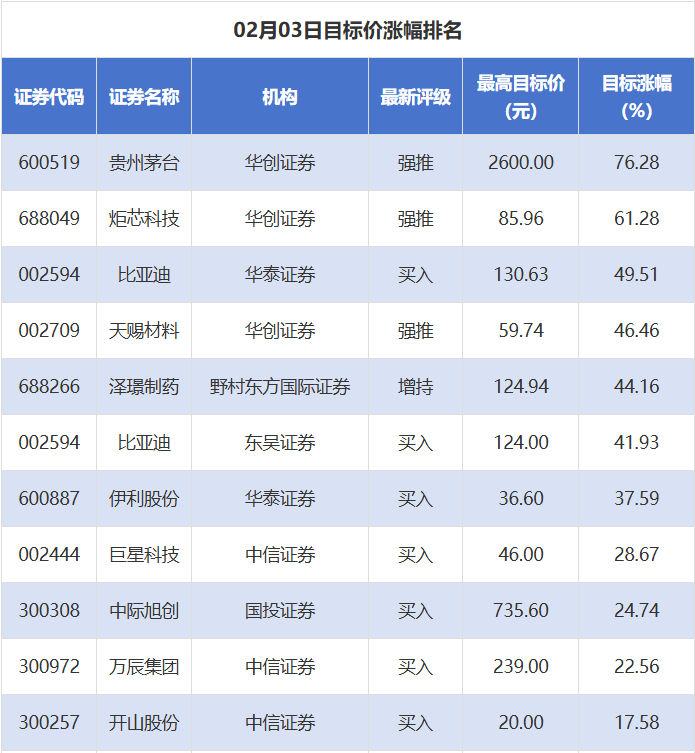
贵州茅台目标价涨幅超76%,29家上市公司获券商推荐
2 1 Shi Ji Jing Ji Bao Dao· 2026-02-04 04:33
Group 1 - The article highlights the target price increases for several listed companies, with Guizhou Moutai (600519) leading at a target price increase of 76.28%, followed by Juchip Technology at 61.28%, and BYD (002594) at 49.51% [1][3] - On February 3, a total of 29 listed companies received broker recommendations, with BYD receiving the highest number of recommendations at 3 [4] - The article mentions that 7 companies received first-time coverage from brokers, including China National Glass (600176) with a "recommend" rating and Olay New Materials with an "increase" rating [5][6] Group 2 - The highest target prices and corresponding target price increases for the companies are as follows: Guizhou Moutai at 2600.00 yuan, Juchip Technology at 85.96 yuan, and BYD at 130.63 yuan [3] - The sectors represented among the companies with the highest target price increases include liquor, semiconductors, and passenger vehicles [1][3] - The article provides a detailed list of companies and their respective broker ratings, indicating a diverse range of industries from consumer electronics to industrial metals [5][6]