
爱美客

Search documents
胶原赛道竞争再升级!媛颂首发全球首款牛跟腱胶原,抢占千亿胶原市场
Sou Hu Cai Jing· 2026-01-04 02:39
Core Insights - The strategic partnership between Yuansong Group and Chongshan Biotechnology has led to the launch of the world's first collagen product derived from bovine tendons, named "Jiaoyuan Angel," which received regulatory approval on December 10 [1][3] - The collagen market has reached a scale of 200 billion and is projected to grow to 500 billion by 2030, indicating significant growth potential in the industry [3] Product Advantages - "Jiaoyuan Angel" features a high medical collagen concentration of 45 mg/ml, ensuring strong support [5] - The product uses collagen extracted from bovine tendons, ensuring high purity and structural integrity [5] - Advanced application technology allows for precise subcutaneous implantation, providing deeper network support for the skin [5] - The company has addressed industry challenges, establishing 45 mg/ml as the optimal concentration to balance efficacy and safety [5] Market Positioning - The collaboration signifies an upgrade in the synergy between clinical institutions and research enterprises, aiming to redefine the application of collagen in the market [6] - The focus is shifting from "volume enhancement" to "nutritional tightening," which is expected to become the mainstream trend in the collagen market [8] - Yuansong Group has previously launched several successful products in the medical beauty sector, positioning itself as a market leader [8] - "Jiaoyuan Angel" is anticipated to capture significant market share and potentially become a dark horse in the medical beauty market by 2026 due to its technological advantages and promotional capabilities [8]


盘点2025最惨股:最高跌超34%,千亿白马股陨落,三大雷区勿碰
Sou Hu Cai Jing· 2026-01-03 07:15
Group 1: Market Overview - The A-share market in 2025 experienced extreme polarization, with some stocks soaring while others plummeted, indicating a significant shift in investor sentiment towards new productivity sectors [1][9] - Over 4,000 stocks rose, with the ChiNext index increasing nearly 50%, yet 40 stocks saw declines exceeding 30%, reflecting a collective flight from traditional industries [1] Group 2: Real Estate Sector - Vanke A and Poly Developments, once leading real estate companies, faced declines of 34.71% and 28.77% respectively due to tightening real estate policies and low consumer confidence [3] - The sales revenue for these companies dropped sharply, as market funds shifted away from real estate towards technology and new energy sectors [3] Group 3: Automotive Industry - SAIC Motor Corporation experienced a decline of 25.64%, struggling to adapt to the rapid transition to new energy vehicles amid competition from BYD and Tesla [3] - The company's sales growth in the new energy vehicle segment fell short of expectations, while the traditional fuel vehicle market continued to shrink [3] Group 4: Alcohol Industry - The white liquor sector saw significant divergence, with Yanghe and Wuliangye declining by 22.07% and 19.96% respectively, while Moutai and Luzhou Laojiao remained stable [3] - Weak consumer recovery and high channel inventory pressured prices, particularly for Yanghe, which lacked innovation and marketing appeal [3] Group 5: Medical Aesthetics Sector - Aimeike, a leader in the medical aesthetics industry, fell by 20.56% due to stricter regulations and intensified market competition, leading to a decline in core product growth [5] - The industry faced challenges from consumption downgrades and product homogenization, undermining previous high-growth narratives [5] Group 6: ST Stocks and Market Dynamics - 2025 was marked as the "year of new delisting regulations," with ST stocks suffering severe declines, such as Zitian's drop of over 96% due to financial fraud [5][9] - The phenomenon of increasing shareholder numbers in declining ST stocks highlighted a dangerous "buy the dip" mentality among investors [7] Group 7: Technology Sector - Companies like Aowei New Materials and Tianpu Holdings saw extraordinary gains of 1820% and 1662% respectively, driven by trends in humanoid robotics and AI chips [1][7] - Shenghong Technology emerged as a significant player in the AI sector, with a net profit surge of 324% and a market capitalization exceeding 260 billion yuan [7] Group 8: Overall Market Metrics - The total market capitalization of A-shares surpassed 109 trillion yuan, with a trading volume of 419.86 trillion yuan and a margin balance of 2.55 trillion yuan [9] - Extreme cases of liquidity issues were noted, such as ST Suwu's minimum daily trading volume of only 70,000 yuan, indicating potential risks in market liquidity [9]

美容护理系列深度报告2:技术、需求双轮驱动,PDRN应用提速
Orient Securities· 2025-12-31 15:40
Investment Rating - The report maintains a "Positive" investment rating for the beauty and personal care industry, specifically focusing on PDRN applications [6]. Core Insights - The report highlights that PDRN (Polydeoxyribonucleotide) is expected to unleash stronger commercial potential due to increasing registrations and search metrics. The extraction of PDRN is transitioning from animal sources to microbial fermentation and synthetic biology, laying a solid foundation for accelerated applications in the medical beauty and skincare sectors [3][4]. - The report emphasizes that domestic beauty companies are likely to redefine the value boundaries of PDRN, with leading firms accelerating their strategies in this competitive landscape [3][4]. Summary by Sections PDRN Overview - PDRN, derived from salmon and other sources, has a high similarity to human DNA (98%) and is known for its skin repair and cell regeneration properties. Its historical development spans from the 15th century to its current applications in medical aesthetics and cosmetics [8][13][19]. Market Growth Potential - The PDRN market is projected to grow significantly, with estimates indicating an increase from USD 0.72 billion in 2024 to USD 8.55 billion by 2031, reflecting a CAGR of 43%. The demand for anti-aging products is a core driver of this growth [8][30]. Competitive Landscape - Domestic companies are actively entering the PDRN medical and skincare sectors, with significant advancements in extraction technologies. Companies like Huaxi Biological and Lepu Medical are leading the charge in developing PDRN-based products [8][30][34]. Key Mechanisms and Benefits - PDRN operates through two main mechanisms: acting as an agonist for the adenosine A2A receptor to suppress inflammation and providing nucleotides for DNA synthesis, thus promoting cell regeneration and tissue repair [34][36]. - The primary benefits of PDRN include skin repair, anti-inflammatory effects, and anti-aging properties, making it suitable for various cosmetic and medical applications [34][39].




新材料驱动医美新生态-供给革命推动千亿市场重回增长
2025-12-29 15:51
Summary of Key Points from the Conference Call Industry Overview - The Chinese medical aesthetics market has a significantly lower penetration rate compared to developed countries, with an expected penetration rate of approximately 3.2% by 2025, compared to South Korea's 16.1%, indicating substantial growth potential over the next decade, potentially reaching a market size of 700 to 800 billion or even over 1 trillion yuan [1][4] - The market is currently facing challenges due to consumer fatigue and accelerated regulatory approvals, leading to increased competition and price reductions for products like homologous injections [1][5] Core Insights and Arguments - Medical aesthetics institutions are struggling with high sales expense ratios, often between 30% and 40%, which erodes profits. New business models like the "Xiaoyang model" and "dual beauty integration model" are seen as effective ways to reduce sales costs and improve profitability [2][3] - PDIN (salmon needle) is gaining attention as a new medical aesthetic material due to its high similarity to human DNA, good biocompatibility, and regenerative properties, potentially becoming a new profit growth point for medical aesthetic institutions [1][10] - The leading brand in the Korean PDN market, Rejuran, is expected to generate approximately 870 million yuan in global revenue in 2024, with projections of reaching 1.5 billion yuan in 2025, supported by a planned 25% compound annual growth rate over the next five years [1][17] Investment Opportunities - Investment opportunities in the medical aesthetics industry can be categorized into upstream (new materials) and downstream (medical aesthetic institutions). Upstream new materials are currently a key investment direction, while downstream institutions that can effectively lower sales costs and improve profitability are also valuable [2][6] - Companies like Lepu Medical are actively developing PDI and ECM medical aesthetic products, with PDI products expected to be approved in the first half of 2026, potentially serving as new growth engines for the company [2][23] Competitive Landscape - The competitive landscape for medical aesthetic materials has changed significantly, with new products being approved at a rapid pace, increasing competition and driving down prices for traditional materials like collagen [7][9] - The overall growth rate of the Chinese medical aesthetics industry has slowed to about 10% in recent years, down from over 30% pre-pandemic, with a decline in average transaction prices impacting profit margins [8] Future Outlook - Long-term growth potential remains strong for the Chinese medical aesthetics industry, driven by low current penetration rates and the anticipated normalization of domestic consumption [6] - The demand for PDI materials is expected to increase, with several companies, including Lepu Medical, actively pursuing development in this area, indicating a shift towards new profit sources as traditional materials face declining margins [23] Company-Specific Insights - Lepu Medical's current valuation is considered undervalued at around 30 billion yuan, with a potential market value of at least 40 billion yuan based on its serious medical business, PDIN, and innovative drug potential [2][26] - Rejuran's market share in the Korean PDN market is estimated to be between 70% and 80%, with significant revenue contributions from both domestic and international markets [17][19] Additional Considerations - The approval status of Rejuran in various countries, including Singapore, Thailand, and Australia, is progressing, with pending applications in China and the U.S. that could significantly enhance its global market presence [21] - The ECM component market is also showing potential, with several companies in China working on related products, indicating a growing interest in this area [24][25]

330亿陕西首富携女亮相,巨子生物意欲何为?
Sou Hu Cai Jing· 2025-12-29 14:01
Core Viewpoint - The strategic partnership between Giant Bio and Nordberg Medical aims to leverage Giant Bio's patented recombinant collagen technology for global market expansion in the medical aesthetics sector, indicating a shift towards international growth opportunities [2][5][10]. Financial Performance - In the first half of the year, Giant Bio reported revenue of 31.13 billion yuan, a year-on-year increase of 22.52%, and a net profit attributable to shareholders of 11.82 billion yuan, up 20.23% [7]. - Despite positive growth, the revenue and net profit growth rates have slowed compared to previous years, where growth rates exceeded 40% [7]. - The company's gross margin for the first half of the year was 81.68%, down from previous years' figures of 85.11%, 84.14%, and 82.4% [7]. Strategic Developments - The partnership with Nordberg Medical allows Giant Bio to utilize the latter's established global marketing and sales network, facilitating quicker entry into international markets [5][10]. - Giant Bio received a medical device registration certificate for its recombinant type I α1 collagen product, marking a significant step into the professional medical sector [10][12]. Market Position and Competition - The competitive landscape in the recombinant collagen market is intensifying, with companies like Huaxi Bio and Jinbo Bio also making significant advancements [10][11]. - Jinbo Bio has established a lead in the market with multiple approved medical device registrations, highlighting Giant Bio's relatively slower progress in this area [11][12]. Stock Performance and Market Sentiment - Giant Bio's stock has seen a significant decline, dropping approximately 60% from its peak of 85.14 HKD per share earlier in the year, now trading at 34.56 HKD [12]. - The company announced a share buyback plan to repurchase up to 10% of its issued shares, reflecting confidence in its long-term strategy and growth potential [12].

医疗美容板块12月29日跌0.97%,爱美客领跌,主力资金净流出7417.96万元
Zheng Xing Xing Ye Ri Bao· 2025-12-29 09:02
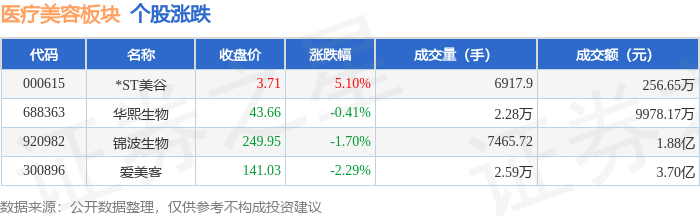
Core Viewpoint - The medical beauty sector experienced a decline of 0.97% on December 29, with Ai Meike leading the drop, while the overall Shanghai Composite Index rose slightly by 0.04% [1] Group 1: Market Performance - The Shanghai Composite Index closed at 3965.28, and the Shenzhen Component Index closed at 13537.1, down by 0.49% [1] - The medical beauty sector's individual stock performance showed varied results, with *ST Meigu leading with a rise of 5.10% to a closing price of 3.71, while Ai Meike fell by 2.29% to 141.03 [1] Group 2: Capital Flow - The medical beauty sector saw a net outflow of 74.18 million yuan from main funds, while retail investors contributed a net inflow of 29.66 million yuan [1] - Individual stock capital flow indicated that Ai Meike had a significant net outflow of 74.86 million yuan from main funds, despite a net inflow of 36.80 million yuan from retail investors [2]
化妆品医美行业周报:林清轩本周港股IPO,领跑国货高端精华油赛道-20251228
Shenwan Hongyuan Securities· 2025-12-28 13:13
Investment Rating - The report maintains a "Positive" outlook on the cosmetics and medical beauty industry [2]. Core Insights - The cosmetics and medical beauty sector underperformed the market, with the Shenwan Beauty Care Index declining by 1.1% from December 19 to December 26, 2025, which is weaker than the market performance [4][5]. - Lin Qingxuan is set to lead the high-end domestic essence oil sector with its upcoming IPO on December 30, 2025, planning to issue 13.9665 million H shares. The company has shown significant growth, with revenue projected to increase from 690 million yuan in 2022 to 1.21 billion yuan in 2024, representing a compound annual growth rate (CAGR) of 32.7% [4][10]. - The report highlights the strong performance of Yiwang Yichuang (300792SZ) in the e-commerce agency sector, leveraging AI to enhance operational efficiency and revenue potential [11][12]. Summary by Sections Industry Performance - The cosmetics and medical beauty sector's performance was weaker than the market, with specific indices showing declines: the Shenwan Cosmetics Index fell by 1.3%, and the Shenwan Personal Care Index decreased by 1.0% [4][5]. Key Company Developments - Lin Qingxuan's IPO is anticipated to bolster its market position, with a focus on high-end skincare products. The company has achieved a market share of 1.4% in the high-end skincare segment and ranks 10th in the anti-wrinkle product market with a 2.2% share [10]. - Yiwang Yichuang's business model is robust, with a comprehensive coverage of consumer goods categories and deep collaboration with Alibaba, positioning it well for future growth [11][12]. Market Trends - The report notes a recovery in the e-commerce agency sector, driven by increased demand for brand representation on platforms like Alibaba, with a notable rebound in traffic [12][13]. - The overall retail sales of cosmetics in China showed a growth of 4.8% year-on-year for the first 11 months of 2025, with November alone seeing a 6.1% increase, aided by promotional events [18][20]. Regulatory and Product Innovations - Jiangsu Chuangjian Medical Technology's collagen implant product received approval from NMPA, indicating ongoing innovation in the medical beauty sector [22]. - The report also mentions the investment by L'Oréal in a Chinese pharmaceutical company, marking a significant move into the skin health sector [25].
商贸零售行业周报:潮宏基多渠道高效推新,毛戈平推出高端冻龄系列-20251228
KAIYUAN SECURITIES· 2025-12-28 02:41
Investment Rating - The industry investment rating is "Positive" (maintained) [1] Core Views - The retail industry is experiencing a transformation with a focus on emotional consumption and innovative product offerings, particularly in the jewelry and cosmetics sectors [6][33] - Companies like潮宏基 and毛戈平 are leveraging multi-channel strategies to enhance brand visibility and product sales, indicating a strong market presence [26][31] Summary by Sections Retail Market Overview - The retail index closed at 2462.73 points, with a weekly increase of 0.16%, underperforming the Shanghai Composite Index, which rose by 1.88% [5][15] - The retail sector has seen a year-to-date increase of 10.00%, lagging behind the Shanghai Composite Index's 18.26% rise [15][19] Company Highlights - **潮宏基**: Achieved a revenue of 62.37 billion yuan in the first three quarters of 2025, up 28.4% year-on-year, with a net profit of 3.17 billion yuan, reflecting a 0.3% increase [42] - **毛戈平**: Launched the "琉光赋活" skincare series, set to debut on January 1, 2026, focusing on high-end skincare needs [31] - **周大福**: Reported a revenue of 389.86 billion HKD for FY2026H1, a slight decrease of 1.1%, but with a net profit increase of 0.1% [39] Investment Themes - **Gold and Jewelry**: Focus on brands with differentiated product offerings and consumer insights, recommending潮宏基 and老铺黄金 as key players [6][33] - **Offline Retail**: Emphasis on companies adapting to market changes, with recommendations for永辉超市 and爱婴室 [6][33] - **Cosmetics**: Highlighting brands that innovate with emotional value and safe ingredients, recommending毛戈平 and珀莱雅 [6][34] - **Medical Aesthetics**: Targeting differentiated product manufacturers and expanding medical aesthetic chains, with recommendations for爱美客 and科笛-B [6][34]


产线工程师可跨省聘为“特聘教授”
Xin Lang Cai Jing· 2025-12-27 17:39
Core Insights - The Chengdu-Chongqing region is advancing the integration of industry and education in the Internet of Things (IoT) sector, aiming to address structural contradictions between talent cultivation and market demand [1][2] - A proposal for establishing a collaborative community for IoT industry-education integration was released, emphasizing shared resources and mutual recognition of credits and skills [1][2] Group 1: Industry and Education Integration - The event highlighted the need to shift from a linear model of "market demands courses" to a collaborative approach where leading enterprises and key institutions co-create cross-domain course resources [2] - A "dual-teacher" sharing pool will be established, incorporating technical experts from enterprises and core teachers from institutions to promote cross-regional hiring and collaborative teaching [2] - Mechanisms for mutual recognition of credits and skill levels will be developed to facilitate course selection and practical training outcomes between institutions in the region [2] Group 2: Regional Development and Collaboration - The Chengdu-Chongqing area has become a significant hub for advanced manufacturing, producing approximately two-thirds of iPads globally, one-seventh of China's automobiles, and one-fifth of power batteries [2] - The region is recognized as the first national-level advanced manufacturing cluster across provinces, with leading companies like XGIMI Technology, BOE Technology Group, and Chenxian Optoelectronics [2] - The integration model aims to break down administrative barriers, allowing for greater mobility of talent, such as engineers from companies like Canopus Robotics being appointed as "visiting professors" at vocational colleges in Chongqing [2]
业绩滑坡、纷争升级……医美上游企业告别“野蛮生长”态势,行业迎来“洗牌期”|年终盘点
Xin Lang Cai Jing· 2025-12-27 06:33
Core Viewpoint - The medical aesthetics industry is entering a "cooling period" by 2025, with increasing competition leading to performance declines for upstream companies, making it challenging for leading manufacturers to maintain high growth rates. Price wars are becoming inevitable as the number of competitors rises, and conflicts over product pricing and agency rights are escalating among companies [1][2][4]. Industry Overview - The medical aesthetics market is approaching saturation, with many listed companies experiencing significant declines in performance. For instance, Huaxi Biological reported a revenue drop of 18.36% and a net profit decline of 30.29% for the first three quarters of the year. Similarly, Aimeike experienced a revenue decrease of 21.49% and a net profit drop of 31.05% [2][3]. - Despite the current challenges, industry experts remain optimistic about the future growth of the medical aesthetics market, projecting a double-digit growth rate driven by consumer preferences and increasing demand for aesthetic procedures [3][4]. Competitive Landscape - The approval of various hyaluronic acid and collagen products has intensified competition, leading to a "price war" among manufacturers. The market for "童颜针" (AestheFill) has seen a significant increase in competition, with multiple products now available, creating a scenario referred to as "九子夺嫡" (Nine Princes Competing for the Throne) [4][5][6]. - The pricing strategies of downstream institutions are causing conflicts with upstream manufacturers, as some institutions adopt low-price strategies that disrupt traditional pricing systems [4][5]. Mergers and Acquisitions - The industry is witnessing a wave of mergers and acquisitions as companies seek to acquire technology, brands, or channel resources. Notable transactions include Aimeike's acquisition of a majority stake in Korean REGEN and Bausch Health's acquisition of Wuhan Zhibo Zhenmei Technology [6][7]. - The trend of consolidation is expected to continue, with both upstream and downstream companies engaging in strategic acquisitions to enhance their market positions and operational efficiencies [7].