
沐曦

Search documents
DeepSeek的一串“符号”背后:对国产芯片意味着什么?
2 1 Shi Ji Jing Ji Bao Dao· 2025-09-02 13:44
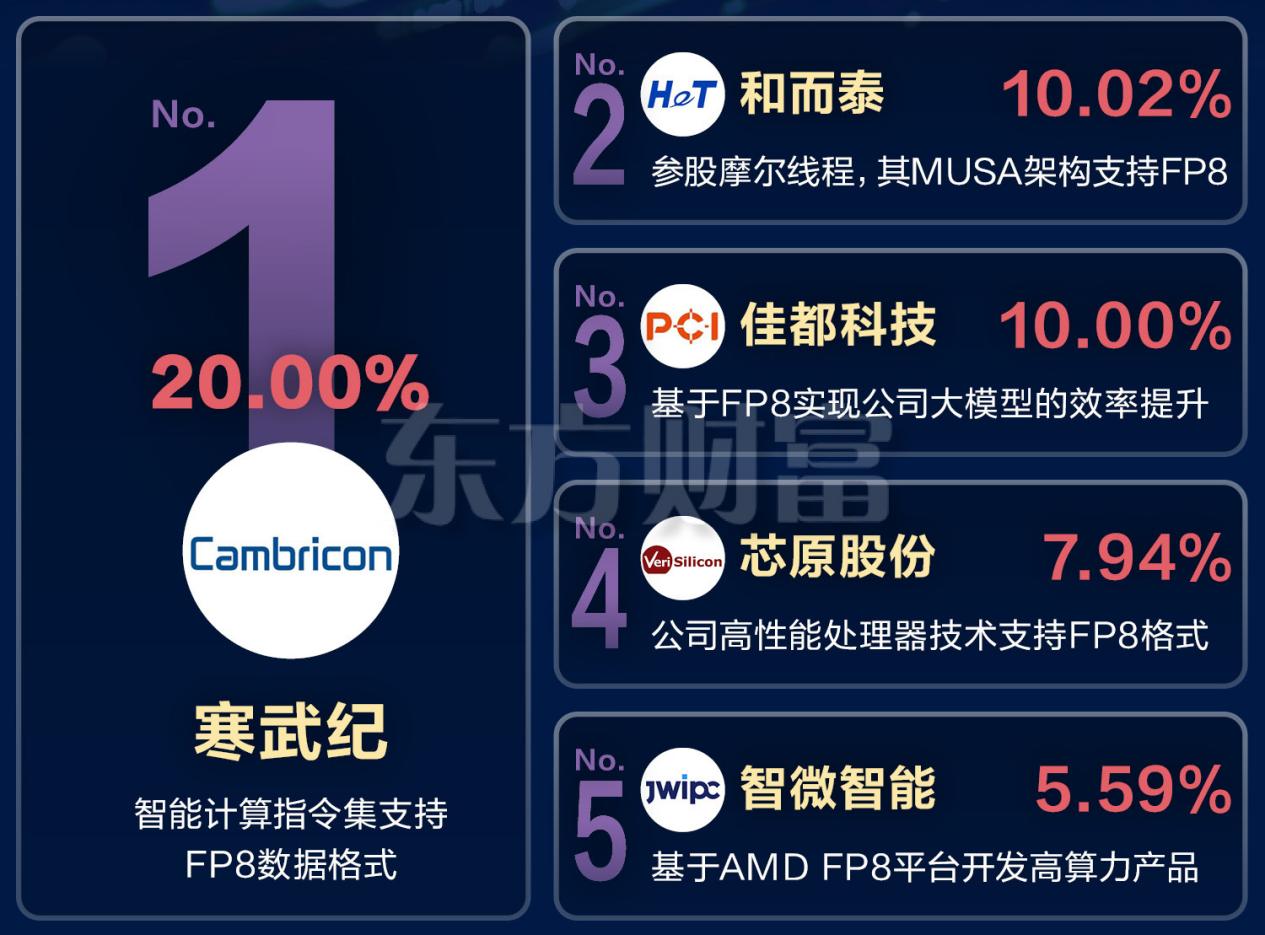
Core Viewpoint - The introduction of "UE8M0 FP8" represents a significant advancement in the domestic chip design tailored for the Chinese market, aiming to enhance computational efficiency and stability in AI applications, particularly in the context of the DeepSeek V3.1 model release [1][4][8]. Group 1: Understanding "UE8M0 FP8" - "FP" stands for "floating point," a fundamental unit in binary computing, with "FP8" indicating an 8-bit floating point format, which is suitable for various applications including graphics processing and deep learning [2]. - "UE8M0 FP8" signifies a parameter format with unsigned 8-bit exponent and 0-bit mantissa, allowing for a data range comparable to FP32 while being more efficient [3]. - The format sacrifices some precision for improved global stability, making it particularly suitable for AI models that rely on extensive floating-point ranges [3]. Group 2: Suitability for Domestic Chips - "UE8M0 FP8" is designed to be compatible with domestic chip manufacturers, addressing the current limitations in technology and performance in the Chinese chip industry [4][5]. - The format simplifies calculations, reducing computational load significantly, which is crucial given the existing gaps in advanced manufacturing processes compared to international standards [5]. - As an open-source format, "UE8M0" could help rebuild the ecosystem for domestic chips, which have historically been constrained by the dominance of NVIDIA's CUDA ecosystem [5][6]. Group 3: Market Impact and Future Prospects - Following the release of DeepSeek V3.1, companies like Cambricon have seen significant stock price increases, indicating strong market interest in chips that support FP8 calculations [8]. - The future of "UE8M0 FP8" in the market remains uncertain, with various companies yet to confirm their adoption of this mixed-parameter model [8]. - Experts believe that domestic chip manufacturers will ultimately succeed, provided they can achieve competitive performance advantages [9].


DeepSeek-V3.1适配下一代国产芯片引爆市场,大模型这次和哪些国产芯一起“自主可控”?
3 6 Ke· 2025-09-01 11:37
Core Insights - DeepSeek officially launched DeepSeek-V3.1 on August 21, featuring a hybrid reasoning architecture, improved thinking efficiency, and enhanced agent capabilities [1] - The release sparked significant market activity, with FP8 concept stocks surging, including companies like Cambricon, Hezhong Technology, and Jiadu Technology [1] Group 1: DeepSeek-V3.1 Features - The hybrid reasoning architecture allows the model to support both thinking and non-thinking modes [1] - DeepSeek-V3.1-Think demonstrates higher efficiency, providing answers in a shorter time compared to its predecessor, DeepSeek-R1-0528 [1] - Enhanced agent capabilities are achieved through post-training optimization, improving performance in tool usage and agent tasks [1] Group 2: FP8 and UE8M0 FP8 - FP8, or Floating-Point 8, is a format that uses 8 bits to balance range and precision, with the introduction of UE8M0 FP8 specifically designed for upcoming domestic chips [4][8] - UE8M0 FP8 prioritizes dynamic range while sacrificing some precision, making it suitable for stable training on non-NVIDIA architectures [22] - The shift to FP8 is driven by the need for lower precision formats to reduce memory usage and improve computational speed, especially in AI applications [9][15] Group 3: Market Impact and Collaboration - The announcement of DeepSeek-V3.1 and its FP8 capabilities led to a surge in interest from domestic chip manufacturers, indicating a collaborative effort between model developers and chip manufacturers [17][22] - The compatibility of UE8M0 FP8 with domestic chips is seen as a strategic move to enhance the stability and efficiency of AI model training in the context of export restrictions on NVIDIA technology [22] - The collaboration aims to establish a robust FP8 ecosystem within China, facilitating the development of AI infrastructure independent of foreign technology [22][23]


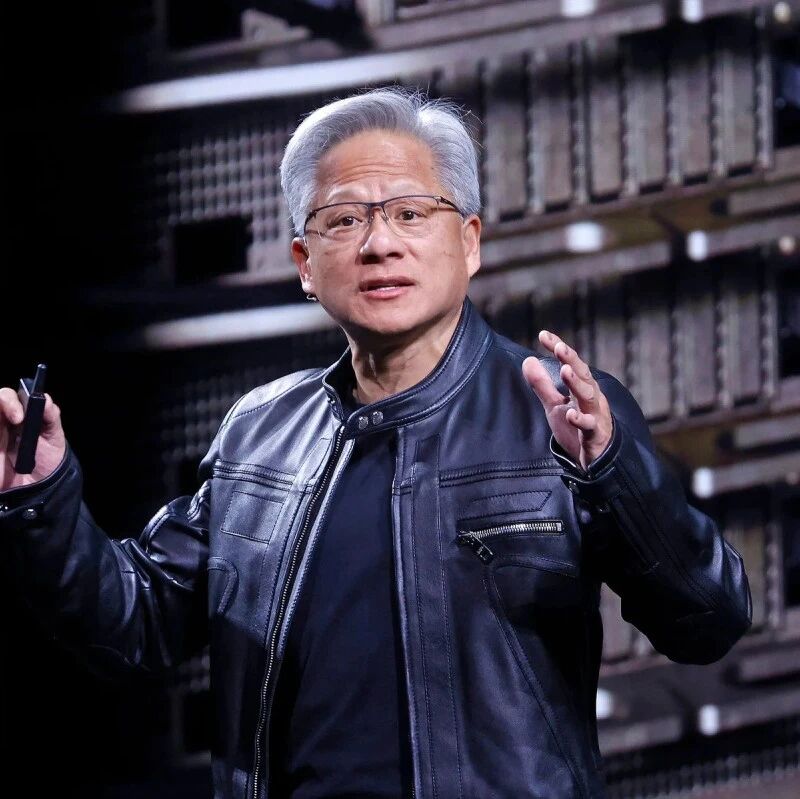
老黄给白宫画饼,国产芯片“借上英伟达的东风”
首席商业评论· 2025-08-31 03:55
Core Viewpoint - The Chinese chip market is currently valued at $50 billion and is expected to grow by 50% annually, leading to a surge in domestic investment in local chip stocks, particularly in companies like Cambricon [3][5]. Group 1: Market Dynamics - As of August 28, Cambricon's stock price reached 1587.91 yuan, surpassing Kweichow Moutai's price of 1446.1 yuan, making it the highest-priced stock in A-shares, with a 33-fold increase since the end of 2022 [3]. - Goldman Sachs raised Cambricon's target price to 1835 yuan, suggesting a market capitalization approaching 770 billion yuan [3]. Group 2: Financial Projections - Dongwu Securities projected Cambricon's revenue for 2025 at 5.2 billion yuan, aligning with the company's own estimate of 5 to 7 billion yuan, while estimating a price-to-earnings ratio of 130 for 2026, leading to a valuation of 287.7 billion yuan, significantly lower than the current market cap of around 600 billion yuan [5]. Group 3: Investment Sentiment and Risks - Goldman Sachs identified three main factors for Cambricon's potential stock price increase: surging capital expenditures from domestic cloud providers, the trend of domestic AI chip replacement, and Cambricon's fundraising of 4 billion yuan for AI model chip development [7]. - Despite the optimism, there are concerns about the sustainability of growth in capital expenditures and the risks of overvaluation, as Cambricon announced expected revenues of 5 to 7 billion yuan without new product releases, indicating potential market misinterpretations [7]. - The TMT sector's daily trading volume accounts for approximately 41% of total A-share trading, indicating a high level of market speculation [7]. Group 4: Competitive Landscape - Domestic GPU company Muxi stated that despite NVIDIA's H20 chip being approved for sale in mainland China, there is no direct competition due to differing customer bases [10]. - Muxi highlighted that the H20 chip has lower computational power for large-scale AI training tasks but excels in AI inference scenarios due to its high bandwidth and software ecosystem [10][12]. - Current domestic chips show some improvements in computational power but still lag behind NVIDIA in interconnect efficiency and software ecosystem maturity, leading to potential cost-performance issues [12]. Group 5: Industry Context - The chip industry is increasingly viewed as a battleground for technological and geopolitical competition, with significant implications for supply chains and market dynamics [13].
H20不卖了,老黄还怎么给英伟达画饼?
首席商业评论· 2025-08-30 03:50
Core Viewpoint - Nvidia's CEO Jensen Huang emphasizes the importance of the Chinese market for the company's growth, predicting a 50% increase in China's AI industry next year and expressing a desire to re-enter the market despite regulatory challenges [4][8]. Group 1: Nvidia's Market Strategy - Nvidia is considering introducing its advanced Blackwell processors to China, highlighting the potential for significant revenue from this market, estimated at $50 billion this year [4][8]. - Huang acknowledges the competitive landscape in China, stating that local companies are becoming increasingly capable and that Nvidia must act quickly to regain market share [8][9]. - The company has faced export restrictions from the U.S. government, which complicates its ability to sell high-end chips to China, necessitating licenses for exports [9][10]. Group 2: Financial Performance - Nvidia reported a revenue of $46.743 billion for the second quarter of fiscal year 2026, a 56% year-over-year increase, with a net profit of $26.422 billion, up 59% [17]. - Despite exceeding revenue expectations, Nvidia's data center business has seen two consecutive quarters of revenue below projections, raising concerns about future growth [19]. - The new Blackwell chip series has shown a 17% quarter-over-quarter revenue increase, but the overall market dynamics are shifting, leading to a more cautious outlook [19][22]. Group 3: Competitive Landscape - By 2024, major Chinese internet companies like ByteDance, Tencent, Alibaba, and Baidu are expected to account for 87% of H20 chip purchases, indicating a strong local demand for AI chips [12]. - The self-sufficiency rate of domestic AI chips in China is projected to rise from 10-15% in 2023 to nearly 50% by 2026, reflecting the growing capabilities of local manufacturers [12]. - The introduction of the B40 chip, which is designed to comply with U.S. export regulations, shows Nvidia's attempt to adapt to the changing market while maintaining some competitive advantages [20][22].
沐曦回复IPO首轮问询:与英伟达H20芯片不构成直接竞争
Nan Fang Du Shi Bao· 2025-08-28 07:19
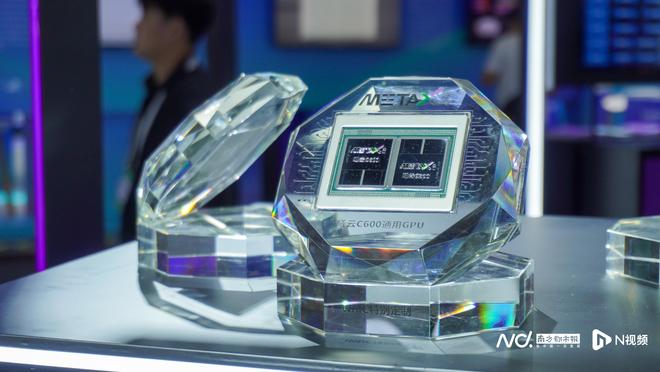
Core Viewpoint - Domestic GPU company Muxi claims that despite NVIDIA's H20 chip being approved for sale in mainland China, there is no direct competition between Muxi and NVIDIA due to differing customer bases [1][2]. Group 1: IPO and Financials - Muxi's IPO application was accepted on June 30, aiming to raise 3.904 billion yuan [1]. - The company reported a significant reliance on its C500 series, which accounted for 97.28% and 97.87% of revenue in 2024 and the first three months of 2025, respectively [7]. - Muxi's net losses from 2022 to the first quarter of 2025 were approximately 777 million yuan, 871 million yuan, 1.409 billion yuan, and 233 million yuan [9]. Group 2: Product Development and Market Position - Muxi's flagship AI chip, the C600, has been developed with a memory capacity of 144GB and a computing power of 1000 TFLOPS [3][8]. - The C600 is expected to enter risk mass production by the end of 2025, with significant interest from major internet companies and banks [8]. - Muxi's next-generation chip, the C700, is in development and aims to support FP4 precision calculations, with performance close to NVIDIA's H100 [8]. Group 3: Competitive Landscape - Muxi's primary customers include national AI public computing platforms and various industries, which do not overlap with NVIDIA's main market [3]. - The company acknowledges a lag in customer acquisition compared to competitors due to a lack of internet enterprise shareholder support and reliance on a general-purpose GPU architecture [6]. - The trend towards domestic alternatives is expected to benefit Muxi, as the proportion of AI chips sourced from foreign suppliers is predicted to decrease from 63% in 2024 to 49% in 2025 [5].
港股异动 | 芯片股延续近期涨势 国产模型绑定国产芯片 机构看好国产芯片行情持续推进
智通财经网· 2025-08-27 02:39
Group 1 - Semiconductor stocks continue their recent upward trend, with notable increases in share prices: SMIC up 5.52% to HKD 59.3, GlobalFoundries up 4% to HKD 0.52, Fudan Microelectronics up 2.66% to HKD 34.7, and Hua Hong Semiconductor up 2.26% to HKD 54.4 [1] - Deepseek officially released the DeepSeek-V3.1 version, which utilizes UE8M0 FP8 Scale parameter precision, indicating advancements in the design of next-generation domestic chips that are expected to see large-scale application [1] - Dongfang Securities highlights that the new generation of domestic chips is beginning to support FP8, including models such as Muxi 690, Chip Origin VIP9000, Cambricon 690, Moore Threads MUSA 3.1 GPU, and Haiguang Deep Computing No. 3 [1] Group 2 - The firm believes that with improvements in domestic AI chip design technology and manufacturing processes, along with the ongoing development of domestic large models and their compatibility with domestic chips, the market share of domestic computing power is expected to continue to rise [1] - The ongoing bullish trend in domestic chips is anticipated to persist, driven by advancements in technology and increasing market demand [1]

计算机行业周报:Deepseek引领国产AI产业发展-20250826
Tai Ping Yang Zheng Quan· 2025-08-26 12:42
Investment Rating - The report maintains a positive outlook on the computer industry, expecting overall returns to exceed the CSI 300 index by more than 5% in the next six months [27]. Core Insights - The computer industry index rose by 7.93% during the week of August 18-24, 2025, ranking 4th among 31 primary industries, with a year-to-date increase of 28.86%, outperforming the CSI 300 index by 17.60 percentage points [3][22]. - The release of DeepSeek-V3.1 is expected to drive the domestic AI industry, enhancing the capabilities of programming and search agents significantly [4][8]. - DeepSeek-V3.1 features a hybrid reasoning architecture, improved efficiency, and enhanced agent capabilities, marking a significant advancement in AI technology [12][14]. Summary by Sections 1. DeepSeek-V3.1 Release - DeepSeek-V3.1 was officially released on August 21, 2025, featuring a hybrid reasoning architecture that supports both thinking and non-thinking modes with an expanded context of 128K [12]. - The new version shows improved reasoning efficiency, with a score of 88.4 in AIME 2025, compared to 87.5 for the previous model [13]. - Enhanced agent capabilities were achieved through post-training optimization, significantly improving performance in programming and multi-step tasks [14][16]. 2. Market Review - The computer industry index increased by 7.93% in the week of August 18-24, 2025, with a year-to-date increase of 28.86%, outperforming the CSI 300 index by 17.60 percentage points [22]. - The top five companies in terms of weekly gains included Yuyin Co. (+46.2%), Chengmai Technology (+34.92%), and Kexin Information (+33.94%) [24][25]. 3. Investment Recommendations - The report recommends focusing on companies that will benefit from the release of DeepSeek-V3.1, including Haiguang Information, Zhiwei Intelligent, and Lenovo Group [8]. - Application-side recommendations include Kingsoft Office, Yonyou Network, and Saiyi Information, among others [8].





打破封锁!中国芯片强势突围 引发美股动荡,英伟达一夜蒸发上万亿
Sou Hu Cai Jing· 2025-08-26 12:12
Core Insights - The article discusses the recent volatility in the US stock market, particularly focusing on the significant drop in Nvidia's stock price, which resulted in a market value loss of approximately 1.1 trillion RMB, attributed to the rise of China's chip industry and advancements in AI technology [1][5]. Group 1: Market Dynamics - Nvidia's stock fell by 3.5% on August 19, marking its largest drop since April 21, with a single-day market value loss of about 150 billion USD [5]. - The entire semiconductor sector faced declines, with Intel's stock dropping over 7% and other chip companies also experiencing varying degrees of losses [5]. - In contrast, Chinese AI company DeepSeek launched its new language model DeepSeek-V3.1 on August 21, showcasing significant advancements in AI technology [7]. Group 2: Technological Advancements - DeepSeek-V3.1 features a mixed expert architecture that balances efficiency and performance, allowing users to switch between two thinking modes based on different scenarios [7]. - The model is specifically designed to adapt to the next generation of domestic chips, optimizing parameter precision formats to reduce redundancy in chip computing units, enhance computational efficiency, and lower memory usage by 50%-75% compared to FP16 [9][12]. - The new model demonstrates impressive performance metrics, achieving similar or slightly higher accuracy with fewer tokens compared to its predecessor, indicating significant resource optimization [14]. Group 3: Industry Implications - The decline in US chip stocks is linked to growing skepticism about the commercial returns of AI investments, with a report indicating that 95% of organizations see no returns from generative AI investments [16]. - The launch of DeepSeek's model represents a major opportunity for the Chinese semiconductor industry, particularly benefiting domestic AI chip manufacturers like Cambricon, Huawei Ascend, and others, with Cambricon's stock rising over 45% in five trading days [20]. - The collaboration between models and chips signifies a critical breakthrough for China's AI industry, moving towards self-reliance in computing power and reshaping the global semiconductor landscape amid US-China tech competition [22][27]. Group 4: Future Outlook - The release of DeepSeek-V3.1 marks a fundamental shift in AI development focus from merely scaling parameters to balancing practicality and efficiency, indicating a new phase in global AI competition [31]. - The model's ability to operate in both "thinking" and "non-thinking" modes and its compatibility with Anthropic API environments suggest a significant advancement in AI capabilities [33]. - As Chinese tech companies continue to break Western monopolies, there is potential for China to lead a new wave of AI chip innovation globally [38].
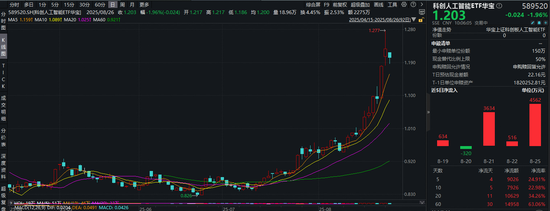
科创人工智能为何遭遇调整?589520盘中跌近2%?AI亟需自主可控!资金迎来逢跌布局机会?
Xin Lang Ji Jin· 2025-08-26 02:24
Core Viewpoint - The domestic AI industry chain, particularly the Sci-Tech Innovation Artificial Intelligence ETF (589520), is experiencing a market correction, with significant fluctuations in component stocks, reflecting both market dynamics and investor sentiment towards AI domestic alternatives [1][3][4]. Group 1: Market Performance - On August 26, the Sci-Tech Innovation Artificial Intelligence ETF (589520) saw a decline of 1.96%, with major component stocks like Chipone Technology dropping over 8% and Cambricon Technologies falling more than 3% [1]. - Despite the market downturn, the ETF attracted significant capital inflow, with 45.62 million yuan on August 25 and a total of 150 million yuan over the past 60 days, indicating strong investor interest in AI domestic alternatives [1][3]. Group 2: Stock Dynamics - The decline in the ETF is attributed to the performance of major weighted stocks, particularly Cambricon Technologies and Chipone Technology, which faced sell-offs due to shareholder actions rather than fundamental business deterioration [3]. - Analysts emphasize that the reduction in shareholding does not equate to a decline in business fundamentals, as Chipone Technology maintains competitive strength in the AI chip sector [3]. Group 3: Industry Trends - The development of domestic computing chips is characterized by two main technological routes: one focusing on GPGPU compatibility with NVIDIA's CUDA, and the other aiming to establish an independent ecosystem outside of NVIDIA's influence [3]. - The growth of the domestic computing market share is driven by product advancements and the narrowing gap with NVIDIA, alongside improvements in the domestic computing ecosystem [3]. Group 4: Future Outlook - First Shanghai Securities projects that the market size for NVIDIA's graphics cards in China will exceed 10 billion USD by 2024, capturing 70-80% of the market share, while domestic computing demand is expected to double by 2025 [4]. - Donghai Securities anticipates that the demand for AI chips will surge, with local brands like Cambricon expected to capture 40% of the market share by 2025 due to increased R&D and supportive industry policies [4]. - The emphasis on self-sufficiency in AI technology is crucial, with the Sci-Tech Innovation Artificial Intelligence ETF (589520) positioned to benefit from the acceleration of domestic AI industry development [4].

中兴通讯20250824
2025-08-25 09:13
Summary of the Conference Call Company and Industry Overview - The conference call primarily discusses **ZTE Corporation** and the **domestic computing power industry** in China, particularly focusing on the developments in AI and semiconductor sectors [2][3][6]. Key Points and Arguments 1. **Market Concerns and Recovery**: Concerns regarding domestic computing power stem from tariffs, trade wars, and the H20 ban, leading to a decline in capital expenditure. However, since May, there has been a recovery in overseas demand for inference and application, indicating a formed commercial closed loop [2][3]. 2. **Profitability Improvement**: The profitability of the domestic computing power sector is improving, with specific segments like switches showing better performance. From a valuation perspective, these companies are more attractive compared to peers like Xinyi and Xuchuang [2][5]. 3. **ZTE's Dual Drivers**: ZTE is highlighted as a key player with dual drivers of performance release and technological breakthroughs. Although 2025 may see a decline in operator capital expenditure, a recovery in 5G investments is expected in 2026, alongside increased capital expenditure on computing power [2][6]. 4. **Impact of Tariffs**: Recent U.S. tariffs on semiconductors may pose short-term challenges but are expected to drive long-term advancements in domestic chip technology [2][7]. 5. **Technological Advancements**: The release of Deepsec's V3.1 model indicates significant technological breakthroughs in domestic chip design, enhancing the competitive strength of local companies [2][8]. 6. **GPU Supply Uncertainty**: There is uncertainty in overseas GPU supply, but domestic companies like Cambricon, Kunlun, and Muxi are making progress in this area. ZTE plans to incorporate domestic chips in its next-generation products, indicating an increase in domestic computing power demand [2][9]. 7. **ZTE's Comprehensive Capabilities**: ZTE is recommended as a core investment due to its full-stack capabilities in AI cluster computing, covering everything from chips to complete systems, and its involvement in liquid cooling technology [2][10]. 8. **R&D Investment**: ZTE has shifted focus from traditional connectivity to computing power, with R&D expenses projected to reach 24 billion yuan in 2024, accounting for 20% of total revenue, which is comparable to Huawei's investment levels [2][11]. 9. **Business Segment Performance**: ZTE's business segments include operators, government enterprises, and consumer markets. The operator segment is expected to decline by 15% in 2024, but 5G and 6G upgrades may provide future growth opportunities [2][12]. 10. **Chip Development**: ZTE's subsidiary, ZTE Microelectronics, has achieved significant milestones, including the commercialization of 130 types of chips and a shipment volume of 200 million units, covering a wide range of applications [2][13]. 11. **Ethernet Switch Chip Capabilities**: ZTE has developed Ethernet switch chips capable of 51.2T, surpassing competitors like Shengke, which have achieved lower levels [2][14][15]. 12. **DPU Significance**: The introduction of the Dinghai DPU is crucial for optimizing CPU and GPU collaboration, indicating ZTE's commitment to enhancing its market competitiveness [2][16]. 13. **Market Analysis Reports**: IDC's report highlights ZTE's comprehensive capabilities in the large model inference market, showcasing its critical components in computing and connectivity [2][17]. 14. **Scale-Up Architecture**: The scale-up architecture is essential for enhancing overall performance in computing clusters, presenting new market opportunities for domestic GPUs [2][18]. 15. **Competitive Landscape**: Huawei and Nvidia maintain a competitive edge in the global computing power sector due to their comprehensive capabilities in computing and networking [2][19]. 16. **Future Prospects for Domestic GPUs**: Domestic GPUs and overseas inference ASICs are expected to become significant growth areas in the latter half of 2025, although they may face challenges in cluster network construction [2][20]. 17. **Potential Collaborators**: Companies like Cambricon and Kunlun are positioned to assist in the interconnection deployment of domestic GPUs, leveraging their technical expertise [2][21]. 18. **ZTE Microelectronics' Financials**: ZTE Microelectronics reported revenues of 9.73 billion yuan in 2021, with profits exceeding 800 million yuan, indicating its growth trajectory [2][22]. 19. **ZTE's Future Outlook**: ZTE's comprehensive layout in the domestic computing power chain positions it favorably for future growth, with a projected PE ratio of 25 times for 2025, suggesting it is relatively undervalued [2][24]. Additional Important Content - The call emphasizes the importance of ongoing technological advancements and strategic shifts within ZTE and the broader domestic computing power industry, highlighting the potential for significant growth and investment opportunities in the coming years [2][3][6][10][24].
