
菲利华

Search documents
商业火箭资本化加速-航天产业化变革启新
2025-12-29 15:51
Summary of Key Points from Conference Call Records Industry Overview: Commercial Aerospace - The domestic commercial aerospace industry is experiencing rapid capitalization, with several companies initiating IPO preparations, potentially accelerating listings to Q2 and Q3 of 2026 [1][5] - Reusable rocket technology is deemed crucial for the development of domestic commercial aerospace, with companies like Interstellar Glory and CAS Space planning their maiden flights and attempting first-stage recovery [1][6] - The domestic market is integrating market-oriented approaches with national systems to catch up with international standards, aiming to achieve global leadership in reusable technology [1][8] Key Developments and Predictions - The Shanghai Stock Exchange has introduced favorable listing standards for high-quality commercial aerospace companies, particularly those utilizing reusable rocket technology, requiring a minimum market value of 4 billion [2] - SpaceX's internal valuation is reported at $800 billion, with Ark Invest predicting a post-IPO market cap of $2.5 trillion, driven by expectations from Starlink and Starship [1][7] - Major satellite constellation projects, GW and Qianfan, are advancing rapidly, with Qianfan aiming to deploy 15,000 satellites by 2030 and GW planning at least 1,300 launches by 2030 [1][9] Technological Impact and Challenges - The success of reusable rocket technology is expected to significantly lower launch costs, thereby increasing market demand and frequency of commercial space missions [12] - The complexity and risks associated with technological innovation necessitate a degree of tolerance for potential failures during initial attempts at recovery [6] - Security challenges are emerging with the increasing intelligence of satellite payloads, necessitating enhanced management and protection measures [17] Infrastructure and Market Dynamics - The domestic capacity for satellite manufacturing has exceeded 3,000 units, supported by multiple state-owned and private enterprises [16] - Infrastructure developments include the establishment of commercial launch sites and demand-side investments in specialized networks, enhancing the overall commercial aerospace ecosystem [18] Investment Opportunities - Companies such as Aerospace Electronics, Fudan Microelectronics, China Satellite, and China Satcom are recommended for investment due to their strong market positions and liquidity [26] - The domestic market for large aircraft and engine manufacturing is identified as a significant investment theme for 2026, with companies like AVIC Xi'an Aircraft and Aero Engine Corporation of China presenting good opportunities [4][22] - The focus on military-to-civilian transitions and military trade is expected to drive growth, with specific recommendations for quartz fiber leaders and key players in the aerospace sector [28][29] Conclusion - The commercial aerospace sector is poised for significant growth driven by technological advancements in reusable rockets and satellite constellations, with various investment opportunities emerging as companies prepare for IPOs and expand their operational capabilities [1][26][29]


建材行业2026年度投资策略
2025-12-29 15:50
Summary of Key Points from the Conference Call on the Building Materials Industry Industry Overview - The building materials industry is shifting towards an alpha-driven investment strategy, focusing on companies that can increase market share and achieve performance growth, such as Sanke Tree, Rabbit Baby, Oriental Yuhong, and Henkel Group, with expected growth rates between 20% and 30% [1][2] Core Investment Strategies - **Cyclical Opportunities**: The industry is expected to remain in a downward trend in 2026, with no significant beta opportunities. The focus is on structural alpha-driven opportunities [2] - **Overseas Expansion**: The African building materials market is promising due to population growth and urbanization, benefiting from the US interest rate cut cycle. Key players like Keda Manufacturing and Huaxin Cement are expected to see significant growth, with Huaxin Cement projected to have a compound annual growth rate (CAGR) exceeding 30% over the next three years [1][2] - **AI Sector**: The AI PCB segment, particularly electronic cloth materials, is highlighted, with companies like Feilihua and China National Materials performing well. China National Materials is expected to reach a target market value of 80 billion by 2026, potentially reaching 90 to 100 billion by 2027 [1][2] Market Demand and Supply Dynamics - Overall real estate sales area in 2026 is projected to reach 600 million square meters, a year-on-year decline of approximately 10%. Average demand for building materials is expected to decrease by 3% to 5% [5] - Renovation demand is anticipated to support total demand, particularly in coatings, panels, and hardware sectors [5] - Supply side is contracting, with a cumulative decline of about 30% expected by 2024, leading to increased competitiveness among leading companies through price wars and brand competition [6][7] Company Recommendations - Recommended companies for mid-term investment include Oriental Yuhong, Sanke Tree, Rabbit Baby, and Henkel, with Sanke Tree and Henkel showing the highest growth potential [3][8] - Keda Manufacturing is noted for its dual business model, benefiting from both building materials and lithium carbonate, which could significantly enhance profitability [13] Emerging Trends - The low dielectric constant electronic cloth market is projected to reach 25 billion RMB by 2027, with domestic companies expected to capture 75% market share [16] - The AI-driven electronic cloth market is expected to see significant growth due to increased demand for advanced materials in technology applications [14][19] Regional Insights - The African market is highlighted for its long-term growth potential, driven by urbanization and population growth, with companies like Huaxin Cement and Keda Manufacturing positioned for rapid growth [10][11] - Huaxin Cement's overseas market development is noteworthy, with expected profits reaching 5 billion RMB by 2027 [11][12] Conclusion - The building materials industry is navigating a challenging environment with a focus on alpha-driven growth strategies, overseas expansion, and technological advancements in AI and electronic materials. Key players are expected to adapt and thrive amidst changing market dynamics, with specific recommendations for investment in leading companies and emerging sectors.
国防ETF(512670)涨近1%续创年内新高,上交所明确商业火箭科创板上市新规
Xin Lang Cai Jing· 2025-12-29 02:47
Group 1 - The Shanghai Stock Exchange has released guidelines for commercial rocket companies to apply for listing on the Sci-Tech Innovation Board, marking a significant step in supporting the commercialization of the space industry [1] - The policy and industry collaboration is driving the development of China's commercial aerospace sector, with the National Space Administration's action plan for 2025-2027 emphasizing high-quality and safe development [1] - Major companies, including SpaceX and domestic firms like Blue Arrow Aerospace and Tianbing Technology, are planning IPOs by 2026, indicating a potential acceleration of capital and industry synergy [1] Group 2 - As of December 29, 2025, the CSI Defense Index has risen by 0.43%, with notable increases in constituent stocks such as Guangwei Composites (up 10.98%) and Haige Communication (up 10.04%) [2] - The CSI Defense Index reflects the performance of listed companies involved in providing weaponry and equipment to the national armed forces, with a focus on companies under the top ten military industrial groups [2] - The top ten weighted stocks in the CSI Defense Index account for 44.06% of the index, highlighting the concentration of market influence among leading defense companies [2]
CCL专家交流会
2025-12-29 01:04
Summary of CCL Expert Conference Call (December 27, 2025) Industry Overview - The conference focused on the **CCL (Copper Clad Laminate)** industry, particularly the supply and pricing trends of key materials such as **copper foil**, **resin**, and **glass fabric** [2][3]. Key Points and Arguments Supply and Pricing Trends - **High-end AI applications** are causing a tight supply of copper foil, leading to a continuous increase in the copper foil price index due to limited suppliers and the slow ramp-up of resin production capacity [2][3]. - **Electronic fabric prices** have generally risen, with LDK generation one experiencing a significant increase, expected to continue rising by approximately **20% in 2026** [2][4]. - The domestic price of Q fabric has reached **300 RMB**, while international prices exceed **400 RMB**. Domestic manufacturers are nearing the performance levels of overseas products [2][8][9]. - The **fourth generation copper foil** is anticipated to begin large-scale shipments in the second half of **2026**, primarily from overseas suppliers, significantly impacting the high-end copper foil market [2][21][23]. Material Usage and Demand - In PCB boards, the usage ratios of different thicknesses of copper foil are **30%-40% for 35 microns**, **30%-40% for 18 microns**, and **20% for 9 microns**, influenced by PCB design and signal transmission requirements [2][24]. - The demand for Q fabric is projected to reach **4.5 million meters per month** in 2026, with a total expected range of **10 million to 20 million meters** depending on Nvidia's CPS version shipment volumes [2][6][8]. Supply Chain and Production Capacity - Current effective supply is about **4 million meters per month**, with gradual increases expected as qualified suppliers expand capacity in **Q2 or Q3 of next year** [2][7]. - Several suppliers are significantly expanding production, with companies like **Beili Huang** and **International Composite Materials** expected to add over **10 million square meters** of capacity in 2026 [2][13]. Pricing Mechanisms and Strategies - The pricing mechanism for copper foil consists of copper paper prices and processing fees, with adjustments made based on market conditions rather than fixed schedules [2][20]. - PCB manufacturers face challenges in passing on cost increases to downstream customers, with strategies varying based on competitive dynamics. PCR suppliers find it difficult to lower prices, while TP manufacturers may face greater challenges due to intense competition [2][28]. Future Expectations - The prices of **electrolytic resins and glass fabric** are expected to continue rising in **2026**, with domestic resin production ramping up but glass fabric facing significant price pressures due to supply-demand imbalances [2][26][27]. - The overall market for high-end CCL products is expected to see increased demand and potential price adjustments, although maintaining strategic customer relationships may limit price increases for high-end products [2][28]. Additional Important Insights - The verification process for CCL products from customer testing to terminal validation typically takes **1 to 2 years** [2][11]. - The fastest progress in this verification process is currently being made by **Feilihua** [2][12]. - The overall PCB yield rate is currently around **50%**, with expectations to improve to **70%** in the future, depending on substrate and processing optimizations [2][16]. This summary encapsulates the critical insights from the CCL expert conference call, highlighting the current state and future expectations of the industry.
Q布观点更新
2025-12-29 01:04
Summary of Conference Call Notes Industry Overview - The Q fabric (Q 布) industry is experiencing a significant boost due to the deployment of A-grade chips, which is enhancing the overall PCB (Printed Circuit Board) market sentiment. The market is particularly focused on the store segment, driven by projected demand for AI PCBs and the value share of CCL (Copper Clad Laminate) in 2026 [2][4]. Key Insights and Arguments - The announcement of NVIDIA's CPS (Cloud Processing Service) solution has clarified the market's understanding of the supply-demand relationship, with approximately 1,000 million meters of demand already met for 70% of PCB capacity compensation [2][4]. - In 2026, the demand is expected to increase significantly, with Robin's mass production of the Switch version anticipated to add around 4 million meters of demand. If Google's TPU V8 series adopts the proposed repair solution, an additional 8 million meters of demand could arise, potentially doubling total demand from 1,000 million meters to over 2,000 million meters [2][5][6]. - Looking ahead to 2027, if NVIDIA's ROPIN ULTRA series fully adopts the proposed solutions and Google's TPU V8 and V9 chips reach a production target of 5 million units, total demand could exceed 80 million meters [6]. Production Challenges - The production of Q fabric faces three main challenges: 1. High purity and low impurity requirements for quartz raw material. 2. Complex quartz rod drawing processes that require uniformity control and are prone to breakage. 3. Strict weaving processes that involve maintaining smoothness and applying lubricants [7]. - Currently, only two suppliers, Feiliwa and Asahi Kasei, can produce quartz fibers with a dielectric constant DF value below 5/10,000 in small batches. Feiliwa has a mature drawing process capable of supporting 300,000 meters of customer production monthly, with plans to expand to a capacity of 1,200 million meters by 2026 [7]. Company-Specific Developments - New Qimei Beauty Company is optimistic about its prospects in the PCB equipment sector, with new products like CO2 laser drills and advanced packaging expected to ramp up production next year. The company is positioned to benefit from the rising PCB market, potentially achieving a second growth curve and enhancing its valuation [3][8]. - Other domestic companies, such as Xi'an Laide Optoelectronics, are also making strides in the Q fabric supply chain, including upstream quartz mining and downstream weaving processes. Shanghai Telai Crystal is expected to reach a production capacity of 1 million meters per month by 2027, contingent on successful capacity construction and validation [9].
电话会、研报井喷!分析师“肝到冒烟”,商业航天投资主线地位确认?
Zheng Quan Shi Bao Wang· 2025-12-28 23:12
Core Insights - The commercial aerospace sector has gained significant attention in the capital markets and investment research circles, with a surge in related reports and conference calls in the past week [1][2] - Analysts from various sectors, including telecommunications, computing, and machinery, are increasingly crossing over to study commercial aerospace, indicating a shift in focus from traditional defense and military analysis [2][3] - A total of 14 commercial aerospace-related companies have been investigated by institutions this month, with some companies receiving attention from over 50 institutions [5] Group 1: Research and Reports - There has been an explosion of deep-dive reports and conference calls focused on commercial aerospace, with 26 themed calls held in the past week, some attracting over 500 participants [3][2] - Notable reports include those from Zhongyou Securities and Guotai Junan, covering topics such as the evolution of space computing and investment perspectives in the new phase of commercial aerospace [2][3] - The research community is actively exploring the commercial aerospace supply chain, with multiple firms releasing series of reports on various aspects of the industry [3] Group 2: Institutional Interest - Institutions have shown heightened interest in commercial aerospace stocks, with 14 companies being targeted for research, including Guanglian Aviation and Chaojie Co., which have received significant institutional attention [5][6] - Guanglian Aviation has engaged in partnerships to integrate into the regional aerospace ecosystem, while Chaojie Co. focuses on manufacturing components for commercial rockets [5] Group 3: Investment Opportunities - Analysts believe that the commercial aerospace industry is at a historic development turning point, with some institutions suggesting that its status as an investment mainline may be confirmed [6][8] - The recent policy changes, such as the Shanghai Stock Exchange's guidelines for commercial rocket companies, are expected to further stimulate the industry [7] - Key investment areas identified include the commercial rocket supply chain and satellite manufacturing, which are anticipated to benefit from increased launch demand and technological advancements [7][8]



非金属建材行业周报:看好Q布提高渗透率-20251228
SINOLINK SECURITIES· 2025-12-28 13:33
Investment Rating - The report highlights a positive outlook for the Q fabric market, suggesting it has the potential to become a mainstream material with increased supply capacity and market confidence [2][12]. Core Insights - The Q fabric market is gaining attention, with companies like Lite-On Optoelectronics investing in the sector to create an integrated advantage in sand mining, rod production, weaving, and more. The M9+Q fabric is identified as the most proactive material solution, while M9+ second-generation and 2.5 generation fabrics represent a more conservative approach. The Q fabric's low expansion and dielectric properties are emphasized as key advantages [2][12]. - The report suggests that the bottleneck for Q fabric lies in downstream processing difficulties, particularly in PCB upgrades, while upstream issues in silk and fabric production are being addressed by companies like Fihua and China National Materials [2][12]. - The report encourages a rational view of new entrants in the Q fabric market, emphasizing the need for upstream and downstream participants to enhance industry connectivity and penetration rates [2][12]. Summary by Sections Weekly Discussion - The Q fabric market is highlighted as a focal point, with significant investments and technological advancements expected to drive its adoption [2][12]. - The report discusses the importance of evaluating companies based on raw material advantages, technological capabilities, customer resources, and equipment strengths [2][12]. Market Performance - The report notes that the cement market is experiencing a decline in average prices, with a national average of 354 RMB/t, down 67 RMB/t year-on-year and 1 RMB/t month-on-month. The average shipment rate is 41.4%, reflecting a slight decrease [4][14]. - The glass market shows a slight decline in prices, with the average price for float glass at 1140.08 RMB/ton, down 11.32 RMB/ton, and an increase in inventory days [4][14]. - The concrete mixing station's capacity utilization is reported at 7.33%, indicating a decrease [4][14]. Price Changes - The report details that the national cement price remains stable, with fluctuations observed in specific regions. The average shipment rate has decreased by approximately 1 percentage point [24][25]. - The float glass market is experiencing a slight downward trend in prices, with increased inventory levels noted [34][35]. - The report indicates that the electronic fabric market is stable, with prices for 2400tex non-alkali yarn remaining steady [56][58].


一周26场会!商业航天赛道大火 相关公司被调研
Xin Lang Cai Jing· 2025-12-27 23:51
Core Insights - The commercial aerospace sector has gained significant attention in the capital markets and investment research circles, with a surge in related reports and conference calls in the past week [2][4] - Analysts from various sectors, including telecommunications, computer science, and mechanical engineering, are increasingly engaging in cross-disciplinary research on commercial aerospace, indicating a shift in focus from traditional defense and military analysis [4][5] - A total of 14 commercial aerospace-related companies have been investigated by institutions this month, with some companies receiving attention from over 50 institutions [7] Group 1: Research and Reports - There has been an explosion of deep-dive reports and conference calls focused on commercial aerospace, with 26 themed calls held in the past week, some attracting over 500 participants [5][4] - Notable reports include those from Zhongyou Securities and Guotai Junan, covering topics such as the evolution of space computing and investment perspectives in the new phase of commercial aerospace [4][5] - The research community is actively exploring the commercial aerospace supply chain, with multiple firms releasing series of reports on upcoming events and opportunities in the sector [5] Group 2: Institutional Interest - Institutions have shown heightened interest in commercial aerospace stocks, with companies like Guanglian Aviation and Chaojie Co. receiving significant attention from over 50 institutions [7][8] - Guanglian Aviation is collaborating with Wenchang International Aerospace City to integrate into the regional aerospace ecosystem, while Chaojie Co. focuses on manufacturing components for commercial rockets [7] - The data indicates that several companies have experienced substantial stock price increases, with Chaojie Co. rising by 106.39% in December [8] Group 3: Policy and Market Trends - The Shanghai Stock Exchange has introduced guidelines for commercial rocket companies to list on the Sci-Tech Innovation Board, facilitating market entry for these firms [9] - Analysts believe that the commercial aerospace industry is at a historic turning point, driven by national strategies and policies that position it as a new growth engine [10] - The focus is on two core areas: the commercial rocket supply chain and satellite manufacturing and application, which are expected to benefit from increased launch demand and technological advancements [10] Group 4: Future Outlook - The industry is anticipated to enter a rapid development phase as launch costs decrease, enabling commercial aerospace to transition from technology validation to market expansion [11] - Analysts are optimistic about the potential of space computing and the scalability of manufacturing, with significant infrastructure developments underway [11][10] - The investment focus is shifting towards space computing and reusable rockets, with low Earth orbit communication satellite chains emerging as a promising segment supported by fundamental logic and orders [11]
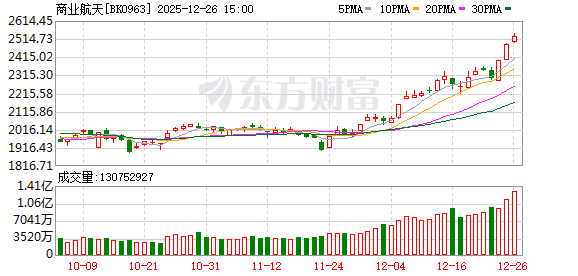
一周26场会!这个赛道大火,相关公司被调研
券商中国· 2025-12-27 23:25
Core Viewpoint - The commercial aerospace sector is experiencing a surge in interest from the capital market and research circles, with numerous reports and conferences emerging in a short period [1][2]. Group 1: Market Activity - In the past week, there has been a significant increase in research reports and conference calls focused on commercial aerospace, with 26 themed calls attracting over 500 participants in some cases [2][3]. - Analysts from various sectors, including telecommunications, computing, and mechanical engineering, are increasingly engaging in cross-sector research on commercial aerospace, indicating a shift in focus from traditional defense and military analysis [2][3]. Group 2: Company Research and Interest - A total of 14 commercial aerospace-related companies have been investigated by institutions this month, with companies like Guanglian Aviation and Chaojie Co. receiving attention from over 50 institutions [5][6]. - Guanglian Aviation has been actively collaborating with Wenchang International Aerospace City and is in the process of acquiring Tianjin Yuefeng, a company specializing in aerospace equipment manufacturing [5][6]. - Chaojie Co. has reported significant interest, with 80 institutions conducting research, focusing on the manufacturing of commercial rocket components [5][6]. Group 3: Policy and Strategic Developments - The Shanghai Stock Exchange has released guidelines for commercial rocket companies to list on the Sci-Tech Innovation Board, marking a significant step for the industry [7]. - The national strategy to elevate China as a "space power" has positioned commercial aerospace as a new growth engine, prompting analysts to recommend investments in the commercial rocket and satellite manufacturing sectors [8]. Group 4: Future Outlook - Analysts predict that the commercial aerospace industry is on the verge of a historic development turning point, with investment opportunities becoming more apparent [6][9]. - The cost of launching satellites is expected to decline significantly, facilitating market expansion and the transition from technology validation to rapid growth [9].

国防ETF(512670)涨超1%,工信部有序开展卫星物联网等新业务商用试验
Xin Lang Cai Jing· 2025-12-26 06:13
Group 1 - The Ministry of Industry and Information Technology aims to cultivate and expand emerging and future industries by 2026, focusing on sectors such as integrated circuits, new displays, new materials, aerospace, low-altitude economy, and biomedicine [1] - Support for artificial intelligence initiatives and the orderly development of satellite IoT commercial trials is emphasized, along with the establishment of national emerging industry development demonstration bases and innovative industrial clusters [1] - The development of 6G technology is highlighted as a key area for research and innovation [1] Group 2 - As of December 26, 2025, the CSI Defense Index (399973) increased by 0.91%, with notable gains in constituent stocks such as Guangwei Composites (300699) up 8.27% and Aerospace Electronics (600879) up 6.23% [2] - The CSI Defense Index reflects the overall performance of listed companies in the defense industry, selecting stocks from major military groups and those involved in supplying equipment to the armed forces [2] - The top ten weighted stocks in the CSI Defense Index account for 44.06% of the index, including companies like AVIC Shenyang Aircraft (600760) and Aero Engine Corporation of China (600893) [2]